

Casino platform support is easy to underestimate until a payment outage, stalled game round, failed KYC check, or bonus configuration issue starts costing revenue in real time. For an online casino, support is not a nice extra. It is part of the operating system.
A strong SLA, short for service-level agreement, turns vague promises like “fast support” and “enterprise uptime” into measurable commitments. It defines what happens when something breaks, who responds, how quickly, what is included, and how accountability is handled.
For operators evaluating an iGaming platform, especially a white label casino platform or turnkey casino solution, the goal is not simply to find the vendor with the most optimistic uptime number. The goal is to understand whether the provider can support your real operating model: payments, game aggregation, fraud controls, player accounts, bonuses, compliance, APIs, analytics, and launch velocity.
Why Casino Platform Support Is Different
A general SaaS support agreement is not enough for online gambling. Casino operations run across multiple high-pressure systems at once. A single player journey can touch account registration, KYC, wallet balance, fiat or crypto payment rails, bonus rules, game provider APIs, fraud monitoring, and settlement reporting.
That means support must be evaluated across the full chain, not only the platform interface. If deposits work but withdrawals are delayed, the business still has a support problem. If slot games load but round reconciliation is unclear, the business still has a risk problem. If a compliance workflow depends on manual vendor intervention, the business still has a scalability problem.
Casino platform support should be judged by how well it protects five outcomes:
- Player access to games, wallets, and account functions
- Operator control over backoffice, payments, bonuses, and reporting
- Financial accuracy across balances, settlements, refunds, and chargebacks
- Compliance continuity across KYC, AML, responsible gaming, and audit trails
- Revenue protection during incidents, maintenance, and traffic spikes
This is why support and SLAs should be part of vendor selection from the first demo, not a legal appendix reviewed after commercial terms are already agreed.
Start With the Systems That Matter Most
Before you compare SLA language, map the platform areas that directly affect revenue, trust, or regulatory exposure. A casino software provider may offer one headline SLA, but not every module carries the same operational risk.
| Platform area | Why it matters | SLA questions to ask |
|---|---|---|
| Player login and account access | Players cannot deposit or play if identity systems fail | Is authentication covered by uptime guarantees? |
| Wallet and balance services | Balance accuracy is critical for trust and compliance | How are balance discrepancies escalated and resolved? |
| Payment gateway and withdrawals | Payment failures quickly become support and reputation issues | Are payment incidents covered end to end or passed to processors? |
| Game aggregator | Game loading, session handling, and round settlement affect revenue | What happens when a game provider outage affects only part of the lobby? |
| KYC and AML workflows | Compliance delays can block onboarding and withdrawals | Are verification provider failures included in incident management? |
| Bonus engine | Incorrect rules can create financial leakage or player disputes | What severity applies to bonus misconfiguration or calculation errors? |
| Backoffice admin panel | Teams need control during live operations | What support exists for urgent configuration issues? |
| APIs and integrations | Custom frontends, CRM, BI, and affiliate systems depend on API stability | Are API latency, errors, and version changes covered? |
This exercise also helps you avoid a common trap: accepting an SLA that covers only platform hosting while the most operationally sensitive parts are treated as “third-party dependencies.” In iGaming, those dependencies are often exactly where incidents occur.
If your evaluation is still early, it is useful to turn these requirements into a structured vendor process. Spinlab’s guide to an online casino platform RFP template for operators can help you document the questions that should be answered before commercial negotiation.
Understand the Difference Between Support and SLAs
Support and SLAs are related, but they are not the same thing.
Support is the service model: channels, people, expertise, documentation, escalation paths, and operating rhythm. SLA is the measurable commitment: uptime targets, response times, resolution objectives, maintenance notice, and remedies.
You need both. A vendor can have friendly support but weak commitments. Another can have strong contract language but slow, unclear communication when incidents happen. The best casino platform partners combine operational expertise with written accountability.
Evaluate support across practical questions:
- Which channels are available for urgent issues, such as ticketing, Slack, email, phone, or dedicated account management?
- Is support available 24/7, or only during business hours in the vendor’s time zone?
- Who handles payment, compliance, game, and API issues: general support agents or specialized teams?
- Is there a named escalation path for production incidents?
- Are launch, migration, and go-live periods supported differently from normal operations?
- Is documentation current, searchable, and specific to the modules you will use?
Support quality is also cultural. Operators in any digitally enabled environment, from iGaming to adaptive education models like Colegio Pioneros in Chicureo, depend on reliable systems, clear escalation, and responsive service when users are active. The lesson for casino operators is simple: technology is only as strong as the operating model behind it.
Define Incident Severity Before You Need It
Severity levels are one of the most important parts of a casino platform SLA. They determine what counts as urgent and how fast the provider must react.
Do not accept vague labels without examples. Ask the vendor to define severity by business impact, not just technical symptoms. A “partial outage” can still be critical if it blocks deposits for your main market or affects a high-value game category during peak hours.
| Severity | Typical casino example | What to clarify |
|---|---|---|
| Critical | Platform unavailable, wallet unavailable, deposits or withdrawals blocked, major game launch failure | 24/7 response, escalation, communication frequency, workaround process |
| High | Major feature degraded, payment method failing in one key market, game provider outage affects large segment | Response target, ownership across third parties, expected updates |
| Medium | Backoffice function issue, reporting delay, limited bonus configuration problem | Business-hours support, resolution target, temporary workaround |
| Low | Cosmetic bug, documentation question, non-urgent configuration request | Standard ticket handling and queue priority |
A strong SLA should also explain how severity can be upgraded. If a medium issue becomes a revenue-impacting incident during a campaign, your team should not be stuck in the wrong queue.
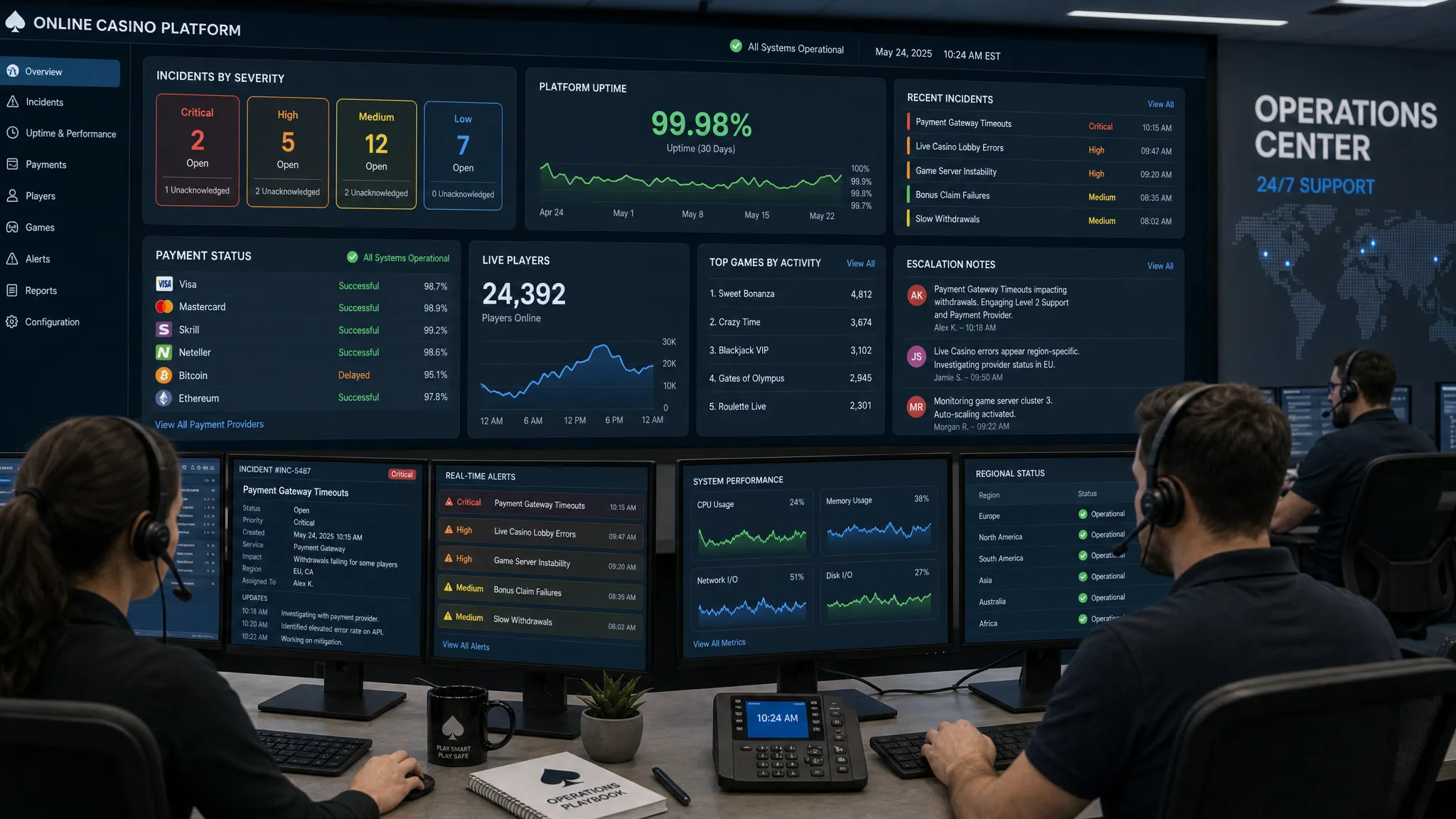
Look Beyond Response Time
Many buyers focus on response time because it is easy to compare. Response time matters, but it is only the first step. A vendor who replies in 10 minutes but takes 12 hours to identify the cause is not necessarily better than one who responds in 30 minutes with the right specialist and a clear workaround.
Ask for the full support metric set:
| Metric | What it means | Why it matters |
|---|---|---|
| First response time | Time until the vendor acknowledges the issue | Confirms the ticket is seen and triaged |
| Time to triage | Time until the issue is classified and routed | Shows whether the vendor can identify the right owner quickly |
| Time to workaround | Time until a temporary fix reduces business impact | Critical during payment, wallet, or game incidents |
| Time to resolution | Time until the root issue is fixed | Measures actual restoration, not just communication |
| Update frequency | How often the vendor communicates during incidents | Helps your team manage players, affiliates, and internal stakeholders |
| Root cause analysis timing | When the vendor provides a post-incident report | Supports prevention, compliance records, and executive review |
For casino operators, time to workaround is especially important. If a payment gateway route fails, can traffic be redirected to another method? If a game provider is down, can affected games be hidden from the lobby? If a bonus rule is misfiring, can it be paused without waiting for engineering?
These questions reveal whether the platform is built for real operations, not just sales demos.
Clarify What “Uptime” Actually Covers
Uptime percentages can be misleading if the scope is unclear. A 99.9% uptime commitment sounds reassuring, but it does not help much if it excludes payments, game aggregation, third-party services, scheduled maintenance, API latency, and regional availability.
Ask the vendor to define uptime in plain language. Specifically, clarify whether uptime applies to the player frontend, backoffice, wallet, APIs, game aggregator, payment orchestration, authentication, and reporting. If the SLA excludes third-party providers, ask how the vendor coordinates with those providers during an incident.
You should also ask how uptime is measured. Is it based on internal monitoring, third-party monitoring, request success rate, or infrastructure availability? Infrastructure can be “up” while players still cannot complete deposits or launch games.
A more useful SLA will distinguish between system availability and transaction success. In online gambling, the player experience is often transactional. The platform is only truly available if players can register, deposit, play, withdraw, and access support-critical account functions.
Evaluate Maintenance Windows and Release Discipline
Planned maintenance is not a failure, but poor maintenance planning can create avoidable disruption. Casino activity is not evenly distributed across the week. Sports events, paydays, holidays, affiliate campaigns, and new game launches can all create traffic spikes.
Your SLA should explain how planned maintenance is scheduled, how much notice is provided, what types of changes require downtime, and whether emergency maintenance follows a separate process.
Release discipline is equally important. Ask how often the vendor releases updates, how rollbacks work, whether changes are tested in staging, and how breaking API changes are communicated. If your team uses open API integration, versioning and deprecation policies should be reviewed carefully. A platform can have strong uptime historically and still create operational risk if releases are poorly governed.
For game-specific dependencies, negotiate separately where needed. A platform may aggregate content from many providers, but provider contracts can contain their own obligations and limitations. Spinlab’s game provider contract checklist for SLAs, fees, and data rights is a useful companion when reviewing obligations outside the core platform contract.
Check Payment, Crypto, and Wallet Support in Detail
Payments deserve special scrutiny because they sit at the intersection of revenue, player trust, fraud risk, and compliance. For a crypto-ready solution, support must also cover crypto onramp flows, custody arrangements, wallet monitoring, network issues, and multi-currency handling.
When evaluating a payment gateway or wallet SLA, ask how the vendor handles failed deposits, delayed withdrawals, duplicate transactions, mismatched balances, chargeback events, blocked payment routes, and reconciliation discrepancies. If the platform supports both fiat and crypto payments, make sure the team can explain how incidents differ across rails.
Important questions include:
- Who owns communication with payment processors, crypto onramp partners, and custodial wallet providers?
- How are stuck or pending transactions investigated?
- What audit trail exists for manual adjustments?
- Can payment methods be disabled or reprioritized quickly by market?
- Are withdrawal queues, risk checks, and AML flags visible to operators in real time?
Do not treat payment support as a generic module. A payment incident can become a player support crisis within minutes, especially during campaigns or peak activity.
Assess Backoffice Support for Day-to-Day Operations
A good SLA should not only protect catastrophic outages. It should also support the operational workflows your team uses every day.
For lean casino teams, backoffice usability matters because they cannot depend on engineering for every change. If your team needs vendor support to adjust bonuses, review player status, export reports, manage affiliate settings, or configure payment rules, the support queue becomes a bottleneck.
Ask whether your team can handle common operational tasks directly from the admin panel. Then ask what happens when a task fails or produces unexpected results. The strongest support model is the one that reduces dependency on support for routine work while still providing fast expert help for complex issues.
This is where demo evaluation matters. During vendor selection, do not only watch polished workflows. Ask the vendor to simulate a failed payment, a bonus dispute, a KYC review, a game outage, a suspended account, and a reporting discrepancy. Spinlab’s casino software demo checklist before you buy can help you structure that process around real operating scenarios.
Review Remedies, Credits, and Accountability
SLA remedies are often less valuable than buyers expect. Service credits may not compensate for lost deposits, affiliate dissatisfaction, compliance exposure, or player churn. Still, they matter because they show how seriously the vendor treats accountability.
Review the remedy section carefully. Ask whether credits apply automatically or only after a claim. Check whether the credit is capped, whether repeated failures trigger stronger remedies, and whether chronic underperformance gives you termination rights.
Also ask what is excluded. Common exclusions may include force majeure events, customer misconfiguration, third-party outages, scheduled maintenance, DDoS attacks, and payment processor failures. Some exclusions are reasonable, but broad exclusions can weaken the SLA until little is left.
A practical approach is to negotiate operational remedies, not just financial ones. For example, repeated critical incidents might trigger an executive review, a written remediation plan, extra monitoring, or dedicated technical sessions. These actions can be more useful than a small invoice credit.
Red Flags in Casino Platform Support
Some warning signs show up before the contract is signed. Pay attention to how the vendor behaves during evaluation. Slow answers, unclear ownership, and vague technical explanations often predict future support friction.
Be cautious if you see these patterns:
- The vendor will not provide sample SLA language until late in the process
- Uptime is advertised without a clear definition of covered services
- Third-party dependencies are excluded without any coordination process
- Support channels differ from what sales promised
- Critical incidents are handled only during business hours
- No root cause analysis process exists for major incidents
- The vendor cannot explain how payment, game, or wallet incidents are escalated
- The platform requires vendor intervention for too many routine admin tasks
None of these automatically disqualifies a provider, but each should trigger deeper questioning. The point is not to demand perfection. The point is to understand risk before launch.
How to Test Support Before Signing
The best time to test support is before you depend on it. During procurement, create a support evaluation plan and tell the vendor you will be assessing responsiveness and clarity.
A simple pre-contract test can include submitting technical questions through the normal support process, asking for escalation examples, requesting incident report samples with sensitive details removed, reviewing documentation quality, and running scenario-based demos. You can also ask who will support you after signing. The sales engineer may be excellent, but they might not be the person handling production incidents.
For go-live, ask for a launch support plan. This should cover staffing, escalation contacts, deployment schedule, rollback options, monitoring, payment checks, game availability checks, and post-launch review. A casino launch is too important to rely on normal ticket queues alone.
Build Support Into Your Vendor Scorecard
Support and SLAs should carry real weight in vendor scoring. A platform with attractive features but weak support can become expensive once live. Conversely, a modular iGaming platform with strong operational controls, transparent escalation, and practical admin tools can reduce pressure on your team as you scale.
A balanced scorecard should include product capabilities, commercial terms, compliance fit, payment and game coverage, API flexibility, backoffice usability, launch support, incident management, SLA clarity, and long-term vendor accountability.
If you are comparing white label casino software providers, give extra weight to support transparency. With a white label casino, your brand owns the player relationship, even when the underlying incident sits with the platform, payment processor, game aggregator, or KYC provider. Players will not care which vendor caused the issue. They will expect your casino to communicate clearly and fix it quickly.
Frequently Asked Questions
What is a casino platform SLA? A casino platform SLA is a contract section that defines service commitments such as uptime, response times, incident severity, maintenance notice, escalation, and remedies. It should cover the systems that matter to live casino operations, not only basic hosting.
What uptime should an online casino platform offer? There is no single number that fits every operator. Instead of focusing only on the percentage, ask what services are included, how uptime is measured, whether third-party dependencies are excluded, and what happens when player transactions are affected.
Should payment gateway issues be included in the SLA? Payment issues should at least be included in the incident management process, even if the payment processor itself has a separate SLA. Your platform provider should explain how payment failures are detected, escalated, communicated, and reconciled.
How do I compare support between casino software providers? Compare support channels, hours of coverage, escalation paths, technical expertise, documentation quality, incident communication, root cause analysis, and launch support. Also test responsiveness before signing whenever possible.
Are SLA credits enough protection? Usually not. SLA credits can create accountability, but they rarely cover the full business impact of downtime or payment disruption. Operators should also negotiate operational remedies, executive review processes, and termination rights for repeated failures.
Evaluate Support Before It Becomes Urgent
Casino platform support is not paperwork. It is a live operating capability that affects revenue, compliance, player trust, and team efficiency. The right SLA gives you measurable commitments, but the right support model gives you confidence when something unexpected happens.
Spinlab offers a modular, all-in-one iGaming platform for operators who want to build, launch, and scale with integrated payments, game aggregation, compliance tools, real-time analytics, fraud prevention, crypto and fiat support, and a customizable backoffice experience. If you are evaluating a white label casino platform or turnkey casino solution, use support and SLA quality as a core buying criterion, not an afterthought.
A platform can help you launch. Strong support helps you stay live, protect players, and scale with fewer operational surprises.