

An online casino platform RFP should do more than collect feature checkboxes. It should reveal whether a vendor can help you launch, operate, localize, secure, and scale a real-money casino without creating hidden costs or compliance gaps.
That matters because the platform choice touches almost every operating function: player onboarding, KYC and AML, game aggregation, payments, wallets, bonuses, affiliate tracking, fraud controls, reporting, and support workflows. A weak RFP can make every vendor look equal until the real problems appear after contract signature.
The better approach is evidence-based procurement. Instead of asking, “Do you support crypto?” ask, “Show the deposit, ledger, custody, reconciliation, and AML workflow for a crypto deposit and withdrawal.” This mirrors broader software procurement best practice, where strong RFPs focus on outcomes, proof, and working artifacts rather than generic promises. For a useful perspective outside iGaming, Ravenna Interactive’s guide to RFP questions that actually work is a good reminder to ask vendors how they solve real operational problems.
Use the template below to compare online casino platform vendors on what matters most: launch readiness, cost transparency, compliance evidence, payment performance, operational control, and long-term flexibility.
What an Online Casino Platform RFP Should Decide
A platform RFP is not just a purchasing document. It is a decision framework for your operating model.
Before you send it to vendors, align internally on the outcomes you need. For example, a founder launching a lean white label casino has different requirements from a multi-brand operator migrating from a fragmented legacy stack. A crypto-first casino will evaluate custody, KYT, onramps, and stablecoin settlement differently from a fiat-only operator focused on cards, open banking, and local APMs.
Your RFP should help you answer seven core questions:
- Can this platform support our launch timeline without skipping compliance gates?
- Can it handle the payment rails, currencies, and crypto flows our target players expect?
- Can our operations team run bonuses, affiliates, player reviews, and reporting without constant developer help?
- Can the vendor prove auditability across wallet, KYC, AML, game sessions, and payments?
- Can we expand into new markets, brands, or game categories without rebuilding?
- Can we access our data through analytics, exports, webhooks, or APIs?
- Can we understand the true 24-month cost before we sign?
If you are still defining your must-have modules, Spinlab’s guide to must-have features in casino platform software can help you separate essential platform capabilities from nice-to-have extras.
RFP Preparation: Inputs to Define Before Contacting Vendors
Vendors give better answers when you give them a realistic operating profile. Without this, they will answer with broad capability statements that are difficult to compare.
| Input | What to Provide | Why It Matters |
|---|---|---|
| Target markets | Countries, languages, currencies, and excluded jurisdictions | Determines licensing, geo-controls, payment rails, KYC, and content restrictions |
| Launch model | White label, modular platform, headless frontend, custom build, or migration | Shapes timeline, implementation scope, pricing, and staffing |
| Payment mix | Cards, bank transfer, open banking, e-wallets, crypto, stablecoins, onramps | Reveals gateway, wallet, reconciliation, and fraud requirements |
| Game strategy | Slots, live casino, crash games, table games, original games, provider priorities | Determines aggregation, certification, launch speed, and commercial exposure |
| Compliance posture | License path, KYC thresholds, AML model, responsible gambling requirements | Shows whether the vendor can produce audit-ready evidence |
| Traffic assumptions | Expected registrations, deposits, concurrent users, peak campaigns | Helps evaluate scalability, SLAs, and hosting cost |
| Operating team | Roles for support, fraud, payments, CRM, affiliates, compliance, finance | Determines backoffice permissions, workflows, and automation needs |
| Data needs | Analytics, exports, BI tools, CRM integrations, API use cases | Prevents vendor lock-in and reporting blind spots |
If you do not know all numbers yet, provide conservative, base, and breakout scenarios. A serious casino software provider should be able to model how pricing, hosting, support, and payment costs change across those cases.
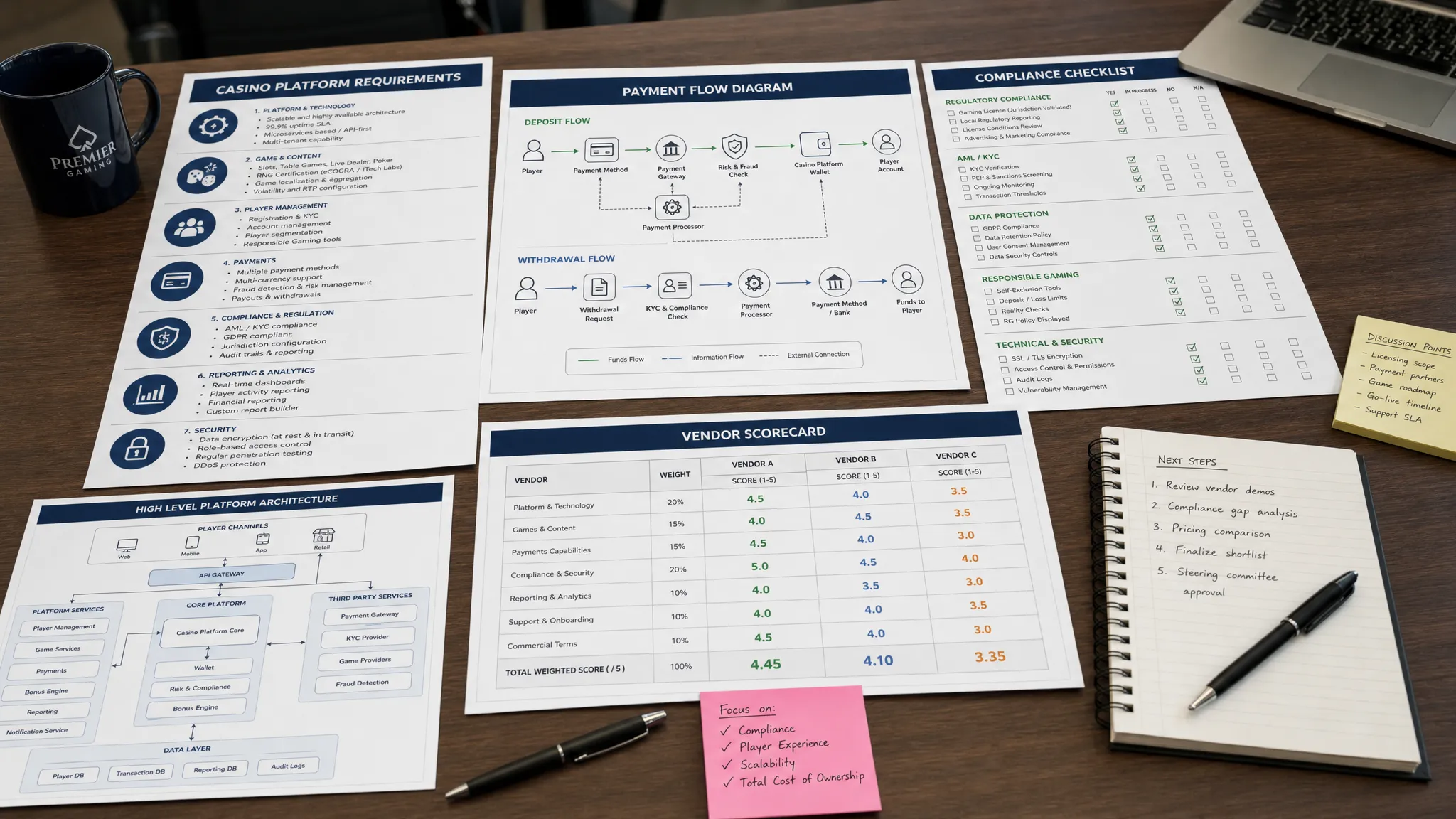
Copy-Paste Online Casino Platform RFP Template
Use the sections below as your starting template. You can paste them into a procurement document, add your business context, and ask every vendor to answer in the same format.
1. Vendor Response Instructions
Start with strict response rules. This makes comparison easier and reduces sales-heavy answers.
Ask vendors to provide:
- A direct answer to every question, including “not supported” where applicable.
- Evidence for each major claim, such as API documentation, sample reports, screenshots, workflow diagrams, sandbox access, or example exports.
- A 24-month commercial model using your traffic and payment assumptions.
- A list of third-party dependencies, including PSPs, KYC vendors, game providers, hosting partners, and analytics tools.
- A clear split between included platform functionality, optional modules, pass-through costs, and operator responsibilities.
- A named implementation owner, target onboarding timeline, and required operator inputs.
Also ask vendors not to merge unrelated items into bundled “yes” responses. For example, “crypto support” should be broken into deposits, withdrawals, custody, onramp, KYT, Travel Rule considerations, ledger posting, reconciliation, and reporting.
Section A: Platform Model, Architecture, and Scalability
The first section should clarify what you are actually buying. “Turnkey,” “white label,” “modular,” and “customizable” can mean very different things depending on the vendor.
| RFP Question | Evidence to Request |
|---|---|
| What platform model do you offer: white label, modular all-in-one, headless, custom, or hybrid? | Architecture overview and module list |
| Which parts of the stack are configurable by operators without developer support? | Backoffice demo and permission matrix |
| How are wallet, identity, payments, games, bonuses, and compliance separated or integrated? | Service map, data flow diagram, and API documentation |
| How do you support multi-brand or multi-market operations? | Brand configuration example and role-permission model |
| What performance levels can you support during traffic spikes? | Load test summary, scaling approach, and uptime history |
| How are platform releases deployed without breaking money-moving flows? | Release process, rollback process, and incident runbook |
| What data can the operator export if they leave the platform? | Sample export files and termination terms |
A strong answer should explain architecture in plain language. You do not need every vendor to expose proprietary infrastructure, but you do need enough detail to assess operational risk and lock-in.
For deeper technical evaluation, see Spinlab’s open API checklist for iGaming platforms.
Section B: Licensing, Compliance, and Responsible Gambling
Compliance is where vague vendor answers create real risk. Treat this section as an evidence request, not a marketing questionnaire.
| RFP Question | Evidence to Request |
|---|---|
| Which licensing jurisdictions and operating models does your platform commonly support? | Example compliance evidence pack, with sensitive data removed |
| How do you configure jurisdiction-specific rules for registration, KYC, payments, games, and bonuses? | Policy configuration demo or rule matrix |
| How are KYC checks triggered, reviewed, escalated, and logged? | Sample KYC case workflow and audit log |
| How does the platform support AML monitoring across deposits, withdrawals, gameplay, bonuses, and crypto activity? | Risk scoring workflow, alert examples, and case management view |
| What responsible gambling controls are available? | Limit-setting flow, self-exclusion flow, reality check examples, and audit logs |
| How are player consent, data retention, deletion, and export requests handled? | Privacy workflow documentation |
| What compliance reports can operators generate without engineering support? | Sample reports and export formats |
Avoid asking only, “Are you compliant?” Compliance depends on your jurisdiction, license, policies, and operating behavior. A useful vendor answer should show how the platform helps you enforce and evidence your own compliance program.
Section C: Payments, Wallets, Crypto, and Reconciliation
Payments are one of the highest-impact parts of an online casino platform RFP. A vendor may support many payment logos, but your real concern is conversion, ledger correctness, fraud control, settlement, and reconciliation.
| RFP Question | Evidence to Request |
|---|---|
| Which fiat payment methods are supported directly or through partners? | Payment rail list by market and integration model |
| Do you support crypto deposits, crypto withdrawals, stablecoins, and fiat-to-crypto onramps? | End-to-end crypto flow diagram |
| How does your wallet ledger record deposits, wagers, wins, bonuses, withdrawals, fees, reversals, and chargebacks? | Ledger schema overview and sample transaction timeline |
| How do you prevent duplicate credits from webhook retries or payment status changes? | Idempotency design and event state machine |
| How are withdrawal holds, manual reviews, auto-pay thresholds, and payout approvals configured? | Withdrawal workflow demo |
| How do you reconcile ledger, PSP reports, blockchain transactions, and bank statements? | Sample reconciliation report and exception queue |
| How is multi-currency support handled across display, wallet balance, payments, FX, and reporting? | Currency policy documentation |
| What fraud controls exist for card testing, bonus abuse, payment velocity, and suspicious withdrawal behavior? | Rule examples and fraud dashboard screenshots |
Ask vendors to demonstrate a failed deposit, a successful deposit, a withdrawal hold, a refund or reversal, and a reconciliation exception. These scenarios reveal far more than a polished payment slide.
Section D: Game Aggregation and Content Operations
Game aggregation is not only about the number of providers. Operators need launch reliability, content control, jurisdiction gating, metadata quality, bonus compatibility, and cost transparency.
| RFP Question | Evidence to Request |
|---|---|
| Which slot, table, live casino, crash, and specialty game providers are available through the platform or aggregator? | Provider list by market and certification status |
| How are game launches, sessions, wallet callbacks, and provider errors handled? | Game launch sequence diagram and error examples |
| Can the operator configure game availability by jurisdiction, currency, brand, or player segment? | Content rules demo |
| How are new slot releases added, tested, localized, and promoted? | Content launch workflow |
| How do bonuses interact with game contribution rules, excluded games, max bets, and wagering requirements? | Bonus and game contribution configuration example |
| What reporting is available by provider, game, category, player segment, and market? | Game performance dashboard sample |
| Can you support custom casino original games or exclusive content? | Scope, certification requirements, and integration model |
| What game-related fees are excluded from headline platform pricing? | Commercial schedule with pass-throughs and minimums |
If your growth plan depends on frequent content drops, treat the aggregation workflow as an operating system, not just a catalog. You can also use Spinlab’s casino game aggregation guide to build deeper follow-up questions.
Section E: Security, Fraud Prevention, and Operational Resilience
Security questions should connect technical controls to casino-specific risks: account takeover, bonus abuse, payment fraud, bot traffic, data exposure, and money-path outages.
| RFP Question | Evidence to Request |
|---|---|
| How do you secure operator access to the backoffice? | MFA, SSO, role permissions, and admin audit logs |
| What player account security controls are available? | Login risk rules, 2FA or passkey options, session controls |
| How do you detect device, network, bot, and multi-accounting risk? | Fraud signal list and example risk decision |
| What controls protect cashier and wallet APIs? | Rate limits, authentication model, monitoring, and abuse controls |
| How do you handle incident detection, escalation, rollback, and communication? | Incident runbook and SLA structure |
| Are payment and card data flows designed to reduce PCI scope? | PCI responsibility matrix and tokenization approach |
| What security testing is performed before releases? | Pen test summary, vulnerability management process, and remediation SLA |
| How is sensitive data encrypted, retained, exported, and deleted? | Data governance and encryption documentation |
Strong vendors will be comfortable showing how security controls work in daily operations. Be cautious if security is described only as “enterprise-grade” without evidence.
Section F: Backoffice, Bonuses, Affiliates, and CRM Operations
Your platform is not only a player-facing website. It is also the workspace for payments teams, fraud analysts, compliance reviewers, CRM managers, affiliate managers, and finance.
| RFP Question | Evidence to Request |
|---|---|
| Can operators manage players, balances, KYC cases, withdrawals, bonuses, affiliates, and reports from one backoffice? | Admin demo by role |
| How are permissions separated for support, compliance, payments, CRM, affiliates, and finance? | Role matrix and approval workflow examples |
| What bonus types are supported, and how are wagering, eligibility, expiry, caps, and abuse rules enforced? | Bonus configuration demo |
| How does the affiliate engine handle tracking, attribution, payout models, fraud review, and settlement? | Affiliate workflow and sample partner report |
| Can CRM teams create segments and campaigns without developer support? | Segmentation and campaign demo |
| How are manual adjustments, bonus grants, account restrictions, and player notes audited? | Audit log export |
| Can the platform support a Shopify-like operating experience for non-technical teams? | Live demo of common operator workflows |
For lean teams, backoffice usability is often the difference between a platform that scales and a platform that requires constant support tickets. Require vendors to perform real tasks during the demo, not just show static dashboards.
Section G: Analytics, APIs, and Data Ownership
Analytics should not be limited to pretty charts. Operators need trustworthy event data that connects acquisition, deposits, gameplay, bonuses, fraud, and retention to profit actions.
| RFP Question | Evidence to Request |
|---|---|
| Which real-time dashboards are included for payments, player activity, games, bonuses, affiliates, and fraud? | Dashboard walkthrough and metric definitions |
| What event data is captured server-side? | Event taxonomy and sample payloads |
| Can operators export raw or modeled data to a warehouse or BI tool? | Export formats, cadence, and data dictionary |
| What APIs are available for identity, wallet, payments, bonuses, affiliates, games, and analytics? | API docs, sandbox access, and authentication model |
| Do you support webhooks for key events such as registration, deposit, withdrawal, KYC status, bonus issued, and affiliate conversion? | Webhook catalog and retry policy |
| How are metrics defined to avoid disputes between finance, marketing, and product teams? | KPI glossary and reconciliation examples |
| Can the platform trigger real-time actions from player behavior? | Example segmentation or automation flow |
A good iGaming platform should help you close the loop from data to action. If a vendor only offers delayed CSV reports, your CRM, fraud, and payment optimization work will be slower.
Section H: Implementation, Support, Commercials, and Exit Terms
The final RFP section should expose timeline risk and true cost. Many platform deals look affordable until you add setup fees, hosting, provider pass-throughs, payment fees, minimum guarantees, support tiers, custom development, and data export costs.
| RFP Question | Evidence to Request |
|---|---|
| What is the realistic timeline for demo, soft launch, and public launch? | Implementation plan with dependencies |
| What operator tasks can delay launch? | Responsibility matrix |
| What is included in onboarding, configuration, QA, training, and go-live support? | Onboarding checklist |
| How is support provided after launch? | Support hours, severity levels, escalation path, and SLA terms |
| What is the complete pricing model for 24 months under conservative, base, and breakout scenarios? | Itemized TCO model |
| Which costs are pass-through, variable, optional, or excluded? | Commercial schedule |
| How do contract terms handle data ownership, termination, migration, and post-termination support? | Exit clause and data export sample |
| What product roadmap items are committed versus aspirational? | Roadmap with release confidence and dependencies |
For pricing due diligence, compare vendor quotes using a total cost model rather than the monthly platform fee alone. Spinlab’s guide to white label casino pricing in 2026 explains the cost layers operators often miss.
Suggested RFP Scoring Matrix
A scoring matrix keeps procurement objective. Weight each category based on your strategy, then rate vendors from 1 to 5. Multiply the rating by the weight to produce a comparable score.
| Category | Suggested Weight | What a High Score Looks Like |
|---|---|---|
| Compliance, KYC, AML, fraud, and security | 18% | Configurable workflows, audit logs, risk controls, evidence exports, clear responsibility matrix |
| Payments, wallet, crypto, and reconciliation | 16% | Multi-rail support, correct ledger design, crypto-ready flows, strong reconciliation, clear PSP dependencies |
| Architecture, APIs, and scalability | 14% | Modular design, open APIs, sandbox, webhooks, release safety, realistic scaling evidence |
| Backoffice, bonus, affiliate, and operator UX | 12% | Non-technical teams can run daily operations with strong permissions and auditability |
| Game aggregation and content operations | 12% | Reliable launch flows, provider access, jurisdiction gating, reporting, bonus compatibility |
| Onboarding, support, and vendor delivery | 10% | Clear timeline, trained implementation team, strong QA, support SLAs, practical launch plan |
| Commercial transparency and contract terms | 10% | Itemized 24-month TCO, limited hidden fees, fair exit terms, clear data ownership |
| Analytics, reporting, and data access | 8% | Real-time dashboards, event exports, KPI definitions, API or warehouse integration |
Do not award the highest score to the vendor with the longest feature list. Award it to the vendor that best proves your target operating model can work in production.
RFP Demo Script: Workflows Vendors Should Perform Live
A live workflow demo is one of the fastest ways to separate real platform maturity from polished sales material. Give vendors a script before the call and ask them to run through it in a test environment.
Ask each vendor to demonstrate:
- Registering a new player on mobile and triggering the appropriate KYC flow.
- Completing a fiat deposit and showing the ledger entries created.
- Completing a crypto deposit or explaining exactly where crypto support begins and ends.
- Launching a slot game and showing the wallet callback and session record.
- Creating a bonus with eligibility rules, wagering, expiry, excluded games, and abuse controls.
- Reviewing a suspicious player account with device, payment, KYC, and gameplay context.
- Holding, approving, and reconciling a withdrawal.
- Creating an affiliate link, attributing a player, and generating a partner report.
- Viewing real-time analytics for deposits, active players, games, and bonus cost.
- Exporting audit evidence for a player, payment, bonus, or compliance case.
If a vendor refuses to demonstrate core workflows until after contract signature, treat that as a procurement risk.
Red Flags to Watch For
Some red flags are commercial. Others are operational. The worst ones are both.
Be cautious if a vendor:
- Says “yes” to crypto but cannot explain custody, KYT, ledger posting, or reconciliation.
- Offers a very low headline price but excludes game provider costs, hosting, support, payments, KYC, or data exports.
- Cannot show API documentation, webhook behavior, or sandbox access.
- Treats KYC, AML, and responsible gambling as external afterthoughts rather than platform workflows.
- Requires vendor developers for routine bonus, game, affiliate, or content changes.
- Cannot demonstrate audit logs for manual balance changes, withdrawals, bonus grants, or admin actions.
- Avoids questions about data ownership and exit support.
- Promises an aggressive launch date without identifying licensing, PSP, KYC, content, and QA dependencies.
A cheap platform is only cheap if it reduces operating cost without creating hidden risk. The right RFP should reveal whether low cost comes from efficiency or from missing controls.
How Spinlab Fits Into an Operator RFP
Spinlab is designed for operators that want a modular, all-in-one iGaming platform with a fast, operator-friendly setup. The platform combines core online casino capabilities such as crypto and fiat payment support, game aggregation, real-time analytics, KYC and AML workflows, fraud prevention, multi-currency support, affiliate and bonus tooling, customizable backoffice administration, open API integration, crypto onramp options, merchant custodial wallets, and support for custom casino original games.
For teams comparing white label casino platforms, Spinlab is especially relevant when the RFP prioritizes fast onboarding, flexible modules, cost-conscious operations, and a Shopify-like interface that lets non-technical teams manage the brand day to day.
You should still run a structured RFP. The goal is not to pick the vendor with the best pitch. It is to identify the platform that can prove the workflows your business depends on.
Frequently Asked Questions
What is an online casino platform RFP? An online casino platform RFP is a structured request for proposal that operators send to software vendors to compare platform capabilities, pricing, implementation timelines, compliance workflows, payment support, game aggregation, analytics, and contract terms.
Who should create the RFP? The best RFPs are created by a cross-functional team that includes leadership, product, payments, compliance, finance, CRM, fraud, support, and technical stakeholders. Each team should define the workflows and evidence they need from vendors.
How many vendors should operators invite? A practical shortlist is usually three to five vendors. Fewer than three limits comparison, while too many can slow procurement and make demos difficult to evaluate properly.
Should a startup use an RFP for a white label casino platform? Yes, but it should be lightweight. Startups do not need a 100-page enterprise document. They do need structured questions about launch timeline, pricing, payments, KYC, games, backoffice usability, and support.
What is the biggest mistake in casino platform RFPs? The biggest mistake is asking feature checklist questions without requiring proof. A vendor can answer “yes” to payments, crypto, analytics, or compliance, but operators need demos, sample reports, workflow evidence, and contract clarity.
How should operators compare platform pricing? Compare vendors using a 24-month total cost model. Include setup, monthly platform fees, revenue share, game provider costs, payment fees, KYC and AML costs, hosting, support, custom work, data export, and termination costs.
Do RFPs slow down casino launches? A focused RFP can speed up launch by revealing blockers early. The key is to ask practical questions, require evidence, and run workflow-based demos instead of dragging vendors through unnecessary procurement bureaucracy.
Ready to Compare Casino Platforms With Better Questions?
If you are preparing an online casino platform RFP, include Spinlab in your vendor evaluation. Spinlab’s modular, crypto-ready white label casino platform is built to help operators launch and scale with integrated payments, game aggregation, compliance workflows, analytics, fraud prevention, bonus and affiliate tools, and a practical backoffice experience.
Explore Spinlab Studio or request a walkthrough to see how the platform performs against your RFP workflow checklist.