

For global online casino operators, payments are not a back-office detail. They are part of the product experience. A player may trust your games, bonuses, and brand, but if the cashier rejects their preferred method, hides fees, or delays withdrawals without explanation, that trust disappears quickly.
A strong online casino payments setup does three jobs at once: it helps players deposit easily, keeps withdrawals controlled and auditable, and gives the operator enough compliance, fraud, and reconciliation visibility to scale into new markets without chaos.
The challenge is that “global payments” does not mean adding every payment method at once. It means building a flexible payment foundation, then localizing the cashier by market, currency, risk profile, and regulation.
Start with market-payment fit
The biggest payment mistake new operators make is treating every country like a slightly different version of the same checkout. In reality, payment behavior is deeply local. Cards may be familiar in one region, bank transfers may dominate another, and crypto may be most useful where cross-border access, speed, or currency volatility are major concerns.
Before choosing a payment gateway, define your market-payment fit. That means answering practical questions such as which countries you will serve first, which player currencies you will support, what deposit and withdrawal methods are expected locally, and what licensing or compliance obligations apply in each jurisdiction.
This kind of localization is not unique to iGaming. Other multi-region businesses also adjust their operating model by geography. For example, regional real estate services such as flat-fee MLS and brokerage models structure offers around state-specific market needs rather than assuming one national flow will work everywhere. Casino operators need the same mindset for cashier design, payment coverage, and compliance workflows.
A global payment setup should begin with a market matrix, not a PSP shortlist. The matrix should include target country, player currency, local deposit habits, withdrawal expectations, payment restrictions, KYC requirements, chargeback exposure, fraud patterns, and settlement currency.
The core payment stack for a global online casino
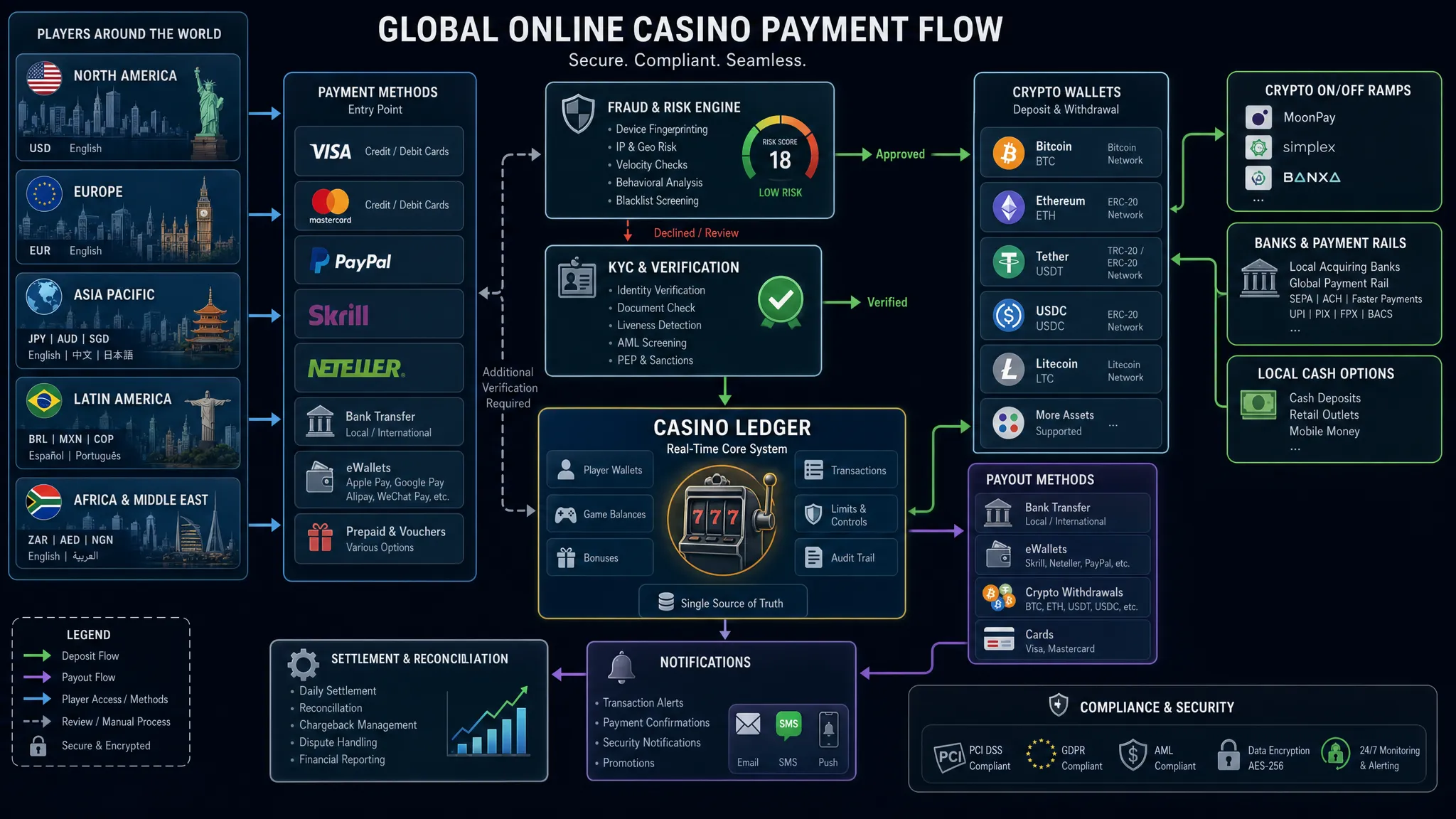
A scalable casino payment stack is more than a payment gateway. It is a group of connected systems that must agree on player identity, wallet balances, transaction states, risk signals, and accounting records.
| Stack layer | What it does | Why it matters globally |
|---|---|---|
| Cashier interface | Presents deposit and withdrawal options to players | Localizes the payment experience by market, currency, and device |
| Payment gateway or PSP | Processes cards, wallets, bank payments, and alternative methods | Provides access to local payment rails and acquiring relationships |
| Payment orchestration | Routes transactions across providers and fallback paths | Improves approval rates and reduces dependency on one provider |
| Player wallet and ledger | Records balances, bonuses, deposits, wins, losses, and withdrawals | Keeps funds accurate across currencies and payment methods |
| KYC and AML controls | Verifies player identity and monitors suspicious behavior | Supports licensing, risk management, and responsible operations |
| Fraud prevention | Scores transactions, devices, behavior, and account patterns | Reduces chargebacks, bonus abuse, account takeover, and payment fraud |
| Treasury and settlement | Manages FX, reserves, liquidity, and provider settlements | Protects margins and ensures withdrawals can be paid reliably |
| Backoffice reporting | Gives finance, risk, and support teams operational visibility | Helps teams investigate disputes, reconcile transactions, and monitor KPIs |
For a small launch, some of these layers may be handled by one platform or provider. As you expand, the important thing is not how many vendors you have. It is whether the architecture stays modular enough to add new payment methods without disrupting player balances, compliance checks, or reporting.
Choose payment methods by launch stage, not popularity
The best payment method is the one that matches your target player, risk model, and operational maturity. A new operator does not need every possible method on day one. It needs enough coverage to convert deposits, process withdrawals reliably, and learn from real transaction data.
| Payment method category | Best fit | Setup considerations |
|---|---|---|
| Cards | Broad coverage in many markets | Approval rates, MCC restrictions, chargebacks, 3DS, acquiring quality |
| Bank transfers and pay-by-bank | Markets where bank payments are trusted | Settlement timing, reference handling, refunds, open banking availability |
| E-wallets | Players who value speed and privacy from bank statements | Provider availability, withdrawal support, fees, account verification |
| Local APMs | Country-specific conversion lift | Local licensing rules, settlement currencies, provider reliability |
| Crypto and stablecoins | Cross-border access, faster settlement, crypto-native audiences | Wallet custody, volatility, onramps, AML screening, chain monitoring |
| Vouchers and prepaid | Cash-preferred or underbanked segments | Redemption risk, limits, fraud checks, and withdrawal policy |
For a deeper method-by-method comparison, Spinlab has a practical guide to the best payment methods for online casinos in 2026 that can help operators prioritize cards, open banking, wallets, local APMs, and crypto based on market conditions.
The key is to avoid copying another operator’s cashier blindly. A crypto casino targeting LATAM, a fiat-first casino targeting Western Europe, and a hybrid casino targeting multiple emerging markets will have very different payment priorities.
Build the ledger before expanding the cashier
A global casino cashier can look simple to players, but behind the scenes every transaction needs a clean lifecycle. Deposits, reversals, chargebacks, bonus credits, wins, losses, withdrawals, FX conversions, and manual adjustments must all reconcile to the same source of truth.
Your ledger should record more than “deposit succeeded” or “withdrawal paid.” It should capture pending, approved, failed, cancelled, reversed, refunded, charged back, and manually reviewed states. It should also separate player wallet balance, bonus balance, locked funds, pending withdrawals, and operator adjustments.
This is especially important when adding new methods. A failed card deposit, a delayed bank transfer, and a crypto deposit with insufficient confirmations should not create different accounting logic. They should feed a consistent transaction model.
If you are already planning to expand your payment coverage, review Spinlab’s technical guidance on adding new payment methods without breaking your ledger. The operational risk is rarely the payment button itself. It is the mismatch between provider events, wallet updates, and financial reporting.
Use payment orchestration to improve approval rates
Once you operate across multiple markets, one payment gateway is rarely enough. Approval rates vary by acquirer, issuing bank, country, card type, transaction amount, and risk score. A setup that performs well in one market may fail in another.
Payment orchestration solves this by routing transactions based on business rules. For example, low-risk card deposits can go to one acquirer, higher-risk transactions can trigger stronger authentication, and failed deposits can be retried through an approved fallback route when appropriate.
Good orchestration is not just about maximizing approvals. It also protects the operator from fraud and compliance problems. Routing should consider player verification status, geolocation, payment history, bonus exposure, velocity limits, device signals, and provider health.
Spinlab’s guide to casino payment orchestration and routing explains how operators can use routing logic to improve deposit conversion while still managing fraud, risk, and cost.
Make crypto-ready mean compliant, not anonymous
Crypto can be a powerful part of an online casino payments setup, especially for global markets where players want fast deposits, lower cross-border friction, or stablecoin access. But crypto payments should not be treated as a shortcut around compliance.
A crypto-ready solution should support clear deposit attribution, wallet monitoring, transaction confirmations, withdrawal controls, and AML screening. Operators also need to decide whether they will support direct crypto deposits, crypto onramps, custodial wallets, stablecoin balances, or instant conversion into fiat.
Stablecoins can reduce volatility compared with assets such as BTC or ETH, but they still introduce operational questions. Which networks will you support? How will you handle wrong-chain deposits? Who holds funds? What happens if a transaction is delayed, underpaid, or flagged by risk tools?
International standards from the Financial Action Task Force continue to shape how virtual assets are supervised, especially around AML, Travel Rule expectations, and suspicious activity monitoring. For operators, the practical lesson is simple: crypto payments need the same governance discipline as fiat payments, plus blockchain-specific controls.
Design withdrawals as carefully as deposits
Deposit conversion gets most of the attention, but withdrawals shape player trust. A casino can have a beautiful cashier and strong deposit approval rates, yet lose loyalty if cashouts feel slow, inconsistent, or opaque.
Global operators should define withdrawal rules before launch. These rules should cover identity verification thresholds, bonus wagering completion, payment method matching, withdrawal limits, pending review queues, manual approval permissions, and expected processing times by method.
A common best practice is to return funds through the same method used for deposit where possible, while giving verified players alternative payout methods when the original rail does not support withdrawals. This requires clear policy, strong audit trails, and support team visibility.
Fast withdrawals are attractive, but uncontrolled instant payouts can expose operators to fraud, bonus abuse, and account takeover losses. The right balance is to automate low-risk withdrawals and escalate unusual cases for review.
Protect card data and payment credentials
If your payment stack touches cardholder data, PCI DSS requirements matter. Many operators reduce their compliance scope by using tokenized payment flows, hosted payment pages, or PSP-managed card forms instead of storing sensitive data directly.
The PCI Security Standards Council provides the official standards for protecting cardholder data. Even when a PSP handles the most sensitive parts of card processing, operators still need strong access controls, secure integrations, logging, vulnerability management, and vendor due diligence.
The same principle applies to crypto wallets, admin panels, and API credentials. Payment systems are high-value targets. Backoffice permissions, withdrawal approvals, API keys, and manual adjustment tools should be protected with role-based access, multi-factor authentication, and audit logs.
Plan for multi-currency from the beginning
Global casino payments are not just about accepting more currencies. They are about deciding where currency conversion happens, how balances are displayed, how bonuses are valued, and how finance teams reconcile settlements.
At minimum, operators should distinguish between display currency, deposit currency, wallet currency, game currency, bonus currency, and settlement currency. These can be the same in a simple setup, but they often diverge as a casino expands.
For example, a player may deposit in EUR, play games priced in a platform wallet currency, receive a bonus calculated in local equivalent value, and trigger provider settlement in USD. Without a clear currency model, small FX differences can create support complaints, margin leakage, and reconciliation breaks.
The safest approach is to define your base operating currency, supported player currencies, FX rate source, rate refresh timing, rounding rules, bonus conversion rules, and settlement reporting before launch.
Launch roadmap for global casino payments
A practical payments rollout should move in phases. Each phase should reduce uncertainty before the next market or method is added.
- Map target markets: Define priority countries, player currencies, licensing constraints, local payment preferences, and expected transaction volumes.
- Select the core payment architecture: Choose whether you will rely on one PSP, multiple PSPs, an orchestration layer, or a modular iGaming platform with integrated payments.
- Design the ledger and wallet model: Document balance types, transaction states, FX rules, bonus interactions, reversals, and reconciliation requirements.
- Implement KYC and AML checkpoints: Decide when verification is required, how risk scores affect deposits and withdrawals, and how suspicious activity is escalated.
- Configure payment methods by market: Start with the highest-impact methods for each launch region instead of enabling every available option.
- Test real operational scenarios: Run sandbox and controlled live tests for failed deposits, partial approvals, chargebacks, delayed bank transfers, crypto confirmations, refunds, and manual reviews.
- Launch with monitoring and limits: Use deposit limits, withdrawal review thresholds, provider health checks, and daily reconciliation until transaction data is stable.
This phased approach helps avoid a common failure pattern: launching with too many payment options, too little reporting, and no clear ownership when a transaction gets stuck.
Metrics to monitor after launch
Once payments are live, the goal is continuous optimization. Track metrics by market, method, provider, currency, device, and player segment. A single global approval rate can hide serious local issues.
| Metric | What it reveals | Why it matters |
|---|---|---|
| Cashier conversion rate | How many players start and complete a deposit | Shows whether the payment UX and method mix are working |
| Approval rate | How many attempted payments are accepted | Helps identify routing, acquiring, issuer, or risk problems |
| Failed payment reasons | Why deposits fail | Guides method changes, UX improvements, and provider escalation |
| Withdrawal processing time | How long players wait for payouts | Directly affects trust, retention, and support volume |
| Chargeback rate | Card dispute exposure | Indicates fraud, player dissatisfaction, or descriptor issues |
| Fraud loss rate | Confirmed losses from abuse or fraud | Helps tune risk rules without blocking good players |
| Reconciliation breaks | Transactions that do not match across systems | Signals ledger, provider, or reporting issues |
| Payment cost per deposit | Total cost of processing by method | Protects margins and informs routing decisions |
These metrics should be visible to product, finance, risk, and support teams. Payments are cross-functional. If only finance sees reconciliation issues, product may keep scaling a broken flow. If only risk sees fraud signals, marketing may continue sending traffic that creates payment losses.
Common setup mistakes to avoid
Many payment problems are preventable if operators design for global complexity from day one.
- Relying on cards alone: Cards are important, but local bank payments, wallets, and crypto can materially improve coverage in the right markets.
- Adding methods without a ledger model: Every new provider creates new event types, failure states, settlement files, and reconciliation requirements.
- Treating withdrawals as manual support tasks: Manual review is useful for exceptions, but most verified low-risk withdrawals should follow a controlled workflow.
- Ignoring payment descriptors: Confusing card descriptors can increase disputes and support tickets.
- Using crypto without AML controls: Blockchain payments still require wallet screening, transaction monitoring, and documented risk policies.
- Skipping provider redundancy: One PSP outage or acquiring issue can block revenue if there is no fallback plan.
- Measuring only total deposits: Revenue can rise while approval rates, fraud losses, or payout delays quietly worsen.
Frequently Asked Questions
What is the best payment gateway for an online casino? The best payment gateway depends on your license, target markets, currencies, risk appetite, and method requirements. Many global operators use multiple PSPs or payment orchestration rather than relying on one gateway for every market.
Should a new online casino launch with crypto payments? Crypto can be valuable if your target players expect it or if cross-border payment friction is high. It should be launched with wallet controls, AML screening, transaction monitoring, and clear deposit and withdrawal rules.
How many payment methods should a casino offer at launch? Start with the methods most likely to convert in your first target markets. A smaller, well-tested cashier with reliable deposits and withdrawals is better than a long list of poorly supported options.
Why is reconciliation so difficult for global casino payments? Reconciliation becomes complex because payment providers, wallets, ledgers, game systems, bonuses, chargebacks, refunds, FX conversions, and settlements all create events that must match. A strong transaction model reduces errors.
What matters more, deposit speed or withdrawal speed? Both matter, but withdrawals often have a stronger effect on long-term trust. Players may tolerate an extra step to deposit, but delayed or unclear payouts quickly damage confidence.
Build a global-ready payment setup with Spinlab
Spinlab is built for operators who want an all-in-one, modular iGaming platform without assembling every payment, compliance, game, and backoffice layer from scratch. The platform supports crypto and fiat payments, multi-currency operations, KYC and AML workflows, fraud prevention, game aggregation, analytics, affiliate and bonus tools, open API integration, and mobile-optimized casino experiences.
For teams launching a whitelabel casino or scaling an online gambling platform into new markets, Spinlab offers a Shopify-like experience with the flexibility needed for global payments, crypto onramps, custodial wallet support, and customizable operations.
If you want to build, launch, and scale with a payment foundation designed for international growth, explore Spinlab’s iGaming platform.