

Payment strategy in 2026 is no longer about adding cards, turning on a payment gateway, and hoping approvals stay healthy. For online casinos, the cashier now affects acquisition cost, first-time depositor conversion, fraud exposure, withdrawal trust, reconciliation workload, and long-term player value.
The best payment methods for online casinos are not universal. A casino targeting crypto-native players needs a different mix from a regulated European brand, a LATAM-first slot site, or a mobile casino built around fast repeat deposits. The winning approach is hybrid: offer the rails players already trust locally, connect them to a clean wallet and ledger, and use real-time risk controls to approve more good transactions without opening the door to fraud.
This guide breaks down the strongest casino payment methods for 2026, where each one fits, and how operators should build a cashier stack that can scale.
What makes a casino payment method best in 2026?
A payment method is only valuable if it works across the full player journey. Fast deposits are important, but they are not enough. A rail that converts well but creates chargebacks, reconciliation gaps, withdrawal complaints, or compliance headaches will damage margin over time.
For operators, the practical scorecard should include:
- Player trust: Does the method feel familiar in the target market?
- Deposit conversion: How many initiated payments become playable balances?
- Approval rate: How often do banks, wallets, PSPs, or blockchain checks allow the transaction?
- Time to credit: How quickly can the player start playing after payment?
- Withdrawal fit: Can the same or a compatible rail support fast payouts?
- Fraud and chargeback risk: Does the method create reversible payment exposure or bonus abuse risk?
- Compliance readiness: Can you connect the rail to KYC, AML, sanctions screening, responsible gambling controls, and audit logs?
- Reconciliation quality: Can ledger entries, PSP reports, bank statements, and blockchain transactions be matched cleanly?
- Total cost: What is the true cost after gateway fees, FX, chargebacks, manual reviews, refunds, and support tickets?
In other words, the best payment method is not just the one with the lowest fee. It is the one that produces the highest fraud-adjusted conversion and retention in a specific market.
Quick comparison: best online casino payment methods in 2026
Speeds and availability depend on jurisdiction, PSP coverage, internal risk rules, KYC status, and the casino ledger design. Still, this table gives a practical operator view of where each method fits.
| Payment method | Best for | Typical deposit experience | Withdrawal fit | Main operator risk |
|---|---|---|---|---|
| Cards | Mainstream deposits, broad coverage | Instant authorization when approved | Moderate, fast card payouts depend on support | Chargebacks, issuer declines, 3DS friction |
| Apple Pay and Google Pay | Mobile-first conversion | Very fast tokenized card payment | Depends on underlying card and PSP | Wallet and scheme policy constraints |
| Open banking and pay-by-bank | Lower-cost banked users, Europe and UK-style markets | Seconds to minutes when instant rails are available | Strong where instant payouts are supported | Bank coverage gaps, consent UX |
| Local APMs | Regional conversion and trust | Instant to same-day depending on rail | Varies by method | Fragmented providers, local restrictions |
| E-wallets | Repeat deposits and fast payouts | Usually fast after wallet login | Often strong | Fees, wallet policies, account limits |
| Crypto and stablecoins | Crypto-native players, cross-border deposits, fast payouts | Minutes, sometimes seconds on low-cost networks | Strong with the right custody and controls | AML, KYT, custody, Travel Rule readiness |
| Crypto onramps | Fiat users entering a crypto cashier | Minutes, with provider KYC and payment checks | Not usually a payout rail by itself | Fee transparency, onramp approval rates |
| Prepaid vouchers and cash alternatives | Underbanked or cash-preferring segments | Instant after redemption | Weak unless paired with another payout rail | Refund mismatch, bonus abuse, KYC timing |
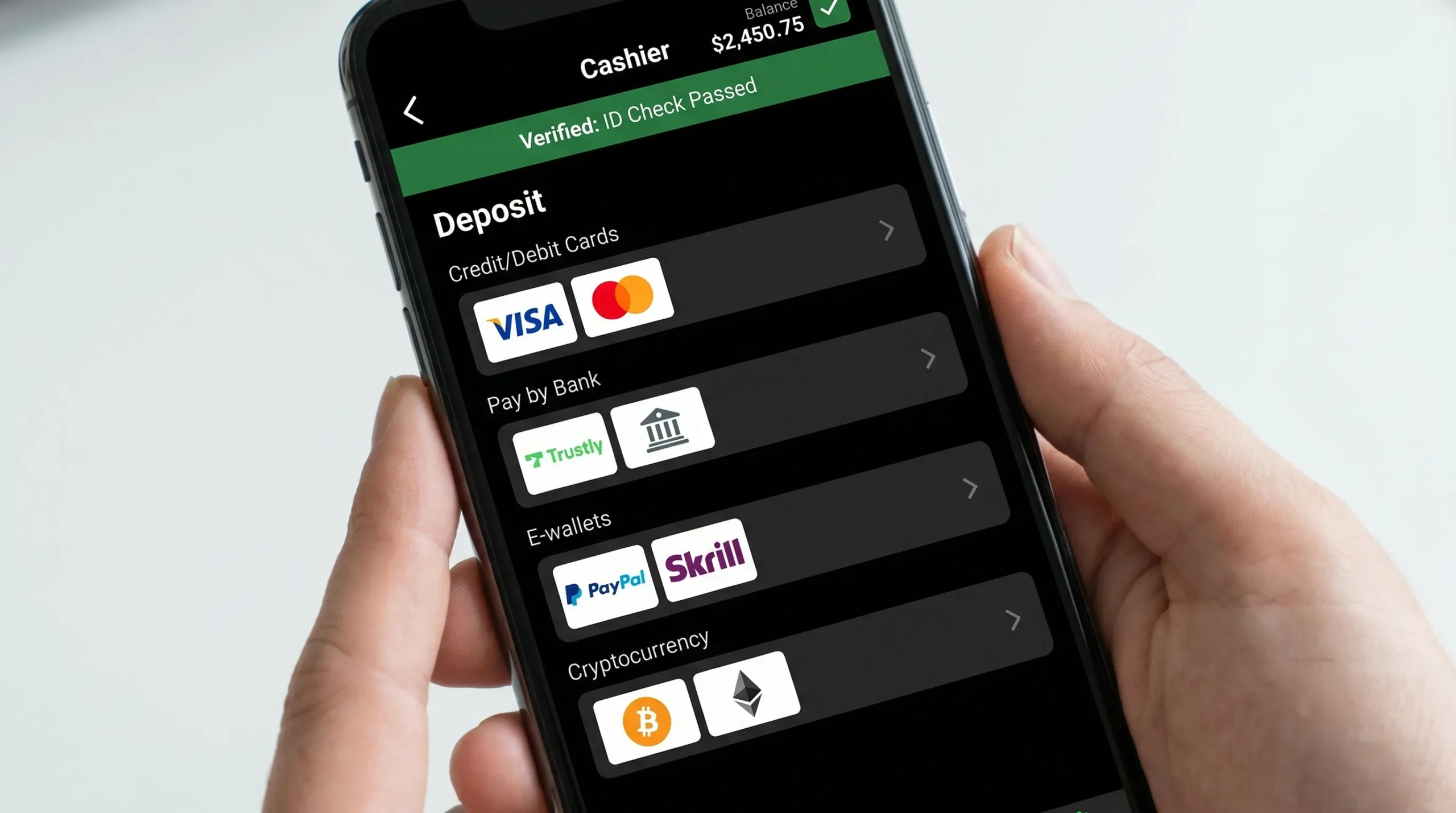
Cards: still essential, but no longer enough
Cards remain one of the most important payment methods for online casinos because players understand them and they are widely supported. For many new casino brands, cards still provide the fastest path to familiar deposits.
The challenge is that card performance varies heavily by market, issuer, merchant category, player history, and 3DS configuration. Gambling transactions can face higher decline rates than standard e-commerce, especially for cross-border traffic or poorly configured acquiring. Card deposits also carry chargeback exposure, which means the operator needs strong evidence logs, clear descriptors, device intelligence, and dispute workflows.
Cards work best in 2026 when operators treat them as a managed rail, not a default rail. That means using local acquiring where possible, applying risk-based 3DS instead of challenging every player, monitoring soft and hard declines separately, and giving players a fallback method when a legitimate deposit fails. For more detail, see Spinlab’s guide to 3DS for casino deposits.
Operators should also avoid storing or touching card data unnecessarily. Card payments should be tokenized through compliant providers, and teams should understand how PCI DSS scope affects their architecture. The PCI Security Standards Council remains the primary source for PCI DSS requirements.
Apple Pay and Google Pay: the mobile conversion layer
Apple Pay and Google Pay are often described as payment methods, but for casino operators they usually function as high-converting tokenized card experiences. The underlying rail may still be card-based, but the UX is much smoother.
For mobile-first casinos, wallet buttons can reduce form friction, typing errors, and checkout hesitation. Players do not need to manually enter card numbers, expiry dates, or billing details. Authentication is handled through device biometrics or passcode flows, which can feel safer and faster than a traditional card form.
The trade-off is that digital wallet performance depends on the underlying PSP, card acceptance, wallet policy, jurisdiction, and merchant setup. Operators should confirm whether gambling transactions are supported, whether recurring or saved credentials are allowed, how refunds work, and how wallet tokens appear in reconciliation.
If your casino relies heavily on iOS traffic, Apple Pay can be a meaningful conversion lever. Spinlab has a technical checklist for operators exploring Apple Pay in Curacao-licensed casinos.
Open banking and pay-by-bank: one of the strongest 2026 contenders
Open banking and pay-by-bank payments are becoming a core casino cashier rail because they combine bank-level trust with lower card-style dispute exposure. Instead of entering card details, the player authenticates with their bank and approves an account-to-account payment.
For operators, the appeal is clear. Pay-by-bank can reduce card processing dependency, improve approval for players whose banks block gambling card transactions, and simplify certain reconciliation flows when references are well designed. It is especially powerful in markets where instant bank transfers are common and consumer banking apps are widely used.
Regulation is also moving in this direction. In Europe, the European Commission’s PSD3 and PSR proposal aims to improve payment services, fraud protection, and open banking rules. Instant bank transfers are also becoming more important across European payment infrastructure.
The main challenge is UX. Players need to understand what happens after they tap pay-by-bank, why they are being redirected, when funds become playable, and what to do if a bank session expires. The best casino cashiers treat pay-by-bank as a first-class payment journey with clear pending states, deep links, and automatic recovery.
For implementation detail, read Spinlab’s Open Banking for iGaming integration guide.
Local APMs: the highest-impact method in many markets
Alternative payment methods are often where the biggest conversion gains happen. In many markets, local APMs are more trusted than international cards. Examples include bank transfer systems, instant payment schemes, local wallets, QR payments, mobile money, cash vouchers, or real-time account-to-account rails.
The key is not to add every APM available. The goal is to identify the payment methods that players in your target market actually expect to see at the cashier.
Examples include:
- Canada: Interac e-Transfer is often more familiar than card-only checkout.
- Mexico: SPEI and cash-based methods can matter depending on segment.
- Brazil: PIX-style instant payments are a major consumer habit, where gambling regulation and provider support allow use.
- India: UPI-style flows can be high-converting, but operators must be extremely careful with legality, provider restrictions, and compliance.
- LATAM and Africa: Local wallets, cash vouchers, and mobile money can outperform global cards in specific markets.
The risk with APMs is operational complexity. Every rail has its own status codes, refund rules, settlement timing, reconciliation format, limits, and compliance requirements. This is why operators should add local methods through a payment architecture that normalizes events into one wallet and ledger instead of letting each provider become a separate backoffice process.
E-wallets: strong for repeat players and withdrawals
E-wallets have remained popular in iGaming because they can support fast deposits, fast withdrawals, and a sense of separation between gambling funds and a player’s main bank account. They are especially useful for returning players who already keep balances in a wallet.
For operators, e-wallets can reduce card-entry friction and sometimes lower direct card chargeback exposure. They can also be useful for VIP segments and international players, depending on market coverage.
However, e-wallets are not free of friction. Fees can be higher than bank rails, wallet providers may apply gambling-specific restrictions, and some users may face account limits or additional verification. Operators should also check whether the e-wallet supports both deposits and withdrawals in the target jurisdiction. A method that is great for deposits but poor for payouts can create support tickets later.
E-wallets work best as part of a broader cashier mix, not as a replacement for local bank rails or cards.
Crypto and stablecoins: best for crypto-native and cross-border segments
Crypto payments are no longer a fringe casino feature. In 2026, they are a serious payment option for operators targeting crypto-native players, global audiences, streamer-led communities, and markets where traditional payment acceptance is difficult.
Stablecoins are usually the most practical starting point. They reduce volatility compared with assets like BTC or ETH while still enabling blockchain settlement. On low-cost networks and Layer-2 rails, stablecoin deposits and withdrawals can be fast and inexpensive compared with legacy cross-border flows.
The biggest operator advantage is that crypto payments do not create card chargebacks. They can also improve withdrawal trust when players receive funds quickly and transparently. But that does not mean crypto is risk-free. Operators need wallet screening, sanctions controls, blockchain monitoring, Travel Rule workflows where applicable, custody policies, and clear accounting.
The FATF virtual assets guidance is a useful reference point for understanding how regulators think about virtual asset service providers and Travel Rule obligations. Spinlab also covers practical implementation in Crypto Casino Payments Explained for New Operators and Travel Rule Compliance for Crypto Casinos.
Crypto is strongest when integrated into the same risk and ledger framework as fiat. If crypto deposits sit in a separate tool with manual crediting, manual withdrawals, and disconnected AML checks, the operational risk rises quickly.
Crypto onramps: the bridge between fiat players and crypto rails
A crypto onramp lets a player buy crypto, often stablecoins, using a fiat method such as card, bank transfer, or a local payment rail, then deposit into the casino wallet. This is useful when players like the idea of crypto deposits but do not already hold crypto.
The onramp is not the same as a direct crypto deposit. It introduces an extra provider, additional KYC steps, separate fees, and another approval layer. Done badly, it can confuse players and increase drop-off. Done well, it gives fiat users a guided path into a crypto-ready cashier.
Good onramp UX should show the asset, network, fees, estimated arrival time, exchange rate, and verification requirements before the player commits. Operators should also make it clear which party is processing the purchase and how support is handled if the onramp transaction fails.
For many casinos, the right answer is to offer both direct crypto deposits for experienced users and an embedded onramp for newcomers.
Prepaid vouchers and cash alternatives: useful, but limited
Prepaid vouchers, cash payment options, and similar alternatives can still be valuable in markets with underbanked players or high card decline rates. They can also support players who prefer strict budget control.
But these methods create a major payout challenge. If a player deposits with a voucher, the casino still needs a compliant withdrawal method. That usually means collecting KYC information and adding a bank, wallet, card payout, or crypto withdrawal option later.
Operators should use prepaid and cash alternatives carefully. They can increase top-of-funnel conversion, but they may also attract bonus hunters, create refund complexity, and increase support volume if withdrawal expectations are not explained early.
The best method depends on the goal
Instead of asking which payment method is best overall, operators should map methods to business goals.
| Operator goal | Best-fit payment methods | Why it works |
|---|---|---|
| Maximize first-time deposits | Cards, Apple Pay, Google Pay, local APMs, pay-by-bank | Familiar, fast, and easy to understand |
| Reduce chargebacks | Pay-by-bank, instant bank transfers, crypto, vouchers | Less card-style reversibility |
| Improve withdrawal trust | Instant bank payouts, e-wallets, stablecoins | Faster time-to-paid and fewer support tickets |
| Serve crypto-native players | Stablecoins, direct crypto deposits, crypto onramps | Matches player expectations and supports fast payouts |
| Enter a new local market | Local APMs, local currency, local bank rails | Builds trust and reduces payment friction |
| Support higher-value deposits | Bank transfer, pay-by-bank, stablecoins with EDD | Better limits and stronger auditability |
For most operators, the best 2026 cashier is not card vs crypto or bank vs wallet. It is an orchestrated mix that routes players to the most appropriate rail based on geography, device, currency, risk score, player history, and provider health.
Payment orchestration matters more than payment choice
Adding more payment logos to the cashier does not automatically improve revenue. Too many options can overwhelm players, while poorly integrated methods create ledger issues, delayed credits, and reconciliation gaps.
A modern casino payment stack needs orchestration. That means each payment method connects into a unified system for intents, wallet updates, KYC checks, fraud decisions, provider routing, ledger postings, and reconciliation.
Key capabilities include:
- Payment intents that track the full lifecycle from initiation to success, failure, refund, or reversal.
- Rail-agnostic wallet logic so cards, bank payments, APMs, and crypto all update balances through consistent ledger rules.
- Smart routing based on BIN, player country, currency, device, risk, and PSP health.
- Risk-based step-ups so suspicious payments face extra verification while trusted players avoid unnecessary friction.
- Idempotency and duplicate protection to prevent double credits from retries, delayed webhooks, or provider redelivery.
- Three-way reconciliation across the casino ledger, PSP or blockchain records, and bank or settlement reports.
- Real-time analytics to monitor approval, abandonment, cost, fraud, and time-to-credit by method.
Spinlab covers this architecture in detail in Casino Payment Orchestration 101, How to Add New Payment Methods Without Breaking Your Ledger, and Casino Payments Reconciliation.
Recommended payment mix for online casinos in 2026
A new operator does not need every possible method on day one. It needs the smallest set of high-trust methods that covers the target audience while keeping operations manageable.
| Casino model | Recommended starting mix | Notes |
|---|---|---|
| Lean white label startup | Cards or digital wallets, one local APM, one fast withdrawal rail, optional stablecoin | Keep cashier simple and measurable |
| Europe-focused casino | Cards, Apple Pay or Google Pay, open banking, SEPA-style instant payouts where available | Optimize for SCA, bank trust, and withdrawal speed |
| LATAM-focused casino | Local cards, key local bank rail, cash or voucher option where relevant, stablecoin optional | Local currency and trusted rails matter more than a generic global cashier |
| Crypto-first casino | Stablecoins, direct crypto deposits, crypto onramp, fiat fallback | Build around custody, KYT, Travel Rule, and network fee transparency |
| Multi-market operator | Payment orchestration, local acquiring, regional APMs, multi-currency wallet, crypto optional | Standardize ledger and risk controls before adding methods aggressively |
The right launch mix should also reflect your licensing model, marketing channel, player geography, and risk appetite. Affiliate-led traffic, streamer traffic, VIP traffic, and SEO-driven traffic can all behave differently at the cashier.
Metrics that reveal whether a method is actually working
Operators often judge payment methods by headline processing fee. That is too narrow. A method with a lower fee but poor completion, slow support, or messy reconciliation may cost more than a higher-fee method that converts reliably.
Track each payment method using operational and revenue metrics:
- Initiation rate: Share of cashier visitors who select the method.
- Completion rate: Share of initiated payments that succeed.
- Approval rate: Provider-approved transactions divided by submitted transactions.
- Time to credit: Median and P95 time from payment start to playable balance.
- Cost per successful deposit: Fees divided by completed deposits, not attempted deposits.
- Fraud-adjusted approval rate: Approvals after subtracting confirmed fraud and chargeback losses.
- Withdrawal time-to-paid: Median and P95 time from request to player receipt.
- Manual review rate: Share of transactions requiring operational intervention.
- Reconciliation exception rate: Unmatched or mismatched transactions by rail.
- Support tickets per 1,000 transactions: A practical measure of cashier confusion.
- LTV by deposit method: Long-term value of players acquired through each rail.
If a payment method does not improve conversion, retention, market coverage, or risk economics, it does not deserve a permanent place in the cashier.
Common mistakes when choosing casino payment methods
The most common mistake is launching with a card-only cashier and assuming payment coverage is solved. Cards are important, but they are not enough for global growth.
Another mistake is adding methods without redesigning the ledger. Every new rail introduces new statuses, timing, settlement files, reversals, fees, and edge cases. If these are handled manually, the operator eventually pays through support load and reconciliation errors.
Operators also hurt conversion by hiding fees until the final step, failing to explain bank redirects, using generic decline messages, forcing KYC at the wrong moment, or sending every player through the same fraud checks. Payment UX and risk controls should be contextual.
Finally, many teams optimize deposits while ignoring withdrawals. Fast deposits create short-term revenue. Fast, transparent withdrawals create trust, repeat deposits, and fewer support tickets.
For a deeper look at failures and fixes, read Spinlab’s guide to Payment Failures in iGaming.
Frequently Asked Questions
What is the best payment method for online casinos in 2026? There is no single best method for every casino. The strongest approach is a hybrid cashier with cards or digital wallets, local APMs, pay-by-bank where available, and crypto or stablecoins when they fit the audience and compliance model.
Should a new online casino still offer card payments? Yes, in most card-friendly markets. Cards remain familiar and important for first deposits, but they should be supported by local APMs, bank rails, or crypto options to reduce declines and improve coverage.
Are crypto payments better than fiat for casinos? Crypto can be better for crypto-native audiences, fast withdrawals, cross-border access, and lower chargeback exposure. Fiat is usually better for mainstream conversion and regulated local markets. Many operators should offer both through one unified wallet and risk framework.
Which casino payment methods reduce chargebacks? Pay-by-bank, instant bank transfers, crypto, stablecoins, and prepaid methods can reduce card-style chargeback exposure. They still require fraud controls, AML monitoring, and clear player communication.
How many payment methods should an online casino launch with? A focused launch usually performs better than a crowded cashier. Start with three to six high-trust methods based on your target market, then add more only when data shows a clear conversion or retention benefit.
What matters more, deposit speed or withdrawal speed? Both matter, but withdrawals have an outsized impact on trust. A casino that accepts instant deposits but delays withdrawals will generate support tickets, negative reviews, and lower repeat deposit rates.
Build a 2026-ready casino cashier with Spinlab
The best payment strategy is not about choosing one rail. It is about building a cashier that can localize, route, verify, credit, reconcile, and scale without creating operational chaos.
Spinlab Studio gives operators a modular iGaming platform with crypto and fiat payment support, multi-currency capabilities, crypto onramp solutions, merchant custodial wallets, KYC and AML workflows, fraud prevention, real-time analytics, open API integration, and an operator-friendly backoffice. It is designed for teams that want a fast, flexible, cost-conscious path to launching and scaling an online casino.
If you are planning a new casino launch or upgrading an existing cashier, Spinlab can help you design a payment mix that matches your market, compliance needs, and growth goals. Explore Spinlab Studio and see how a modern white label casino platform can simplify payments from day one.
Hello,
I have developed an iGaming website and am currently exploring suitable payment providers.
At this stage, the project is personally owned, and I have not yet registered a company or obtained a gambling license. I would like to understand whether your company can provide any payment solution for a project in this situation, such as a development, testing, or pre-launch account.
Please let me know whether your services may be suitable and what steps I would need to take.
Best regards,