

Low TCO casino software is not simply the platform with the lowest setup fee. In online casino operations, total cost of ownership includes everything required to launch, run, maintain, protect, and scale the business over time. A cheap monthly license can become expensive if you need custom wallet work, manual payment reconciliation, extra compliance tooling, slow support, or a migration six months after launch.
For founders, operators, and product teams, the goal is to choose casino software that keeps both visible and hidden costs under control. That means evaluating the platform as an operating system for your casino, not just as a website with slot games and a backoffice.
This guide breaks down what low TCO really means, where costs hide, and how to compare vendors before you commit.
What TCO means in casino software
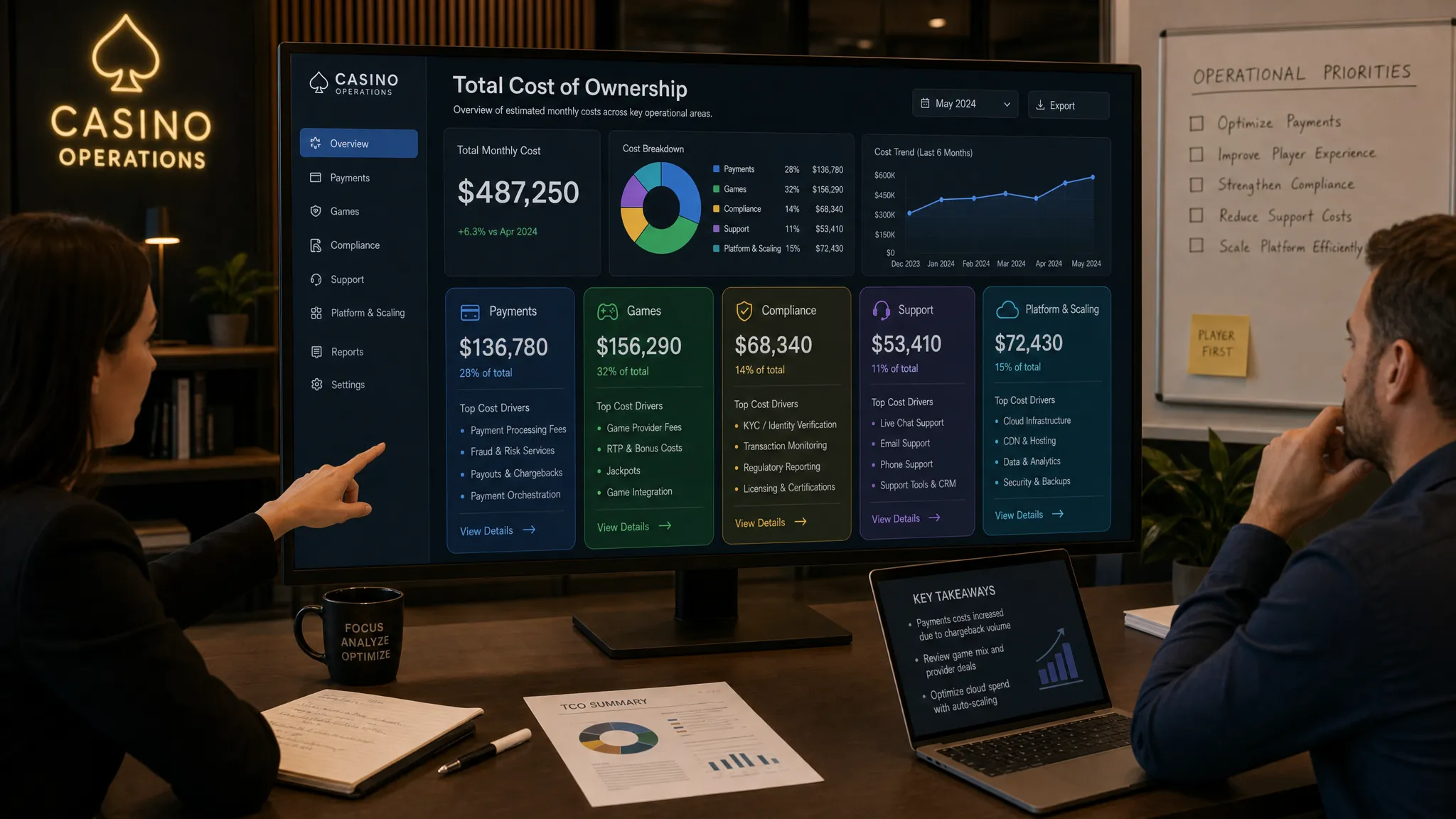
Total cost of ownership, or TCO, is the full economic impact of a casino software decision across the life of the platform. It includes direct vendor fees, but it also includes internal labor, compliance overhead, payment failures, integration delays, downtime, technical debt, and lost growth caused by platform limits.
A simple way to think about it is:
Casino software TCO = launch cost + recurring platform cost + operational labor + integration cost + compliance and risk cost + scaling cost + switching cost.
That formula matters because many online casino buyers compare only the first two items. They look at setup fees and monthly fees, then assume the lower quote is the lower-cost choice. In reality, the most expensive costs often appear after go-live.
| Cost area | Obvious cost | Hidden TCO risk |
|---|---|---|
| Platform license | Setup and monthly fee | Feature gaps that require paid custom work |
| Payments | PSP or payment gateway fees | Manual reconciliation, failed deposits, withdrawal delays |
| Games | Aggregator or provider commercial terms | Slow integrations, weak lobby tools, limited market coverage |
| Compliance | KYC, AML, reporting tools | Manual checks, blocked markets, audit preparation |
| Operations | Backoffice users and support | Staff time spent on bonuses, fraud reviews, and customer issues |
| Engineering | API, frontend, data, and integrations | Vendor dependency for every small change |
| Growth | Affiliates, bonuses, analytics | Poor campaign control and limited segmentation |
| Migration | Data export and switching support | Lock-in if the platform cannot scale or adapt |
A low-TCO iGaming platform reduces the amount of extra work required to operate safely and grow. It consolidates core functions, makes routine changes easy, and gives your team enough flexibility without forcing you into constant development projects.
Start with your operating model, not the vendor demo
Before comparing casino software providers, define how your business will actually operate. A sleek demo can hide the fact that the product was built for a different type of operator.
For example, a crypto-first casino startup needs different wallet, ledger, and onramp capabilities than a fiat-focused brand targeting card and local payment methods. A multi-market operator needs localization, multi-currency support, and market-specific compliance workflows. A lean founder needs a backoffice that non-technical staff can use without asking developers for every change.
Your operating model should clarify:
- Target markets and languages
- Fiat, crypto, or hybrid payment strategy
- Expected game mix, such as slot games, live casino games, or casino original games
- Bonus and affiliate model
- Compliance obligations and KYC depth
- Internal team size and technical capability
- Launch timeline and expected growth curve
If you are still narrowing the budget side of the decision, Spinlab’s guide on what to look for in cheap casino software is a useful companion because it focuses on the difference between low price and risky underbuilding.
Once the operating model is clear, you can evaluate TCO in context. The best platform is not the one with the longest feature list. It is the one that supports your model with the least unnecessary friction.
Choose the right platform model for your cost profile
The biggest TCO decision is often the platform model. Custom builds, turnkey casino solutions, and white label casino platforms all carry different cost patterns.
| Platform approach | TCO profile | Best fit | Watch-outs |
|---|---|---|---|
| Custom build | High upfront cost, high control, ongoing engineering responsibility | Large teams with deep technical resources | Long timeline, maintenance burden, integration complexity |
| Turnkey casino solution | Moderate setup, faster launch, packaged core components | Operators that want speed with more configuration | Vendor dependency, limits on customization may vary |
| White label casino platform | Lower launch cost, faster go-live, shared infrastructure benefits | Startups, lean teams, test-and-scale brands | Must verify ownership, reporting, payment flexibility, and exit terms |
White label casino software can produce a lower TCO when it includes the components you would otherwise have to buy, integrate, and maintain separately. But not every white label product is equal. Some are low-cost because they are efficient. Others are low-cost because they leave critical work to you.
Architecture also matters. Multi-tenant platforms can reduce infrastructure and maintenance costs, while single-tenant platforms can offer more isolation and control but may require more operational ownership. If architecture is a key part of your decision, it is worth reviewing the tradeoffs in multi-tenant vs single-tenant casino platforms before selecting a vendor.
Evaluate payments as a TCO center, not a checkbox
Payments are one of the biggest sources of hidden cost in online gambling platforms. A vendor may say it supports payments, but that statement does not tell you enough. You need to understand how deposits, withdrawals, reconciliation, fraud checks, chargebacks, limits, currencies, and crypto flows actually work.
A low-TCO payment setup should reduce manual work for finance, support, compliance, and risk teams. The more your staff has to investigate mismatches, chase failed deposits, or manually approve routine withdrawals, the higher your operating cost becomes.
For fiat payments, ask how the platform connects with payment gateway providers, how transaction states are tracked, and how refunds or failed deposits are reflected in the player wallet. If card processing is involved, understand whether and how PCI DSS scope applies. The PCI Security Standards Council provides the baseline standards for protecting cardholder data, although your exact obligations depend on your payment setup and providers.
For crypto-ready solutions, go deeper than deposit address support. Crypto creates its own TCO questions around wallet custody, confirmations, exchange rates, onramps, withdrawals, and transaction monitoring. Crypto onramp support can reduce friction for players, but it also needs to fit your compliance and treasury model.
The key question is not, “Do you support payments?” The better question is, “How much operational work will our team need to perform for every 1,000 deposits and withdrawals?”
Look at game aggregation through the lens of speed and control
Game content is a major driver of acquisition and retention, but it can also become a cost trap. A strong game aggregator should help you add and manage content without turning each provider relationship into a technical project.
For a low-TCO online casino, game aggregation should support fast provider onboarding, stable game performance, clean reporting, and manageable lobby organization. If your team wants to promote new Pragmatic slots, new Hacksaw slots, live casino games, or branded original games, the backoffice should make it practical to surface and manage content without developer involvement for every update.
Ask vendors how games are categorized, how provider reporting works, how new games are added, and whether the platform supports market-specific availability. Also ask how game issues are handled. A game that loads slowly or breaks on mobile creates support tickets, lost deposits, and player churn, all of which increase TCO.
Prioritize compliance and fraud tooling early
Compliance is not a feature to “add later” if you want low TCO. Retrofitting KYC, AML, fraud prevention, responsible gambling controls, and reporting workflows after launch can be more expensive than choosing a platform that supports them from the start.
Regulated gambling obligations vary by jurisdiction, but remote casino operators commonly need to manage player identity checks, source-of-funds risk, transaction monitoring, suspicious activity escalation, and recordkeeping. The UK Gambling Commission’s anti-money laundering guidance for casinos is one example of how detailed these expectations can become in regulated environments.
Even if your first launch market is lighter-touch, weak compliance tooling creates operational risk. Manual reviews consume staff time. Poor audit trails make investigations harder. Inconsistent limits can expose the brand to avoidable disputes.
Low-TCO casino software should help your team answer basic operational questions quickly:
- Who is the player?
- What is their verification status?
- What transactions look unusual?
- What limits, bonuses, and restrictions apply?
- What actions did staff take, and when?
If the backoffice cannot answer these questions clearly, the cost shows up later in support, compliance, finance, and management time.
Backoffice usability is a direct operating cost
The backoffice is where TCO becomes visible every day. A confusing admin panel forces your team to rely on developers, vendor support, or spreadsheets for routine work. That increases cost even if the license fee looks attractive.
For a lean operator, a strong backoffice should make common workflows simple: player management, bonus setup, affiliate tracking, payment review, risk flags, game management, segmentation, reporting, and admin permissions. The goal is not just “more controls.” The goal is faster, safer work by non-technical users.
When comparing vendors, ask for a workflow-based demo rather than a feature tour. For example, ask the vendor to show how your team would create a welcome bonus, review a suspicious withdrawal, export transaction data, disable a game in one market, or check affiliate performance.
If those workflows take too many steps, require custom scripts, or depend on vendor intervention, the platform may have a higher real TCO than the quote suggests.
Measure integration cost before you sign
Many casino software buyers underestimate integration costs. Your platform may need to connect with payment providers, KYC vendors, affiliate systems, CRM tools, analytics, BI platforms, customer support software, or custom frontends. Every weak API becomes a future cost.
A low-TCO casino software provider should offer clear API documentation, stable integration patterns, and a realistic onboarding process. Open API access can be valuable because it prevents your team from being trapped inside the vendor’s roadmap for every integration.
However, “API available” is not enough. Ask whether the APIs support the workflows you actually need. Ask about authentication, rate limits, webhooks, sandbox environments, test data, versioning, and support for integration troubleshooting.
The cost of a weak integration layer is not just developer time. It can delay launch, block partnerships, limit analytics, and make future migration more expensive.
Compare support, SLAs, and upgrade policies
Support quality has a direct effect on TCO. In iGaming, delays can cost real revenue. If deposits fail on a weekend, games stop loading, or bonus logic behaves incorrectly, your team needs a support path that matches the seriousness of the issue.
Review the vendor’s support model before signing. Who handles urgent incidents? What is included in the base agreement? What costs extra? How are bug fixes prioritized? How often is the platform updated? Do upgrades require downtime or manual work from your team?
You should also understand how much control you have over roadmap requests. Some vendors are flexible but charge heavily for every change. Others include more configuration but less custom development. Neither model is automatically wrong, but the economics should be transparent.
Use a practical low-TCO scorecard
A structured scorecard helps prevent decisions based on demos, relationships, or headline pricing. Weight each category based on your operating model, then score vendors with evidence.
| Evaluation category | Suggested weight | What to verify |
|---|---|---|
| Payments and wallet accuracy | 20% | Multi-currency support, crypto and fiat flows, reconciliation, withdrawal controls |
| Compliance and fraud controls | 15% | KYC, AML, audit trails, risk rules, responsible gambling workflows |
| Backoffice usability | 15% | Bonus setup, player management, reporting, admin roles, operational speed |
| Game aggregation | 15% | Provider coverage, content management, reporting, performance, market controls |
| Integration flexibility | 10% | Open API quality, webhooks, sandbox, documentation, third-party tooling |
| Performance and reliability | 10% | Mobile performance, uptime process, incident handling, scaling model |
| Commercial transparency | 10% | Setup fees, revenue share, add-ons, support costs, migration terms |
| Vendor fit | 5% | Roadmap alignment, onboarding support, communication quality |
For a more vendor-comparison-oriented framework, Spinlab’s guide to comparing white label casino software vendors expands on how to structure evidence-based evaluations.
The most important rule is to score based on proof. Demos, documentation, test access, sample reports, and contract language matter more than verbal assurances.
Red flags that “low TCO” may become expensive
Some casino software looks affordable during procurement but becomes costly after launch. Watch for these warning signs.
The quote excludes critical modules
If payments, KYC, game aggregation, affiliate tools, bonus management, analytics, or support are priced separately, the base quote may not reflect your real operating cost. Always ask what is included and what is optional.
Every change requires vendor development
Customization is useful, but constant dependency is expensive. If routine changes require tickets, sprints, and paid development, your team loses speed and control.
Reporting is limited or delayed
Weak reporting creates hidden labor. Operators need timely visibility into deposits, withdrawals, GGR, NGR, bonuses, affiliate performance, game performance, and player behavior. If your team has to assemble key reports manually, TCO rises.
The platform cannot support your payment strategy
Payment limitations can damage conversion and retention. If the platform lacks the payment gateway, crypto, fiat, multi-currency, or wallet model you need, you may end up paying for workarounds.
Exit terms are unclear
A low-TCO decision should include a future exit path. Ask about data export, domain control, player account data, transaction history, and migration support. Vendor lock-in can become one of the largest long-term costs.
Questions to ask every casino software provider
Use these questions in vendor calls and procurement discussions:
- What is included in the base platform fee?
- Which modules cost extra now or later?
- How are fiat and crypto transactions reconciled?
- Which payment gateways, wallets, and onramps are already supported?
- How does the platform handle KYC, AML, fraud prevention, and audit trails?
- Can non-technical staff create bonuses, manage games, and review withdrawals?
- What game providers are integrated, and how are new games added?
- What APIs, webhooks, and sandbox tools are available?
- What support is included, and what response times apply to critical incidents?
- How are upgrades handled?
- What data can be exported if we leave?
- Which costs typically increase as operators scale?
The answers should be specific. If a vendor cannot explain how costs change as you grow, assume you have not yet seen the full TCO picture.
Frequently Asked Questions
What is low TCO casino software? Low TCO casino software is a platform that keeps the full cost of launching, operating, maintaining, and scaling an online casino under control. It is not just a low setup fee. It includes payments, compliance, games, backoffice work, integrations, support, and future migration risk.
Is white label casino software usually lower TCO than custom development? For startups and lean operators, white label casino software often has lower TCO because it packages core components that would otherwise require separate development and integrations. Custom development can make sense for large teams that need deep control and can fund ongoing maintenance.
What is the biggest hidden cost in casino software? Payments and operations are often the biggest hidden costs. Manual reconciliation, withdrawal reviews, failed deposits, weak reporting, and limited wallet controls can consume staff time and reduce revenue even when the platform license looks cheap.
How should crypto-ready casino software be evaluated for TCO? Evaluate crypto-ready software by looking at wallet structure, ledger accuracy, onramp support, withdrawal controls, exchange-rate handling, transaction monitoring, and compliance workflows. Crypto support should reduce operational complexity, not add manual treasury work.
Should I choose the cheapest casino software provider? Not automatically. Choose the provider with the lowest realistic total cost for your operating model. A slightly higher platform fee can be cheaper overall if it includes stronger payments, compliance, game aggregation, backoffice tools, and support.
Build a lower-TCO casino platform with Spinlab
Choosing casino software with low TCO means choosing a platform that helps your team launch quickly, operate efficiently, and scale without rebuilding the basics. Spinlab is designed as an all-in-one, modular iGaming platform for online casino operators that want a flexible, cost-conscious path to market.
Spinlab brings together crypto and fiat payment support, game aggregation, real-time analytics, fraud prevention, KYC and AML compliance capabilities, mobile-optimized casino experiences, affiliate and bonus tools, a customizable backoffice, open API integration, multi-currency support, crypto onramp options, custodial wallet support, and the ability to create custom casino original games.
If you want a Shopify-like experience for launching and managing a whitelabel casino without taking on unnecessary platform complexity, explore Spinlab’s casino software platform and evaluate how a modular setup can help reduce your total cost of ownership from day one.