

Building an online casino used to mean commissioning a bespoke, single-tenant server stack that cost six figures and took months to deploy. In 2025, operators can instead subscribe to a multi-tenant iGaming platform that works a lot like Shopify: you sign up, pick your modules, go live in days, and only pay for the capacity you use. But is multi-tenant always the smartest bet? This deep-dive compares multi-tenant and single-tenant casino platforms across architecture, security, performance, compliance, and—most importantly—total cost of ownership (TCO). By the end, you’ll know which model fits your roadmap, risk appetite, and budget.
1. Tenancy 101: How the Two Models Differ
| Characteristic | Multi-Tenant Casino Platform | Single-Tenant Casino Platform |
|---|---|---|
| Infrastructure | Shared compute, database clusters, global CDN | Dedicated servers and databases per operator |
| Upgrades | Continuous, automatic for all tenants | Scheduled, operator-controlled |
| Customisation | Configuration-driven (themes, modules, APIs) | Full code-level customisation |
| Go-Live Time | Hours to days | Weeks to months |
| Typical Pricing | Subscription or revenue-share | Up-front licence + hosting + maintenance |
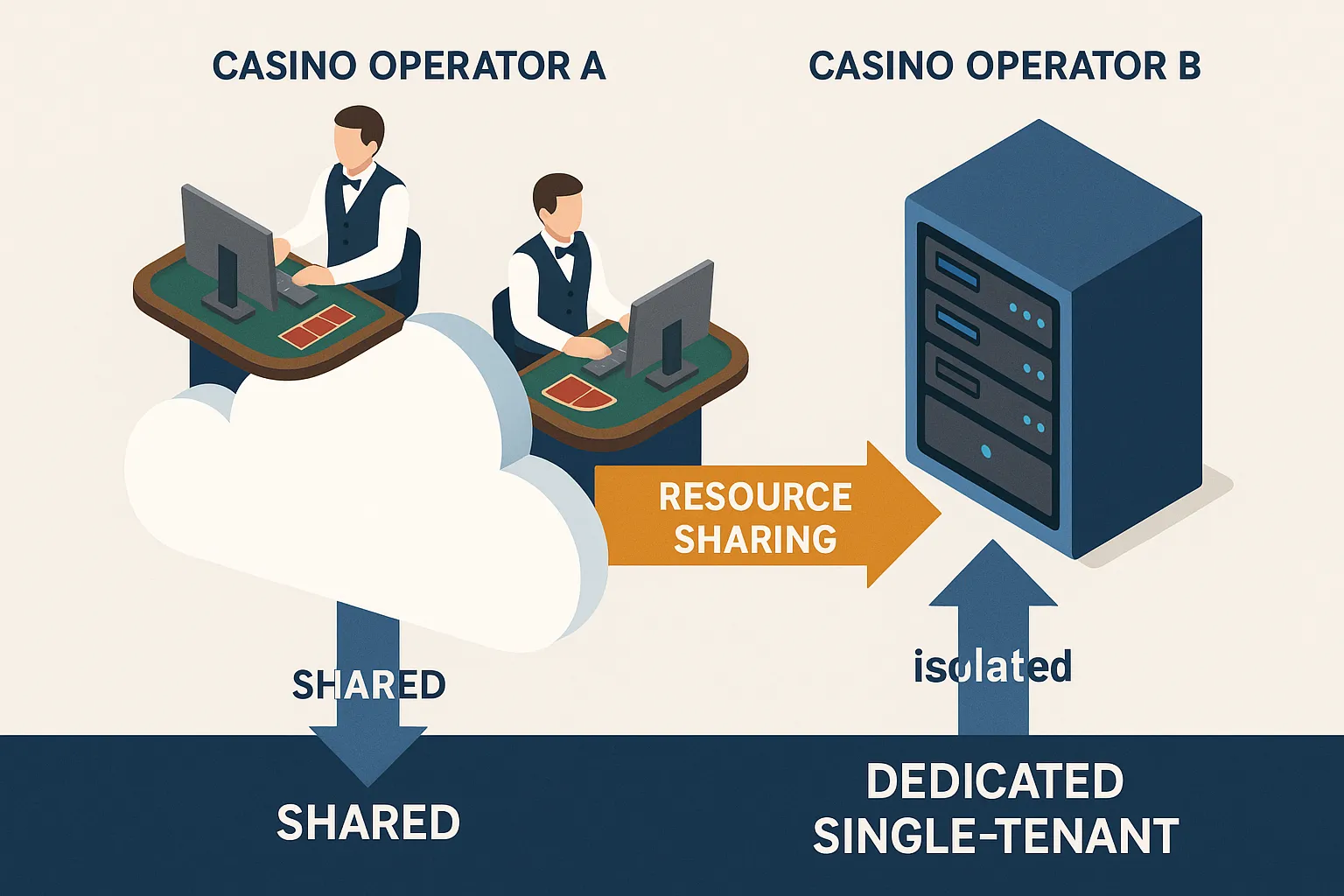
Multi-tenant means all operators run on the same core codebase and hardware pool. Isolation is achieved logically (per-tenant schemas, IAM policies, encryption keys). Single-tenant gives each operator their own instance—think of renting an entire condo versus leasing an apartment in a high-rise.
2. Pros and Cons That Actually Matter to Casino P&L
Multi-Tenant: The Good
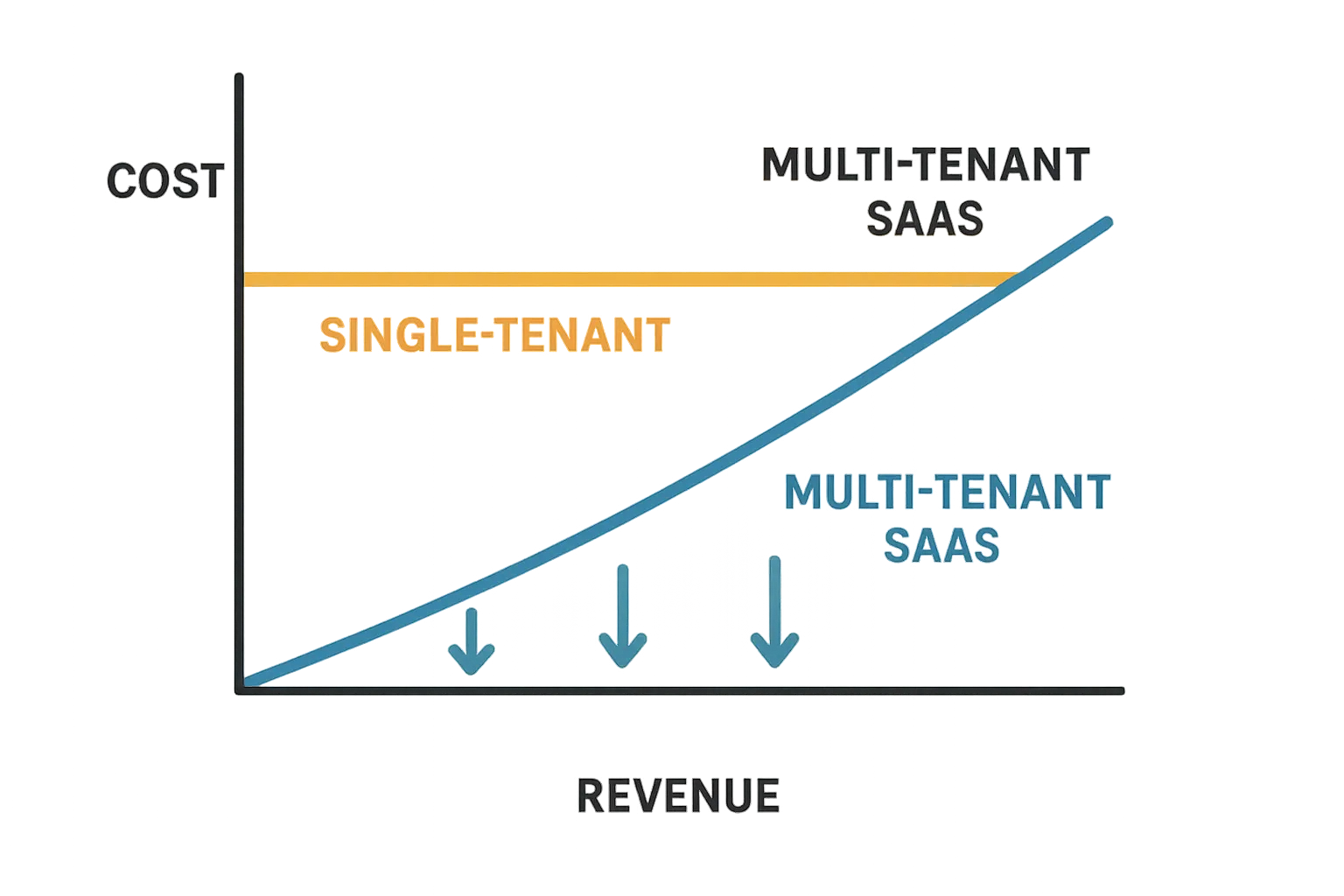
- Lower TCO. Hardware amortisation, shared DevOps, and pooled licences drive per-tenant costs down by 30–60% versus comparable single-tenant stacks, according to AWS SaaS economics research.
- Faster feature velocity. Every platform update—new payment rail, fresh game studio, security patch—drops instantly for every tenant. You never fall behind on compliance or player expectations.
- Elastic scalability. Capacity bursts are absorbed by the shared cluster. In Spinlab’s Fullhouse case study, traffic spikes during a €1 M jackpot promo were handled without pre-provisioning (link to Scaling from 1,000 to 1,000,000 Players).
- Built-in best practice. PCI DSS, KYC/AML modules, fraud AI and real-time analytics are baked in and audited centrally—ideal for startups that lack specialist teams.
Multi-Tenant: Watch-Outs
- Limited deep code tweaks. You configure but rarely fork the core logic. Rich APIs mitigate this, yet operators with proprietary bonus engines or niche jurisdictions may chafe.
- Perceived data risk. Some boards still prefer physical separation, even though field-level encryption and VPC segmentation in modern SaaS meets stringent regulators like the UKGC.
- Vendor lock-in. Migrating away can be harder if your workflows depend on proprietary modules (see our guide to spotting tech-stack growth bottlenecks).
Single-Tenant: The Good
- Complete control. Custom RTP maths? Exotic jackpot logic? Bespoke compliance feeds? Anything is possible—if you have budget and time.
- Physical separation. Some high-roller brands or state lotteries mandate dedicated HSMs, air-gapped RNGs, or on-premise data residency.
- Independent release cadence. Decide when to upgrade, test, or freeze versions—useful when regulation changes mid-campaign.
Single-Tenant: Hidden Downsides
- Higher CapEx and OpEx. You’ll pay for peak capacity, 24/7 DevOps, redundant RDS clusters, and emergency DBA calls. Our benchmark shows median €450k year-1 cost for a 50k MAU single-tenant setup, versus €120k on a multi-tenant SaaS with similar GGR potential.
- Slower market response. Adding Pix in Brazil or UPI in India often means new PSP contracts, gateway code, QA, certification, and redeploy—costing weeks while competitors convert traffic.
- Patch fatigue risk. Zero-day exploits (e.g., Log4Shell) demand urgent patches. Single-tenant operators shoulder that burden alone.
3. The Numbers: Cost Models Side by Side
| Cost Bucket (Year 1) | Multi-Tenant SaaS (Spinlab-style) | Single-Tenant Self-Hosted |
|---|---|---|
| Platform Licence | €0 – €50k setup + 12–20% rev-share | €100k – €250k one-off licence |
| Hosting & CDN | Included in rev-share | €5k / month mid-range cloud |
| Compliance & PCI | Included | €30k audit + €10k yearly upkeep |
| DevOps & Upgrades | Included | €15k – €25k / month staff & contractors |
| Feature Add-ons | Pay-as-you-grow (e.g., new markets) | Custom dev €80 – €120 / hour |
| 12-Month TCO | €80k – €250k | €350k – €650k |
Numbers are based on 2025 EU pricing for a mid-tier casino targeting €5 M NGR. Exact figures vary, but the delta is consistent: multi-tenant converts chunky CapEx into variable OpEx, improving cash flow (detailed model in our CapEx vs OpEx budgeting guide).
4. Security & Compliance: Does Shared Equal Riskier?
Regulators focus on controls, not tenancy models. What matters:
- Data segregation. Row-level tenant IDs, per-tenant AES-256 keys, and strict IAM roles minimise bleed risk.
- Audit logs. Centralised, immutable logs across tenants simplify regulator audits and AML investigations.
- Patch cadence. Multi-tenant SaaS often patches vulnerabilities in hours, while single-tenant teams juggle priorities.
Operators in high-scrutiny markets (UK, Malta, New Jersey) routinely pass audits on multi-tenant clouds—provided the provider is ISO 27001 and PCI DSS v4.0 certified. Spinlab’s Payment Hub, for instance, is PCI Level 1 and segregates card holder data in a separate microservice.
5. Performance & Scalability
Latency is revenue: a 100 ms increase in game load time can drop wager volume by 5–7%. Multi-tenant platforms win here for two reasons:
- Global edge networks. Traffic from all tenants justifies premium CDN PoPs in LATAM, Africa, and SEA.
- Auto-scaling pools. When one operator sleeps, another’s tournament surge uses the spare compute—improving overall utilisation and cost.
Single-tenant stacks can match this, but only if you over-provision or build sophisticated autoscaling logic—costly for most startups.
6. Decision Matrix: Which Model Fits Your Roadmap?
| Operator Scenario | Recommended Model | Rationale |
|---|---|---|
| Bootstrapped startup, < €1 M launch budget | Multi-tenant | Fast go-live, no DevOps hires, variable OpEx |
| Mid-tier brand entering new markets quickly | Multi-tenant with strong API layer | Scale content/payments fast; customise UX via APIs |
| State-run lottery or tier-1 brand with legacy systems | Hybrid / Single-tenant | Strict data residency, heavy bespoke integrations |
| Crypto-native degen casino focused on innovation | Multi-tenant + on-chain modules | Rapid L2 payouts, provably-fair, lower fees |
7. Where Spinlab Lands
Spinlab’s Fullhouse platform is a configurable multi-tenant SaaS with isolated data spaces and optional dedicated front-end nodes for high-traffic brands. You get:
- Shopify-like admin UI—non-technical staff can launch promos, quests, and bonus templates without dev tickets.
- Hybrid cashier with built-in fiat, 25+ APMs, and instant crypto onramp.
- Real-time analytics and fraud shield baked in (see Real-Time Analytics in iGaming).
- Transparent rev-share with no hidden aggregator mark-ups (breakdown in True Cost of a Game Aggregator).
For operators needing ring-fenced infrastructure, Spinlab offers a “virtual single-tenant” add-on: dedicated DB cluster, custom domains, and isolated Kubernetes namespace—still cheaper than full bespoke builds.
Frequently Asked Questions
Does multi-tenant mean I share the same database table with other casinos? No. Modern SaaS uses separate schemas or row-level security combined with tenant-specific encryption keys to guarantee isolation.
Can I migrate from multi-tenant to single-tenant later? Yes, but plan data export contracts upfront. Spinlab provides automated dump tools and dedicated migration support.
Will regulators approve a shared platform? Most major regulators (MGA, UKGC, NJ DGE) accept multi-tenant clouds provided the provider meets ISO 27001, PCI DSS, and maintains tamper-proof logs.
What about noisy-neighbor performance hits? Kubernetes CPU/memory quotas and pod auto-scaling protect each tenant; real-world Spinlab telemetry shows < 2% performance variance during peak cross-tenant loads.
Can I still have unique games or jackpots? Absolutely. Spinlab supports original game IP uploads and segregated jackpot wallets while keeping the core platform shared.
Ready to Compare Costs on a Live Call?
Multi-tenant SaaS isn’t always the answer—but eight out of ten casino startups we talk to can save 40–70% on Year-1 costs and shave months off launch timelines by choosing the right shared platform.
Book a 30-minute discovery session with a Spinlab solutions architect and receive a free personalised TCO model comparing multi-tenant, virtual single-tenant, and self-hosted options for your specific market and growth goals.