Casino operations get expensive when the platform creates work instead of absorbing it. Every manual payout check, bonus adjustment, game upload, KYC review, and support escalation adds friction. At low volume, that friction is annoying. At scale, it becomes headcount, slower launches, player complaints, and operational risk.
The best casino software features do not just help an online casino look modern. They reduce the number of recurring tasks your team has to touch in the first place. That is the difference between a platform that launches a brand and an iGaming platform that can actually run one efficiently.
For operators evaluating whitelabel casino software, the practical question is simple: which features remove daily work from operations, support, compliance, payments, and marketing?
Start with the ops-work test
Feature lists can be misleading. A platform may advertise payments, bonuses, analytics, and game aggregation, but still force your team into spreadsheets, support inboxes, and developer requests.
A more useful test is to ask what operational task each feature eliminates or simplifies.
| Operational burden | Casino software feature that reduces it | What good looks like |
|---|---|---|
| Manual player checks | Integrated KYC and AML workflows | Clear review queues, status tracking, and audit history |
| Repetitive payment questions | Payment gateway, wallet, and withdrawal visibility | Players and staff can see statuses without chasing finance |
| Slow content updates | Game aggregator and centralized game catalog | New slot games and live casino games can be managed without custom integrations |
| Developer-dependent campaigns | Configurable bonus engine | Marketing can launch and adjust offers safely |
| Guesswork in daily decisions | Real-time analytics dashboard | Teams spot issues before they become ticket floods |
| Fragmented tools | Customizable backoffice admin panel | Ops, support, risk, and marketing work from one reliable source of truth |
If a feature does not reduce a task, reduce a handoff, or reduce a risk, it may be nice to have, but it will not meaningfully lower operational load.
1. A unified backoffice that makes work visible
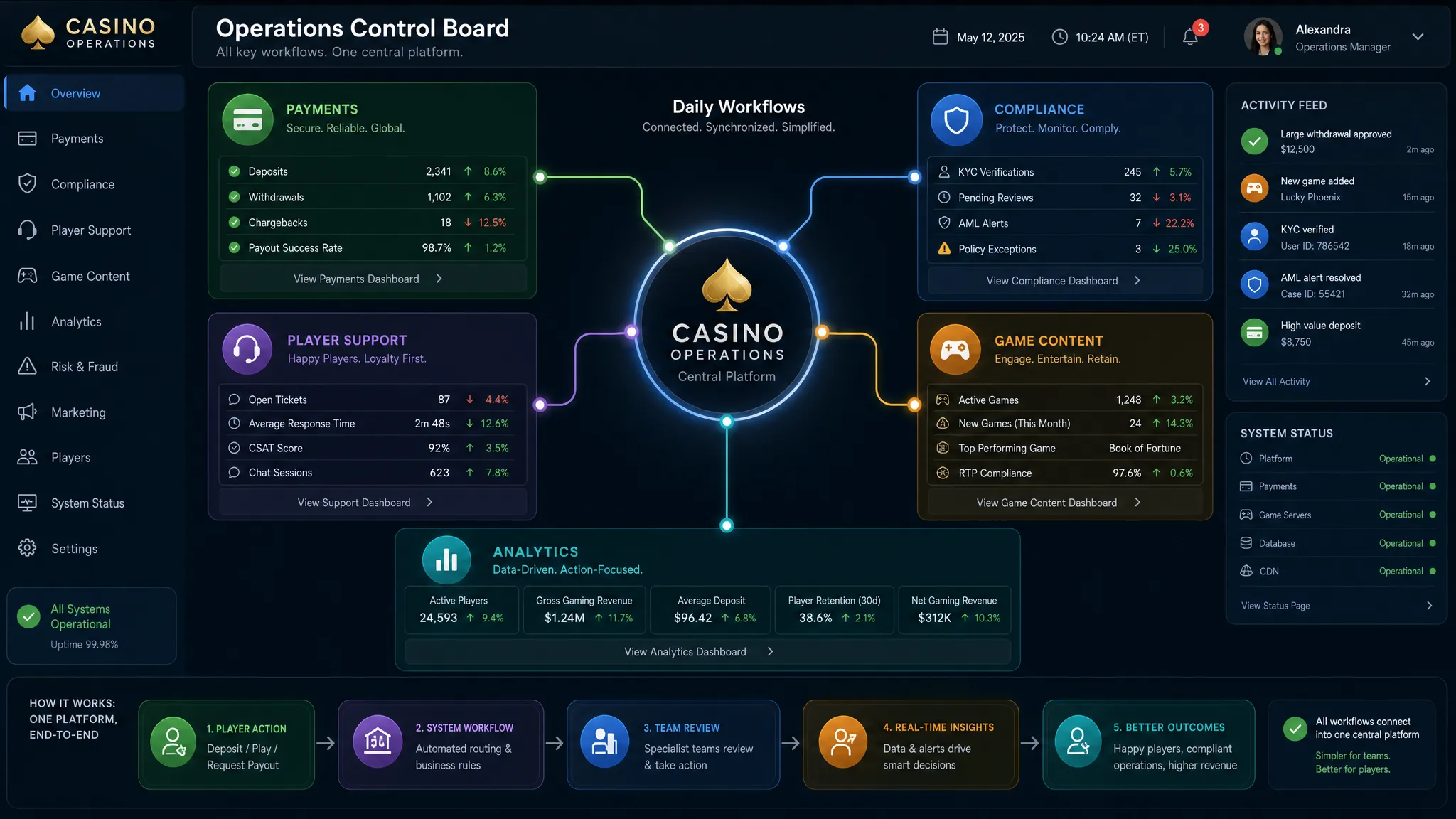
The backoffice is where casino operations either become manageable or fall apart. When player profiles, payments, KYC documents, bonus history, risk notes, and support context are scattered across tools, staff spend more time hunting for information than solving problems.
A strong backoffice reduces ops work by centralizing the day-to-day operating layer. Team members should be able to open a player profile and quickly understand deposits, withdrawals, account status, documents, bonuses, game activity, flags, and notes. Just as importantly, managers should be able to control permissions so each team sees what it needs without exposing sensitive functions unnecessarily.
The highest-leverage backoffice features are usually not flashy. Search, filters, review queues, bulk actions, status labels, case notes, and audit logs are the details that save hours every week. They also reduce the chance that two agents give different answers to the same player.
This is why casino backoffice UX matters so much. A backoffice should not feel like a technical database. It should feel like an operating system for the casino team.
2. Payment and wallet tooling that reduces reconciliation
Payments are one of the biggest sources of operational drag in an online gambling platform. Deposits fail, withdrawals wait for review, players ask for status updates, finance teams reconcile balances, and compliance teams need transaction history.
A modern casino software stack should reduce this workload through integrated payment gateway support, multi-currency wallets, clear transaction states, and admin controls for review and approval. For operators serving global audiences, both fiat and crypto payment support can matter. The key is not simply accepting more payment methods. The key is making those methods easy to operate.
Crypto-ready casino software can create operational efficiency when wallet activity, onramp flows, custodial fund handling, and player balances are connected to the same operational view. Without that connection, crypto adds another reconciliation surface.
Withdrawal visibility is especially important. Many support tickets come from players asking where their money is, what step is pending, or why extra verification is required. Better status messaging, internal review queues, and consistent payment logic can reduce avoidable conversations. Spinlab has a dedicated playbook on how operators can reduce withdrawal support tickets by treating withdrawals as a product experience, not just a backoffice task.
3. KYC and AML workflows that are built into the platform
Compliance work becomes costly when it lives outside the casino platform. If teams manually collect documents, track reviews in spreadsheets, or copy data between systems, every verification step becomes slower and less reliable.
Built-in KYC and AML compliance features reduce ops work by making verification part of the player lifecycle. The platform should help teams define when checks happen, show who needs review, record decisions, and preserve the audit trail. This is particularly important as regulators increasingly expect operators to follow a risk-based approach to customer due diligence. The FATF risk-based guidance is a useful reference point for understanding why processes need to be documented, consistent, and proportionate to risk.
For lean casino teams, the operational goal is not to automate every compliance decision blindly. It is to automate the routing, evidence gathering, reminders, status changes, and documentation around decisions so trained staff can focus on judgment calls.
Good compliance tooling reduces work in several ways:
- It prevents incomplete player records from reaching later-stage payment issues.
- It gives support teams a clear status without exposing sensitive compliance details.
- It helps risk teams prioritize high-risk reviews instead of treating every case the same.
- It creates a cleaner audit trail when regulators, payment partners, or internal managers ask questions.
When compliance is embedded in the platform, it becomes a controlled workflow rather than a scramble.
4. Fraud prevention that prioritizes the right cases
Fraud prevention is another area where more alerts do not automatically mean better operations. Too many false positives can bury risk teams. Too few controls can create chargebacks, bonus abuse, duplicate accounts, and payment losses.
Advanced fraud prevention features should reduce ops work by turning scattered signals into useful prioritization. Operators should look for configurable rules, risk indicators, account-level history, payment behavior visibility, and clear escalation paths. The goal is to help the team identify suspicious behavior quickly and act consistently.
Fraud tools are most useful when they connect to the rest of the casino platform. A suspicious withdrawal should not require staff to manually compare player activity, bonus usage, wallet history, KYC status, and account notes across five systems. The more context is available in one place, the less time is wasted on investigation.
This also improves player experience. Legitimate players are less likely to be delayed by broad manual reviews, while risky activity is easier to isolate.
5. Game aggregation that simplifies content operations
Game content is one of the main reasons operators choose a turnkey casino solution or white label casino platform. But game aggregation is not only about access to more titles. It is about reducing the operational burden of managing providers, categories, launches, availability, and player experience.
A strong game aggregator helps operators add and manage slot games, live casino games, and other casino content through a centralized layer. Instead of coordinating separate technical integrations for each provider, the operator can manage content more efficiently through the platform.
This matters because content teams move quickly. New games are released, providers update portfolios, markets require different availability, and promotions often depend on specific game categories. If every change requires developer involvement, the catalog becomes slow to maintain.
For operators building differentiated brands, original games can also be part of the content strategy. The operational question remains the same: can the platform support custom content without creating a maintenance burden for every future update?
6. A bonus engine that marketing can use safely
Bonuses can drive acquisition and retention, but they can also create a surprising amount of ops work. Manual bonus credits, unclear eligibility, wagering disputes, abuse investigations, and campaign misconfigurations all create tickets and risk.
A capable bonus engine reduces that work by giving marketing and operations teams controlled flexibility. The platform should allow authorized users to configure offers, define eligibility, set limits, schedule campaigns, and monitor performance without needing a developer for every adjustment.
The word safely is important. A bonus engine should not just make promotions easy to create. It should make mistakes harder to publish. Clear rules, previews, segmentation, caps, and approval flows can prevent campaigns from becoming financial or support problems.
For lean teams, this is one of the biggest advantages of a Shopify-like casino operating model. Non-technical staff can move faster, while technical resources stay focused on higher-value platform work.
7. Real-time analytics that replace status meetings
Analytics reduce ops work when they answer operational questions before the team has to ask them. A real-time analytics dashboard can help teams monitor deposits, withdrawals, registrations, KYC throughput, game performance, bonus usage, affiliate activity, and support-impacting trends.
The real value is not a dashboard full of charts. The value is faster diagnosis. If deposits drop after a payment method update, teams should notice quickly. If a bonus campaign attracts low-quality traffic, marketing should see it. If a new game category performs well on mobile, content teams should know where to focus.
Good analytics also reduce internal reporting work. Instead of exporting CSVs, building manual summaries, or asking developers for database pulls, managers can use the platform to check key metrics directly.
The most ops-friendly analytics tools have three qualities. They are timely, so the team is not reacting days late. They are role-relevant, so each department sees metrics it can act on. They are connected to platform actions, so insight can quickly become a fix.
8. Open API integration without forcing custom work for everything
A modular iGaming platform should be flexible enough to connect with important external systems, but not so dependent on custom development that every operational change becomes an engineering project.
Open API integration reduces ops work by allowing operators to connect tools for payments, CRM, affiliate tracking, reporting, identity verification, or other business needs. The platform should provide enough structure that integrations are manageable, documented, and stable.
This is especially important for scaling brands. Early-stage operators often want simplicity. Growing operators want flexibility. The best casino software supports both by providing built-in operational tools while still allowing integrations when the business needs them.
9. Mobile-optimized player experience that reduces support load
Mobile optimization may sound like a front-end feature, but it has a direct impact on operations. If players struggle to register, deposit, claim bonuses, upload documents, or find games on mobile, the support team pays the price.
A mobile-optimized casino platform reduces tickets by making key player actions clear and reliable. It also helps marketing convert traffic more efficiently, since many acquisition channels send players directly to mobile sessions.
The operational benefits show up in small ways. Fewer abandoned KYC attempts. Fewer deposit confusion tickets. Fewer bonus claim questions. Fewer complaints about game navigation. Each improvement may seem minor, but together they reduce daily support pressure.
What lean teams should prioritize first
If your team is trying to reduce ops work quickly, prioritize features that remove the most repeated tasks. Advanced customization is useful, but only after the basic operating flows are smooth.
| If your team is struggling with… | Prioritize this feature first | Why it reduces workload |
|---|---|---|
| Too many support tickets | Payment visibility, mobile UX, and player status messaging | Players get clearer answers without contacting support |
| Slow campaign launches | Configurable bonus and affiliate tools | Marketing can operate without constant developer requests |
| Manual compliance reviews | Built-in KYC and AML workflows | Reviews become trackable and auditable |
| Content bottlenecks | Game aggregation and catalog controls | Game updates require fewer technical handoffs |
| Fragmented decision-making | Real-time analytics dashboard | Teams work from shared data instead of manual reports |
| Scaling without hiring fast | Customizable backoffice and role-based workflows | Existing staff can handle more volume with less chaos |
The mistake many operators make is buying for the launch moment only. A launch checklist is important, but the real cost of casino software appears after launch, when every workflow is repeated thousands of times.
How to evaluate vendors for operational efficiency
When comparing casino software providers, do not stop at whether a feature exists. Ask how the feature works in daily operations.
A few practical evaluation questions can reveal a lot. Can non-technical staff update bonuses, games, and player settings? Can support see payment and KYC status without asking another department? Can managers audit who changed what? Can the platform handle both crypto and fiat flows in a unified way? Can analytics answer real operational questions without manual exports?
It also helps to request workflow-based demos instead of feature tours. For example, ask the vendor to walk through a player registering, depositing, triggering KYC, claiming a bonus, winning, requesting a withdrawal, and contacting support. That journey will show where work is automated and where staff still need to intervene.
A platform built for low operational load should feel coherent. The backoffice, payment gateway, game aggregator, bonus engine, compliance tools, and analytics should work together rather than behave like separate products stitched into one menu.
Frequently Asked Questions
What are casino software features that reduce ops work? The most important features are a unified backoffice, integrated payments and wallets, KYC and AML workflows, fraud prevention, game aggregation, configurable bonuses, real-time analytics, mobile optimization, and open API integration. These features reduce repetitive manual tasks across support, compliance, marketing, finance, and operations.
Can a white label casino platform reduce staffing needs? A white label casino platform can help lean teams operate with fewer technical and operational bottlenecks, especially when it includes built-in payments, compliance, game aggregation, bonuses, and backoffice controls. It does not remove the need for skilled operators, but it can reduce the amount of manual work those operators handle.
Why do payments create so much operational work for online casinos? Payments touch player trust, compliance, finance, and support. Failed deposits, pending withdrawals, currency issues, and unclear statuses can all generate tickets. Integrated payment gateway and wallet tools reduce this by giving players and staff better visibility into each transaction.
Is crypto-ready casino software harder to operate? It can be harder if crypto payments, wallets, onramps, and reporting are handled separately from the main platform. A crypto-ready solution reduces operational work when crypto and fiat flows are connected to the same backoffice, risk, and analytics workflows.
What should operators ask before choosing casino software? Operators should ask which tasks the software removes, not just which features it includes. The best questions focus on daily workflows: how withdrawals are reviewed, how bonuses are configured, how KYC cases are tracked, how games are added, and how non-technical teams manage the platform.
Build a casino operation that stays lean
Casino software should not force your team to grow headcount just to keep up with routine tasks. The right platform gives operators a cleaner way to manage payments, compliance, games, bonuses, analytics, fraud controls, and backoffice workflows from one operational layer.
Spinlab is built for teams that want a flexible, modular, crypto-ready white label casino platform with a Shopify-like operating experience. With support for crypto and fiat payments, game aggregation, KYC and AML compliance, fraud prevention, real-time analytics, affiliate and bonus tools, open API integration, multi-currency support, and a customizable backoffice, it helps operators launch and scale without turning daily operations into unnecessary manual work.