

Withdrawals are the moment of truth for any online casino. Players can tolerate a slow lobby or a minor bonus glitch, but when money is leaving their account, uncertainty turns into tickets fast: “Where is my payout?”, “Why is it pending?”, “Do you need more documents?”, “Can you cancel it?”, “I used the wrong wallet address.”
A 40% reduction in withdrawals support tickets is realistic when you stop treating withdrawals as a back-office batch job and start treating them as a product surface with clear states, proactive messaging, and automated checks.
This playbook focuses on the highest-volume, highest-friction drivers of withdrawal tickets and shows how to eliminate them with better cashier UX, event-driven ops, and smarter risk controls.
First, measure the right thing (or you will “fix” the wrong problem)
Most casinos lump withdrawal tickets into one queue. That hides the real causes.
Start by tagging every withdrawal-related ticket with one primary reason and one system state (the state your withdrawal was in when the ticket was created). Do this for 2 weeks and you will usually find that 70% to 90% of tickets come from a small set of predictable issues.
Track these operational metrics alongside ticket volume:
| Metric | Definition (simple) | Why it predicts tickets | Target direction |
|---|---|---|---|
| Time to first status update | Time from “Withdraw” click to showing a non-generic status | If the UI stays vague, players open tickets | Down |
| Median time-to-paid | Median time from request to completed payout | Direct driver of “where is my withdrawal” | Down (within policy) |
| P95 time-to-paid | 95th percentile payout time | Long tail creates most tickets and anger | Down |
| Manual review rate | % withdrawals that hit human review | Manual reviews create waiting and uncertainty | Down (without increasing risk) |
| Failure rate by rail | % withdrawals that fail per payout method | Failures create tickets plus rework | Down |
| “Pending verification” share | % withdrawal attempts blocked by KYC/AML gating | Often a UX/design problem, not a compliance one | Down |
Once you have this, you can attack the root causes in a way that reliably moves the needle.
The 5 biggest drivers of withdrawal tickets (and how to eliminate them)
1) “Where is my withdrawal?” (status ambiguity)
This is usually the largest category. The common mistake is displaying a single state like Pending for everything.
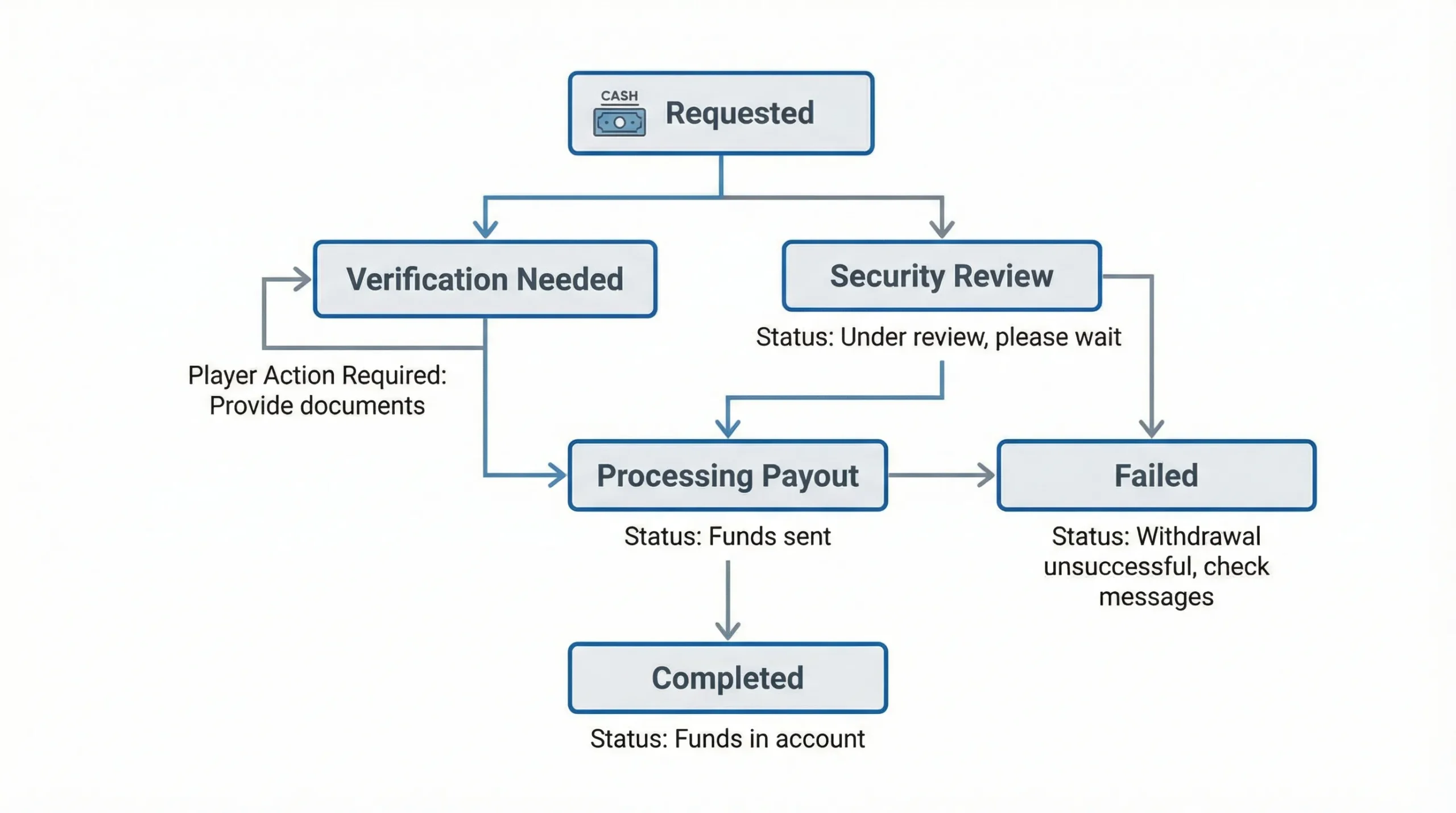
Instead, implement a player-visible withdrawal tracker with explicit states and realistic expectations. Your goal is simple: a player should be able to answer “what is happening” and “what happens next” without contacting support.
A practical state model that reduces tickets:
| Player-facing status | What it actually means | What the UI should say (example) | Owner |
|---|---|---|---|
| Requested | We received the request and created an internal withdrawal record | “Request received. We are preparing your payout.” | Platform |
| Verification needed | A required check is incomplete (KYC, limits, details) | “Action needed: verify your identity to withdraw.” | KYC |
| Security review | Withdrawal is within policy but flagged for review | “We are reviewing this withdrawal for security. Typical time: X hours.” | Risk/AML |
| Processing payout | Sent to PSP/rail or broadcast on-chain | “Payout initiated. You will see funds after confirmation/clearing.” | Payments |
| Completed | Settled and marked paid | “Completed. Reference: ####.” | Platform |
| Failed (with next step) | Failed with reason code | “Failed: bank rejected details. Update info and retry.” | Payments |
Key principles that reduce tickets:
- Always show the next action (wait, upload, edit details, contact support only if necessary).
- Show an ETA range when possible (even if broad). Players hate uncertainty more than slowness.
- Expose a payout reference (withdrawal ID, PSP reference, or on-chain tx hash when crypto).
- Avoid dead-end states like “Pending” without context.
Spinlab-related note: if your iGaming platform already centralizes wallet, cashier, and analytics events, you can drive this tracker from real-time events rather than brittle polling.
2) KYC friction triggered at withdrawal (surprise gating)
A huge share of tickets are created by players who deposited, played, and only discover at cashout that they cannot withdraw. Even when your policy is correct, the timing is what creates tickets.
Reduce tickets by moving to “KYC readiness,” not “KYC at the worst moment.”
What works operationally:
- Pre-withdrawal readiness indicator in the cashier: “You are ready to withdraw” or “1 step left to withdraw.”
- Progressive verification: collect only what you need early, then step up only when risk, volume, or regulation requires it.
- Document quality UX: many “KYC pending” tickets are actually “my photo was rejected and I don’t know why.” (See how small UX tweaks can materially cut abandonment in KYC flows, the same logic applies to support load.)
If you want a structured approach to reducing identity friction, Spinlab has also written about UX-driven KYC improvements here: 11 UX Tweaks That Cut KYC Drop-Off by 30%.
3) Payment rail mismatch (players choose a method that will fail)
Withdrawals fail when players pick rails that do not match their deposit method, currency, geography, or bank acceptance rules.
Ticket reduction comes from preventing invalid choices, not handling them faster.
Practical fixes:
- Eligibility filtering: hide payout methods that cannot work for that player (geo, currency, KYC status, limits).
- Contextual defaults: default the payout rail that is most likely to succeed for that player cohort.
- Upfront constraints: show min/max, expected time, and required fields before submission.
- Crypto-specific validation: if you allow crypto withdrawals, validate address format and network selection, and clearly separate chains (for example, USDT on TRON vs Ethereum).
If you run multi-rail cashiers, orchestration logic helps not only approval rates but also support volume. Related reading: Casino Payment Orchestration 101: Routing for Higher Approval.
4) “My withdrawal is stuck” (manual risk and AML reviews with no visibility)
Some reviews are unavoidable. The ticket spike happens when the review process is opaque.
The fastest support ticket is the one never created: tell the player what is happening and when you will update them, without revealing sensitive fraud logic.
What reduces tickets without weakening controls:
- Reason-coded holds (player-safe): “Identity check,” “payment method verification,” “security review.” Avoid “AML review” in player copy unless your policy requires it.
- Update promises: “We will update you within X hours.” Then actually send the update.
- Queue SLAs inside ops: reviews need measurable service levels like any other production system.
For crypto operators, risk controls often span both on-platform behavior and blockchain activity. Spinlab has a deeper technical view on doing fast crypto withdrawals while preserving control: Implementing Self-Custody Withdrawals Without Losing AML Control.
5) Withdrawal failures and reversals (reconciliation gaps)
Nothing generates tickets like “Completed” in the UI while the player did not receive funds.
This is almost always a reconciliation problem: your platform marked the withdrawal as paid based on the wrong signal (or you never got the final signal).
To reduce tickets, your withdrawal pipeline should be idempotent, event-driven, and reconciled.
Minimum requirements:
- Idempotency keys for payout requests so retries do not double-send.
- Clear separation of states: “sent” is not “settled.”
- Automated retries for transient failures (network timeouts, provider blips), with a cap and alerting.
- Daily ledger-to-provider reconciliation plus real-time anomaly alerts for mismatches.
If you also operate multi-currency wallets, mismatches can create edge cases like negative balances or locked funds, which then become support load. Related operational guidance: How to Handle Negative Balances in Multi-Currency Wallets.
The highest-ROI lever: proactive messages that prevent tickets
Once your withdrawal states are reliable, you can prevent tickets with a small set of event-triggered communications.
Send messages only when they add information. If you spam, players learn to ignore you.
A good baseline:
| Trigger | Message goal | Channel |
|---|---|---|
| Withdrawal requested | Confirm receipt and set expectation | On-site + email |
| Verification required | Tell the player exactly what to do next | On-site + email |
| Review started | Reduce anxiety with timeframe | On-site |
| Review taking longer than SLA | Acknowledge delay and recommit to update | Email + on-site |
| Payout initiated | Provide reference/tx hash and what “processing” means | On-site |
| Failure | Give one-step fix and retry CTA | On-site + email |
| Completed | Confirm completion and provide receipt/reference |
When operators do this well, “where is my withdrawal?” tickets collapse because players stop feeling blind.
Build self-serve “withdrawal tools” that support can use too
A common scaling mistake is building tools for support that players cannot access. You end up with tickets for simple tasks.
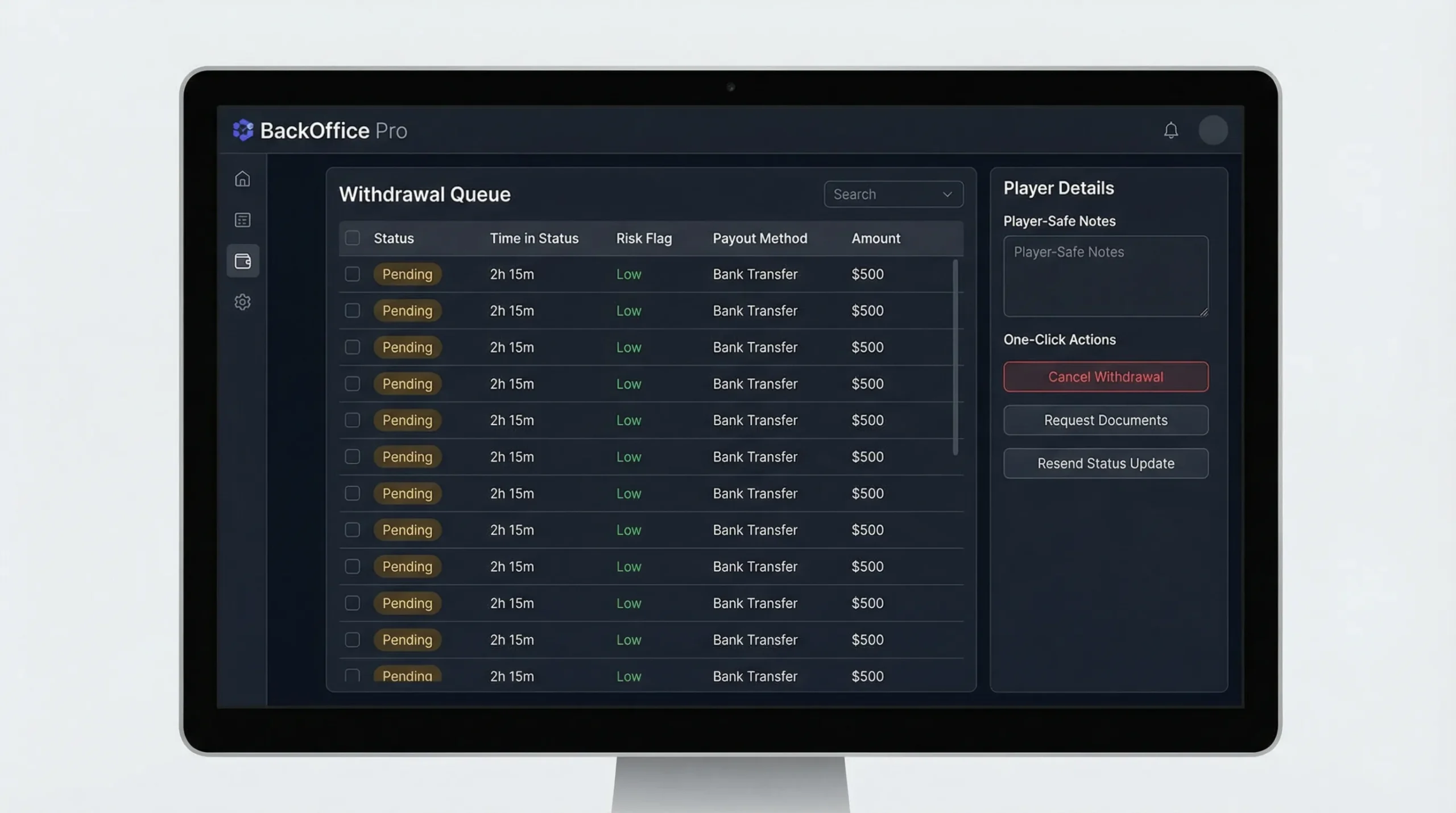
The best pattern is to create a player self-serve action with the same backend action available in the backoffice.
High-impact self-serve actions:
- Cancel a withdrawal (only while eligible)
- Change payout details (only before processing, with appropriate step-up checks)
- Re-submit a failed withdrawal after correcting details
- Upload missing documents from the withdrawal screen
- View withdrawal timeline with timestamps and references
This is where an integrated admin panel matters: if payments, KYC, and wallet live in different tools, agents cannot confidently resolve issues, and players keep writing back.
A practical 2-sprint implementation plan (without a full rebuild)
You can ship most of the ticket reduction in 2 focused sprints if your platform supports event hooks and configurable cashier UI.
Sprint 1: make withdrawals observable and explainable
Deliverables:
- A withdrawal state machine (internal truth)
- Player-facing tracker mapped to internal states
- Reference IDs (PSP reference and/or tx hash when crypto)
- Ops dashboard: P50/P95 time-to-paid by rail and by cohort
- Ticket tagging: reason + state at ticket creation
Sprint 2: prevent invalid withdrawals and automate the obvious work
Deliverables:
- Eligibility filtering for payout methods
- Pre-withdrawal “readiness” nudges for KYC
- Automated retries for transient failures
- Proactive notifications for long-tail delays
- Self-serve actions (cancel, edit, retry) with guardrails
If you already run a modular iGaming platform with unified payments, KYC/AML, fraud prevention, and real-time analytics, the work becomes configuration and workflow design more than custom engineering. Spinlab’s approach is to centralize these modules (including crypto and fiat payments, compliance, and backoffice controls) so operators can iterate quickly without creating new integration debt.
For operators who want to go further on payout speed, you can also look at productized instant payout experiences (which typically cut both time-to-paid and ticket load). See: Revenue Impact of Instant Cashout Buttons: A Case Study.
The “40% reduction” rule of thumb: remove three ticket categories, not 40% of effort
Support teams often try to respond faster. That helps CSAT, but it does not reduce volume.
To cut withdrawals support tickets by 40%, aim to eliminate (or heavily shrink) three categories:
- Status ambiguity (“where is it?”)
- KYC surprise at withdrawal (“why do you need this now?”)
- Failures caused by invalid rail selection (“why did it fail?”)
These are product and system design problems, and they are solvable.
If you want a fast audit of your withdrawal funnel
If you share two weeks of anonymized data (withdrawal states, time-in-state, failure reasons, and ticket tags), you can usually pinpoint the exact 2 to 4 changes that will deliver the biggest ticket drop.
Spinlab Studio builds modular, crypto-ready online casino infrastructure (payments, compliance, game aggregation, analytics, and backoffice tooling). If you are evaluating how to reduce withdrawal friction without rebuilding your stack, start with an architecture and workflow review at spinlab.studio.