

Picking the right casino tech stack in 2026 is not just a procurement decision. It determines how fast you can launch, which markets you can enter, how reliably you can process deposits and withdrawals, how quickly your team can ship campaigns, and whether your online casino can scale without a painful rebuild.
The mistake many founders make is starting with a vendor demo and comparing surface-level features. A stronger approach is to define the operating model first, then evaluate each layer of the iGaming platform against that model. A lean crypto casino, a regional fiat-first brand, and a multi-market operator with live casino games all need different priorities, even if the vendor checklist looks similar.
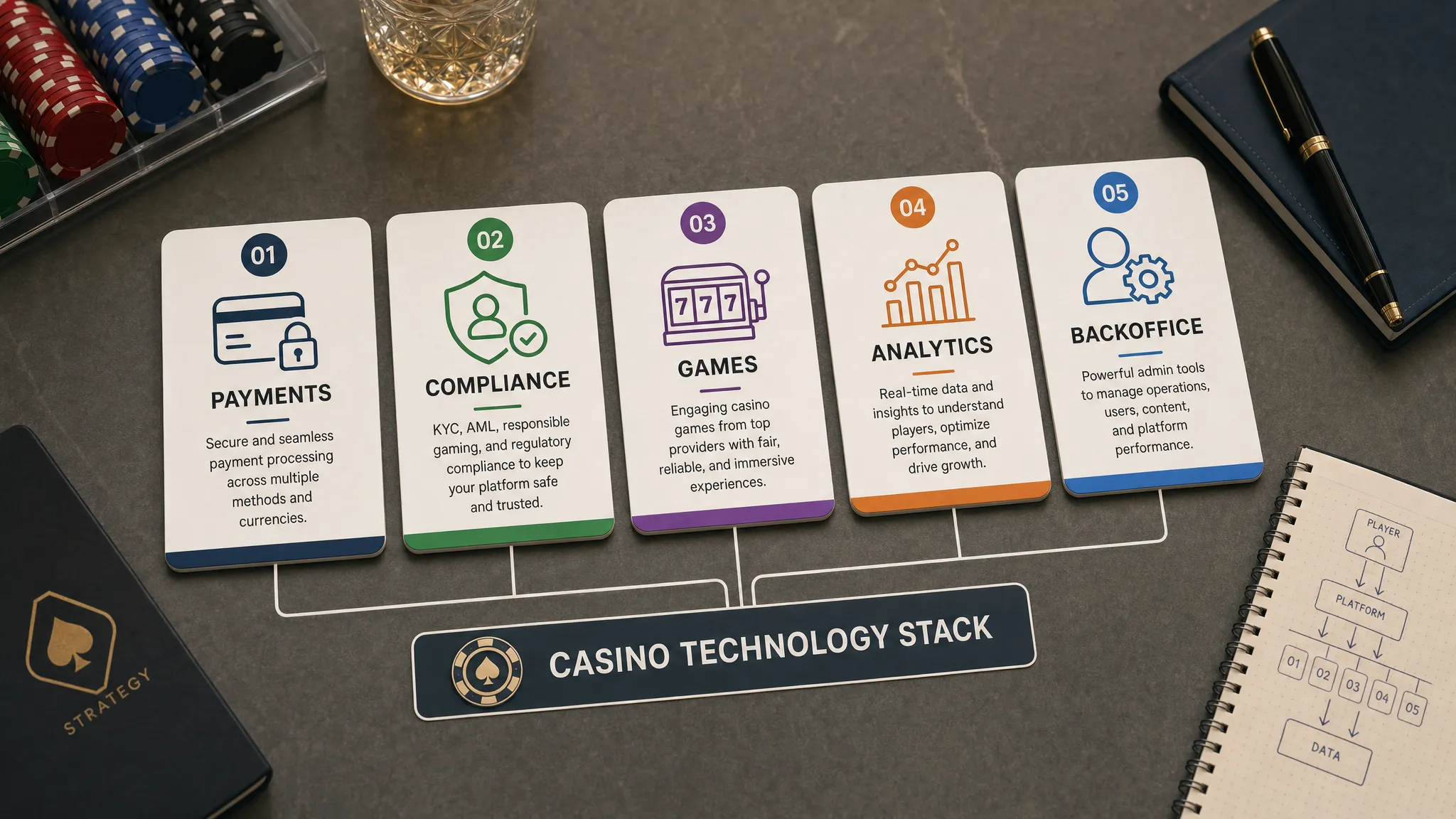
This guide breaks down the casino tech stack decisions that matter most in 2026, from payments and compliance to game aggregation, analytics, APIs, and backoffice control.
Start with your casino operating model
Before comparing platforms, define what the business needs to do in its first 12 to 24 months. Your tech stack should fit your growth plan, not the other way around.
A simple whitelabel casino can be the right choice when speed, cost control, and operational simplicity matter more than owning every component. A more modular setup makes sense when you need deep customization, multiple brands, or a differentiated product roadmap. A fully custom build may be justified for large operators, but it usually demands a larger engineering, compliance, and infrastructure team from day one.
Your operating model should answer five questions clearly: where you will launch, which currencies you will support, what type of player acquisition you will use, what content mix you need, and how much technical work your internal team can realistically manage.
| Operating choice | Why it matters for the tech stack | What to evaluate |
|---|---|---|
| Target markets | Determines licensing, KYC, payments, language, and currency needs | Jurisdiction support, local payment methods, responsible gambling tools |
| Fiat, crypto, or hybrid | Impacts wallet design, treasury operations, risk controls, and settlement | Multi-currency ledger, crypto onramp, payment gateway coverage |
| Content strategy | Shapes game aggregation, provider contracts, lobby design, and retention | Slot games, live casino games, original games, provider activation speed |
| Team structure | Determines how much you can configure without developers | Backoffice usability, admin permissions, open API, vendor support |
| Growth model | Affects bonus engine, affiliate tracking, CRM, and analytics | Campaign tools, segmentation, real-time analytics, attribution quality |
The best casino software provider for one operator can be the wrong choice for another. A tech stack only makes sense when it matches the brand, market, and team behind it.
Understand the core layers of a modern casino tech stack
A casino tech stack is more than a website with games. It is a set of connected systems that must handle money, identity, gameplay, risk, marketing, reporting, and support without breaking under volume.
In 2026, operators should think in layers. Each layer should be strong enough on its own, but also integrated cleanly with the rest of the platform.
| Stack layer | Main role | Key questions to ask |
|---|---|---|
| Player front end | Registration, lobby, cashier, account area, and mobile experience | Is it fast, mobile-optimized, localized, and easy to customize? |
| Wallet and ledger | Tracks balances, bonuses, deposits, withdrawals, and adjustments | Is there a reliable ledger of record for every transaction? |
| Payment gateway and routing | Connects cards, wallets, bank payments, crypto, and alternative methods | Can you support local methods and optimize approval rates? |
| Game aggregator | Provides access to slots, live casino, table games, and specialty content | How quickly can new providers and games be activated? |
| Risk and compliance | Supports KYC, AML, fraud prevention, limits, and reporting | Are controls configurable by market and player risk level? |
| Backoffice | Lets teams manage players, bonuses, content, payments, and operations | Can non-technical teams work without constant developer help? |
| Data and analytics | Turns events into operational and marketing intelligence | Are events real-time, accurate, and exportable? |
| APIs and integrations | Connects CRM, affiliate tools, BI, payment providers, and custom products | Is the API documented, stable, and flexible enough for growth? |
When one of these layers is weak, the rest of the business feels it. A strong game library will not fix a poor cashier. A beautiful front end will not compensate for slow KYC. A powerful affiliate program will not scale if analytics are delayed or inaccurate.
Make payments and wallet architecture non-negotiable
Payments are not a plug-in detail. They are one of the most important conversion, retention, and risk layers in an online gambling platform.
A serious 2026 casino stack should support multiple payment methods, reliable transaction states, clean reconciliation, and a wallet model that can handle both real-money and bonus balances. If your roadmap includes crypto, the platform should not treat crypto as an afterthought. It should support crypto and fiat payments with clear ledger logic, risk controls, and treasury workflows.
For fiat, evaluate whether the platform can connect to the payment gateway and payment methods your target players actually use. Cards may be important in one market, while bank transfers, digital wallets, instant bank payments, or local alternatives may matter more elsewhere. For card data environments, operators should understand how vendors align with standards such as PCI DSS v4.0.1.
For crypto, look beyond accepting deposits. You need to understand onramps, offramps, wallet custody, settlement, supported assets, confirmation logic, transaction monitoring, and how crypto movements appear in your ledger and reports. If this is central to your model, it is worth reviewing how to build a crypto-ready casino treasury before choosing a platform.
Strong payment due diligence should cover the full lifecycle: deposit, balance update, wager, win, bonus interaction, withdrawal request, review, payout, settlement, refund, chargeback, and reconciliation. Spinlab has a deeper operator checklist on how to audit your casino payments stack if payments are already becoming a bottleneck.
Build compliance and fraud prevention into operations
Compliance cannot sit outside the platform as a manual process. In regulated or semi-regulated markets, the tech stack should help teams identify players, monitor risk, apply limits, detect suspicious behavior, and produce reliable records.
At minimum, evaluate how the platform supports KYC, AML, sanctions screening, fraud prevention, responsible gambling controls, document review, player limits, account closure workflows, and audit trails. These controls should be configurable by market and risk profile, not hardcoded into a one-size-fits-all process.
AML expectations vary by jurisdiction, but risk-based controls are a global theme. The FATF Recommendations are a useful reference point for understanding why identity, monitoring, and reporting processes need to be designed intentionally. This is not legal advice, but it is a reminder that compliance architecture should be part of your platform decision from the start.
Fraud prevention also needs to be connected to payments and gameplay. A stack that can detect unusual deposit patterns, bonus abuse, multi-accounting, chargeback risk, device anomalies, and withdrawal red flags will protect margin as the casino grows. If you are building from scratch, a dedicated casino compliance stack for new operators can help you map the operational requirements before launch.
Choose game aggregation for control, not just game count
Game count is easy to advertise, but it is not the best way to judge a game aggregator. Operators should care about content quality, provider access, activation speed, metadata, lobby control, regional availability, performance, and commercial terms.
A launch calendar that can add new Pragmatic slots, new Hacksaw slots, live tables, regional favorites, and specialty games quickly is often more valuable than a static library with a large headline number. The aggregator should also make it easy to manage categories, tags, thumbnails, search, game status, volatility labels where available, and provider promotions.
Ask how the platform handles game outages, provider maintenance, demo mode, jackpot feeds, free spin campaigns, bet limits, jurisdiction restrictions, and reporting. These details affect daily operations and player trust.
If your brand strategy includes casino original games, the stack should also support custom-designed content without forcing the entire platform into a custom build. Original games can help differentiate a casino, but they need wallet, RNG, reporting, and compliance logic that fits the rest of the platform.
Demand a backoffice your team can actually use
The backoffice is where your team will spend much of its time. If every bonus, landing page, payment rule, or game change requires developers, the platform will slow your growth.
A good casino backoffice should let operations, payments, risk, CRM, and support teams do their jobs with the right permissions and audit trails. It should be clear enough for daily work, but powerful enough to manage complex rules as the brand grows.
Look for practical controls such as player search, manual adjustment workflows, role-based access, bonus configuration, affiliate visibility, game management, withdrawal review, risk flags, segment creation, and reporting exports. The best systems reduce dependency on engineering without removing governance.
This is where a Shopify-like experience matters. Operators increasingly expect a white label casino platform to feel configurable and approachable, not like legacy enterprise software that requires a ticket for every change.
Design data and CRM around server-side events
Analytics should not be an afterthought added after launch. Your CRM, affiliate program, bonus engine, risk tools, and management reporting all depend on accurate events.
In casino operations, event quality matters more than dashboard beauty. If deposits, wagers, bonus activations, failed payments, KYC states, and withdrawals are not captured consistently, your teams will make poor decisions. Real-time analytics are especially important when you need to react to payment issues, bonus abuse, VIP behavior, or campaign performance.
| Event category | Examples | Why it matters |
|---|---|---|
| Account events | Registration, login, KYC state, verification failure | Helps measure onboarding and compliance friction |
| Payment events | Deposit attempt, approval, failure, withdrawal request, payout | Reveals cashier conversion and operational risk |
| Gameplay events | Game launch, wager, win, session duration, provider error | Supports retention, content strategy, and issue detection |
| Bonus events | Bonus issued, accepted, wagered, expired, converted | Shows campaign profitability and abuse risk |
| Risk events | Device change, suspicious pattern, limit hit, manual review | Helps fraud and compliance teams act quickly |
The stack should allow clean exports or integrations with BI, CRM, affiliate platforms, and custom data warehouses. Even if you do not need advanced analytics on day one, you will want the event foundation later.
Pick the right build model: white label, turnkey, modular, or custom
There is no universally best build model. The right choice depends on speed, budget, control, technical capacity, and regulatory complexity.
White label and turnkey casino solutions are attractive for founders who want to launch faster and avoid building core infrastructure from scratch. Modular platforms suit operators who want a strong foundation but still need flexibility through APIs, custom front ends, specific payment providers, or differentiated games. Fully custom builds offer maximum control, but they also carry the highest cost and execution risk.
| Build model | Best fit | Main advantage | Main trade-off |
|---|---|---|---|
| White label casino | Lean teams, fast launches, cost-conscious operators | Faster onboarding and lower operational complexity | Less control than a fully custom build |
| Turnkey casino solution | Operators who want platform, games, payments, and tools bundled | Simplifies vendor coordination | Can be limiting if the bundle is rigid |
| Modular iGaming platform | Growth-focused brands with specific roadmap needs | Flexible integrations and phased scaling | Requires clearer technical planning |
| Fully custom build | Large operators with strong engineering and compliance teams | Maximum control and differentiation | High cost, long timelines, ongoing maintenance burden |
In practice, many successful operators choose a modular white-label approach first, then customize around the areas that create differentiation. That might be payments, CRM, original games, loyalty, front-end experience, or market localization.
Evaluate APIs and integration flexibility early
A platform that looks complete in a demo can become restrictive when you try to connect real operational tools. APIs matter because no casino stack stays static.
You may need to integrate payment service providers, affiliate platforms, CRM tools, customer support software, risk vendors, KYC providers, BI systems, or custom front-end experiences. The question is not only whether an API exists. You need to know what it exposes, how it is documented, how authentication works, how webhooks are handled, and how version changes are managed.
A strong open API integration model gives you room to grow without replacing the platform. It also helps you avoid vendor lock-in. If your software provider insists that every integration must be custom-scoped through them, clarify timelines, costs, and ownership before signing.
Build a vendor scoring matrix before demos
Vendor demos are useful, but they can make every platform look polished. A scoring matrix keeps your team focused on what actually matters.
Assign weights based on your operating model. A crypto-first startup may weight wallet architecture and onramps heavily. A regional fiat brand may prioritize local payment methods, compliance workflows, and affiliate tools. A content-led brand may give more weight to game aggregation and lobby management.
| Evaluation area | Suggested weight | What strong looks like |
|---|---|---|
| Payments and wallet | 20% | Multi-currency support, reliable ledger, strong reconciliation, crypto and fiat readiness |
| Compliance and risk | 20% | KYC/AML workflows, fraud prevention, responsible gambling controls, audit trails |
| Game aggregation | 15% | Relevant providers, fast activation, live casino support, metadata control |
| Backoffice usability | 15% | Non-technical configuration, role permissions, clear workflows, reporting exports |
| Data and analytics | 10% | Real-time events, reliable dashboards, export options, CRM-ready data |
| API and integrations | 10% | Documented APIs, webhooks, integration flexibility, stable versioning |
| Cost and speed to launch | 10% | Transparent scope, fast onboarding, realistic implementation timeline |
The weights are only a starting point. What matters is forcing trade-offs into the open before a sales process pulls attention toward the flashiest feature.
Run proof of concept tests like an operator
Before committing to a casino software provider, ask for a practical proof of concept or sandbox walkthrough. Do not only watch slides. Simulate the workflows your team will run every day.
A useful demo should show real operational paths:
- Player registration, KYC state changes, deposit, gameplay, bonus use, withdrawal, and payout review.
- A failed payment, a pending payment, a refund, and a reconciliation report.
- A new bonus campaign created by a non-developer with clear eligibility rules.
- A new game provider or game category added to the lobby.
- A suspicious player pattern flagged for review.
- A support agent resolving a player issue with the correct permissions.
- An analytics view showing deposits, wagers, withdrawals, bonus cost, and provider performance.
If the vendor cannot demonstrate these flows clearly, the gap will likely become your operational problem after launch.
Watch for red flags before signing
The wrong stack can look affordable at the beginning and become expensive once growth exposes limitations. Watch for warning signs during vendor evaluation, contract review, and onboarding.
Common red flags include vague ledger logic, limited payment method support, no clear crypto custody model, slow game provider activation, weak KYC/AML workflows, developer-dependent bonus tools, poor mobile performance, unclear API documentation, and reporting that cannot be reconciled against real balances.
Also be careful when a vendor avoids detailed questions about ownership, data exports, uptime, implementation responsibilities, support response times, or change requests. These details may not feel exciting during the sales process, but they determine how painful operations become later.
The right stack should help you launch and adapt
A strong casino tech stack in 2026 should do two things at once. It should help you launch quickly, and it should give you enough flexibility to adapt as payments, games, markets, compliance rules, and player expectations change.
That balance is the key. A platform that is fast but rigid can trap you. A platform that is flexible but too complex can delay revenue. The best choice gives your team a stable foundation, operational control, and a clear path to scale.
When evaluating vendors, focus less on the longest feature list and more on how the stack behaves under real operating conditions. Can it move money accurately? Can it handle compliance? Can it add games quickly? Can non-technical teams run campaigns? Can data flow into the tools you need? Can the platform support the brand you want to build, not just the launch you want to complete?
Frequently Asked Questions
What is a casino tech stack? A casino tech stack is the full set of systems used to run an online casino, including the front end, wallet, payment gateway, game aggregator, compliance tools, fraud prevention, backoffice, analytics, CRM, and APIs.
Should I choose a white label casino platform or build custom software? A white label casino platform is usually better for faster launches, leaner teams, and lower operational complexity. Custom software may suit large operators that need full control and have the engineering, compliance, and infrastructure resources to maintain it.
Why is the wallet so important in an iGaming platform? The wallet and ledger track player balances, deposits, withdrawals, bonus funds, wins, losses, and adjustments. If this layer is weak, reconciliation, compliance, support, and player trust all suffer.
How important is crypto support in 2026? Crypto support is important if your target players expect it or if your brand is built around digital assets. The platform should support crypto onramps, custody workflows, transaction monitoring, multi-currency balances, and clean reporting rather than simply accepting crypto deposits.
What should I ask a casino software provider before signing? Ask how the platform handles payments, wallet accuracy, KYC/AML, fraud prevention, game aggregation, bonus configuration, mobile performance, API access, analytics, data exports, support, implementation timelines, and future scaling.
Build your 2026 casino stack with Spinlab
Spinlab offers an all-in-one, modular iGaming platform for operators who want to build, launch, and scale online casinos with less technical friction. The platform supports crypto and fiat payments, game aggregation, real-time analytics, advanced fraud prevention, KYC and AML compliance, mobile-optimized casino experiences, affiliate and bonus tools, a customizable backoffice, open API integration, multi-currency support, crypto onramp solutions, custodial wallets, and custom-designed casino original games.
If you want a cost-conscious whitelabel iGaming software option with a Shopify-like operating experience, explore Spinlab and see how a flexible casino platform can help you launch faster without boxing in your growth roadmap.