

Scaling an online casino globally is not just a traffic problem. The real test is whether your casino software can support new payment rails, currencies, game providers, KYC rules, fraud patterns, affiliate models, and player expectations without forcing your team into a rebuild every time you enter a new market.
For operators, founders, and product teams, the right question is not whether a platform can launch an online casino. Many can. The better question is whether the platform can keep operating cleanly when your business adds jurisdictions, currencies, player segments, studios, bonus structures, and compliance obligations.
Choosing casino software for global scale means looking beyond the storefront. You need to evaluate the operational core: payments, wallets, compliance logic, game aggregation, analytics, backoffice controls, APIs, and the economics of growth.
What global scalability really means for casino software
In iGaming, scale is often misunderstood. A platform that handles more users is useful, but global scalability is broader than uptime or server capacity.
A globally scalable casino platform should help you adapt across markets without fragmenting your operation. That includes letting you configure payment methods by country, display and settle in multiple currencies, restrict game availability where needed, apply KYC and AML rules by risk profile, localize bonuses, and monitor business performance in real time.
This is why the best casino software decisions start with operating design, not feature comparison. A platform can look impressive in a demo, yet become expensive if every new market requires custom development, manual workarounds, or separate vendor contracts.
Think of global scale across five layers:
| Scalability layer | What to evaluate | Why it matters |
|---|---|---|
| Payments and wallets | Fiat, crypto, local methods, ledger accuracy, reconciliation | Deposits and withdrawals directly affect conversion and trust |
| Compliance | KYC, AML, geo controls, audit logs, configurable rules | Regulations change by market and must be operationalized |
| Content | Game aggregation, provider coverage, mobile performance, market controls | Game availability and preferences vary by region |
| Operations | Backoffice, roles, analytics, support workflows, fraud tools | Growth increases operational complexity |
| Integration | Open APIs, modular services, exportable data, provider flexibility | Prevents vendor lock-in and rebuild risk |
If a vendor is strong in only one layer, your team may still struggle globally. The goal is to choose an iGaming platform that is balanced enough to support expansion without making your roadmap dependent on one bottleneck.
Start with your target markets, not the software demo
Before comparing vendors, define where and how you expect to grow. A casino aimed at one regulated European market has different software needs than a crypto-first casino targeting multiple emerging markets. A brand focused on sportsbook-style affiliate acquisition will operate differently from a casino built around original games and community-led retention.
At minimum, map your first three launch markets and your next three expansion markets. Then ask what changes between them. Payment preferences may shift from cards to bank transfers, e-wallets, vouchers, crypto, or mobile money. Player identity requirements may vary. Some game providers may not be available everywhere. Bonus rules, tax reporting, language support, and risk monitoring may all need local adaptation.
This exercise prevents a common mistake: choosing software because it works beautifully for your first launch, then discovering it does not fit the markets that matter six months later.
Use this market-readiness table before you speak with vendors:
| Question | What a scalable answer looks like |
|---|---|
| Which currencies will players deposit, play, and withdraw in? | Multi-currency support with clear wallet and settlement logic |
| Which payment methods are required by market? | Configurable payment gateway options and local method support |
| What KYC and AML rules apply? | Risk-based verification, audit logs, and configurable workflows |
| Which game providers are essential? | Game aggregator access with market-level availability controls |
| How will affiliates and bonuses be managed? | Built-in campaign tools with segmentation and reporting |
| What data will leadership need weekly? | Real-time analytics and exportable reporting |
If the vendor cannot answer these questions in operational terms, the software may not be ready for global expansion.
Choose modular architecture over a rigid monolith
Global casino growth rarely follows a perfect plan. You may add a payment provider sooner than expected, localize for a new audience, launch a crypto onramp, test different bonus mechanics, or integrate a new game studio because a region demands it.
A modular platform makes those changes easier because core components can evolve without disturbing the entire system. Payments, game aggregation, player account management, KYC, AML, analytics, bonuses, and affiliate tools should work together, but they should not be so tightly coupled that changing one breaks the others.
This matters because rebuilding tech during growth is one of the most expensive mistakes an operator can make. It slows acquisition, distracts engineering teams, and often creates operational risk around money movement and player data. If your team is already thinking about long-term expansion, it is worth studying the practical constraints in scaling an online casino without rebuilding tech before committing to a platform.
When evaluating casino software architecture, look for signs of flexibility. Open API integration, configurable workflows, modular payments, game aggregator support, and customizable admin tools are more important than a long list of surface-level features.
A good vendor should be able to explain what can be configured by your operations team, what requires vendor support, and what needs custom development. The more your team can safely configure inside the backoffice, the faster you can respond to market changes.
Payments and wallets are the first global scaling test
Payments are where global casino software often succeeds or fails. Player acquisition can be strong, but if deposits fail, withdrawals are slow, or the cashier does not feel local, revenue will leak.
A global-ready platform should support both fiat and crypto payment flows where relevant. It should also handle multi-currency balances, transaction histories, reconciliation, fees, withdrawal controls, refunds, and risk checks in a way your finance and compliance teams can audit.
Crypto-ready solutions add another layer. Operators may need crypto deposits, crypto onramp solutions, merchant custodial wallets, and clear separation between player balances, operational funds, and settlement processes. These capabilities should not be bolted on casually. They need wallet logic, transaction monitoring, and compliance workflows that match the risk profile of the business.
For fiat payments, evaluate whether the platform can support local payment methods by market rather than forcing every player through a generic card-first flow. For crypto, evaluate whether the platform supports the assets and custody model your business actually intends to use. In both cases, insist on clear ledger design. If your team cannot reliably answer what happened to a transaction, when it happened, and why it changed status, the software is not mature enough for global scale.
For a deeper operational breakdown, Spinlab has a dedicated guide to online casino payments setup for global markets that covers payment methods, orchestration, ledgers, KYC, AML, and fraud controls in more detail.
Compliance must be configurable, not hardcoded
Casino compliance is not a single checklist. Different markets can require different approaches to identity verification, age checks, source-of-funds reviews, responsible gambling controls, sanctions screening, transaction monitoring, and record retention.
The FATF Recommendations are widely referenced for AML and counter-terrorist financing standards, including customer due diligence and record keeping. In regulated gambling markets, technical and operational expectations can also be highly specific. For example, the UK Gambling Commission publishes remote gambling and software technical standards that show how detailed platform expectations can become.
Your casino software should help operations teams apply rules by market and risk level. That means configurable KYC thresholds, AML monitoring workflows, geo controls, player limits, role-based access, and audit trails. It also means the platform should preserve clean records for internal review, regulator requests, payment disputes, and fraud investigations.
Hardcoded compliance logic is a warning sign. It may work for one market, but global operations require rules that can be adjusted without destabilizing the product.
Game aggregation should support regional strategy
Game aggregation is not just about having thousands of titles. A scalable game aggregator helps you manage content intelligently across markets, devices, player segments, and provider restrictions.
Operators often focus on recognizable studios, slot games, live casino games, or the newest releases from popular providers. That matters, but global growth requires more than adding new games. You need reliable provider integrations, localized metadata, market-level availability controls, mobile-optimized loading, search and filtering, category management, and performance reporting.
A strong content layer should help you answer practical questions. Which slot games are converting in a specific region? Which live casino games retain high-value players? Are certain providers unavailable in a target jurisdiction? Can your team promote a new game category without engineering support? Can you test original casino games alongside aggregated content?
Casino original games can also become a strategic advantage when you want differentiated content rather than a catalog that looks identical to every competitor. If custom original games are part of your plan, verify whether the platform can support them cleanly within the same wallet, reporting, bonus, and risk systems.
Backoffice usability becomes a growth multiplier
Many casino software evaluations overemphasize the player-facing website and underemphasize the backoffice. That is risky because global operations are won or lost in the admin layer.
Your team will need to manage payments, player accounts, KYC reviews, bonus campaigns, affiliate performance, game catalogs, risk flags, customer support issues, and financial reporting. If every change requires technical support, growth slows. If the admin panel is confusing, operational mistakes become more likely.
Look for a customizable backoffice admin panel that supports clear permissions and workflows. Finance should not need the same access as marketing. Support agents should not be able to change risk controls. Affiliate managers should see campaign performance without touching payment settings.
A Shopify-like user experience can be valuable here, especially for lean teams. The easier it is for non-technical operators to configure safe parts of the business, the faster the casino can react to local campaigns, payment issues, provider updates, and player behavior.
Analytics should connect growth, risk, and finance
Real-time analytics are not just for dashboards. They are how global casino operators detect what is working, what is breaking, and where money or risk is moving.
At a minimum, your analytics layer should connect player acquisition, deposits, withdrawals, game activity, bonus usage, affiliate performance, fraud signals, and revenue. If these data points sit in separate systems with inconsistent definitions, leadership will struggle to make confident decisions.
The most useful casino analytics answer business questions quickly. Which market has strong registrations but weak first deposits? Which payment method has rising failure rates? Which affiliate sources produce high bonus abuse? Which games drive retention after the first week? Which withdrawal queues need review?
A platform with real-time analytics, clean exports, and operational dashboards helps teams react before small issues become expensive. This is especially important when you expand across time zones and payment ecosystems, because delays in detection can quickly become lost revenue or compliance exposure.
Fraud prevention needs to scale with acquisition
Growth attracts fraud. As marketing spend increases, so do multi-accounting, bonus abuse, payment fraud, chargebacks, account takeovers, collusion, and suspicious transaction patterns.
Advanced fraud prevention should be integrated with the platform rather than treated as an afterthought. The software should allow risk teams to review patterns across accounts, devices, payment methods, bonuses, and withdrawals. It should also support escalation workflows so suspicious activity can be paused, reviewed, and documented.
This is where payments, KYC, AML, and bonuses need to work together. A generous bonus engine can drive acquisition, but without risk controls it can also create abuse. A fast withdrawal experience can improve trust, but without transaction monitoring it can expose the operator. A scalable platform balances growth with control.
API flexibility protects your future roadmap
No casino software provider can predict every tool you will need in two years. You may add new BI tools, CRM systems, affiliate platforms, payment providers, risk vendors, blockchain analytics, local identity services, or custom frontends.
Open API integration is what keeps that future possible. APIs should be documented, stable, and designed around real operational needs. Ask vendors what data can be accessed, what events can be triggered, what integrations are already supported, and how API changes are versioned.
API quality is also a signal of platform maturity. Vendors with strong APIs tend to understand that operators need control over their own growth stack. Vendors with closed systems may appear simpler at launch, but they can become restrictive once you need differentiation.
Evaluate total cost, not just launch price
Price matters, especially for startups and lean operators. But the cheapest launch quote is not always the lowest total cost. Global scale introduces costs around integrations, payment provider setup, compliance adjustments, support, custom development, game provider access, data exports, and migration risk.
When comparing casino software providers, ask for pricing clarity across launch, monthly platform costs, revenue share, payment fees, provider fees, custom work, support, and add-on modules. Also ask what happens if you grow faster than expected. Some platforms become expensive exactly when the business starts working.
Use this vendor comparison lens:
| Evaluation area | Red flag | Better sign |
|---|---|---|
| Launch cost | Low price but unclear add-ons | Transparent setup and operating costs |
| Configuration | Vendor must change everything | Admin tools support safe self-service |
| Payments | One-size-fits-all cashier | Market-specific fiat and crypto options |
| Compliance | Fixed workflows only | Configurable KYC, AML, and audit controls |
| Games | Large catalog with little control | Aggregation plus market and performance tools |
| Data | Static reports only | Real-time analytics and exportable data |
| Integrations | Closed ecosystem | Open APIs and modular integration options |
A cost-efficient white label casino platform can be a smart choice if it reduces both launch friction and long-term operating complexity. The key is to confirm that lower cost does not mean limited control.
Questions to ask before signing with a casino software provider
A strong vendor evaluation should move from promises to proof. Do not rely only on a polished demo. Ask for operational walkthroughs, configuration examples, integration documentation, and clear explanations of what your team can manage independently.
These questions reveal whether the casino software can scale globally:
- How does the platform handle multi-currency deposits, gameplay, withdrawals, and reconciliation?
- Which fiat and crypto payment flows are supported, and what requires additional integration?
- Can KYC, AML, fraud, and player limits be configured by market or risk tier?
- How are game providers managed across jurisdictions and player segments?
- What can operators configure in the backoffice without engineering support?
- What analytics are available in real time, and what data can be exported?
- How are APIs documented, secured, versioned, and supported?
- What costs increase as volume, markets, currencies, or providers increase?
You do not need every feature on day one. You do need confidence that the platform will not block your second, third, or fourth market.
A practical scorecard for global casino software selection
Once you have shortlisted vendors, score them against the capabilities that matter most to your operating model. A weighted scorecard prevents the team from overvaluing visual design or game count while undervaluing payments, compliance, and operations.
| Category | Suggested weight | What to look for |
|---|---|---|
| Payments and wallet infrastructure | 20% | Fiat, crypto, multi-currency, ledger accuracy, reconciliation |
| Compliance and fraud controls | 20% | KYC, AML, geo rules, audit logs, risk workflows |
| Game aggregation and content control | 15% | Provider access, market restrictions, mobile performance, original games support |
| Backoffice and operations | 15% | Role permissions, campaign tools, support workflows, usability |
| Analytics and reporting | 10% | Real-time dashboards, exports, market-level performance visibility |
| API and integration flexibility | 10% | Open APIs, documentation, modularity, integration support |
| Commercial model and vendor support | 10% | Transparent pricing, onboarding speed, support quality, roadmap fit |
Adjust the weights based on your strategy. A crypto-first casino may weight wallet infrastructure and compliance even higher. A content-led brand may prioritize game aggregation and original games. A fast-growth affiliate model may need stronger bonus, analytics, and fraud prevention capabilities.
Where Spinlab fits
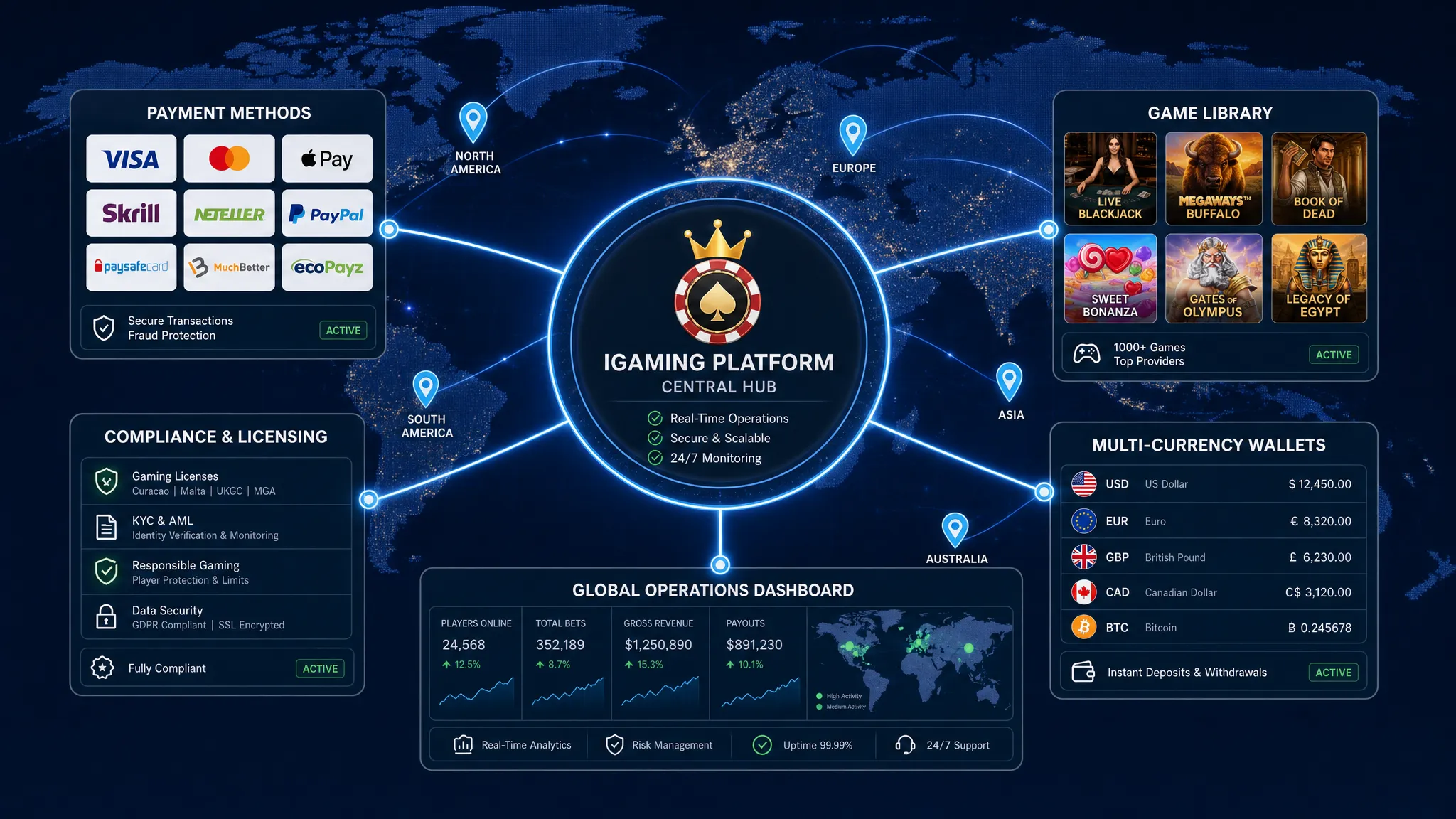
Spinlab is built for operators that want an all-in-one, modular iGaming platform for building, launching, and scaling online casinos. The platform supports crypto and fiat payments, game aggregation, real-time analytics, fraud prevention, KYC and AML workflows, multi-currency support, affiliate and bonus tools, open API integration, crypto onramp solutions, merchant custodial wallets, and customizable backoffice administration.
For teams that want a white label casino platform with a simpler operating experience, Spinlab is designed to offer a Shopify-like interface while keeping the stack flexible enough for global expansion. It is especially relevant for operators who want to launch quickly without giving up the payment, compliance, content, and analytics foundations needed to grow.
You can also compare broader platform requirements in Spinlab’s guide to must-have features in casino platform software if you want a feature-by-feature checklist before vendor conversations.
Frequently Asked Questions
What is the most important feature in casino software for global scale? Payments and compliance are usually the most important foundations. If deposits, withdrawals, KYC, AML, and transaction records do not work reliably across markets, growth will be difficult even with a strong game catalog.
Is a white label casino platform suitable for international expansion? Yes, if the platform is modular, configurable, and supports market-specific payments, compliance workflows, game aggregation, analytics, and APIs. A rigid white label setup may be fine for launch but weak for global scaling.
Should global casino software support both fiat and crypto payments? It depends on your target markets and player strategy. Many operators benefit from both, but crypto support should include proper wallet logic, monitoring, onramp options where needed, and compliance controls.
How do I know if a game aggregator is good enough? Look beyond the number of games. Evaluate provider quality, market availability controls, mobile performance, reporting, metadata, live casino support, and whether the platform can support differentiated content such as casino original games.
What should I avoid when choosing casino software? Avoid platforms with unclear pricing, hardcoded compliance rules, weak payment flexibility, limited data access, poor backoffice usability, and closed integrations that make future expansion dependent on custom vendor work.
Build for the markets you want next
The best casino software is not just the platform that gets you live. It is the platform that keeps your operation flexible as you add markets, payment methods, currencies, providers, player segments, and compliance rules.
If you are planning a global online casino, choose software that gives your team control over the core operating layers: payments, wallets, KYC, AML, fraud prevention, games, bonuses, analytics, and integrations.
Spinlab helps operators launch and scale with a modular, crypto-ready iGaming platform built for fast onboarding, flexible operations, and global growth.