

Scaling an online casino is not just a server problem. Most growth bottlenecks come from money movement, game operations, compliance workload, fraud pressure, slow releases, and fragmented data. If the answer is always to rebuild the tech stack, the operator loses months of momentum and often reintroduces the same risks in a new codebase.
A better approach is modular scaling: keep the parts that work, isolate the parts that slow growth, and upgrade them behind stable APIs. For many operators, this is the difference between spending the next quarter relaunching the same casino and spending it entering a new market, adding a stronger payment gateway, expanding the game lobby, or improving player retention.
This guide explains how to scale an online casino without rebuilding tech from scratch, with a practical framework for architecture, operations, migration, and platform selection.
Why rebuilding is usually the wrong first move
A full rebuild feels clean on a whiteboard. In real-money gaming, it is rarely clean in production.
An online casino has many tightly coupled systems: player accounts, wallet balances, bonus rules, game sessions, payment states, KYC evidence, AML cases, affiliate attribution, withdrawal reviews, and regulatory audit trails. Rebuilding all of that at once creates a long freeze period where the team is distracted from growth, while every migrated balance, transaction, and player state becomes a risk surface.
The goal should not be to preserve legacy technology forever. The goal is to avoid unnecessary rework. A modern scaling plan should separate the platform into domains and modernize one constraint at a time. This is close to the Strangler Fig pattern, where new services gradually replace old functionality without a disruptive big-bang rewrite.
For casino operators, this matters because the most valuable assets are continuity and evidence: the player ledger must remain correct, payment records must reconcile, KYC and AML history must remain exportable, and gameplay sessions must be traceable. If those foundations break, growth becomes a liability.
Start by defining what scale actually means
Before changing architecture, define the specific type of scale you need. More players is only one form of growth. A casino can also scale by adding brands, payment rails, currencies, jurisdictions, affiliates, game providers, or operational teams.
| Scaling pressure | Common symptom | Modular response | KPI to watch |
|---|---|---|---|
| More player traffic | Slow lobby, timeouts, failed game launches | Frontend performance work, caching, regional routing, game session monitoring | P95 page load, P95 game launch time, error rate |
| More deposits | PSP declines, cashier abandonment, reconciliation gaps | Payment orchestration, rail-agnostic intents, idempotent ledger postings | Deposit approval rate, time to credit, reconciliation breaks |
| More game content | Slow integrations, inconsistent metadata, weak lobby curation | Game aggregation layer, normalized catalog, provider SLAs | Time to launch games, game launch success rate, GGR per game |
| More markets | Manual localization, unsupported currencies, payment mismatch | Multi-currency wallet, localized cashier, market-specific compliance rules | FTD conversion by market, FX leakage, KYC completion |
| More compliance volume | Manual reviews pile up, audit evidence is hard to export | Risk-based KYC/AML workflows, policy logs, case queues | Manual review rate, case SLA, audit export time |
| More marketing spend | Bonus abuse, low-quality affiliates, unclear ROI | Bonus and affiliate controls tied to analytics and fraud signals | Promo cost to NGR, affiliate payback, abuse rate |
| More operational complexity | Every change needs a developer ticket | Configurable backoffice, role-based workflows, no-code offer management | Time to launch campaign, admin error rate, support tickets |
This table is useful because it keeps scaling conversations concrete. If your main blocker is payments, a new frontend will not fix it. If your main blocker is compliance throughput, adding more games can make operations worse. Scaling without rebuilding starts with the bottleneck, not the buzzword.
Protect the three systems you cannot afford to break
Every modular scaling plan should protect three core systems: money, identity, and evidence.
The money system includes the wallet, ledger, deposits, withdrawals, chargebacks, bonuses, reversals, settlements, and reconciliation. It should be treated as the source of truth, not as a balance field inside a player profile. If you are planning any payment or wallet changes, start with ledger discipline. Our deeper guide to casino ledger design explains the audit trail, reversal, and settlement patterns that matter.
The identity system includes player accounts, devices, KYC states, risk scores, self-exclusion status, jurisdiction, affiliate source, and cross-brand identity. Scaling breaks when every module has its own version of the player. A single player identity model makes fraud prevention, responsible gambling, CRM, and compliance much easier to coordinate.
The evidence system includes logs, events, decision reasons, policy versions, terms acceptance, KYC artifacts, payment state changes, gameplay records, and support actions. Evidence is what lets operators prove what happened. It is also what lets product teams debug conversion, risk, and revenue problems quickly.
If a proposed migration weakens any of these three systems, it is not a scaling plan. It is a risk transfer.
Use modular upgrades instead of a full rebuild
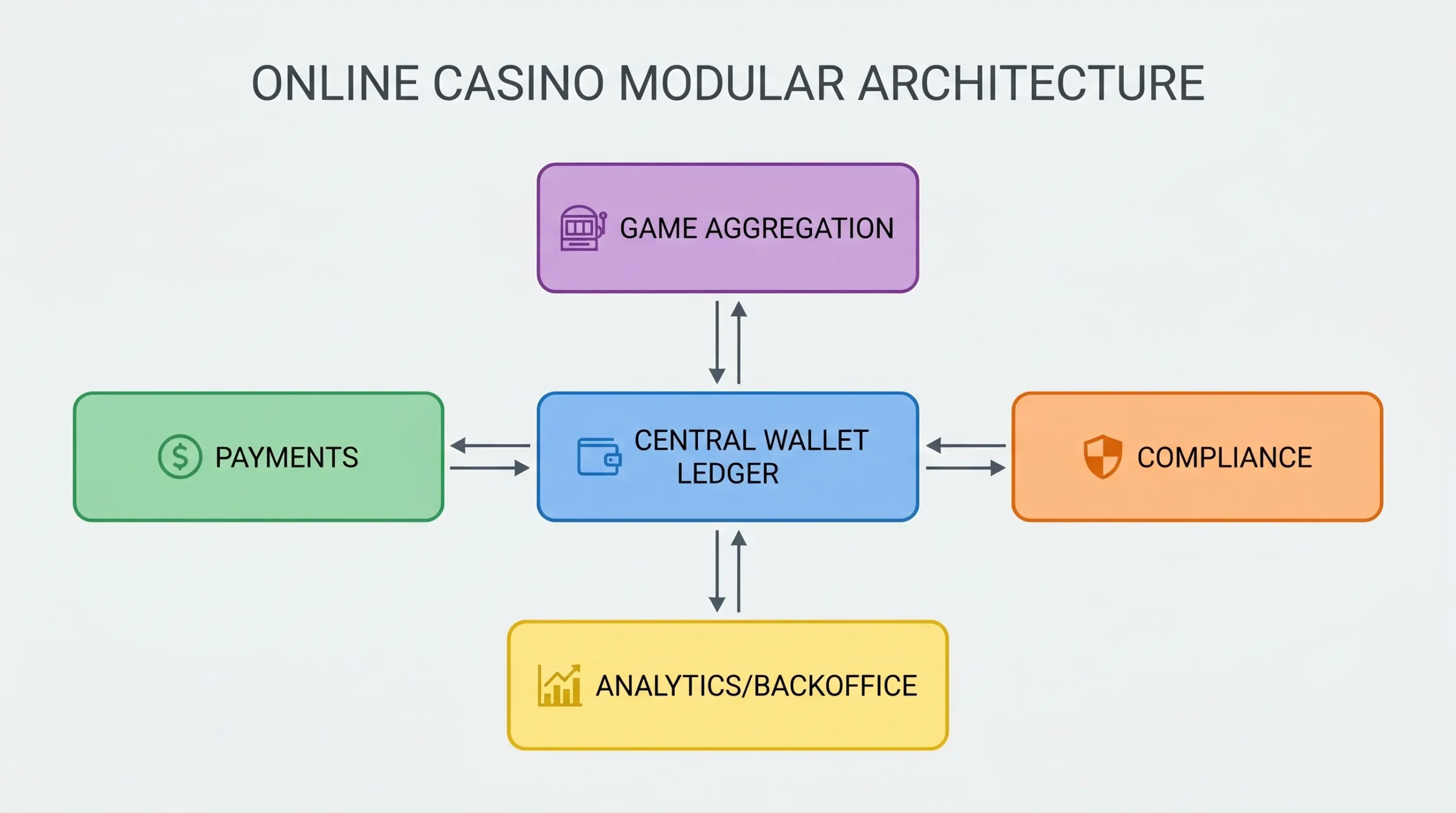
A scalable iGaming platform should let you replace or extend individual domains while keeping the operating model intact. The highest-impact domains are usually payments, game aggregation, compliance, analytics, backoffice, and frontend experience.
| Platform domain | What to avoid | What scalable architecture looks like |
|---|---|---|
| Payments and cashier | Hardcoded PSP logic, one rail per market, manual credit fixes | Payment intents, PSP routing, crypto and fiat support, idempotent wallet credits |
| Game content | Direct integrations with inconsistent launch flows | Game aggregator with normalized metadata, wallet callbacks, provider controls |
| Compliance | Static checks and spreadsheet review queues | Risk-based KYC/AML, geo rules, policy logs, case management |
| Analytics | Daily reports that arrive after the opportunity is gone | Real-time events, live funnels, triggerable segments, operational alerts |
| Bonuses and affiliates | Developer-coded promotions and manual payout checks | Configurable rules, abuse controls, attribution, budget governance |
| Backoffice | Fragmented admin panels and tribal knowledge | Role-based workflows, audit logs, usable tools for ops teams |
| Frontend and CMS | Monolith templates that slow experiments | Mobile-optimized, modular templates, APIs, localized content controls |
This approach lets the business scale in stages. You can introduce a new payment gateway without redesigning the entire lobby. You can add a game aggregator without changing your affiliate program. You can improve KYC and AML workflows without pausing marketing.
1. Put the cashier on a rail-agnostic payment layer
Payments are often the first scaling ceiling. A startup casino can survive with one or two payment methods. A growing online casino cannot. Approval rates vary by market, issuer, currency, device, risk profile, and payment method. Crypto adds more options but also introduces custody, chain monitoring, Travel Rule, and treasury considerations.
The scalable pattern is a rail-agnostic cashier. Instead of coding every payment rail directly into business logic, the platform should create a payment intent, route it through the right provider, normalize provider events, post to the ledger once, and reconcile against external reports.
This is where payment orchestration becomes a growth lever. Smart routing can improve approval rates, reduce false declines, and keep fraud controls proportional to risk. For a deeper operational guide, see casino payment orchestration.
If card payments are part of your stack, keep PCI scope in mind. The official PCI DSS standard is a useful reference for security expectations around cardholder data. The scaling principle is simple: do not let a payment expansion turn into a compliance sprawl.
For crypto-ready casinos, the cashier should also support direct crypto deposits, fiat-to-crypto onramps, wallet monitoring, stablecoin handling, and withdrawal controls. The user experience should make crypto feel like a supported payment rail, not a separate product bolted onto the casino.
2. Turn game supply into a managed portfolio
Game integrations become expensive when each provider has a different launch process, metadata model, reporting format, jurisdiction rule, and bonus compatibility requirement. At small scale, operators can manage this manually. At growth scale, slow game operations hurt revenue.
A game aggregator should do more than provide a list of slot games and live casino games. It should normalize catalog metadata, support jurisdictional availability, standardize game launch flows, handle wallet callbacks reliably, and expose performance data that helps teams curate the lobby.
This is the shift from game access to game operations. Instead of asking whether you can add a provider, ask how quickly you can launch, test, promote, measure, and delist content. Our guide to casino game aggregation covers the technical and commercial checks operators should run before adding content at scale.
The scaling advantage is not only more games. It is faster content cycles, better lobby ranking, cleaner provider reporting, and fewer integration surprises.
3. Move compliance from manual effort to platform behavior
Compliance does not scale if every review depends on a person reading disconnected systems. As the player base grows, KYC, AML, responsible gambling, geo-control, sanctions screening, withdrawal checks, and bonus abuse investigations all increase in volume.
The scalable model is risk-based automation with human escalation. Low-risk actions should pass quickly. Medium-risk actions should trigger step-up checks. High-risk actions should land in a case queue with the relevant evidence already attached.
This requires compliance rules to be embedded in platform workflows. Examples include jurisdiction-based content blocking, KYC thresholds, AML risk scoring, withdrawal review triggers, responsible gambling limits, self-exclusion enforcement, and audit-grade logging.
A strong compliance layer does not remove human judgment. It makes human judgment more efficient, consistent, and defensible.
4. Make analytics operational, not decorative
Many casinos have dashboards. Fewer have analytics that change decisions while the opportunity is still live.
At scale, analytics should connect events to actions. If deposits are failing for a specific PSP, the payments team should know before support tickets spike. If a new slot is driving high engagement but poor retention, the lobby team should see it. If a promotion is attracting suspicious multi-account behavior, the fraud team should be alerted before payout.
A real-time analytics dashboard is useful only when the event model is clean. Start with reliable events for registration, login, KYC, deposit attempts, payment outcomes, game launches, bets, wins, bonus activation, withdrawals, support contacts, risk flags, and affiliate attribution.
Then define the actions that should follow. Some actions are automated, such as triggered recovery messages or risk step-ups. Others are human, such as reviewing an underperforming payment rail or pausing an affiliate source. Our guide on how real-time analytics improve casino growth covers this operating model in more detail.
5. Give operators backoffice tools that do not require developer tickets
A casino cannot scale if every promotion, game reorder, affiliate adjustment, payment rule, or player review requires engineering time. Developer dependency slows growth and increases operational cost.
A scalable backoffice should let authorized teams manage the business safely. That means configurable bonuses, affiliate tools, player timelines, withdrawal queues, fraud review, KYC states, game controls, payment rules, reporting, and audit logs. The key is not unlimited freedom. The key is controlled freedom with roles, approvals, previews, and rollback paths.
This is where a Shopify-like operator experience matters. Non-technical teams should be able to run the brand while technical teams focus on high-value integrations, security, performance, and product differentiation.
6. Keep the frontend flexible without moving the core
Rebuilding often starts because the frontend feels outdated. But frontend modernization does not need to mean core platform replacement.
A modular or headless approach can let teams improve mobile UX, casino CMS pages, landing pages, lobby layouts, onboarding, and cashier presentation while keeping wallet, payments, games, compliance, and analytics stable. This is especially useful for multi-brand operators that need different visual identities on top of shared infrastructure.
The frontend should be treated as a growth surface. It needs fast page loads, clear onboarding, localized content, strong cashier UX, and smooth game discovery. But the frontend should not own money movement, compliance decisions, or source-of-truth player state.
7. Make releases safer before increasing release speed
Scaling increases change frequency. More markets, games, providers, campaigns, and payment rails mean more deployments. If releases are risky, growth slows because teams become afraid to change anything.
The solution is not reckless speed. It is safe speed. Use sandboxes, staged rollouts, canary releases, feature flags, observability, rollback criteria, and post-release reconciliation checks. This is especially important for wallet, cashier, bonus, KYC, and game session code.
API security also becomes more important as the platform opens up. The OWASP API Security Top 10 is a practical reference for common API risks such as broken object-level authorization, weak authentication, rate-limit gaps, and unsafe consumption of third-party APIs.
If the platform has open APIs, insist on versioning, idempotency, webhooks, sandbox environments, observability, and clear documentation. For vendor evaluation, this open API casino platform guide gives operators a useful checklist.
A 90-day roadmap to scale without rebuilding
A modular scaling plan should produce visible business value quickly while reducing technical risk. The sequence below works for many growing operators.
| Timeframe | Goal | Work to complete | Proof of progress |
|---|---|---|---|
| Days 1 to 14 | Map the bottlenecks | Audit payments, game launch, KYC, fraud, analytics, support, and release failures | Ranked list of constraints with KPIs and owners |
| Days 15 to 30 | Stabilize the money path | Review ledger integrity, idempotency, payment state handling, withdrawal queues, and reconciliation | Fewer duplicate credits, clearer payment states, cleaner daily close |
| Days 31 to 45 | Modularize one growth blocker | Add or replace one module such as payment orchestration, game aggregation, or KYC workflow | New module runs behind stable events and rollback path |
| Days 46 to 60 | Connect analytics to action | Build live dashboards and alerts for the chosen bottleneck | Operators can act on live data without manual exports |
| Days 61 to 75 | Reduce developer dependency | Move high-frequency ops tasks into backoffice controls | Campaigns, content changes, or review queues run without tickets |
| Days 76 to 90 | Expand safely | Add another rail, market, provider, or brand using the same modular pattern | Repeatable launch checklist and measurable KPI lift |
The most important rule is to avoid parallel chaos. Do not change cashier logic, KYC rules, bonus enforcement, and game wallet callbacks all in the same week unless the operation is mature enough to isolate failures.
Patch, modular platform, or rebuild: how to decide
Not every problem requires a new platform. Not every legacy system deserves another patch. Use the decision matrix below to keep the conversation grounded.
| Situation | Best path | Why |
|---|---|---|
| One isolated bottleneck, otherwise stable systems | Patch or replace one module | Fastest path to ROI with limited migration risk |
| Multiple growth blockers, fragmented vendors, weak backoffice | Modular iGaming platform | Consolidates core functions without a custom rebuild |
| Core ledger cannot be trusted | Ledger remediation first | Scaling is unsafe until balances and audit trails are reliable |
| No API access, no data export, heavy vendor lock-in | Controlled migration | Growth depends on reclaiming data and integration control |
| Product strategy requires unique games, custom UX, and deep engineering | Hybrid modular plus custom layers | Build differentiation on top of stable platform primitives |
| Existing stack is unsupported, insecure, or non-compliant | Rebuild or replatform | The risk of staying may exceed migration risk |
The best operators are pragmatic. They preserve what works, replace what blocks growth, and build custom technology only where it creates real differentiation.
What to demand from a platform built for scaling
If you are evaluating a white label casino platform, turnkey casino solution, or modular iGaming platform, ask for proof in the areas that affect scale.
You should see evidence of crypto and fiat payment support, game aggregation, KYC and AML workflows, advanced fraud prevention, multi-currency wallets, real-time analytics, affiliate and bonus controls, open API integration, mobile-optimized frontend patterns, and a customizable backoffice.
Ask vendors to demonstrate real workflows, not just feature names. For example, ask them to show how a failed deposit is logged, retried, reconciled, and analyzed. Ask how a new slot provider is enabled for one market but blocked in another. Ask how a bonus rule prevents abuse. Ask how an ops user launches a campaign without engineering. Ask how audit evidence is exported.
The platform should make growth boring. That is a compliment. Scaling should feel like repeating a controlled operating pattern, not launching a new engineering crisis every month.
How Spinlab helps operators scale without rebuilding
Spinlab is built for operators who want the speed of a white label casino platform with the flexibility of a modular stack. The platform brings together crypto and fiat payments, integrated game aggregation, real-time analytics, fraud prevention, KYC and AML compliance workflows, multi-currency support, crypto onramp solutions, affiliate and bonus tools, a customizable backoffice admin panel, open API integration, mobile-optimized casino experiences, merchant custodial wallets, and options for custom-designed original games.
For lean teams, the benefit is operational simplicity. Spinlab is designed to provide a Shopify-like experience for casino operations, so teams can launch, configure, test, and scale without turning every growth initiative into a custom development project.
For scaling teams, the benefit is modularity. You can focus on the next constraint, such as payments, games, compliance, analytics, or backoffice workflow, while keeping the rest of the business moving.
Frequently Asked Questions
Can you scale an online casino without changing platforms? Yes, if the current platform supports APIs, clean data exports, reliable ledgering, payment extensibility, and operational controls. If the platform blocks access to core data or forces every change through the vendor, scaling without migration becomes much harder.
Which module should be upgraded first? Start with the bottleneck closest to revenue or risk. For many operators, that is the cashier, payment gateway routing, KYC throughput, game launch reliability, or bonus abuse control. Use KPI evidence rather than internal opinion to prioritize.
Is a white label casino platform scalable enough for serious growth? It can be, if it is modular, API-friendly, audit-ready, and operationally configurable. A weak white label platform becomes restrictive, but a strong one can help operators scale faster than a fully custom build.
How do you migrate wallets safely? Treat wallet migration as a financial control project, not a normal data migration. Freeze the schema, reconcile balances before and after, preserve transaction history, use dual reporting during transition, and avoid changing bonus or withdrawal rules at the same time.
Does adding crypto make scaling more complex? It adds operational requirements such as custody, blockchain monitoring, AML and KYT checks, stablecoin policies, and treasury controls. A crypto-ready solution reduces complexity by integrating crypto with the same ledger, risk, analytics, and compliance workflows used for fiat.
How do you avoid vendor lock-in while using a turnkey casino solution? Demand open APIs, exportable data, clear event schemas, documented webhooks, transparent commercial terms, and contract language covering termination, data rights, and migration support. Lock-in is reduced when your data and integrations remain portable.
Scale the business, not the rebuild backlog
Rebuilding tech can be the right move in extreme cases, but it should not be the default answer to growth. Most online casinos scale faster by identifying the true constraint, protecting money and evidence, and upgrading the right modules in the right order.
If you want a cost-efficient, modular way to scale payments, games, compliance, analytics, and operations, explore Spinlab. The platform is designed to help operators launch and grow online casino brands with integrated tools instead of a constant rebuild cycle.