

Cheap casino software is not automatically bad. In fact, for many new operators, a lean white label casino platform is the only rational way to test a market, build an audience, and keep cash available for acquisition, compliance, and payments.
The problem is that “cheap” and “low quality” often look similar during a sales call. Both may promise fast launch, game aggregation, payment gateway integrations, bonus tools, and a modern backoffice. The difference appears later, when real players deposit, bonuses trigger, withdrawals queue up, support tickets arrive, and regulators or payment partners ask for clean records.
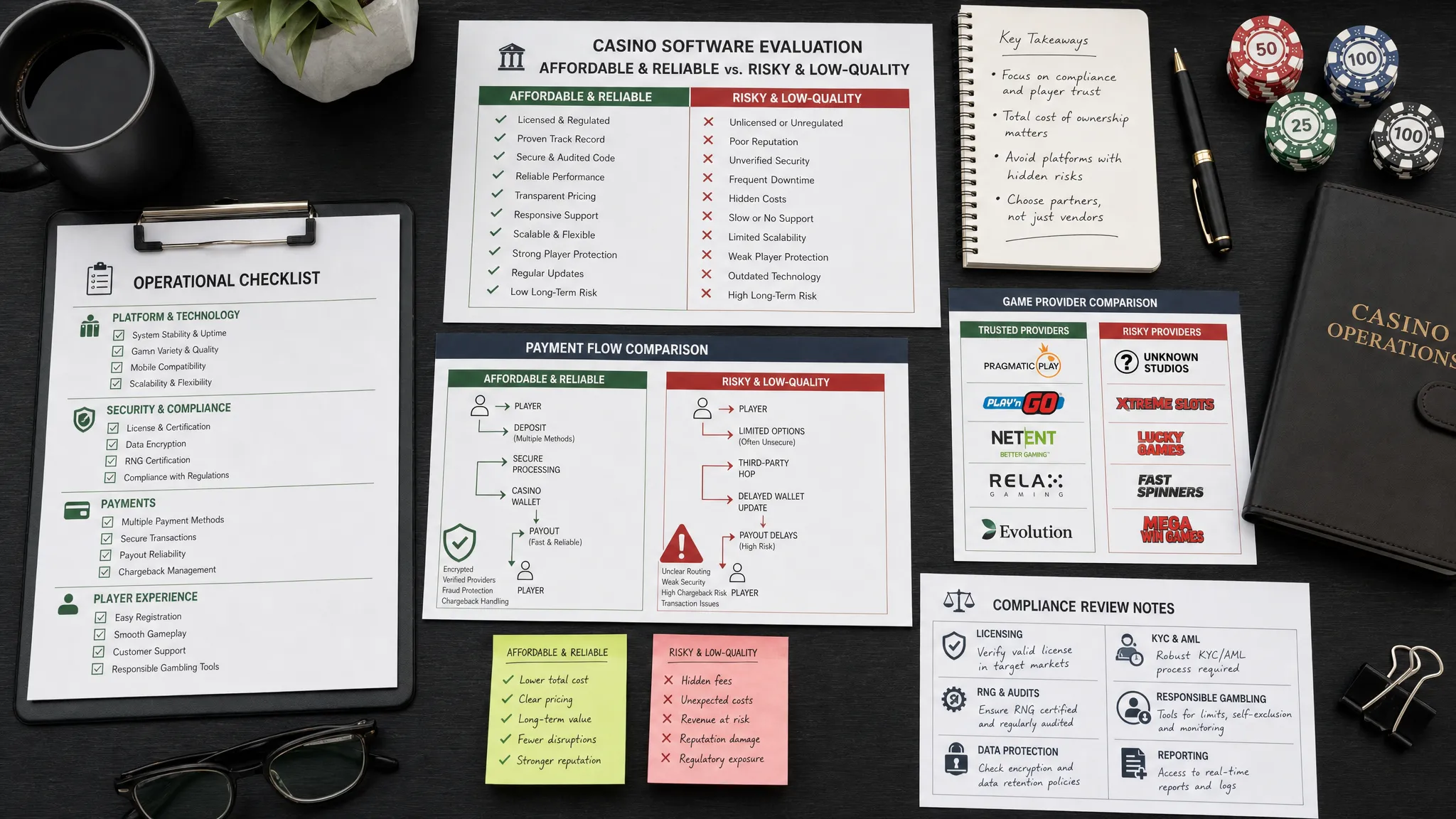
A good low-cost iGaming platform reduces cost through productization, reusable modules, automation, and focused scope. A low-quality platform reduces cost by skipping the difficult parts: ledger accuracy, payment reliability, fraud prevention, compliance workflows, security, documentation, and long-term maintainability.
Here is how to tell the difference before you sign.
Cheap casino software vs low-quality platforms: the core difference
The lowest setup fee is rarely the full story. In online casino operations, the real question is where the vendor saves money.
| Area | Cheap but viable casino software | Low-quality casino platform |
|---|---|---|
| Cost structure | Lower cost because the platform is modular, standardized, and repeatable | Lower cost because critical systems are incomplete or manually patched |
| Launch speed | Fast because onboarding, integrations, and templates are already mature | Fast on paper, but delayed by missing configurations and unstable integrations |
| Payments | Clear payment gateway options, reconciliation, withdrawal flows, and settlement visibility | Unclear payment routing, poor reconciliation, and limited visibility into failures |
| Compliance | Built-in KYC, AML, risk controls, and audit trails appropriate to the operator’s model | Generic “compliance ready” claims with little proof inside the backoffice |
| Games | Reliable game aggregator setup with tested wallet, session, bonus, and reporting flows | Large game counts advertised, but weak provider coverage, broken metadata, or unstable sessions |
| Operations | Admin tools help a small team run the casino without constant developer support | The team depends on vendor support for routine changes |
| Scaling | Cost grows predictably as volume and complexity increase | Hidden fees, manual work, and technical debt increase total cost |
The distinction matters because a cheap platform can be a strategic advantage. A low-quality platform can become the most expensive decision in the company.
If you want a feature-by-feature starting point, Spinlab’s guide on what to look for in cheap casino software is a useful companion. This article focuses on the practical signals that reveal whether a low price is efficient or dangerous.
Why “cheap” can be a good thing in iGaming
Casino founders often overpay because they assume a higher quote means a safer product. That is not always true. Some expensive casino software providers simply bundle unnecessary customization, slow implementation, and legacy processes into the price.
Affordable software can be strong when the vendor has solved the common operating problems once and made them reusable. For example, a modular turnkey casino solution can reduce cost by using prebuilt wallet logic, reusable payment integrations, established game aggregation flows, standardized backoffice screens, and repeatable onboarding steps.
This is similar to how modern ecommerce platforms lowered the cost of launching online stores. The value is not that every store is identical. The value is that operators do not need to rebuild checkout, admin tools, product management, payments, and analytics from scratch.
The same logic applies to an online gambling platform. You should not need custom engineering for every basic workflow, such as creating bonuses, reviewing players, checking deposits, updating banners, viewing revenue, or managing game categories.
Cheap becomes risky only when the price is low because the vendor has avoided hard engineering. In iGaming, the hard parts are usually invisible during a polished demo.
Where low-quality platforms usually cut corners
A low-quality platform rarely fails in one obvious way. It usually fails through small operational gaps that accumulate. The casino technically launches, but the team loses time, players lose trust, and the business becomes difficult to scale.
Wallet and ledger accuracy
The wallet is the financial source of truth for the casino. If it is weak, everything else becomes fragile.
A serious platform should show exactly how player balances change through deposits, wagers, wins, losses, bonus credits, rollbacks, refunds, manual adjustments, and withdrawals. It should separate cash balances from bonus balances, support multi-currency logic where needed, and produce records that finance, risk, and compliance teams can understand.
A low-quality platform may show only a simple balance number without a complete transaction trail. That is not enough. When a player disputes a withdrawal, a provider sends a rollback, or a payment gateway reports a mismatch, your team needs a precise ledger history.
Ask the vendor to demonstrate a full money flow in a test environment. A sales deck is not evidence. A live walkthrough of the ledger is.
Payment gateway and withdrawal flows
Payments are one of the fastest ways to expose weak casino software. Deposits, withdrawals, chargebacks, failed transactions, settlement delays, limits, and provider errors all need operational visibility.
A good platform does not just “support payments.” It helps your team understand what happened to every transaction. That includes payment status, gateway response, player account impact, admin action history, and reconciliation data.
If you need a crypto-ready solution, the same principle applies. Do not accept vague claims like “crypto supported.” Ask how deposits are credited, how confirmations are handled, how withdrawals are approved, how exchange or onramp flows fit into the experience, and how wallet records connect to the player ledger.
Crypto and fiat payments both require careful risk controls. For crypto operators, it is also worth understanding the broader expectations around virtual assets and AML risk. The Financial Action Task Force guidance on virtual assets is a helpful reference point, although your legal and compliance obligations depend on your jurisdiction and operating model.
KYC, AML, and responsible operations
No platform can make legal decisions for you, and this article is not legal advice. Still, casino software should give your team the tools to operate responsibly.
At minimum, look for practical workflows around player verification, risk status, document review, account limits, suspicious activity flags, manual review notes, and admin permissions. The backoffice should make it clear who changed what and when.
Low-quality platforms often treat compliance as a checkbox. They may list KYC and AML on the website, but the actual system is shallow, disconnected, or difficult to use. That creates risk because compliance work depends on repeatable processes, not marketing language.
The right question is not “Do you support KYC?” The better question is “Show me exactly how a player moves from registration to verification, deposit approval, risk review, withdrawal review, and audit history.”
Game aggregation quality
Game count is one of the easiest metrics to exaggerate. A vendor may advertise thousands of slot games, live casino games, crash games, or casino original games, but the number alone tells you little about operational quality.
A reliable game aggregator should handle provider sessions, wallet calls, game launch errors, metadata, thumbnails, categories, free spins, bonus compatibility, regional restrictions, and reporting. It should also make it easy to manage popular content, from major slot releases to live dealer tables and new game categories.
For example, if your acquisition strategy depends on slot content, you need more than a logo wall of providers. You need to know whether new releases can be added reliably, whether game availability is clear by market, and whether the platform can support promotions tied to specific titles or providers.
Low-quality platforms often hide behind provider quantity. Good platforms prove game stability, reporting, and admin control.
Backoffice usability
Cheap software often becomes expensive when every routine change requires a developer or vendor ticket. A small casino team should be able to manage everyday operations inside the backoffice without fighting the system.
That includes player search, account review, payments, bonuses, game categories, affiliate settings, risk notes, permissions, content updates, and analytics. The interface does not need to be flashy, but it must be logical.
A messy backoffice is more than an inconvenience. It slows down withdrawals, increases support errors, makes promotions harder to manage, and creates security risk when too many people need broad permissions to complete simple tasks.
Spinlab has a separate guide on what makes a casino platform easy to run if operational simplicity is a priority for your team.
Security, fraud prevention, and access control
Security is another area where low-quality platforms cut invisible corners. Ask about admin permissions, authentication, activity logs, fraud rules, API access, data handling, and vulnerability management.
You do not need to become a security engineer to evaluate a vendor, but you should expect clear answers. For web application risk, the OWASP Top 10 is a widely used reference for common security categories such as broken access control, injection, and insecure design.
If a vendor cannot explain how admin access is controlled, how suspicious behavior is flagged, or how integrations are protected, treat that as a serious warning sign.
A practical vendor test: make the platform prove itself
A polished demo usually shows the best path: registration works, a deposit succeeds, games launch, and the dashboard looks clean. Real casino operations are messier. Your evaluation should include normal workflows, failed workflows, and edge cases.
Use the table below to structure your next vendor demo.
| Test area | What to ask the vendor to show | What a strong answer looks like |
|---|---|---|
| Deposit to wager | Register a test player, deposit, place a wager, settle a result, and inspect the ledger | Every balance movement is visible and tied to a clear transaction record |
| Failed payment | Trigger or explain a failed deposit and admin view | The platform shows status, gateway response, player impact, and next steps |
| Withdrawal review | Request a withdrawal after play and review it in the backoffice | Admins can see player history, risk signals, KYC status, and approval actions |
| Bonus flow | Create a simple bonus and test wagering, expiry, and balance separation | Bonus rules are understandable and do not corrupt cash balance reporting |
| Game launch | Launch multiple slot and live casino games from different providers | Sessions load reliably, wallet calls are tracked, and errors are diagnosable |
| Compliance review | Move a player through verification or risk review | The system records status, notes, documents, permissions, and audit history |
| Admin permissions | Create roles for support, finance, marketing, and risk | Each role can do its job without unnecessary access to sensitive controls |
| Reporting | Review revenue, payments, player activity, and game performance | Reports are timely, exportable, and consistent with ledger and provider data |
Do not rush this stage. A vendor that is confident in its platform should be comfortable showing real workflows in detail.
Pricing signals that deserve scrutiny
Low setup cost is not the only pricing issue. A platform can look cheap upfront and become expensive through hidden fees, manual work, slow support, or forced upgrades.
This is why total cost of ownership matters. Setup, monthly fees, revenue share, payment costs, provider fees, compliance tools, support, custom work, hosting, and future integrations can all change the true economics. For a deeper cost framework, see Spinlab’s article on choosing casino software with low TCO.
Here are common pricing signals to investigate.
| Pricing signal | Why it can be risky | What to clarify |
|---|---|---|
| Very low setup fee with vague scope | The base package may exclude essential launch items | What is included, what is optional, and what costs extra |
| “Unlimited” claims | Unlimited games, traffic, or support may have fair-use limits | Where limits apply and how overages are billed |
| Cheap launch but expensive changes | Routine configuration may require paid development | Which changes admins can make without vendor work |
| Unclear payment integration costs | Payment setup can become a major hidden expense | Which gateways are supported and what integration work is included |
| No clear support terms | Slow support can delay withdrawals, promos, and fixes | Response times, escalation paths, and support coverage |
| Heavy lock-in | Leaving may be difficult if data access is limited | Data export, domain control, contracts, and termination terms |
Cheap casino software should make the economics clearer, not more confusing. If the vendor cannot explain the total cost model in plain language, assume you have not found the real price yet.
Cheap is acceptable when the tradeoffs are explicit
No platform is perfect for every operator. A startup casino does not need every enterprise feature on day one. What matters is knowing which tradeoffs you are making.
For example, a lean operator may accept fewer custom frontend components if the platform has strong payments, wallet accuracy, game aggregation, and admin tools. A crypto casino startup may prioritize multi-currency support, crypto onramp options, and fraud controls over deep CMS customization. A content-led casino may care most about game provider coverage, bonus flexibility, and mobile performance.
Those are strategic tradeoffs. They are very different from accepting a platform with unclear ledgers, weak compliance workflows, broken reporting, or poor payment visibility.
A useful rule is simple: compromise on cosmetic preferences before you compromise on financial accuracy, player trust, compliance workflows, or operational control.
Warning signs of a low-quality casino software provider
Some red flags are obvious, such as no demo, no documentation, or unrealistic launch promises. Others are more subtle.
Be careful if the vendor avoids detailed workflow demos, cannot explain the wallet model, refuses to discuss failed payment handling, uses generic answers for KYC and AML, or pushes you to sign before providing technical clarity. Also be cautious if every important feature requires custom work, if support terms are vague, or if the contract makes it difficult to access your own data.
Low-quality vendors often sell confidence instead of evidence. Good vendors give you enough detail to make a sober decision.
If you are already comparing providers, Spinlab’s guide to white label casino software red flags can help you spot warning signs during calls, demos, and contract review.
A simple scoring model before you commit
Before choosing a platform, score each vendor from 1 to 5 across the categories below. A low-cost provider can still win if it scores well on the areas that matter most. A flashy provider should not win if it fails core operating tests.
| Category | Suggested weight | Why it matters |
|---|---|---|
| Wallet and ledger | Critical | Financial accuracy affects players, reporting, disputes, and compliance |
| Payments and withdrawals | Critical | Poor payment operations damage trust and retention quickly |
| KYC, AML, and fraud controls | Critical | Operators need repeatable workflows and audit trails |
| Game aggregation | High | Content quality, stability, and reporting affect revenue |
| Backoffice usability | High | Small teams need to operate without constant technical support |
| Mobile performance | High | Many casino players interact primarily on mobile devices |
| Analytics and reporting | Medium | Operators need visibility into revenue, player activity, and campaigns |
| API and integrations | Medium | Flexibility matters as the business grows |
| Support and documentation | High | Launch and live operations depend on fast, competent help |
| Commercial clarity | High | Hidden costs can turn cheap software into an expensive platform |
Set minimum standards before vendor calls. For example, you may decide that any provider scoring below 4 on wallet, payments, and compliance is automatically disqualified, even if the price is attractive.
This approach keeps the conversation grounded. It also prevents the common founder mistake of choosing the best-looking demo instead of the safest operating foundation.
Frequently Asked Questions
Is cheap casino software always risky? No. Cheap casino software can be a smart choice when the vendor lowers cost through productized workflows, modular architecture, and efficient onboarding. It becomes risky when the low price comes from missing controls, weak payments, poor compliance tools, or unstable integrations.
What is the biggest sign of a low-quality casino platform? The biggest sign is a lack of proof around core financial workflows. If the vendor cannot clearly demonstrate deposits, wagers, wins, bonuses, refunds, withdrawals, ledger records, and reporting, you should be cautious.
Can a white label casino platform support both crypto and fiat payments? Yes, some white label platforms support both crypto and fiat payments. What matters is how well those payment flows connect to the ledger, KYC and AML workflows, fraud controls, reconciliation, and admin visibility.
Should I choose the cheapest provider or the most feature-rich provider? Choose the provider with the best fit for your operating model and the lowest sustainable total cost. The cheapest option is only good if it protects the essentials. The most feature-rich option is only useful if your team can actually operate it.
How long should a vendor evaluation take? It depends on your scope, but you should allow enough time for product demos, technical questions, commercial review, compliance review, and reference checks where possible. Rushing the process often leads to expensive fixes later.
Launch lean without settling for low quality
The best cheap casino software is not the platform with the thinnest feature set. It is the platform that gives you the strongest operating foundation at the lowest practical cost.
Spinlab is built for teams that want an affordable, modular iGaming platform with a Shopify-like operating experience. The platform supports online casino launches with crypto and fiat payment support, game aggregation, KYC and AML workflows, fraud prevention, analytics, affiliate and bonus tools, mobile optimization, open API integration, and customizable backoffice controls.
If you want to launch a whitelabel casino without paying enterprise prices or accepting low-quality shortcuts, explore Spinlab’s casino platform and see how a lean launch can still be built on serious infrastructure.