

A casino platform can look polished in a sales demo and still feel frustrating once real players start registering, depositing, claiming bonuses, and contacting support. Better UX is not only about colors, animations, or a modern lobby. In iGaming, UX is the practical quality of every journey that helps a player trust the brand and helps the operating team run the business without friction.
For founders and operators choosing an iGaming platform, the key question is simple: can this platform turn attention into registration, registration into deposits, deposits into repeat play, and operational complexity into manageable workflows?
That requires evaluating both sides of the experience. Players need speed, clarity, trust, and easy access to games and payments. Operators need a backoffice that makes risk, compliance, bonuses, support, and analytics easy to control. If either side is weak, growth becomes expensive.
UX is a platform decision, not a skin decision
A front-end theme can improve the look of an online casino, but it cannot fix a slow wallet, confusing KYC flow, weak game search, missing payment statuses, or an admin panel that requires manual work for every small change. Those problems come from the platform architecture and product design beneath the surface.
A casino platform with better UX should make the important actions obvious. Players should know where to sign up, how to deposit, which bonuses apply, how to launch a game, and when a withdrawal is being processed. Operators should know where to review users, configure promotions, monitor transactions, handle fraud alerts, and analyze performance.
This is why UX should be part of vendor selection from the beginning. A platform that feels easy during launch will usually reduce training time, support tickets, payment drop-offs, and operational mistakes. A platform that feels confusing will force your team to compensate with more manual support, more custom development, and more process documentation.
Map UX to the journeys that affect revenue
Before comparing vendors, list the journeys that matter most to your online casino model. A sportsbook-heavy brand, slot-focused casino, crypto-first casino, and live casino brand may prioritize different flows, but the evaluation logic is similar.
| Journey | What to test | Why it matters |
|---|---|---|
| Registration | Number of steps, field clarity, error handling, mobile ease | Reduces abandonment before the first deposit |
| KYC and AML | Document upload, status messaging, retry flow, review queue | Builds trust while meeting compliance obligations |
| Deposit | Payment method visibility, speed, wallet updates, failure handling | Directly affects first-time depositor conversion |
| Game discovery | Search, filters, categories, provider pages, recently played games | Helps players find slot games and live casino games faster |
| Bonus use | Eligibility, wagering display, opt-in clarity, expiry visibility | Prevents confusion and support disputes |
| Withdrawal | Status tracking, limits, verification prompts, support access | Shapes player trust and retention |
| Backoffice work | User lookup, risk review, bonus setup, payment reconciliation | Determines how efficiently your team can operate |
A better casino platform turns these journeys into predictable workflows. It should not leave players guessing or force staff to jump between disconnected tools to answer basic questions.
Start with mobile performance and navigation
Most casino traffic is mobile-first, so UX evaluation should begin on a real phone, not only on a desktop demo. Ask to test the platform on mid-range devices, slower networks, and different screen sizes. A lobby that feels quick on a vendor’s high-end laptop may feel heavy on a player’s everyday Android device.
Speed matters because every delay creates doubt. If the homepage takes too long to load, if the game lobby stutters, or if the cashier freezes after payment submission, players may assume something is wrong with the brand. Google’s Core Web Vitals offer a useful framework for thinking about loading speed, responsiveness, and visual stability, even if casino products have extra complexity from game providers, payment scripts, and compliance tools.
Navigation also needs to be obvious. A mobile casino UX should make core actions visible without overcrowding the screen: register, log in, deposit, search games, view bonuses, access account settings, and contact support. For a deeper breakdown of speed, cashier, and verification flows, Spinlab’s mobile casino UX checklist is a useful companion when testing vendors.
Treat the cashier as a conversion product
The cashier is one of the highest-impact UX areas in any online gambling platform. Players arrive with intent, but small problems can break that intent: unclear limits, missing local payment methods, slow confirmations, failed deposits without explanation, or a wallet balance that does not update immediately.
A strong payment gateway experience should show the right methods for the player’s region and currency, explain fees or limits where relevant, preserve form state after an error, and provide clear statuses for deposits and withdrawals. If the platform supports both fiat and crypto payments, the user should understand which route they are using and what happens next.
For crypto-ready solutions, UX should go beyond displaying a wallet address. A good flow explains network selection, expected confirmation behavior, minimum deposit requirements, and what to do if the player sends the wrong amount. If the platform includes a crypto onramp, the transition from card or bank payment into crypto funding should feel guided, not like a separate technical product bolted onto the casino.
The cashier should also support your operations team. Finance and support staff need transaction histories, payment statuses, user-level wallet views, and reconciliation tools. If those details are buried or split across multiple systems, every payment issue becomes slower to resolve.
Make compliance feel clear, not punitive
KYC and AML are often treated as pure compliance steps, but they are also major UX moments. Players understand that regulated financial flows require checks, but they get frustrated when a platform asks for documents without context, rejects uploads without useful feedback, or leaves verification status unclear.
Better UX means telling players what is needed, why it is needed, how long review may take, and what they can still do while waiting. The tone should be professional and reassuring. Error messages should be specific enough to help the player correct the issue, without exposing risk rules or encouraging fraud.
From the operator side, compliance UX matters just as much. Review queues, risk flags, audit trails, notes, and role-based permissions help teams work consistently. These tools should be designed so that compliance staff can act quickly while preserving records. Laws and licensing requirements vary by market, so platform UX should support your compliance process rather than replace legal or regulatory advice.
Accessibility also belongs in this conversation. Following recognized guidance such as the W3C Web Content Accessibility Guidelines can improve usability for more players and reduce avoidable friction in forms, navigation, contrast, and error handling.
Evaluate game discovery like a retail experience
Casino lobbies are marketplaces. A player may arrive for a specific slot, a live dealer table, a provider they like, or a promotion. If the lobby makes discovery difficult, the platform wastes game inventory.
A game aggregator is valuable only if the front-end experience helps players use the catalog. Search should handle provider names, game titles, and common partial queries. Categories should be understandable, not overloaded with vague labels. Filters should help players narrow options by provider, type, popularity, volatility where available, new releases, live casino games, jackpots, and favorites.
Game pages should make the next action obvious. If a player is logged out, the platform should guide them to register or log in without losing context. If the game is unavailable in their region or currency, the message should be clear. If the user has a bonus balance, the experience should explain whether the selected game contributes to wagering.
For retention, small details matter: recently played games, favorite games, session continuity, fast relaunch, and visible balance updates. These features are not just nice extras. They reduce friction for repeat play.
Do not ignore backoffice UX
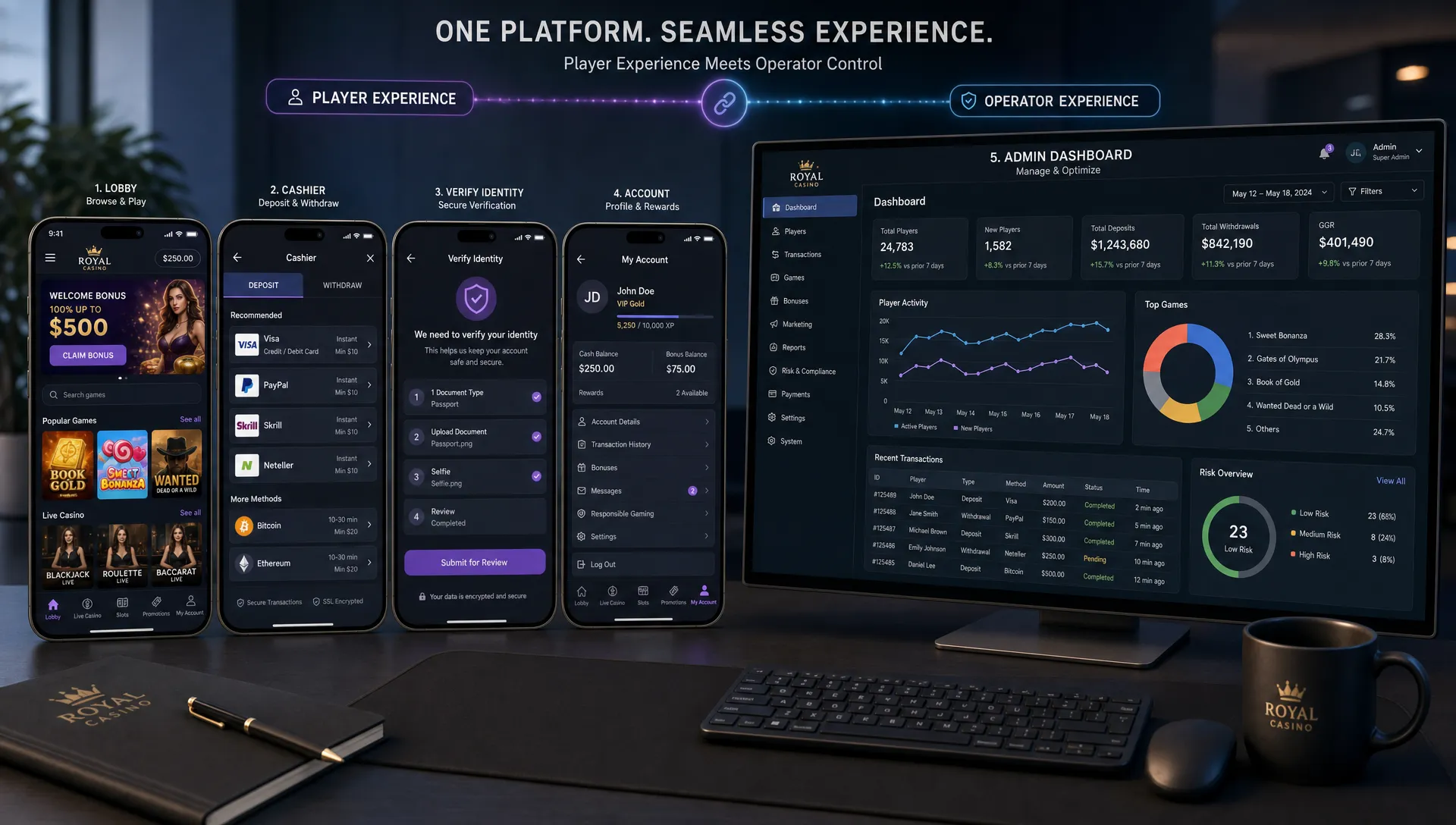
Operators sometimes over-focus on player-facing design and under-test the admin tools. That is a mistake. Backoffice UX determines how quickly your team can respond to problems, launch campaigns, manage users, review risk, adjust content, and understand performance.
A good backoffice should be role-centered. Support agents need fast user lookup, account timelines, payment histories, bonus states, and notes. Marketing teams need safe tools for bonus configuration, segmentation, and campaign monitoring. Finance teams need wallet views, transaction exports, and reconciliation workflows. Risk and compliance teams need alerts, case handling, KYC status, AML review tools, and audit trails.
If you want to go deeper on this side of platform evaluation, Spinlab’s guide to casino backoffice UX explains why admin design is a growth lever, not just an internal convenience.
Measure UX with analytics, not opinions
The best casino platform UX can be measured. Visual taste matters, but business-critical UX should show up in funnel performance, operational speed, and user behavior. During vendor evaluation, ask what analytics are available by default and how easily your team can segment data by market, device, payment method, campaign, and player cohort.
Real-time analytics are especially useful after launch because they help teams spot problems quickly. If a payment method starts failing, if a KYC vendor slows down, if a new lobby layout reduces game launches, or if a bonus creates unexpected support volume, your team needs to see the signal before it becomes a revenue problem.
| UX area | Metric to monitor | What it can reveal |
|---|---|---|
| Registration | Visit-to-signup rate, form error rate | Whether onboarding is too long or confusing |
| KYC | Completion rate, rejection rate, review time | Whether verification instructions or review workflows need improvement |
| Cashier | Deposit start-to-success rate, failed payment reasons | Whether payment UX or routing is causing drop-off |
| Game lobby | Search usage, game launch rate, zero-result searches | Whether players can find what they want |
| Bonus experience | Bonus opt-in rate, support tickets about wagering | Whether promotion rules are clear |
| Withdrawal | Withdrawal requests, status checks, support contacts | Whether players trust the payout process |
| Backoffice | Case handling time, manual adjustments, unresolved queues | Whether internal workflows are slowing operations |
Usability principles from sources such as Nielsen Norman Group’s usability heuristics are useful during product reviews, but analytics show how your specific players behave. Choose a platform that gives you both good defaults and enough visibility to improve.
Run a task-based demo before choosing a casino platform
A vendor demo should not only show polished screens. It should prove that real tasks are easy to complete. Before the demo, create a script based on your operating model and ask the vendor to walk through it live.
Do not accept only happy-path flows. Ask what happens when a player fails KYC, a deposit is pending, a withdrawal needs review, a bonus expires, a game provider is unavailable, or a support agent needs to explain a wallet adjustment. These edge cases reveal the real UX quality of the platform.
| Demo task | What good UX looks like | Red flags |
|---|---|---|
| Register on mobile | Few steps, clear errors, fast response | Tiny fields, vague errors, unnecessary friction |
| Make a deposit | Local methods, clear limits, immediate status | Hidden fees, no pending state, poor failure messages |
| Upload KYC documents | Guided process, visible progress, retry instructions | Generic rejection, no status, confusing document rules |
| Search for a slot game | Fast search, useful filters, relevant results | Slow lobby, no provider filters, many dead ends |
| Claim a bonus | Clear rules, wagering visibility, expiry shown | Hidden terms, unclear eligibility, support dependency |
| Review a risky withdrawal | Case view, user history, notes, audit trail | Manual spreadsheet work, no role permissions |
| Create a promotion | Guardrails, preview, targeting, performance tracking | Hard-coded changes, developer dependency, no preview |
Ask who can change what after launch. If every homepage category, bonus rule, payment setting, or content update requires engineering work, the platform may look flexible but operate slowly. Better UX gives non-technical teams controlled freedom while protecting the business from mistakes.
Look for red flags that create long-term friction
Some UX problems are easy to miss because they do not appear until the casino is live. During selection, watch for patterns that usually become costly later.
- The demo focuses heavily on visual design but avoids payment, KYC, and withdrawal edge cases.
- The vendor cannot show real backoffice workflows for support, risk, finance, and marketing roles.
- Mobile testing is limited to a perfect network or desktop browser simulation.
- The cashier does not show clear statuses for pending, failed, approved, and rejected transactions.
- Bonus rules are difficult to preview from the player’s perspective.
- Game search is slow, shallow, or dependent on manually curated categories.
- Analytics require external setup before basic funnels can be monitored.
- The platform has no clear approach to role-based permissions and audit trails.
- Crypto flows are presented as technical wallet features rather than player-friendly funding journeys.
One red flag does not automatically disqualify a platform, but several together indicate that UX is not deeply built into the product.
Balance launch speed with UX flexibility
For many operators, a white label casino platform or turnkey casino solution is attractive because it reduces time to market. The risk is choosing a platform that launches quickly but becomes rigid after the first version. Better UX requires a balance: enough ready-made structure to launch fast, plus enough modularity to adapt as you learn from players.
Look for flexibility in the areas that change often: payment methods, markets, currencies, bonus strategy, game categories, content blocks, risk settings, reports, and integrations. An open API can also matter if you plan to connect CRM tools, data systems, affiliate software, custom front ends, or specialized compliance providers.
A modular platform is especially useful for lean teams. You can start with the essentials, validate acquisition and retention, then expand into more advanced features such as deeper segmentation, custom promotions, additional payment options, affiliate tooling, or custom-designed casino original games.
The practical UX selection checklist
When comparing casino software providers, summarize your findings in a simple scorecard. This keeps the decision from becoming too subjective and helps your team compare platforms consistently.
- Player onboarding is fast, mobile-friendly, and clear.
- The cashier supports your target payment methods, currencies, and crypto needs.
- KYC and AML workflows are understandable for players and efficient for staff.
- Game discovery works well across slots, live casino games, providers, and promotions.
- The backoffice supports real operational roles without excessive manual work.
- Analytics show the funnels and failure points your team needs to manage daily.
- The platform is flexible enough to change content, bonuses, payments, and integrations after launch.
- Security, fraud prevention, permissions, and audit trails are built into everyday workflows.
- The vendor can demonstrate edge cases, not just the ideal journey.
The platform with better UX is usually the one that makes ordinary work feel simple. Players should not need instructions to deposit or play. Staff should not need workarounds to answer common questions. Founders should not need custom development for every operational change.
Frequently Asked Questions
What does better UX mean in a casino platform? Better UX means players can register, verify, deposit, find games, use bonuses, and withdraw with minimal confusion, while operators can manage payments, compliance, support, analytics, and promotions efficiently from the backoffice.
Is player-facing UX more important than backoffice UX? Both matter. Player UX affects conversion and retention, while backoffice UX affects speed, risk control, support quality, and operating cost. A casino platform with a beautiful lobby but weak admin tools can still be difficult to scale.
How should I test casino platform UX before signing with a vendor? Run a task-based demo. Test mobile registration, deposits, KYC, game search, bonus use, withdrawals, support workflows, fraud review, and promotion setup. Ask the vendor to show edge cases, not only ideal flows.
Does crypto support make casino UX more complicated? It can, unless the platform explains network selection, deposit status, confirmations, wallet balances, and onramp steps clearly. A crypto-ready solution should feel simple for players and traceable for operators.
What UX features matter most for a new online casino? Prioritize mobile speed, clear registration, reliable cashier flows, understandable KYC, strong game discovery, visible wallet balances, simple bonus rules, and a backoffice your team can actually use every day.
Choose a platform your players and team can actually use
Better UX is one of the strongest signals of a platform that can support real growth. It reduces friction for players, gives staff better control, and helps founders move faster without turning every operational need into a development project.
If you are evaluating a cost-efficient, modular, crypto-ready white label casino platform, Spinlab is built to combine payments, game aggregation, KYC and AML workflows, fraud prevention, analytics, backoffice tools, multi-currency support, crypto onramps, and customizable casino experiences in one platform. The goal is simple: make launching and running an online casino feel more like operating a modern commerce product, with the infrastructure iGaming requires behind it.