

Mobile is where most casino sessions start, and where most revenue leaks happen. Not because your game catalog is weak, but because speed, cashier UX, and KYC friction compound: a slow lobby increases bounce, a confusing deposit flow kills first-time deposits, and a badly-timed KYC request turns a “ready to play” moment into abandonment (or a support ticket).
This checklist is built for iGaming product, payments, compliance, and engineering teams who want a practical, testable way to improve mobile conversion without compromising fraud controls or regulatory requirements.
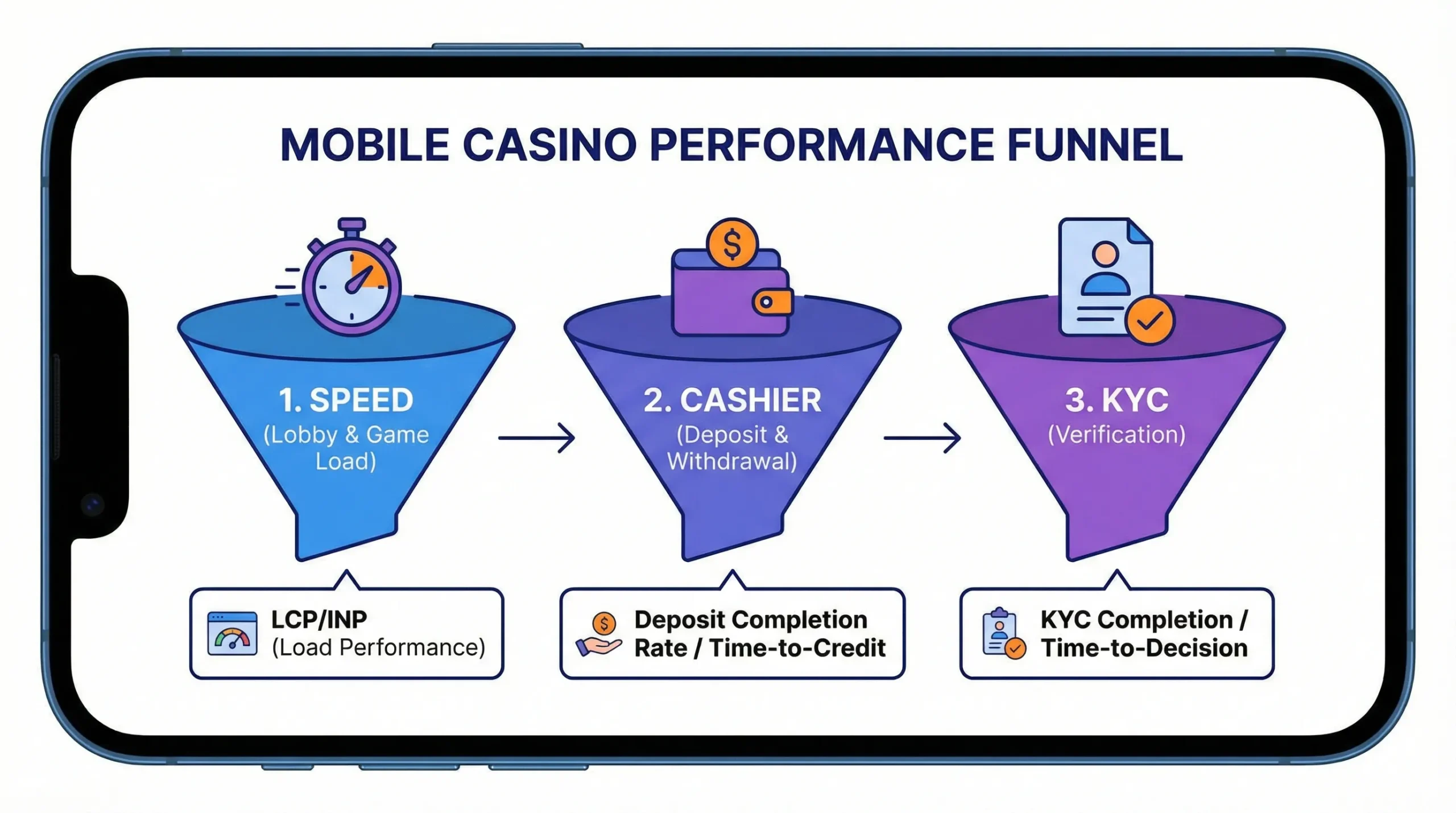
1) Speed checklist (mobile lobby, game launch, in-session responsiveness)
Set performance targets that map to money
If you do not define “good,” teams will optimize random metrics. For mobile casinos, the most actionable baseline is Core Web Vitals, measured on real users at the 75th percentile (P75), not on a developer laptop.
Google’s commonly used thresholds (via web.dev/vitals):
- LCP (Largest Contentful Paint): good at ≤ 2.5s
- INP (Interaction to Next Paint): good at ≤ 200ms
- CLS (Cumulative Layout Shift): good at ≤ 0.1
Add two casino-specific targets:
- Time to First Spin (TTFS): from tap on a game tile to first successful wager/spin
- Time to Credited Balance (TTC) after deposit: from “Pay” to playable wallet
A simple mobile performance budget you can socialize across teams:
| Funnel area | KPI | Target (start here) | Why it matters |
|---|---|---|---|
| Lobby / landing | LCP (P75) | ≤ 2.5s | Bounce and SEO sensitivity |
| UI responsiveness | INP (P75) | ≤ 200ms | Perceived “lagginess” during navigation |
| Visual stability | CLS (P75) | ≤ 0.1 | Mis-taps, rage taps, trust |
| Game launch | TTFS (P75) | define per provider, track deltas | Direct link to wagering start |
| Session stability | JS errors / crashes | continuous reduction | Stops silent revenue loss |
If you want a deeper CWV-specific remediation playbook, Spinlab has a dedicated guide: Core Web Vitals for Casino Sites in 2026.
Instrument real-user monitoring (RUM) before you optimize
Lab tools are useful, but iGaming performance issues often come from real-world variance: mid-tier Android devices, constrained memory, spotty LTE, and third-party game iframes.
Minimum RUM coverage:
- LCP, INP, CLS (P50, P75, P95)
- TTFS (by game provider, country, device class)
- API latency P95 for catalog, session, wallet balance, bonus eligibility
- Frontend error rate (JS exceptions, failed resource loads)
- Network segmentation (Wi‑Fi vs cellular, effective connection type)
Key principle: tag every metric with a funnel step (landing → lobby → game → cashier → KYC) so you can attribute impact.
Fix the biggest mobile speed killers (in casino terms)
Lobby and CMS pages
- Cache public catalog and promo payloads at the edge (with jurisdiction-aware cache keys).
- Preload the true LCP element (usually hero image or main header block), reserve its space to prevent CLS.
- Reduce heavy third-party scripts on the first view (live chat, trackers, tag managers). Defer anything not needed to render and navigate.
Game tiles and game launch
- Lazy-load thumbnails below the fold, but prefetch assets for the first rows.
- Preconnect to the game domain after intent signals (first scroll, hover on desktop, tile tap on mobile).
- Use a launch skeleton that does not shift layout when metadata arrives.
In-session responsiveness
- Move expensive calculations off the main thread where feasible.
- Treat animation frame drops as a production issue, not “nice-to-have.” If you build custom UI around games, keep it under a strict frame budget.
If your stack includes custom game tech, these two deep dives are relevant:
- Can WebAssembly Accelerate Slot Load Times? Benchmarks Inside
- 10 Frontend Animation Tricks That Keep Slot Reels Under 60 FPS
Don’t ship speed regressions again
Speed work that regresses next sprint is demoralizing and expensive.
Add release guardrails:
- Performance budgets in CI (bundle size, route-level LCP proxies)
- Canary releases for high-risk cashier and wallet code (Spinlab’s approach is outlined in Canary Releases in iGaming)
- Automated synthetic monitoring from your top 5 geos, on mobile network profiles
2) Cashier checklist (deposit conversion, trust, and time-to-credit)
A mobile cashier is not a “form.” It is a high-stakes product moment that combines UX, payment orchestration, fraud controls, and compliance disclosures.
Cashier UX requirements that reliably lift conversion
A. Reduce cognitive load on the first deposit
- Default to the most popular local rail per geo (cards, APMs, pay-by-bank, crypto onramp) while still letting users switch.
- Show total cost clearly: fees, FX, and any network fees (for crypto) before confirmation.
- Pre-fill currency and country where compliant to do so.
- Make the primary CTA consistent (“Deposit,” “Buy crypto and deposit,” “Pay by bank”), not a rotating set of labels.
B. Optimize for “fast path” returning depositors
- Offer one-tap methods where possible (tokenized wallets, saved APMs, deep links).
- Minimize re-entry of personal data (most re-entry is a tracking/identity architecture issue, not a UI issue).
- Ensure the “success” state includes a clear next action: “Play now,” plus a recommended game entry.
C. Build recovery into the flow (declines happen)
- Explain declines in plain language without leaking fraud logic.
- Offer an immediate alternative rail when a deposit fails (smart switching).
- Preserve form state after errors.
Spinlab’s cashier-specific tactics are covered in more detail here: Cashier Conversion Hacks: Optimizing Deposit Forms for 3-Second Checkout.
Cashier routing and reliability (the part players never forgive)
On mobile, players assume failures are your fault, even when a PSP is down.
Checklist for operational resilience:
- At least two rails for your top geos (for example, card + APM, or card + pay-by-bank, or crypto + local APM).
- Provider health monitoring with automatic suppression when error rates spike.
- Controlled cascading (do not spray transactions across providers without guardrails).
A strong primer on this approach: Casino Payment Orchestration 101.
Withdrawal UX is part of cashier UX
Many brands over-optimize deposits while under-investing in withdrawal clarity, then pay for it in tickets and churn.
Minimum withdrawal UX checklist:
- Show eligibility up front (KYC status, wagering completion, method availability).
- Provide a player-facing status tracker with timestamps.
- Explain expected timelines by rail and what triggers manual review.
For reducing operational load, see: How to Reduce Withdrawals Support Tickets by 40%.
Cashier KPIs to track weekly (not monthly)
Cashier performance drifts quickly when you add providers, change fraud rules, or roll out new geos.
| KPI | Definition | What “good” looks like | Common root cause when it’s bad |
|---|---|---|---|
| Deposit initiation rate | % of logged-in users who open cashier | Up and stable | Poor discoverability, trust, slow pages |
| Deposit completion rate | % who finish after starting | Up and stable | Field friction, declines, KYC surprise |
| Time-to-credit (P75) | Pay click to playable wallet | Down | Async rails, ledger delays, provider timeouts |
| Approval rate | Successful authorizations / attempts | Up | Routing, issuer mismatch, risk rules too strict |
| Abandonment by step | Drop-off per screen | Concentrated at 1-2 steps | Unclear fees, method confusion, validation issues |
| Support tickets per 1k cashouts | Volume normalized | Down | Status ambiguity, manual review opacity |
3) KYC checklist (reduce drop-off without weakening compliance)
KYC is not only a compliance function. It is a conversion and trust flow. The goal is to meet regulatory obligations while minimizing three killers: surprise, uncertainty, and retries.
Decide your KYC timing strategy explicitly
There is no universal best timing, but there are predictable outcomes:
- KYC at registration: lower fraud, higher early drop-off.
- Progressive / risk-based KYC: better conversion, requires good risk signals and careful gating.
- KYC at withdrawal: often feels like “hostage KYC,” spikes tickets, damages trust.
Whatever you choose, be transparent. Players do not mind verification as much as they mind unexpected verification.
Mobile-first document capture (where most vendors still fail)
Checklist for reducing retries:
- Provide a pre-check list before opening the camera (lighting, glare, edges visible).
- Use real-time feedback (“Move closer,” “Too blurry,” “Glare detected”).
- Auto-crop and show a preview with a clear “Retake” option.
- Keep instructions localized and device-aware (Android vs iOS, camera permissions wording).
- If a step fails, preserve progress and allow resume without restarting the entire flow.
Spinlab’s KYC-focused UX improvements are collected here: 11 UX Tweaks That Cut KYC Drop-Off by 30%.
Design the “pending” state as a product surface
Many KYC failures are not true failures. They are delays.
Your pending state should:
- Show a clear status (“In review,” “Need more info,” “Approved”) and next step.
- Offer self-serve remediation (upload again, change document type) when allowed.
- Set expectations with realistic time windows and escalation paths.
KYC metrics that reveal what to fix
Avoid only tracking “completion rate.” You need to know where users get stuck.
| Metric | Why it matters | Segments to compare |
|---|---|---|
| KYC start rate | Measures willingness and clarity | New vs returning, paid vs organic, by geo |
| KYC completion rate | Core conversion metric | By device model, OS, vendor route |
| Time to decision (P75) | Pending state quality and ops load | Auto vs manual review |
| Retry loop rate | Detects capture UX issues | By document type, camera permission state |
| Manual review rate | Cost driver and latency driver | By method (fiat/crypto), risk tier |
For vendor selection and integration patterns that preserve UX, see: KYC Vendor Comparison: How to Choose Without Killing UX.
4) Cross-cutting checklist (the glue between speed, cashier, and KYC)
Unify identity and event tracking across the funnel
If your analytics cannot stitch an anonymous session to a funded account and KYC outcome, you will argue opinions instead of running experiments.
Minimum event contract for mobile UX work:
- SESSION_STARTED, LOBBY_VIEWED, GAME_LAUNCH_STARTED, FIRST_WAGER
- CASHIER_OPENED, DEPOSIT_STARTED, DEPOSIT_SUCCEEDED, DEPOSIT_FAILED (with normalized reason)
- KYC_STARTED, KYC_SUBMITTED, KYC_APPROVED, KYC_REJECTED (with remediation category)
If you are building toward a full activation stack, Spinlab’s reference is here: Building a Casino CDP: Events, Identity, Activation.
Keep fraud controls invisible until they must be visible
Strong risk controls do not have to feel like punishment.
Patterns that balance risk and UX:
- Risk-based step-up (only introduce extra checks when signals warrant it).
- Bot protection at key surfaces without CAPTCHA rage (see Cloudflare Turnstile for Casinos).
- Clear explanations when you block actions (without disclosing exploit paths).
Make compliance part of the UX, not a wall of text
On mobile, legal pages and long disclosures are ignored. The workaround is progressive disclosure:
- Show the one sentence that prevents misunderstandings at the exact moment it matters.
- Link to full terms, but do not force a detour during intent-heavy steps.
- Log consent acceptance events for audit evidence.
(For payments-heavy compliance, the PCI perspective is worth reviewing in plain English: PCI DSS guidance.)
5) A practical rollout plan (2 sprints, measurable outcomes)
Sprint 1: Measurement and the top 3 fixes
Scope the first sprint to visibility and quick wins.
- Implement RUM for LCP/INP/CLS and TTFS.
- Add cashier step analytics and normalized failure reasons.
- Instrument KYC start, submit, decision, and retry loops.
- Fix the top 3 issues by impact, typically:
- Largest LCP asset and layout shifts on the lobby
- Deposit failure recovery (alternative rail + better messaging)
- KYC capture retries (camera UX + pre-check list)
Sprint 2: Routing, pending states, and prevention
Once you can see the funnel, invest in reliability and clarity.
- Add payment orchestration health checks and safe cascading rules.
- Build a real pending experience for KYC and withdrawals.
- Introduce risk-based KYC gating aligned with your fraud/AML model.
A deployment best practice for money movement and wallet code: use staged releases and abort criteria (outlined in Spinlab’s canary release guide).
Where Spinlab fits (if you want this checklist to be “built-in”)
If you are evaluating a white label casino platform or rebuilding pieces of your iGaming platform, the fastest path is usually a modular stack that treats mobile performance, cashier conversion, and compliance UX as first-class features.
Spinlab Studio provides a modular, crypto-ready iGaming platform with integrated payments (fiat and crypto), game aggregation, KYC/AML tooling, fraud prevention, and a customizable backoffice. If you want to review your current mobile funnel and map the biggest wins against platform capabilities, you can start at spinlab.studio and request a walkthrough of the relevant modules.