

Fast market entry in iGaming is not about picking the vendor with the boldest launch promise. It is about choosing casino software that removes the biggest blockers between idea, approval, player deposits, and live gameplay.
For a new online casino, those blockers usually come from payments, compliance workflows, game integrations, wallet accuracy, mobile performance, and backoffice operations. If any one of these pieces is missing or poorly connected, your launch can stall for weeks while your team waits on technical fixes, provider approvals, or manual workarounds.
The right casino software should help you launch a controlled, compliant, revenue-ready operation first, then expand into more markets, currencies, games, and acquisition channels. Here is how to evaluate platforms when faster market entry is the priority.
Define what market entry actually means before you compare vendors
A common mistake is treating launch as a design milestone. A polished lobby matters, but a casino is not truly ready for market until players can register, deposit, pass required checks, play games, withdraw, and receive support through operational workflows your team can manage.
Before booking demos, define your minimum viable casino. This should include the core systems needed to accept real users safely, not every feature you may want in year two.
At minimum, your first launch scope should clarify:
- The initial target jurisdiction or market cluster
- The currencies and payment methods you need at launch
- Whether you will support crypto, fiat, or both
- The game categories that matter most, such as slot games, live casino games, or casino original games
- Your KYC, AML, fraud prevention, and responsible gambling requirements
- Your acquisition model, including affiliates, bonuses, paid media, or community-led growth
This scope becomes your vendor filter. If a platform cannot support the flows you need on day one, it is not faster simply because the frontend looks finished.
Choose the right build path for speed
Casino operators typically choose between custom development, a turnkey casino solution, a white label casino platform, or a modular platform that combines ready-made core infrastructure with configurable components. The fastest route is usually the one that gives you enough control without forcing you to build every integration from scratch.
| Build path | Best fit | Speed advantage | Main risk |
|---|---|---|---|
| Custom build | Large teams with deep technical, legal, and operational resources | Maximum control over product architecture | Slowest path, high integration burden, higher upfront cost |
| Turnkey casino solution | Founders who want a launch-ready operating stack | Faster setup because core systems are already connected | Less flexibility if the platform is rigid |
| White label casino platform | Teams that want speed, brand customization, and lower operational lift | Shorter time to launch with prebuilt casino workflows | Quality varies widely between providers |
| Modular iGaming platform | Operators who want fast entry now and room to expand later | Launch with essential modules, then add markets, APIs, games, and payment routes | Requires clear planning to avoid unnecessary customization |
If market entry speed is the main goal, a white label or modular iGaming platform is often the strongest starting point. The key is to avoid a platform that is fast only in the sales deck. You need prebuilt infrastructure that still gives your team enough control over payments, content, risk, bonuses, and admin workflows.
For a broader feature checklist, Spinlab has a useful breakdown of must-have features in casino platform software that can help you separate essential launch infrastructure from nice-to-have extras.
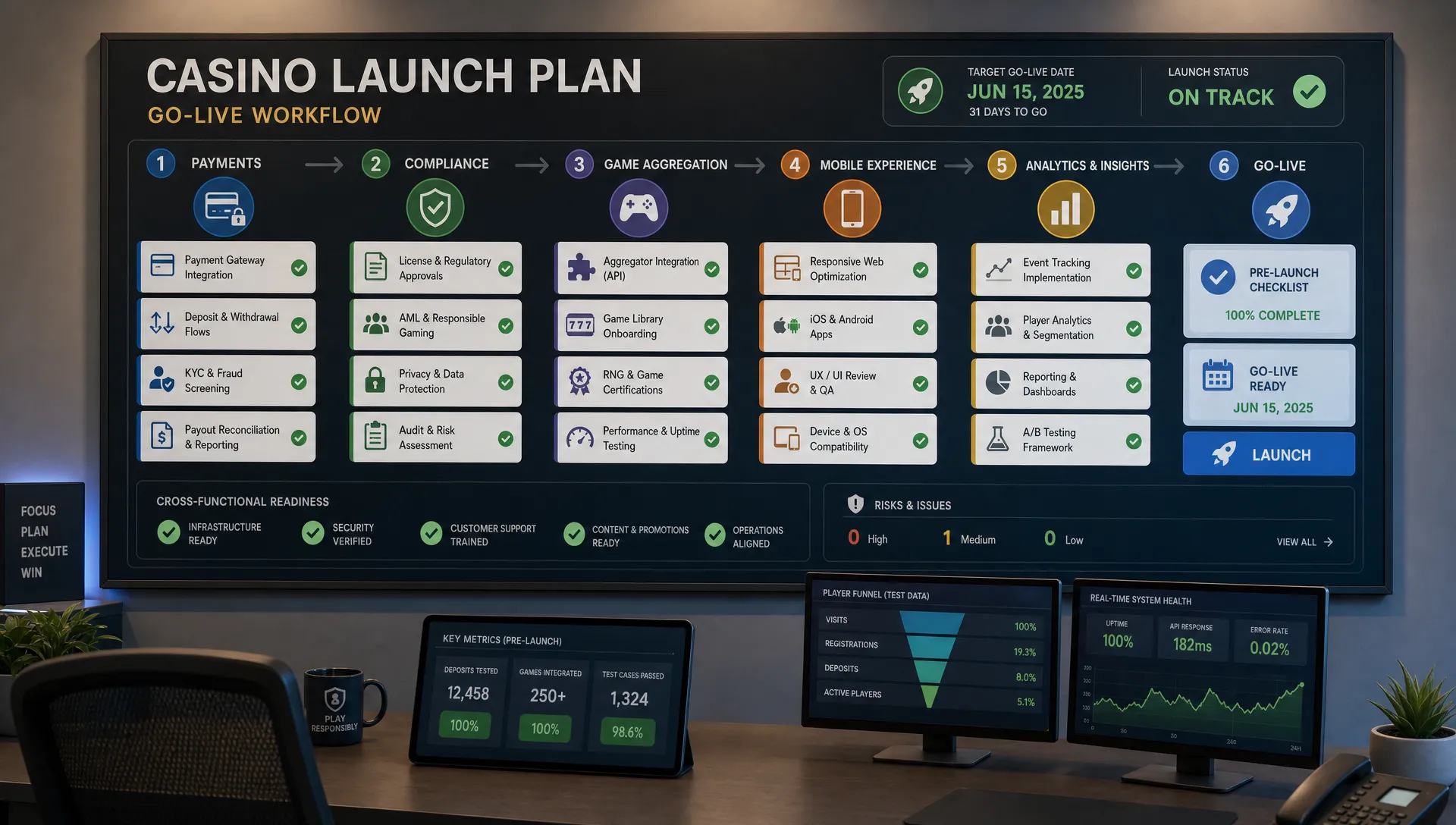
Prioritize the three launch bottlenecks: payments, compliance, and games
Most delayed casino launches do not fail because the logo is not ready. They slow down because the operator underestimated payments, regulatory operations, or game provider integrations.
Payments and wallets
Your payment gateway and wallet layer should be evaluated early, not after the frontend is designed. If your casino cannot reliably accept deposits, reconcile balances, process withdrawals, and handle failed transactions, everything else becomes secondary.
Ask vendors how their platform handles fiat payments, crypto payments, multi-currency balances, player wallets, merchant wallets, refunds, chargebacks, settlement reporting, and reconciliation. If cards are part of your plan, your payment setup will also need to align with security expectations such as those maintained by the PCI Security Standards Council.
For crypto-ready operations, look beyond the deposit button. You need to understand how the platform supports crypto onramp flows, custodial wallet models, transaction monitoring, exchange rate handling, and auditability. Crypto can speed up access in some markets, but it can also introduce compliance, volatility, and operational complexity if the wallet architecture is weak.
KYC, AML, and fraud prevention
Compliance readiness is another major launch gate. Casino software should support the workflows your legal and risk teams need, including identity verification, AML checks, risk flags, account review, transaction monitoring, document handling, and audit logs.
This is especially important if you are serving multiple markets or accepting digital assets. The FATF guidance for virtual assets is a useful reference point for understanding why risk-based controls matter in crypto-related financial activity. Your exact obligations will depend on your jurisdictions, licensing model, and legal advice, but your software should not force your team to manage risk manually in spreadsheets.
Game aggregation and provider access
A strong game aggregator can dramatically reduce launch complexity. Instead of negotiating and integrating every provider separately, you can access a broader catalog through a connected aggregation layer.
Still, aggregation quality varies. If your acquisition strategy depends on popular slot games, live casino games, or frequent new releases, ask how quickly new content can be enabled. For example, if your marketing calendar relies on new Pragmatic slots, new Hacksaw slots, or specific live dealer categories, confirm provider availability, market restrictions, certification requirements, and backoffice controls before signing.
Evaluate launch infrastructure, not just the player-facing lobby
The fastest casino software is not always the prettiest demo. It is the platform that lets your team operate with fewer dependencies after launch.
Backoffice usability matters because your operations team will use it daily. They need to manage players, review payments, configure bonuses, monitor suspicious activity, export reports, adjust content, and handle support issues without waiting for developers every time a setting changes.
Analytics also matter from day one. A real-time analytics dashboard can help you see whether players are dropping at registration, KYC, deposit, game launch, or withdrawal. Without that visibility, you may launch quickly but spend your first month guessing where revenue is leaking.
Mobile performance is another speed factor. In many markets, the first player experience happens on a phone, often on variable network quality. Slow lobby loads, heavy scripts, confusing cashier flows, or game launch failures can damage conversion before you have enough data to optimize. If mobile acquisition is a major part of your plan, it is worth reviewing how to build a mobile casino that loads fast before finalizing your platform requirements.
Make the vendor demo mirror a real launch
A generic product tour will not tell you whether a casino software provider can help you enter the market faster. Instead, give vendors a launch scenario and ask them to walk through the exact workflows your team will run.
| Demo test | What to ask the vendor to show | Why it matters for faster entry |
|---|---|---|
| Player onboarding | Registration, login, KYC review, blocked account handling | Reveals whether compliance workflows are operationally usable |
| Deposit to gameplay | Deposit, wallet update, game launch, balance sync | Tests the connection between payment gateway, wallet, and games |
| Withdrawal flow | Withdrawal request, approval, fraud check, payout status | Shows whether cashout operations can be managed without manual chaos |
| Bonus setup | Create a welcome bonus, apply rules, test abuse controls | Validates marketing readiness before acquisition spend begins |
| Affiliate tracking | Create affiliate links, track registrations, view conversions | Important if partner-led acquisition is part of launch |
| Risk operations | Flag suspicious behavior, restrict account, view audit trail | Reduces exposure during early traffic spikes |
| Reporting | Export player, payment, bonus, and revenue reports | Helps finance, compliance, and leadership monitor launch health |
A serious provider should be comfortable showing these flows in sequence. If they can only show static screenshots or promise that key workflows will be added later, treat that as a risk to your timeline.
Reduce customization until after the first live learning cycle
Customization is tempting, especially for founders who want to stand out. But heavy custom work before launch is one of the easiest ways to lose momentum.
A better approach is to customize what affects trust, conversion, and differentiation, while delaying anything that does not change launch viability. Brand identity, payment experience, mobile UX, bonus structure, and core content selection are worth early attention. Deep lobby personalization, experimental mechanics, complex VIP automation, and unusual backend rules can often wait until real user behavior shows what matters.
This is where modular casino software can help. You can launch with a stable foundation, then add modules or integrations as the business learns. Open API access is valuable here because it allows your team to connect external tools later without rebuilding the core casino platform.
Plan your first 90 days around operational readiness
Fast market entry is not just the day you go live. It is the full path from vendor selection to soft launch, monitoring, and iteration. Timelines vary depending on licensing, banking, compliance requirements, provider approvals, and internal readiness, but a practical launch plan often looks like this.
| Phase | Main goal | Casino software requirement |
|---|---|---|
| First 30 days | Lock scope, market requirements, brand setup, payment strategy, and core workflows | Configurable frontend, wallet setup, KYC and AML workflow mapping, game catalog planning |
| Days 31 to 60 | Test payments, games, bonuses, affiliate tracking, fraud controls, and reporting | Sandbox access, backoffice controls, game aggregation, payment gateway testing, analytics |
| Days 61 to 90 | Soft launch, monitor conversion, resolve operational issues, prepare expansion | Real-time dashboards, support workflows, risk monitoring, content adjustments, API readiness |
The goal is not to rush every feature live. It is to launch a controlled version of the business that can process real players, produce reliable data, and scale without rebuilding the foundation.
Watch for hidden delays in cheap casino software
Low-cost casino software can be a smart choice for lean operators, but cheap and fast are not the same thing. A lower upfront price can become expensive if the platform lacks wallet accuracy, payment reliability, fraud controls, mobile performance, or usable admin tools.
When comparing pricing, ask what is included in onboarding, integrations, support, game access, payment setup, compliance tools, hosting, reporting, and future customization. Also ask which tasks your internal team must handle. A provider can look affordable until you calculate the engineering, legal, payment, and operations work still left on your side.
If you are early in the buying process, reviewing common casino software buying mistakes can help you avoid decisions that feel fast during procurement but slow you down during implementation.
How Spinlab supports a faster market-entry strategy
Spinlab is built for operators that want to launch and scale an online casino without assembling the entire stack from scratch. Its modular iGaming platform combines core casino infrastructure with launch-critical capabilities such as crypto and fiat payment support, game aggregation, KYC and AML compliance tools, fraud prevention, multi-currency support, a customizable backoffice, real-time analytics, affiliate and bonus functionality, and mobile-optimized player experiences.
For founders and lean teams, the practical advantage is reduced operational friction. A Shopify-like user experience can make platform management easier, while modular components help teams start with the essentials and expand as the business grows. Spinlab also supports crypto onramp solutions, merchant custodial wallets, open API integration, and custom-designed original games for operators that want differentiation beyond a standard game catalog.
The best way to evaluate any casino software provider, including Spinlab, is to map your first launch scenario and test it against the platform. If the system can support your target market, payment model, content plan, compliance workflows, and first growth channel without heavy custom development, you are much closer to a realistic launch.
Frequently Asked Questions
What casino software is best for faster market entry? The best casino software for faster market entry is usually a modular or white label casino platform with prebuilt payments, wallet management, game aggregation, compliance workflows, fraud prevention, analytics, and backoffice controls. It should reduce integration work without locking you into a rigid operating model.
Is white label casino software faster than building from scratch? In most cases, yes. White label casino software is generally faster because many core systems are already built and connected. Custom builds can offer more control, but they usually require more time for architecture, integrations, testing, compliance workflows, and operational tooling.
What slows down an online casino launch the most? Payments, KYC and AML workflows, game provider access, wallet reconciliation, fraud controls, and mobile performance are common causes of delay. Teams also lose time when they over-customize before validating the first live version of the product.
Should a new online casino support crypto at launch? Crypto can be valuable if it matches your target audience and market strategy, but it should be supported by strong wallet infrastructure, transaction monitoring, compliance processes, and clear reconciliation. Do not add crypto only as a marketing feature if your team is not ready to operate it safely.
How many games should an online casino launch with? There is no universal number. A focused catalog that loads quickly, supports your target market, and includes the right mix of slots, live casino games, and differentiated content is often better than a huge library that is hard to navigate or poorly localized.
Launch faster with the right casino software foundation
If your priority is faster market entry, choose casino software that removes integration friction and gives your team operational control from day one. Payments, compliance, games, analytics, fraud prevention, and backoffice usability should work together, not as disconnected projects.
Spinlab Studio offers a modular, crypto-ready iGaming platform designed for lean teams that want to build, launch, and scale online casinos with less complexity. If you are preparing your first launch or replacing a slow legacy setup, start by mapping your go-live requirements against a platform built for speed and flexibility.