

A casino wallet is not just a balance shown in the cashier. It is the operational layer that connects players, payment providers, crypto custody, bonus rules, game sessions, compliance checks, settlement, and accounting. If that layer is weak, every other part of an online casino becomes harder to scale.
For crypto and fiat operations, wallet setup has a unique challenge: two very different payment ecosystems must behave like one reliable product. Players expect instant deposits, clear balances, fast withdrawals, and no confusion about fees or currency conversion. Operators need risk controls, auditability, liquidity, and a ledger that can explain every cent or satoshi.
A good casino wallet setup starts before choosing a payment gateway or crypto wallet provider. It starts with the operating model.
Define the wallet operating model first
Before integration begins, decide what the wallet must support on day one and what can be added later. This is especially important for a whitelabel casino or turnkey casino solution, where speed matters but shortcuts in wallet design can create costly reconciliation and compliance problems.
The core decisions are practical:
- Currencies supported: Decide whether players can hold balances in fiat, crypto, stablecoins, or an internal reference currency.
- Custody model: Define whether crypto funds are held by the operator, a licensed custodian, a payment provider, or a combination of hot, warm, and treasury wallets.
- Payment rails: Choose cards, bank transfers, local payment methods, crypto deposits, stablecoin payments, and crypto onramps based on target markets.
- Ledger approach: Determine whether the platform runs one unified player balance or multiple wallets per currency, product, or payment rail.
- Withdrawal policy: Set rules for KYC, AML screening, cooldowns, withdrawal limits, approval workflows, and destination wallet checks.
- Settlement rhythm: Define how frequently funds move from payment processors and hot wallets into treasury accounts.
The biggest mistake is treating fiat and crypto as separate systems that only meet in the front-end cashier. That creates fragmented player balances, duplicated fraud checks, and reporting gaps. Even if the payment rails are separate underneath, the operator should have one operational view of player funds, transactions, and risk.
Core wallet components for crypto and fiat casinos
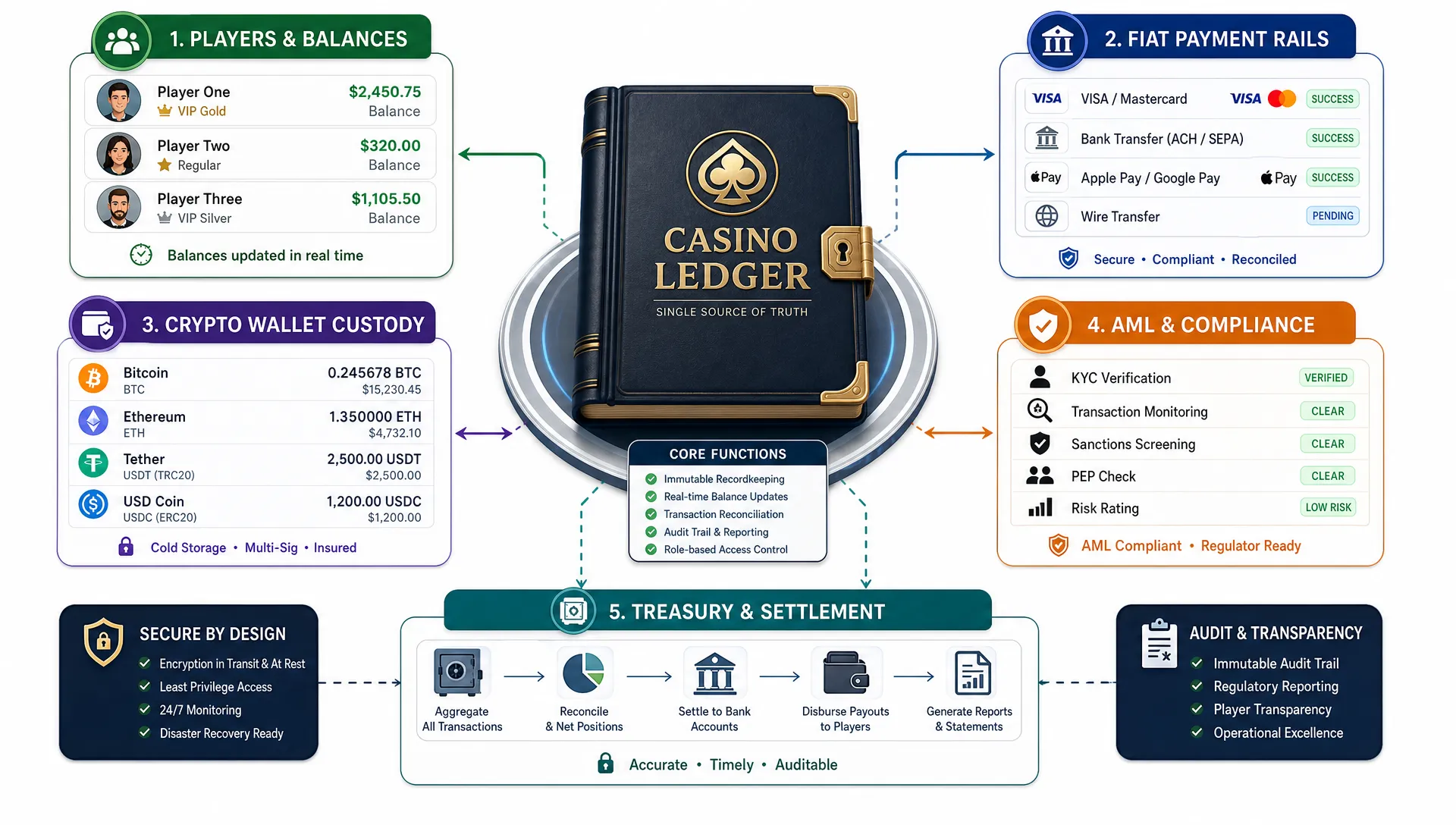
A casino wallet stack typically includes more than one actual wallet. Some components face the player, some hold funds, and others exist only for accounting or settlement. The setup should separate display balances from the true ledger of record.
| Component | Main role | Typical risk if poorly designed |
|---|---|---|
| Player balance ledger | Records deposits, bets, wins, bonuses, withdrawals, and adjustments | Incorrect balances, disputes, and failed audits |
| Fiat payment gateway | Connects cards, bank transfers, and local payment methods | Failed deposits, chargebacks, settlement delays |
| Crypto deposit wallets | Receive player crypto deposits or stablecoin transfers | Lost deposits, wrong-chain transfers, AML exposure |
| Merchant or operational wallets | Hold funds used for player withdrawals and daily liquidity | Excess hot wallet exposure, manual errors |
| Treasury wallets and accounts | Store longer-term liquidity and operator reserves | Poor fund segregation and weak reporting |
| Bonus wallet or bonus ledger | Tracks bonus funds, wagering rules, and restrictions | Bonus abuse, unclear player balances |
| Compliance and risk layer | Screens users, transactions, devices, and wallet addresses | Fraud losses, sanctions exposure, regulatory issues |
The architecture does not need to be overcomplicated, but every component needs a defined owner, approval process, and reconciliation path. If an amount moves, the ledger should know why, when, from where, to where, and under which user or operator action.
Single wallet or multi-wallet?
One of the first design choices is whether the player sees one balance or several balances. A single-wallet model gives players a simpler experience: deposit in one supported method, play across slot games and live casino games, then withdraw through an approved method. A multi-wallet model can be useful when regulations, bonus rules, or currency restrictions require separation.
For example, a platform may separate real-money funds from bonus funds, or fiat balances from crypto balances. It may also maintain internal sub-ledgers while showing a unified balance to the player. The right choice depends on market rules, product scope, accounting needs, and how much flexibility the operator needs in the future.
If you are still deciding between models, Spinlab has a deeper breakdown of single-wallet versus multi-wallet architecture and how each affects UX, custody, ledger design, and settlement.
For most modern iGaming platform builds, the practical answer is not purely one or the other. The strongest setup often uses a unified cashier experience with internal segmentation underneath. Players get clarity, while operators retain the controls needed for compliance, bonuses, and treasury management.
Build the ledger as the source of truth
The wallet interface is what the player sees. The ledger is what the business relies on.
Every financial event should be recorded as an immutable or tightly controlled ledger entry. This includes deposits, withdrawals, bet debits, win credits, bonus grants, bonus conversions, manual adjustments, refunds, chargebacks, onramp confirmations, crypto network fees, and FX conversions.
A reliable casino ledger should support:
- Idempotent transactions: The same payment callback should not credit a player twice.
- Atomic bet settlement: A bet debit and win credit should not leave the player in an impossible intermediate state.
- Currency precision: Fiat and crypto assets have different decimal requirements, so rounding rules must be explicit.
- Event traceability: Each balance change should link to a payment provider event, game round, admin action, or blockchain transaction.
- Reconciliation exports: Finance teams should be able to compare gateway settlements, blockchain transactions, game provider reports, and internal ledgers.
This is where many operators underestimate complexity. An online gambling platform may process thousands of small bet events, payment callbacks, bonus changes, and withdrawal requests. A spreadsheet mindset is not enough. The ledger must be engineered for volume, auditability, and exception handling.
Crypto deposit setup
Crypto deposits can be direct blockchain payments, custodial transfers through a provider, or onramp-assisted purchases where the player uses fiat to obtain crypto value. In all cases, the deposit flow should be clear to the player and tightly monitored by the operator.
A typical crypto deposit flow includes address generation, chain detection, transaction monitoring, confirmation rules, risk screening, crediting the internal ledger, and notifying the player. Stablecoins can simplify volatility, but they introduce network selection issues. A player sending USDT on the wrong chain can create support cases, recovery costs, or permanent loss if the system is not prepared.
Operators should avoid showing crypto as credited until the platform has received the required confirmation signal from its infrastructure or provider. Confirmation thresholds vary by asset, chain, risk policy, and provider configuration, so they should be documented rather than guessed.
The cashier should also make fees and supported networks obvious. If the platform supports USDC on one network but not another, the player should see that before sending funds. Good UX is a risk control.
Crypto withdrawal setup
Withdrawals are where operational discipline matters most. A crypto-ready solution should not simply let every user withdraw to any address instantly. Fast withdrawals are valuable, but they need risk controls.
A strong crypto withdrawal flow checks the player identity, account history, bonus restrictions, withdrawal limits, device and IP risk, wallet address risk, sanctions exposure, and transaction history before approving the payout. Higher-risk withdrawals can be paused for review while low-risk withdrawals move through a faster path.
The operational wallet should also be protected by signing controls. Hot wallets are useful for speed, but they should hold only the liquidity required for normal operations. Larger balances should sit in more protected treasury storage with stricter approval rules.
Fiat wallet and payment gateway setup
Fiat payments come with their own requirements. Card deposits, bank transfers, instant payment methods, e-wallets, and local payment methods all have different settlement times, fee structures, refund processes, and dispute mechanisms.
For fiat operations, the wallet setup must account for three different moments:
| Moment | What happens | Wallet implication |
|---|---|---|
| Authorization or payment initiation | The payment gateway says the transaction has started or is approved | Do not over-credit unless the method and risk rules support it |
| Player balance credit | The casino ledger updates the player balance | Must be tied to a provider reference and fraud decision |
| Settlement to operator | Funds arrive in the operator or merchant account | Must reconcile against credited deposits, fees, refunds, and chargebacks |
The payment gateway integration should also handle failed transactions, duplicate callbacks, partial captures where relevant, refunds, chargebacks, and provider downtime. The casino wallet should never rely only on a front-end success page. Server-to-server callbacks and reconciliation files are essential.
For card payments, operators should also understand PCI DSS obligations. The PCI Security Standards Council publishes the standards used to protect cardholder data, and even operators using hosted payment pages should confirm where their responsibilities begin and end.
Add a crypto onramp when it improves conversion
A crypto onramp lets players use fiat payment methods to acquire crypto or stablecoin value as part of the cashier experience. This can be helpful when players are interested in crypto casino payments but do not already hold assets in a self-custody wallet or exchange account.
From an operator perspective, onramps can reduce friction, but they must be integrated carefully. The onramp provider may perform its own KYC checks, apply transaction limits, and make approval decisions. The casino still needs to understand what data comes back, how funds are credited, how failed purchases are handled, and how onramp transactions reconcile with the internal ledger.
If onramp conversion is part of your launch plan, review the operational flow in Spinlab’s crypto onramp setup guide for operators before defining cashier requirements.
Reconciliation is not optional
Wallet setup is incomplete without reconciliation. Operators need a daily process that compares internal ledger activity with external sources. This includes blockchain explorers or custody provider reports, fiat payment gateway reports, bank settlements, game aggregator round reports, bonus engine records, and manual admin logs.
Reconciliation should answer simple but critical questions: Did every credited deposit settle? Did every withdrawal leave the correct account? Did game results match the game provider report? Did chargebacks reverse player balances correctly? Are crypto network fees recorded properly? Are treasury transfers explained?
A useful reconciliation workflow groups issues into categories:
| Exception type | Example | Recommended response |
|---|---|---|
| Missing credit | Blockchain deposit detected but no player balance update | Investigate address mapping, confirmations, and callbacks |
| Duplicate credit | Same payment provider event credited twice | Reverse duplicate entry and fix idempotency logic |
| Settlement mismatch | Gateway settlement is lower than expected | Compare fees, refunds, chargebacks, and rolling reserves |
| Game round mismatch | Provider round total differs from ledger records | Pause affected reports and reconcile with provider data |
| Manual adjustment gap | Admin balance change lacks a clear reason | Require maker-checker approval and audit notes |
Reconciliation is also a management tool. It shows where support tickets come from, which payment methods fail most often, and where liquidity planning needs improvement.
Compliance, AML, and fraud controls
Crypto and fiat operations should share one risk framework, even if the payment rails differ. A player who deposits by card and withdraws by crypto, for example, creates a cross-rail risk scenario. The wallet must support rules that detect unusual patterns across the full account lifecycle.
Core controls include KYC verification, sanctions screening, transaction monitoring, deposit and withdrawal velocity checks, bonus abuse detection, device fingerprinting, chargeback monitoring, source-of-funds review for higher-risk users, and blockchain address screening where crypto is supported.
Global AML expectations continue to evolve, especially for virtual assets. The FATF Recommendations are a key reference point for how jurisdictions approach AML and counter-terrorist financing controls. Operators should always work with specialized legal and compliance advisers for the markets they target.
Compliance should not be bolted on after launch. It should be part of the wallet workflow from the first deposit through the final withdrawal.
Liquidity and treasury planning
A casino wallet can be technically correct and still fail operationally if liquidity is poorly managed. Players expect withdrawals to be available when they win. At the same time, operators should not keep excessive funds in hot wallets or payment accounts that are exposed to operational risk.
A practical treasury setup separates daily operating liquidity from longer-term reserves. Fiat funds may move from payment processors to merchant accounts and then to treasury bank accounts. Crypto funds may move from deposit addresses or operational wallets into treasury custody. The timing depends on player demand, risk appetite, settlement cycles, and market volatility.
Stablecoins can help reduce crypto price volatility, but they do not remove operational risk. Operators still need rules for supported assets, chain exposure, counterparty risk, and liquidity rebalancing.
Launch checklist for casino wallet setup
Before going live, test the wallet like a financial system, not just a checkout page. Real-money failures are expensive, and many of the most painful issues appear in edge cases.
Use this checklist before launch:
- Test every deposit route from initiation to balance credit, including failed, delayed, duplicated, and cancelled payments.
- Test every withdrawal route with KYC-approved users, high-risk users, bonus-restricted balances, and insufficient liquidity scenarios.
- Validate ledger precision across all supported fiat currencies, crypto assets, stablecoins, and internal bonus balances.
- Confirm reconciliation reports match payment gateway, bank, custody, blockchain, and game aggregator records.
- Review admin permissions so manual balance changes, withdrawal approvals, and treasury movements require appropriate access.
- Document incident procedures for stuck deposits, wrong-chain transfers, provider outages, chargebacks, suspicious withdrawals, and player disputes.
- Set operational limits for hot wallets, daily withdrawals, manual reviews, payment method exposure, and treasury transfers.
- Train support teams on how to explain pending deposits, confirmations, fees, bonus restrictions, and withdrawal review statuses.
The goal is not to eliminate every exception. The goal is to make exceptions visible, traceable, and manageable.
What a strong wallet setup gives operators
A well-designed casino wallet setup improves more than payments. It gives the operator better control over the entire business.
Players get a clearer cashier, fewer failed payments, faster balance updates, and more transparent withdrawals. Finance teams get cleaner settlement reporting. Compliance teams get consistent controls across fiat and crypto. Product teams can launch new payment methods, slot games, live casino games, bonus campaigns, and game aggregator integrations without rebuilding the financial core each time.
For a growing online casino, this flexibility matters. Payment methods change by market, crypto adoption changes over time, and regulation is never static. A modular wallet foundation lets the operator adapt without turning every new rail into a custom project.
Frequently Asked Questions
What is a casino wallet? A casino wallet is the system that records and manages player balances, deposits, withdrawals, bets, wins, bonuses, and adjustments. It may connect to fiat payment gateways, crypto wallets, custody providers, game aggregators, and compliance tools.
Should an online casino use one wallet or multiple wallets? It depends on the operating model. A single-wallet experience is simpler for players, while multi-wallet or sub-ledger structures can help with currency separation, bonus rules, compliance, and accounting.
Can a casino support both crypto and fiat payments? Yes. Many modern operators use a hybrid cashier that supports fiat payment methods, crypto deposits, stablecoins, and sometimes crypto onramps. The key is using a unified ledger and consistent risk controls.
What is the difference between a payment gateway and a casino wallet? A payment gateway processes external payment transactions, such as card deposits or local payment methods. The casino wallet records the player balance and internal financial events connected to those payments.
Why is reconciliation important for casino wallets? Reconciliation confirms that internal ledger records match external sources such as payment gateway settlements, bank deposits, blockchain transactions, custody reports, and game provider records. Without it, operators can miss losses, errors, or fraud.
Build crypto and fiat wallet operations with Spinlab
Spinlab provides a modular, all-in-one iGaming platform for operators building, launching, and scaling online casinos. The platform supports crypto and fiat payments, multi-currency operations, KYC and AML workflows, fraud prevention, real-time analytics, game aggregation, bonus tools, and a customizable backoffice admin panel.
If you want a crypto-ready casino platform with a Shopify-like management experience and the flexibility to grow across markets, explore Spinlab’s whitelabel casino software and build your wallet operations on a foundation designed for fast onboarding and long-term scale.