

Wallet architecture is one of those “invisible” platform decisions that quietly determines your cashier conversion, fraud exposure, reporting speed, and how painful audits become. If you are launching or migrating an online casino in 2026 (especially with mixed fiat and crypto rails), choosing between a single wallet and a multi-wallet model is not just a technical preference, it is an operating model.
This guide breaks down what each approach really means in an iGaming platform, where each one wins, where it fails, and the hybrid patterns most teams end up shipping.
What “single wallet” and “multi-wallet” mean in iGaming
At a high level:
- A single wallet means the player has one available balance that works across the product experience (casino, live casino, sportsbook, etc.), and usually across payment methods. Internally, you might still have multiple ledgers or sub-accounts, but the UX presents one wallet.
- A multi-wallet means the player has separate balances by product, currency, jurisdiction, or even provider. Players may need to transfer funds between wallets (for example, “Main” to “Casino”, or “Fiat” to “Crypto”).
In practice, “wallet” can mean different things depending on your stack:
- Balance store (what the frontend shows)
- Ledger (the audit-grade system of record)
- Custody layer (where money is actually held, especially for crypto and merchant custodial wallets)
- Settlement and reconciliation (how you map PSP statements, on-chain transfers, and provider reports back to the ledger)
A clean decision starts with clarity on which of these you are splitting or unifying.
Single wallet architecture (how it works)
A proper single-wallet system is usually built around an append-only ledger with strong idempotency guarantees. The player’s “available balance” is computed as a function of ledger entries (plus reserved amounts), not as a mutable number that is updated ad hoc.
A typical flow looks like this:
- Deposit is authorized or confirmed (card capture, APM confirmation, bank transfer clearing, or on-chain confirmation).
- Ledger records the credit.
- Game bet requests reserve or debit funds.
- Game outcomes credit winnings.
- Withdrawals reserve funds, then settle when the payout is executed.
Even if you call it “single wallet,” most modern implementations still maintain internal separation such as:
- Available vs reserved (to prevent double-spend during in-flight bets and withdrawals)
- Per-currency sub-ledgers (USD vs EUR vs stablecoins)
- Per-jurisdiction accounting views (for ring-fencing and reporting)
Where single wallet wins
1) UX conversion and cross-sell
A single wallet reduces steps between “deposit” and “play,” and between verticals. That matters because every extra transfer screen becomes a drop-off point and a support burden.
2) Bonus and VIP logic stays coherent
A unified wallet makes it easier to implement platform-wide wagering requirements, bonus locks, and VIP accrual without building complicated “wallet transfer” exceptions.
3) Cleaner responsible gambling controls
Deposit limits, loss limits, reality checks, and affordability workflows are easier to enforce when the player has one balance and one set of platform-wide counters.
4) Less reconciliation sprawl
With one ledger model, you typically have fewer “where did the money go?” investigations, fewer manual adjustments, and less operational drift.
Where single wallet hurts
1) Larger blast radius
If wallet code regresses, you can affect every product line. This is why mature teams treat wallet changes like payments changes, with staged rollouts and heavy telemetry (see Spinlab’s approach to safe rollouts in Canary Releases in iGaming: Rolling Out New Wallet Code Safely).
2) Harder “regulatory ring-fencing” if you model it too simplistically
Some markets require strict separation of balances, reporting, or even custody. You can still implement this with a single-wallet UX, but you must support jurisdiction-aware ledger views and controls.
3) Multi-currency edge cases become your everyday life
FX, rounding, negative balances, chargebacks, and crypto volatility all collide in one place. If you run multiple currencies, you need explicit deficit handling policies and automated playbooks (related: How to Handle Negative Balances in Multi-Currency Wallets).
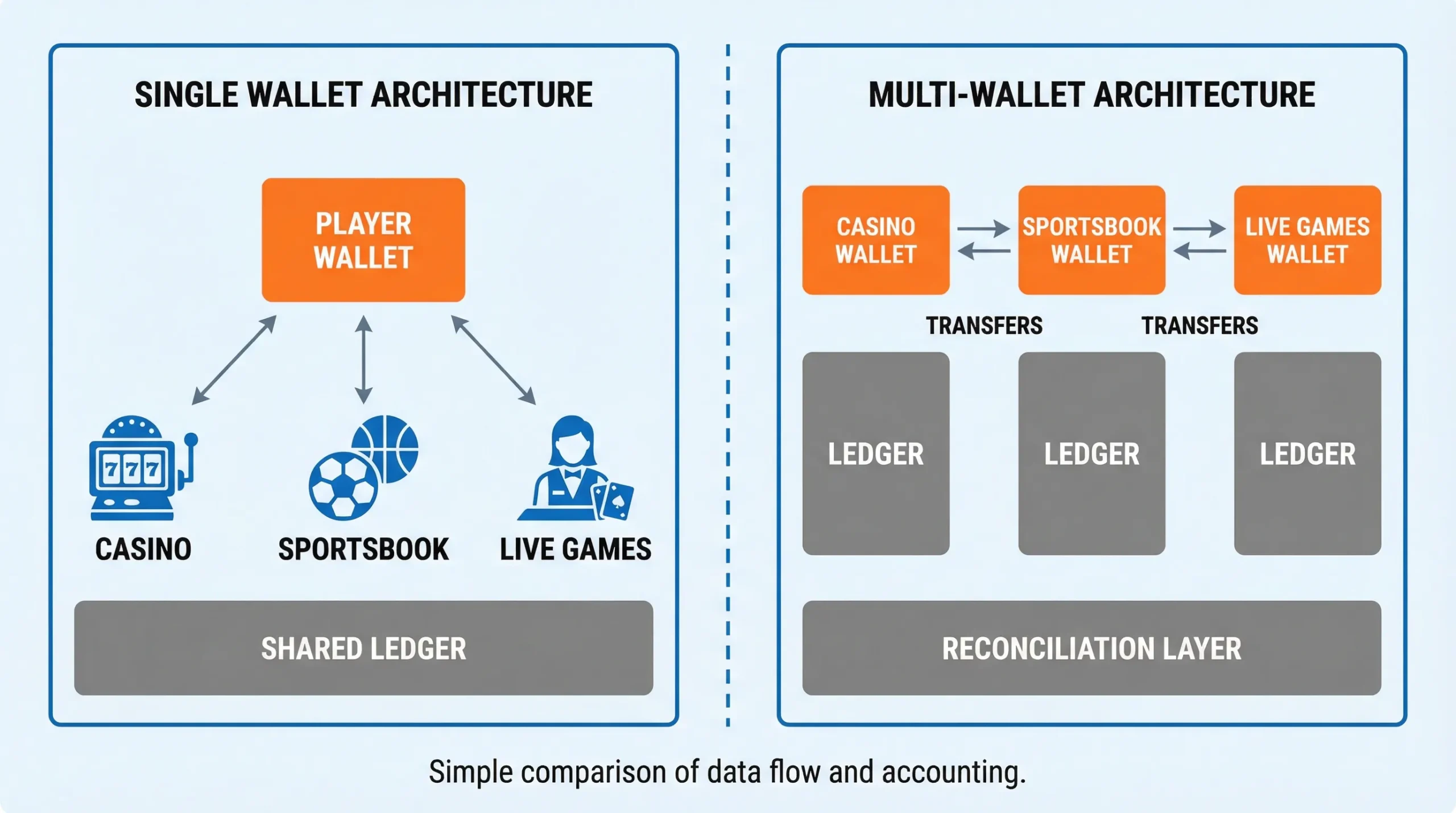
Multi-wallet architecture (how it works)
Multi-wallet designs come in several flavors:
- Per-vertical wallets: Casino wallet, sportsbook wallet, poker wallet.
- Per-currency wallets: USD wallet, EUR wallet, USDT wallet.
- Per-jurisdiction wallets: One wallet per regulated market.
- Per-provider wallets (less common today): Separate balance per game provider or aggregator.
Technically, this often results in:
- Separate ledgers or at least separate account trees
- A transfer service that moves value between wallets
- More complex “available balance” rules (especially when transfers are pending)
- More reconciliation surfaces (each wallet may settle differently)
Where multi-wallet wins
1) Isolation and containment
If one vertical has a dispute, outage, or a provider settlement issue, the impact can be contained to that wallet.
2) Clear separation for ring-fenced operations
If you operate across jurisdictions with strict separation requirements, multi-wallet can make the compliance story simpler, at the cost of UX.
3) Easier integration with legacy verticals
If you are stitching together a sportsbook stack and a casino stack from different vendors, multi-wallet can be the “least bad” path to go live quickly.
Where multi-wallet hurts
1) Cashier friction and transfer abandonment
Players do not think in internal platform boundaries. “Why do I have money, but I cannot bet?” becomes a top support driver.
2) Fragmented bonuses, limits, and analytics
You either duplicate logic per wallet or build a complex cross-wallet rules layer, which defeats the simplicity you were aiming for.
3) More reconciliation and more manual operations
More wallets usually means more statements, more settlement timing differences, and more places for drift. If you are also supporting both crypto and fiat rails, this can become operationally expensive.
Decision framework: when to choose single wallet vs multi-wallet
Use this table as a practical “default” guide. Most teams should still validate the choice against their licensing and banking constraints.
| Decision factor | Single wallet is usually better when… | Multi-wallet is usually better when… |
|---|---|---|
| Player experience | You want the fewest steps from deposit to play and easy cross-sell | You can accept transfers and more cashier steps |
| Product mix | You run casino plus live casino (and want future sportsbook) in one experience | Each vertical is owned by different systems or vendors |
| Compliance model | You can enforce rules via jurisdiction-aware ledgers and controls | You must hard-separate balances by market or entity |
| Payments complexity | You want one place to orchestrate rails, fees, limits, and risk | Different wallets map to different payment providers or settlement models |
| Fraud and abuse | You want unified risk scoring and consistent velocity limits | You prefer isolating certain rails or verticals behind separate balances |
| Ops and support | You want fewer “balance missing” tickets and simpler adjustments | You have a strong payments operations team and tooling for transfers |
| Speed to launch | You are launching on a consolidated platform | You are stitching systems together and need a bridging strategy |
The hybrid pattern most successful operators converge on
In 2026, many “single vs multi” debates end with a hybrid:
- Single wallet UX for the player
- Multi-ledger or sub-ledger backend for audit, jurisdiction separation, and operational clarity
This pattern works because it delivers:
- One balance experience (conversion)
- Clear internal accounting partitions (compliance and reporting)
- Controlled isolation (risk)
Think of it as “one wallet, many views.” Your ledger can represent multiple accounts, but the product does not force players to manage transfers unless there is a real regulatory reason.
Wallet architecture implications you should not ignore
1) Payments, custody, and settlement are part of wallet architecture
Wallet choice impacts how you integrate:
- Fiat PSPs (auth/capture, chargebacks, payouts)
- APMs and pay-by-bank rails
- Crypto deposits and withdrawals, including custody design
If you support crypto, you also inherit Travel Rule and AML requirements in many contexts. Even if you do not operate in the EU, counterparties may enforce these controls. Reference frameworks include FATF guidance and the “Travel Rule” expectations for virtual assets (FATF).
For card acceptance and storage of cardholder data, your architecture decisions can also change PCI scope. PCI DSS is maintained by the PCI Security Standards Council (PCI SSC).
2) Game providers and aggregators assume specific wallet semantics
Game integrations typically need:
- Idempotent bet and win calls
- Consistent balance responses
- Clear handling of round closure and retries
Multi-wallet can complicate this when different providers map to different balances or transfer states.
3) Bonus abuse and fraud controls change with your wallet model
- Single wallet makes it easier to enforce global velocity limits and bonus constraints.
- Multi-wallet can reduce exposure in one vertical, but it can also create arbitrage opportunities if your transfer rules are loose.
If you are building your fraud stack, wallet telemetry should feed your risk layer. Spinlab covers operational playbooks in Bonus Abuse Detection: Rules, Signals, Playbooks.
Implementation checklist (architecture questions to answer early)
Ledger and data model
- Is the ledger append-only, and can you reconstruct balances from events?
- What is your idempotency strategy for deposits, bets, wins, refunds, and chargebacks?
- How do you represent reserved funds for in-flight rounds and withdrawals?
Currency and FX
- Do you maintain separate currency sub-accounts, even if the UX is single wallet?
- What is your FX policy for display, acceptance, and wallet accounting?
- How do you prevent and resolve negative balances, especially across volatile assets?
Compliance and audit
- Can you produce an audit trail that links identity, payment events, wallet entries, and gameplay?
- How do you enforce jurisdiction rules, including geo restrictions and payment method constraints?
Operations and incident response
- What tooling exists for recon, manual adjustments, and dispute evidence packs?
- What is your deployment strategy for wallet changes (staged rollout, dual-write, diffs)?
What to measure after you ship (KPIs that reveal if you chose correctly)
A wallet architecture decision should show up in operational and revenue metrics within weeks.
| KPI | Why it matters | Typical “wallet architecture” failure signal |
|---|---|---|
| Time to playable balance | Directly impacts conversion | Pending states, transfers required, slow confirmations |
| Deposit abandonment rate | Captures cashier friction | Extra steps between deposit and first bet |
| “Balance missing” support tickets | Measures UX clarity | Multi-wallet confusion, transfer delays |
| Reconciliation time per day | Measures ops load | Many ledgers, many settlement schedules |
| Chargeback and refund handling time | Measures dispute readiness | Weak linkage between payments and ledger entries |
| Fraud loss rate per rail | Measures risk containment | Inconsistent limits across wallets or products |
How Spinlab approaches wallet architecture
Spinlab is built as a modular iGaming platform with an emphasis on fast onboarding and an operator-friendly interface, while supporting both crypto and fiat payments, multi-currency, compliance controls (KYC and AML), and fraud prevention.
In practice, operators evaluating Spinlab typically care about wallet architecture for three reasons:
- They want a single-wallet player experience that reduces cashier friction.
- They need crypto-ready flows (including custody and onramp support) alongside fiat rails.
- They want to avoid building and maintaining multiple wallet systems across brands and markets.
If you are currently deciding between single wallet and multi-wallet, a productive next step is to map your licensing, payment rails, and product roadmap to a target ledger model, then sanity-check it against your reconciliation and fraud workflows.
For deeper related reading:
- Wallet security controls: Custodial Wallet Security Checklist for Casinos
- Routing and approval optimization: Casino Payment Orchestration 101: Routing for Higher Approval
Frequently Asked Questions
Is single wallet always better for casino conversion? Usually, yes. Fewer transfer steps and clearer balances reduce friction, especially on mobile. The trade-off is that you must engineer stronger isolation, monitoring, and safe rollout practices.
Do regulators require multi-wallet setups? Some jurisdictions require separation of funds, reporting, or operational controls. That does not always mean you need multi-wallet UX. Many operators implement a single-wallet experience with jurisdiction-aware sub-ledgers and controls.
Can you support both crypto and fiat in a single wallet? Yes, but you should assume you will run per-currency sub-accounts internally and enforce clear policies for FX, volatility buffers, confirmations, and negative balance handling.
What is the biggest operational risk with multi-wallet? Transfer-related complexity: pending states, support tickets, and reconciliation drift across multiple settlement schedules. If you choose multi-wallet, invest early in tooling and clear UX.
What is the biggest operational risk with single wallet? Blast radius. Wallet bugs impact the entire product, so you need strong idempotency, auditability, and staged deployment strategies.
Want a wallet architecture review before you commit?
If you are launching a new online casino or migrating from a fragmented stack, Spinlab can help you pressure-test your wallet model against payments, compliance, fraud, and growth goals.
Explore the platform at spinlab.studio and request a walkthrough to discuss the right wallet architecture for your markets and rails.