

Data residency for online casinos is the discipline of deciding where player, payment, game, security, and operational data is stored, processed, accessed, backed up, and deleted. For iGaming operators, it is not just an IT hosting choice. It can affect licensing, payment approvals, KYC workflows, analytics, fraud prevention, disaster recovery, and the vendors you are allowed to use.
In 2026, this matters more than ever because online casinos increasingly run across multiple markets, currencies, payment rails, and cloud regions. A crypto-ready solution may process wallet addresses and onramp checks. A game aggregator may route round data across borders. A support tool may expose player records to remote agents. A real-time analytics dashboard may copy events into a region that was never reviewed by compliance.
This guide gives operators, founders, and technical teams a practical way to think about data residency before launching or scaling an online gambling platform. It is not legal advice, but it will help you ask the right questions before counsel, regulators, banks, and vendors ask them for you.
What data residency means for an online casino
Data residency means data is physically or logically stored in a specific country, region, or cloud location. For an online casino, the question is not only “where is the database?” It is also “who can access it, where do backups go, where are logs retained, and which third parties receive copies?”
It helps to separate three related concepts:
| Concept | What it means | iGaming example |
|---|---|---|
| Data residency | Data is stored in a chosen location | Player KYC files are stored in an EU cloud region |
| Data localization | Law or regulator requires certain data to remain local | A market requires gambling records or identity data to stay in-country |
| Data sovereignty | Data is subject to the laws of the country where it is stored or controlled | A cloud provider or processor may be compelled under local law to disclose data |
| Cross-border transfer | Data is moved or made accessible outside its original jurisdiction | A support team outside the EEA views an EU player account |
For online casinos, remote access can be as important as storage. If personal data is hosted in Frankfurt but accessed by a risk analyst in another country, that access may still be treated as a transfer under some privacy regimes. The same applies to exports into business intelligence tools, CRM platforms, fraud systems, payment gateways, and cloud logs.
Why casinos have unusually sensitive data flows
An ecommerce business may store names, addresses, orders, and payment tokens. An online casino typically stores all of that plus gambling-specific data that regulators, banks, and privacy authorities treat with extra care.
Casino data often includes identity verification documents, source-of-funds checks, geolocation, device fingerprints, IP addresses, self-exclusion flags, bonus abuse signals, game rounds, wallet activity, affiliate attribution, chargeback records, and customer support transcripts. Some of this data is needed for legal compliance. Some is needed for fraud prevention. Some is used for player experience and retention. All of it needs a clear home.
| Data category | Examples | Why residency matters | Practical handling |
|---|---|---|---|
| Identity and KYC | Passport, selfie, address proof, PEP or sanctions results | Highly sensitive, often shared with verification vendors | Store in approved regions, limit access, encrypt documents, define retention periods |
| Account and profile data | Name, email, phone, date of birth, preferences | Personal data with privacy rights attached | Keep a regional system of record and synchronize only what is necessary |
| Payment data | Card tokens, bank details, deposits, withdrawals, chargebacks | Subject to payment rules and audit expectations | Reduce scope through tokenization and payment processor vaults |
| Crypto data | Wallet addresses, transaction hashes, onramp checks, custodial balances | May link pseudonymous blockchain activity to identified players | Separate wallet operations from player identity where possible and document linkages |
| Game data | Round IDs, bets, wins, RTP logs, session history | Needed for audits, dispute handling, responsible gambling | Retain in regionally approved storage with immutable audit trails where required |
| Risk and fraud data | Device IDs, IP intelligence, velocity checks, bonus abuse signals | Often processed by third-party tools across borders | Use pseudonymous identifiers and validate vendor subprocessors |
| Analytics and marketing | Segments, events, funnels, campaign attribution | Can create profiling risks under privacy laws | Aggregate where possible and avoid exporting raw player data unnecessarily |
| Support data | Chats, emails, complaints, documents | Agents may expose data across borders | Use role-based access, redaction, and regional access rules |
A useful rule of thumb: if a dataset can identify a player, affect a player’s account, prove a gambling transaction, or satisfy a regulator, it belongs in the data residency plan.
Start with the markets, not the servers
Many teams start data residency planning by choosing a cloud region. That is backwards. Start with the jurisdictions where you will operate, advertise, license, accept payments, or provide customer support.
At a minimum, map these sources of obligation:
- Privacy laws: The EU GDPR, UK GDPR, Brazil’s LGPD, and other privacy frameworks may restrict international transfers, require security controls, and give players rights over personal data.
- Gambling license conditions: Regulators may require access to player records, transaction histories, reporting logs, or local audit data.
- Payment and banking requirements: Acquirers, payment service providers, and card schemes may impose data security and processing expectations.
- KYC and AML requirements: Identity checks, sanctions screening, and suspicious activity records may have minimum retention periods.
- Tax and accounting rules: Financial records and betting transactions may need to be retained for specific periods in accessible formats.
- Vendor contracts: Game studios, live casino providers, CRM tools, and fraud vendors may have their own processing locations and subprocessors.
For example, the GDPR does not automatically require all EU personal data to stay inside the EU. But it does restrict transfers of personal data outside the EEA unless the transfer has an approved basis, such as an adequacy decision or appropriate safeguards under GDPR Chapter V. Operators working across Europe and Brazil should also compare GDPR and LGPD data rules for casinos before deciding how to structure player identity, payments, and analytics.
The practical takeaway is simple: your residency model should follow your legal footprint, not your engineering team’s preferred region.
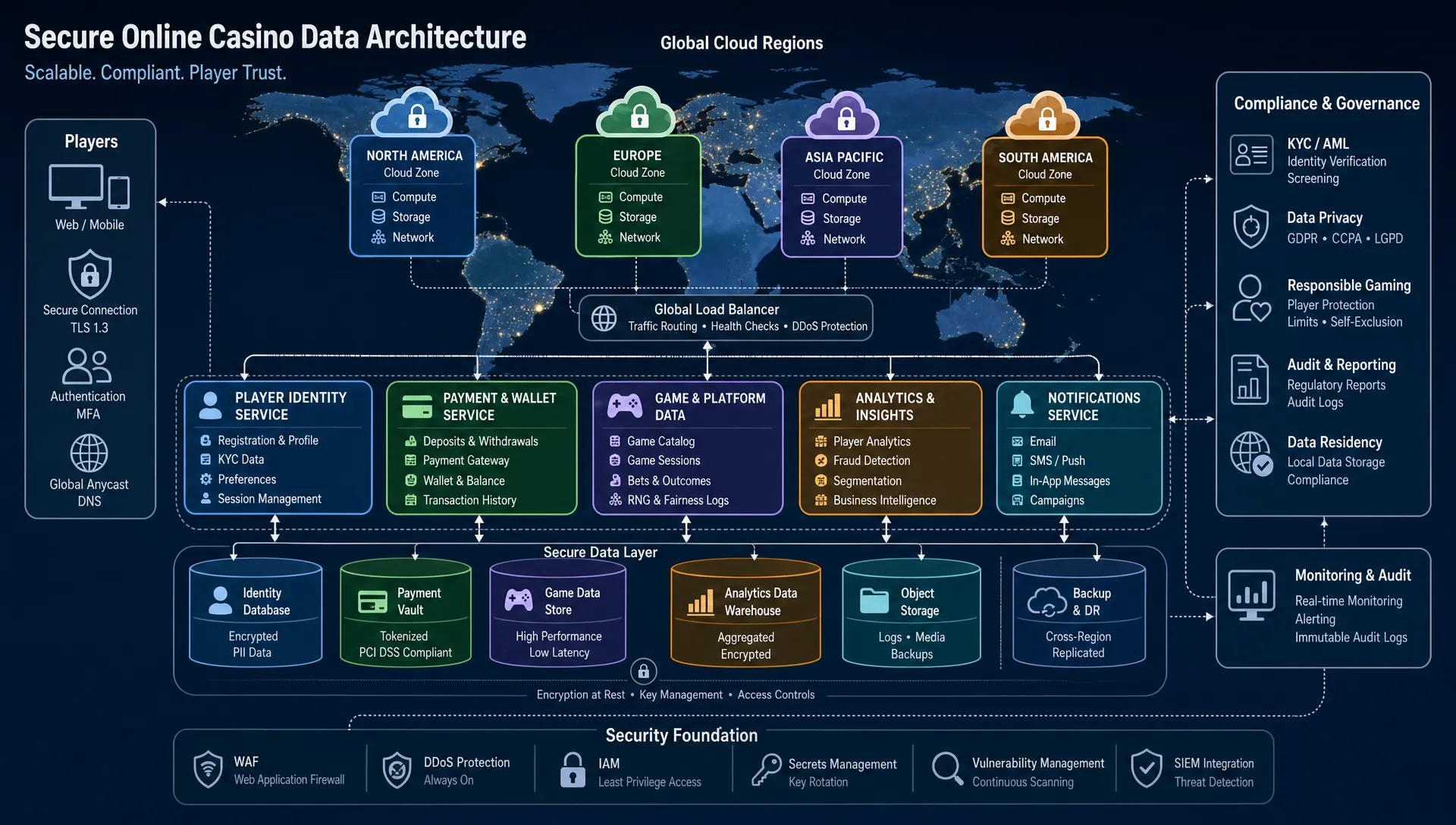
Build a casino data map before choosing a residency model
A data map is the foundation of every serious residency program. It does not need to be perfect on day one, but it must be detailed enough to show where sensitive data enters, where it goes, who touches it, and how long it remains.
For each data flow, document the source, data type, system owner, storage region, processing region, subprocessors, retention period, encryption approach, and deletion process. This should include production databases, replicas, object storage, logs, data warehouses, backups, sandbox environments, and manual exports.
A common mistake is mapping only the main player database. In iGaming, data often leaks into adjacent tools. A bonus engine may store player segments. A payment gateway may store transaction metadata. A game aggregator may store round history. A BI tool may ingest raw events. A support platform may store screenshots of KYC documents. A fraud provider may process device fingerprints.
If your casino uses a Customer Data Platform or event pipeline, treat it as a core residency component, not a marketing add-on. Event streams can contain deposits, failed withdrawals, bonus triggers, location data, device information, and behavioral signals. If you are designing this layer, Spinlab’s guide to building a casino CDP around events, identity, and activation is a useful companion to the residency planning process.
Choose the right data residency architecture
There is no single best architecture for every online casino. The right model depends on your licensing strategy, launch markets, cloud provider, payment stack, game suppliers, budget, and operational maturity.
| Architecture model | How it works | Best fit | Main tradeoff |
|---|---|---|---|
| Single-region hosting | Most systems run in one approved region | Early-stage casinos in one primary market | Simpler, but harder to expand into strict jurisdictions |
| Regional data stores | Player and transaction data stay in market-specific regions | Multi-market operators with clear jurisdiction boundaries | More complex identity, reporting, and support workflows |
| Split control plane and data plane | Admin tools are centralized, sensitive data stays regional | Operators wanting centralized operations without raw data movement | Requires strong access controls and careful API design |
| Tokenized global services | Global tools use tokens or pseudonymous IDs instead of raw player data | Analytics, fraud scoring, and game aggregation | Requires robust token mapping and re-identification controls |
| Local regulated archive | Operational systems are global or regional, but required records are copied locally | Markets that require audit access or local recordkeeping | Adds retention, reconciliation, and deletion complexity |
For a new operator, a pragmatic approach is often to start with one or two carefully selected regions, keep sensitive data close to the licensing and player base, and design APIs so new regional stores can be added later. For an established operator, the challenge is usually untangling existing data flows that grew organically.
If you are relocating production systems or preparing to serve a new jurisdiction, treat residency as part of the migration project. A live-money casino cannot move regions like a simple brochure site. Payments, wallets, game rounds, bonuses, fraud rules, and reporting all need controlled cutovers, which is why a dedicated casino cloud region migration checklist is worth using before any move.
Keep payments, wallets, and KYC under special control
Payments deserve their own residency review because they sit at the intersection of privacy, financial regulation, AML, fraud, and user trust. Even when your payment service provider stores card data or bank details for you, your casino may still store transaction references, player balances, deposit attempts, withdrawal approvals, chargeback notes, and risk decisions.
For card payments, the goal is usually to reduce the amount of cardholder data your platform stores or transmits. Tokenization, hosted payment pages, and payment processor vaulting can reduce exposure, but they do not remove the need to understand where payment metadata is stored. Operators accepting cards should align residency decisions with their PCI scope, and Spinlab’s plain-English guide to PCI DSS for iGaming explains how payment data typically fits into a casino stack.
Crypto adds another layer. A crypto-ready solution may process blockchain transaction hashes, wallet addresses, exchange rates, onramp KYC, withdrawal whitelists, custody records, and suspicious transaction alerts. Some blockchain data is public, but the moment it is linked to a verified player account, it can become personal or regulated operational data. Keep that linkage controlled, encrypted, and limited to systems that truly need it.
KYC and AML vendors also require attention. Many operators assume the vendor “handles compliance,” but the casino remains responsible for choosing appropriate processors and configuring the data flow correctly. Review where identity documents are stored, where biometric checks are performed, who the vendor’s subprocessors are, how results are returned, and how long documents are retained after the account closes.
Review game aggregators and content providers
Game aggregation is central to a modern online casino, but it introduces data residency questions that are easy to overlook. A slot game or live casino game may require player session IDs, currency, balance calls, bet amounts, win amounts, jurisdiction flags, responsible gambling limits, and game round references.
In many integrations, the provider does not need full personal data. Use pseudonymous player IDs rather than email addresses or names. Keep the mapping table in your approved region. Send only the minimum fields required for gameplay, settlement, compliance, and support.
Ask every game aggregator and content provider these questions before launch:
- Which player, transaction, and session data do you receive?
- In which countries or cloud regions do you store and process it?
- Do you use subprocessors for hosting, analytics, fraud, or support?
- Can we configure region-specific routing or data retention?
- How do you handle regulator requests, player disputes, and deletion requests?
- What logs do you retain, and can they contain personal data?
This is especially important when your portfolio includes many third-party slot games, live dealer products, crash games, or casino original games. Each provider may have a slightly different data footprint. Standardize the integration contract so your platform does not leak unnecessary identifiers across every game session.
Make analytics useful without making residency messy
Real-time analytics can improve fraud detection, player experience, bonus performance, and retention. But analytics is also one of the easiest ways to accidentally violate a residency policy. Teams export raw player events to warehouses, dashboards, notebooks, and marketing tools because it is convenient. Convenience is not a control.
A safer model is to separate operational data, sensitive identity data, and behavioral analytics. Keep identity attributes in the approved region. Send pseudonymous event IDs to analytics tools. Aggregate whenever individual-level tracking is not required. Restrict marketing activation to consented, compliant segments. Log which fields are exported and block high-risk fields by default.
For example, your analytics team may need to know that a player abandoned a withdrawal flow after a failed verification step. They probably do not need a passport image, full address, or raw payment account details in the analytics warehouse. Your fraud team may need device and velocity signals, but your CRM team may only need a risk-safe segment label.
This is where strong event taxonomy matters. Define which events are allowed to cross regions, which must remain local, and which must be transformed before export. Apply the same rules to batch pipelines, streaming data, reverse ETL, dashboard snapshots, and ad platform uploads.
Vendor contracts must match the architecture
A data residency plan is only as strong as the contracts and settings behind it. Cloud consoles, SaaS defaults, and vendor templates often allow more data movement than operators expect.
For each processor, review the data processing agreement, hosting regions, subprocessors, support access locations, audit rights, breach notification timelines, deletion obligations, encryption commitments, and transfer safeguards. If you rely on Standard Contractual Clauses or equivalent transfer mechanisms, confirm whether the vendor supports them for the relevant jurisdictions and whether transfer impact assessments are needed.
Do not forget operational vendors. Customer support, affiliate management, email delivery, SMS, push notifications, A/B testing, session replay, error monitoring, and log management tools can all receive personal data if configured carelessly. In a casino environment, even a support note or error trace may reveal account status, location, deposit behavior, or self-exclusion information.
Create a vendor approval rule: no production data goes to a tool until the tool has an owner, a purpose, an approved region, a retention period, and a documented legal basis. This sounds bureaucratic, but it is much easier than explaining undocumented exports during an audit or incident.
Backups, logs, and disaster recovery are part of residency
Many operators design residency for the production database, then forget about backups. That is risky. Backups may contain full copies of player records, payment metadata, wallet references, KYC results, and game histories. If backups are replicated to another region automatically, you may have created a cross-border data transfer without realizing it.
The same applies to logs. Application logs, CDN logs, database logs, WAF logs, fraud logs, and support audit trails can contain IP addresses, player IDs, session tokens, transaction IDs, and error payloads. Logs are often shipped to centralized observability platforms, sometimes outside the market where the player data originated.
A practical residency policy should define backup regions, restore procedures, log redaction rules, retention periods, encryption keys, and access controls. It should also define how disaster recovery works when the approved region is unavailable. If a regulator or privacy law requires data to remain in a jurisdiction, your failover design must account for that before an outage happens.
Operational controls that make residency real
Data residency is not solved by a policy document. It needs controls that engineers, analysts, support agents, and vendors must follow every day.
Important controls include region-aware infrastructure as code, encryption with managed key access, role-based access control, just-in-time admin access, audit logs, data loss prevention rules, field-level redaction, environment separation, and approval workflows for data exports. For higher-risk systems, consider separate admin roles by jurisdiction so a support agent only sees the player data they are authorized to handle.
You should also label data by sensitivity and region. A simple classification such as public, internal, personal, sensitive, regulated, and restricted can help teams understand what can be copied, exported, or viewed. Add region labels such as EU, UK, Brazil, Ontario, or global only if approved. The labels should appear in data catalogs, warehouse schemas, API documentation, and runbooks.
Training matters too. Many residency failures are not caused by malicious behavior. They happen because someone exports a CSV, pastes player data into a ticket, enables a SaaS integration, or shares a dashboard with a vendor. Make the safe path easier than the unsafe one.
A practical data residency checklist for casino launches
Before launching in a new market, run a focused readiness review. The goal is not to create a giant compliance binder. The goal is to prove that your online casino knows where its regulated data lives and can control it.
| Area | Question to answer | Evidence to keep |
|---|---|---|
| Market scope | Which countries, states, or provinces are players accepted from? | Licensing matrix, geo-blocking rules, legal memo |
| Data inventory | What personal, payment, KYC, game, and risk data is collected? | Data map, event catalog, database schema review |
| Storage regions | Where is each dataset stored, replicated, and backed up? | Cloud architecture diagram, backup policy, region settings |
| Vendor review | Which processors receive casino data and where do they process it? | DPAs, subprocessor lists, security questionnaires |
| Transfer basis | What legal mechanism supports cross-border transfers? | Transfer assessments, contractual safeguards, approvals |
| Access control | Who can view sensitive player data and from where? | RBAC matrix, access logs, support policies |
| Retention | How long is each dataset kept and why? | Retention schedule, deletion workflows, audit requirements |
| Incident response | What happens if data is exposed in the wrong region? | Incident playbook, notification workflow, regulator contacts |
| Testing | Have failover, restore, deletion, and access controls been tested? | Test results, remediation tickets, sign-off records |
This checklist should be repeated when you add a new payment gateway, game aggregator, affiliate platform, analytics tool, cloud region, or white label casino skin. Residency is not a one-time setup. It changes whenever your architecture changes.
Common data residency mistakes in online casinos
The most common mistake is assuming a cloud region equals compliance. It does not. A database can be in the right place while backups, support access, analytics exports, and vendor logs are in the wrong place.
Another mistake is sending too much data to game and marketing vendors. A provider may ask for a player identifier, but that does not mean it needs a real username, email address, phone number, or full profile. Minimize fields by default.
Operators also underestimate test environments. Developers may clone production data into staging to debug payment issues or game rounds. If staging is hosted in a different region or has weaker access controls, the residency model breaks. Use synthetic data or anonymized snapshots wherever possible.
Finally, many casinos treat retention as a legal afterthought. In reality, retention is central to residency. If you keep data forever, every region, backup, and vendor becomes a permanent compliance burden. Keep what is required, delete what is not, and document the reason.
Frequently Asked Questions
Does data residency mean all casino data must stay in one country? Not always. Data residency means you decide and control where data is stored and processed. Some markets may require local storage for certain records, while others allow transfers if proper legal safeguards and security controls are in place.
Is player geolocation data subject to data residency rules? It can be. Geolocation data can identify or profile a player, and it may be tied to licensing, fraud prevention, and responsible gambling controls. Treat it as sensitive operational data and include it in your data map.
Can an online casino use global analytics tools? Yes, but only if the data flow is configured properly. Avoid sending raw identity, payment, KYC, or high-risk behavioral data to global tools unless there is a clear legal basis, vendor approval, and documented transfer mechanism.
Do crypto casinos still need data residency planning? Yes. Blockchain transactions may be public, but casino account data, wallet links, onramp KYC, AML alerts, withdrawal approvals, and custodial records can still be personal or regulated data.
Who owns data residency inside a casino business? It should be shared across legal, compliance, security, product, engineering, payments, and operations. One accountable owner should coordinate the program, but every team that collects or exports data has responsibility.
Build data residency into the platform from day one
Data residency is easiest when it is designed into the platform before launch. It is hardest when operators discover, after scaling, that player data has spread across tools, regions, backups, exports, and vendors without a clear owner.
For new operators, the best path is to choose an iGaming platform that supports modular architecture, secure payments, compliance workflows, game aggregation, analytics, and regional growth without forcing every component into a brittle custom stack. Spinlab provides a flexible white label casino platform for building, launching, and scaling online casinos, with crypto and fiat payment support, KYC and AML compliance capabilities, real-time analytics, game aggregation, customizable backoffice tools, and open API integration.
If you are planning a new online casino or expanding into additional markets, make data residency part of the launch conversation early. Explore Spinlab to see how a modern, cost-efficient casino software provider can help you move faster while keeping the technical foundation ready for global growth.