

A casino can have world class games, competitive bonuses, and a fast cashier, and still lose margin because it cannot act on player behavior quickly enough. The missing piece is usually not “more dashboards”, it’s a Customer Data Platform (CDP) purpose built for iGaming: one that captures the right events, resolves identity across devices and wallets, and activates segments into retention, risk, and responsible gaming workflows.
This guide breaks down how to build a casino CDP with a practical focus on three pillars: Events, Identity, Activation.
What a casino CDP is (and what it is not)
A CDP is the system that turns raw behavioral data into usable player profiles and audiences that other systems can consume. The CDP Institute’s definition is a good baseline: a CDP creates a persistent, unified customer database that is accessible to other systems.
In iGaming, that “other systems” list is unusually long:
- CRM (email, SMS, push)
- Bonus and loyalty engine
- Affiliate attribution and fraud controls
- Payments and risk teams (chargebacks, APM routing, crypto risk signals)
- Responsible gaming tools (limits, nudges, exclusions)
- Customer support tooling
A casino CDP is not:
- Just a BI layer. Dashboards help you see what happened, a CDP helps you do something about it.
- Just a data warehouse. Warehouses store data, a CDP turns it into identity, segments, and near-real-time activations.
- Just an ESP or CRM. CRMs message players, they are rarely the best source of truth for game and payment telemetry.
If you already run real-time metrics, you have part of the foundation. (Spinlab’s take on moving from descriptive dashboards to action is a helpful companion: Real-Time Analytics in iGaming: Turning Live Data into Bigger Profits.)
Pillar 1: Events, the minimum viable tracking spec
Your CDP succeeds or fails on whether the events are:
- Complete enough to support conversion, retention, fraud, and RG use cases
- Consistent across products (web, PWA, native wrapper), brands, and game providers
- Trustworthy (idempotent, replayable, and auditable)
Event design rules that matter in casinos
Use a canonical event contract. Casino stacks often have multiple emitters (frontend, backoffice, cashier, KYC vendor, game aggregator). Without a contract, every team “logs what they need” and identity breaks.
Separate “attempted” from “completed”. In payments and KYC, the attempt is often more valuable than the success. Attempt events drive abandonment recovery and fraud signals.
Make events replayable. You will reprocess history (new segments, new models, disputes, regulator evidence). Store raw events in immutable form (object storage or an append-only log) before transforming.
Version your schema. Casinos change quickly: new PSP, new KYC flow, new bonus mechanic. Add schema_version and treat breaking changes as migrations.
Plan for low latency where it pays. You do not need millisecond everything. You do need near-real-time for:
- deposit friction rescue
- early churn prevention
- fraud velocity controls
- RG thresholds and alerts
A practical casino event taxonomy
Below is a starter set that covers most “CDP-worthy” jobs without over-instrumenting.
| Domain | Event name (example) | Why it exists | Minimum properties (examples) |
|---|---|---|---|
| Acquisition | SIGNUP_STARTED |
Measure funnel drop-off before account creation | anonymous_id, utm_source, country, device_type |
| Account | ACCOUNT_CREATED |
Anchor for identity and cohorting | player_id, signup_method, country, currency |
| KYC | KYC_STARTED |
Separate intent from completion | player_id, kyc_provider, flow_type |
| KYC | KYC_SUBMITTED |
Indicates “waiting”, triggers comms | player_id, doc_type, attempt_count |
| KYC | KYC_APPROVED / KYC_REJECTED |
Compliance outcomes, automation | player_id, reason_code, review_type |
| Payments | DEPOSIT_ATTEMPTED |
Most valuable conversion recovery signal | player_id, method, amount, currency, psp, rail_type |
| Payments | DEPOSIT_SUCCEEDED / DEPOSIT_FAILED |
Cohorts, LTV, routing optimization | player_id, method, failure_reason, fees_estimate |
| Gameplay | GAME_LAUNCHED |
Measure content engagement and UX | player_id, game_id, provider, lobby_source |
| Gameplay | BET_PLACED |
Core value event for models and RG | player_id, game_id, bet_amount, session_id |
| Bonuses | BONUS_VIEWED / BONUS_ACTIVATED |
Offer UX and cost control | player_id, offer_id, wagering_rules_version |
| Withdrawals | WITHDRAWAL_REQUESTED / WITHDRAWAL_PAID |
Trust, cashflow, fraud | player_id, method, amount, risk_score |
| RG | LIMIT_SET / LIMIT_HIT |
Regulator evidence, safe automation | player_id, limit_type, threshold, period |
You can extend this with support, VIP, affiliate, and on-chain events, but start here.
Server-side vs client-side events (what to choose)
- Client-side events (web/app) capture UX reality: rage clicks, form errors, lobby interactions, load times.
- Server-side events capture financial and compliance truth: wallet ledger, bonus application, KYC decisions, settlement.
For a casino CDP, the safest pattern is:
- Treat money-moving and compliance events as server-authoritative.
- Treat UX events as client-sourced, but validate and sample if needed.
If you are running a modular platform with open APIs, push your authoritative events out via webhooks or streaming connectors so the CDP is not scraping databases. For example, a webhook-driven approach is often cleaner than nightly exports (see: Using Webhooks to Sync Player Tiers With External CRMs).
Pillar 2: Identity, building a player 360 that works in iGaming
Identity resolution is harder in casinos than in e-commerce because:
- players switch devices frequently
- payment identities do not always match signup identity
- crypto introduces wallet addresses (and sometimes multiple per player)
- regulation requires both strong KYC and careful data minimization
The identity objects you should model
At minimum, model these as first-class objects (even if you store them in one table initially):
- Person / Player: the durable profile
- Account: brand-specific membership, jurisdictional constraints
- Device: browser/app installation
- Wallet: balances, currencies, custodial identifiers
- Payment instrument: tokenized cards, bank rails, crypto addresses
- Session: time-bounded behavior for activation and fraud
Identity stitching keys (and how safe they are)
Not all identifiers are equal. Some are deterministic, some are probabilistic, and some are too sensitive to move around casually.
| Identifier | Type | Typical source | Notes for a casino CDP |
|---|---|---|---|
player_id (internal) |
Deterministic | Platform | Your primary key. Never reassign. |
| Email (hashed) | Deterministic (mostly) | Signup, CRM | Hash early. Store raw only where necessary. |
| Phone (hashed) | Deterministic (mostly) | Signup, KYC | Useful for multi-account detection, handle carefully. |
device_id |
Probabilistic-ish | Frontend SDK | Browsers reset identifiers, treat as “weak”. |
| Payment token / PSP customer id | Deterministic | PSP | High value for deposit behavior, often jurisdiction-bound. |
| KYC provider reference | Deterministic | KYC vendor | Useful for audits and support workflows. |
| Crypto wallet address | Deterministic per address | On-chain / wallet connect | One player can have many addresses, map with consent and AML controls. |
| IP / ASN | Weak, volatile | Edge / WAF | Use for risk signals, not as identity glue. |
A robust identity graph lets you answer questions like:
- Is this a returning player on a new device?
- Did the same payment instrument create multiple accounts?
- Which acquisition source drove this player, even if they deposited a week later?
Anonymous to known, the moment that matters
The most profitable identity transition in casinos is anonymous session to known account and then known account to funded player.
Your CDP should preserve pre-login intent (games browsed, deposit method preference, friction points) and attach it to the player profile at the moment of login or account creation.
This is also where responsible gaming and privacy matter. If you operate in GDPR or LGPD contexts, treat identity resolution as a governed process, not an engineering free-for-all. (For broader regulatory framing in iGaming data handling, see: GDPR vs LGPD: Data Rules Every Transatlantic Casino Must Know.)
Multi-brand and multi-jurisdiction identity
Many operators want “one player across five brands”. Regulators often want “clear separation by license and jurisdiction”. Your CDP architecture should support both via:
- a global person id (group-level)
- brand account ids (license-level)
- policy flags that constrain activation (geo, KYC status, self-exclusion, marketing consent)
A useful mental model is: unify identity for analytics and risk detection, activate only where policy allows.
Pillar 3: Activation, turning profiles into revenue and risk outcomes
A CDP that does not activate is a warehouse with a marketing slide deck.
Activation means:
- building audiences (segments)
- triggering real-time journeys (event-driven)
- syncing attributes to downstream tools (CRM, bonus engine, risk engine)
Two activation modes you should support
Real-time triggers (seconds to minutes)
- deposit attempt failed
- KYC rejected
- first session without wager
- withdrawal requested
- loss limit hit
Batch segments (hourly to daily)
- VIP tier upgrades
- churn risk cohorts
- net deposit deciles
- affiliate quality scoring
Both matter. Real-time saves sessions, batch optimizes budgets.
High-ROI casino CDP activations (practical examples)
| Use case | Trigger or segment | Activation destination | Primary KPI |
|---|---|---|---|
| Abandoned deposit recovery | DEPOSIT_ATTEMPTED without success in 10 minutes |
Email/SMS/push, payment concierge | Deposit conversion rate |
| KYC completion boost | KYC_SUBMITTED pending, or KYC_STARTED not submitted |
In-app prompts, support routing | KYC completion, time-to-verified |
| First-time depositor (FTD) acceleration | ACCOUNT_CREATED with no DEPOSIT_SUCCEEDED in 24 hours |
Tailored offer, cashier tips | FTD rate |
| Early churn prevention | Low bets in first 2 sessions | On-site missions, free spins, content recommendations | Day-7 retention |
| VIP nurturing | Predictive or rules-based high value cohort | Host assignment, custom offers | NGR per active, VIP retention |
| Fraud velocity controls | Multiple deposit attempts across accounts/devices | Risk rules, step-up verification | Fraud loss rate, false positives |
| Responsible gaming interventions | LIMIT_HIT, loss streak thresholds |
RG messaging, cool-down flows | RG compliance, harm indicators |
| Affiliate suppression | Suspicious signup-to-deposit patterns | Block payouts, hold traffic | Affiliate ROI, chargeback rate |
If you want one “activation MVP” that almost always pays back, build abandoned deposit recovery first. It forces you to get events, identity, and messaging right. Spinlab’s breakdown of the required event payload and flow design is here: Turning Abandoned Deposit Attempts Into Triggered Email Revenue.
Activation guardrails unique to iGaming
In other industries, “send more messages” is a common failure mode. In casinos, it is also a regulatory and RG risk.
Hard requirements to bake into activation logic:
- Consent state (marketing opt-in, channel preferences)
- Jurisdiction rules (what you can offer, when, and how)
- KYC state (especially for withdrawals, limits, and certain bonus eligibility)
- Self-exclusion and cool-off flags
- Abuse and fraud signals (multi-accounting, bonus farming)
A practical tip: treat these as global suppression policies enforced by the CDP or by a shared decision service, not “best effort” checks inside each CRM tool.
Reference architecture: a CDP blueprint for casinos
Below is a simple architecture that works whether you buy components or build them.
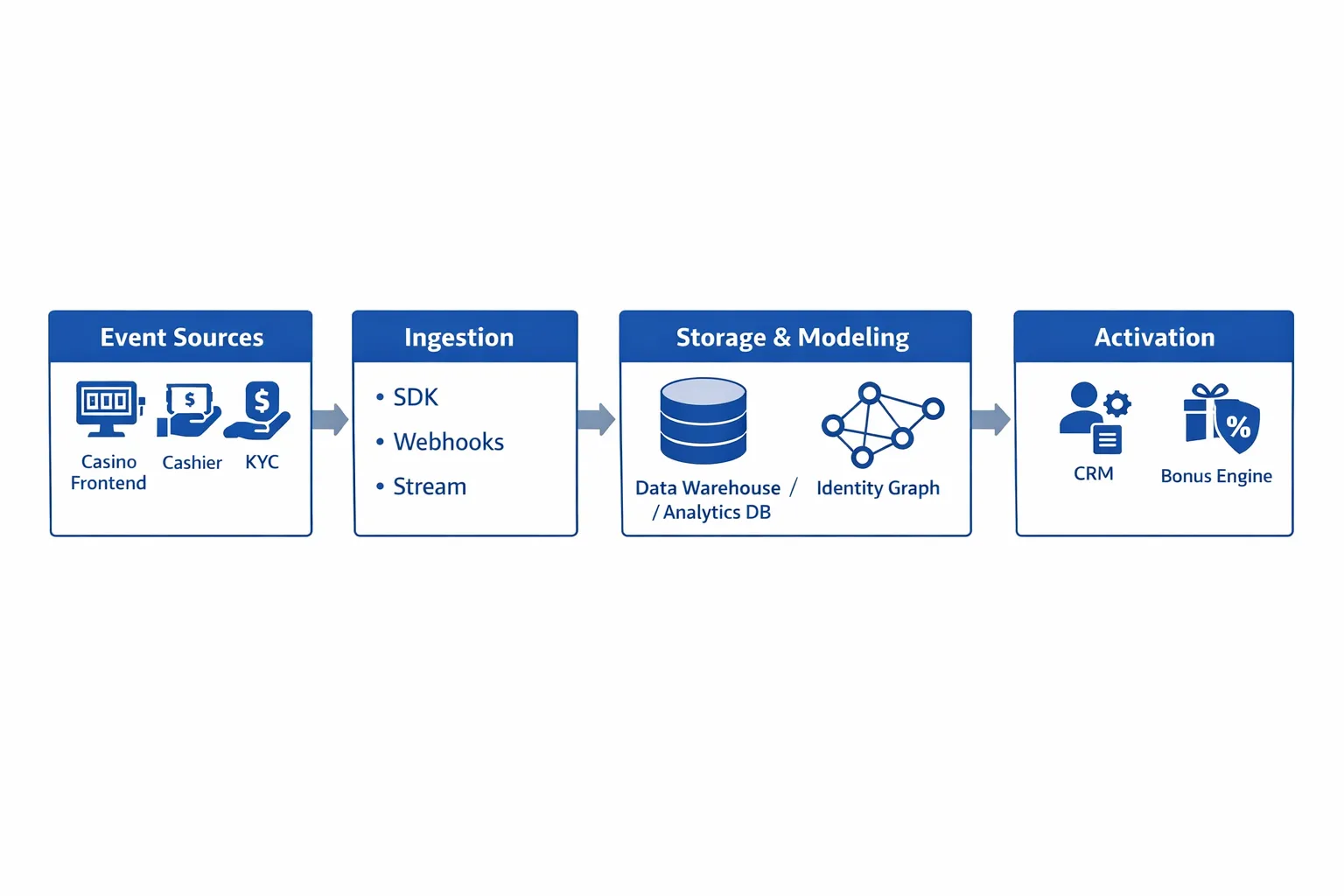
Layer 1: Event sources
- Frontend (web/PWA/app wrapper)
- Cashier and wallet ledger
- KYC/AML providers
- Game aggregation and providers
- Affiliate platform
Layer 2: Ingestion
Common patterns:
- SDK + collector endpoint
- Webhooks from platform services
- Streaming (Kafka/Redpanda-class systems)
Key requirement: ingestion must be able to buffer, retry, and replay.
Layer 3: Storage and modeling
Usually two stores:
- Immutable raw event store (cheap, auditable)
- Queryable store for segments, analytics, and models
Identity resolution can live as:
- a dedicated identity graph store, or
- modeled tables in your warehouse, if performance is acceptable
Layer 4: Activation
- CRM messaging tools
- Reverse ETL / audience sync
- Real-time decisioning (risk rules, bonus eligibility)
If your platform already exposes open APIs and built-in modules (payments, KYC/AML, bonus and affiliate tooling), the CDP’s job becomes easier because you can standardize events and destinations instead of wiring five vendors together.
Implementation roadmap (without boiling the ocean)
Phase A (Weeks 1 to 4): CDP MVP that can pay for itself
Focus on one funnel: Signup → KYC → First deposit → First wager.
Deliverables:
- canonical event contract for the funnel
- raw event capture with replay
- basic identity stitching (anonymous_id → player_id)
- 3 to 5 activation audiences, including deposit abandonment
- a single “player timeline” view for support and growth teams
Phase B (Weeks 5 to 12): Identity depth and operational adoption
Add:
- device and payment instrument graphing
- KYC outcomes and reason codes
- multi-currency normalization for value metrics
- automated suppression policies (consent, RG, jurisdiction)
- experimentation hooks (A/B flags on activations)
If VIP economics matter in your market, this is also where predictive scoring starts to make sense (see: How to Use Predictive LTV Models to Segment VIP Nurture Flows).
Phase C (Quarter 2 and beyond): Optimization and defensibility
This is where the CDP becomes a compounding advantage:
- real-time LTV and promo budget optimization
- affiliate quality scoring and automated payout holds
- cross-brand identity with jurisdiction-aware activation
- deeper RG modeling with auditable evidence trails
Common failure modes (and how to avoid them)
Most casino CDPs fail for predictable reasons:
- Tracking too much too early and shipping an event mess instead of a contract
- No authoritative source for money events, leading to mismatched deposit and wager truth
- Identity stitched with weak keys, producing false merges that break compliance workflows
- Activation built without guardrails, increasing abuse, fatigue, or RG risk
- Segments defined differently in every tool, causing “which number is correct” wars
A simple corrective rule: if an event is used for money, compliance, or RG, treat it as a product with a schema, tests, and owners.
Where Spinlab fits
If you are building a casino on a modular platform, your CDP effort should be mostly about designing the contract and the activations, not rebuilding foundational plumbing.
Spinlab’s platform is built around the operational pieces CDPs depend on, including an open API, integrated payments (crypto and fiat), KYC/AML workflows, and real-time analytics. If you want to map a CDP plan to your launch timeline or retrofit one onto an existing stack, start by scoping:
- the event contract for your core funnel
- the identity keys you can legally use in your target markets
- the first 3 activations you will ship (and how you will measure incrementality)
To see how Spinlab approaches real-time decisioning and activation patterns in practice, explore the analytics overview here: Real-Time Analytics in iGaming: Turning Live Data into Bigger Profits, then book a walkthrough via the main site: Spinlab.