

Consent management in iGaming is not just a cookie banner. For an online casino, consent touches player acquisition, affiliate tracking, CRM campaigns, bonus personalization, analytics, payment journeys, KYC, fraud controls, and third-party game sessions. If consent is vague, poorly recorded, or not enforced across the stack, the operator can lose the ability to prove GDPR compliance when a regulator, payment partner, or player asks difficult questions.
The key is to treat iGaming consent management as a product and data architecture discipline. A good setup tells players what is optional, what is required to provide the service, how their choices affect tracking and marketing, and how they can change their mind. It also gives compliance, marketing, and engineering teams a shared source of truth.
This guide explains how GDPR consent works for online casino operators, where consent is required, where another legal basis is more appropriate, and how to design a practical consent management workflow for 2026.
Why consent management is different in iGaming
Most digital businesses deal with analytics cookies and newsletter opt-ins. Online gambling platforms have a more complex data environment. A player may arrive through an affiliate link, accept cookies, register an account, complete identity checks, deposit through a payment gateway, play slot games through a game aggregator, receive bonus offers, interact with live support, and trigger fraud or responsible gambling reviews.
Each step creates personal data. Some processing is necessary to run the service. Some is required by law. Some supports safety, fraud prevention, or responsible gambling. Some is optional marketing or personalization. GDPR compliance depends on separating these categories instead of using one broad consent checkbox to cover everything.
That distinction matters because GDPR consent must be freely given. If a casino asks for consent to something that is actually mandatory, the consent may not be valid. If the operator asks players to accept marketing in order to open an account, that can create the same problem. Consent works best for optional processing, such as nonessential cookies, promotional emails, push notifications, and certain types of personalization.
For regulated operators, consent management also has to integrate with licensing expectations, advertising rules, AML controls, payments compliance, and data retention policies. It should not be owned by marketing alone. It needs input from legal, compliance, product, engineering, affiliate management, and customer support.
GDPR consent basics for online casino operators
Under the GDPR legal text, valid consent must be freely given, specific, informed, and unambiguous. The European Data Protection Board also explains in its guidelines on consent that consent cannot be bundled into general terms and must be as easy to withdraw as it is to give.
For iGaming, the most important practical lesson is this: consent is only one lawful basis under GDPR. It is not the default answer for every player data flow.
| Processing area | Common GDPR lawful basis | Is consent usually needed? | Practical iGaming note |
|---|---|---|---|
| Account creation and login | Contract necessity | Usually no | The casino needs core account data to provide the service. |
| KYC and AML checks | Legal obligation | Usually no | Do not rely on consent for mandatory compliance checks. |
| Deposits and withdrawals | Contract necessity, legal obligation | Usually no | Payment data must be processed to operate the cashier and meet financial controls. |
| Fraud prevention and platform security | Legitimate interests, legal obligation | Usually no | Document the legitimate interest assessment where applicable. |
| Strictly necessary cookies | Contract necessity, legitimate interests | Usually no | Explain them clearly in the cookie notice. |
| Analytics cookies and product tracking | Consent in many EU contexts | Often yes | Nonessential tracking should be blocked until consent where required. |
| Retargeting pixels and ad identifiers | Consent | Yes | Do not load ad tags before the player opts in. |
| Email, SMS, and push promotions | Consent or local soft opt-in rules | Often yes | Rules vary by country, and gambling ads are high risk. |
| Bonus personalization and behavioral profiling | Consent, legitimate interests, or legal obligation depending on purpose | It depends | Be transparent and assess the impact on player rights. |
KYC and AML are a common source of confusion. A casino cannot let a player withdraw marketing consent and then avoid identity checks required by law. These are different legal bases and different controls. If you need a deeper operational breakdown, Spinlab has a practical guide to KYC and AML workflows in iGaming.
The same principle applies to responsible gambling interventions and fraud prevention. Some of these workflows may be necessary to comply with gambling regulation, enforce terms, protect players, or prevent abuse. Consent is not a shortcut for weak governance. The operator still needs transparency, minimization, access controls, retention rules, and evidence.
Map consent across the casino player journey
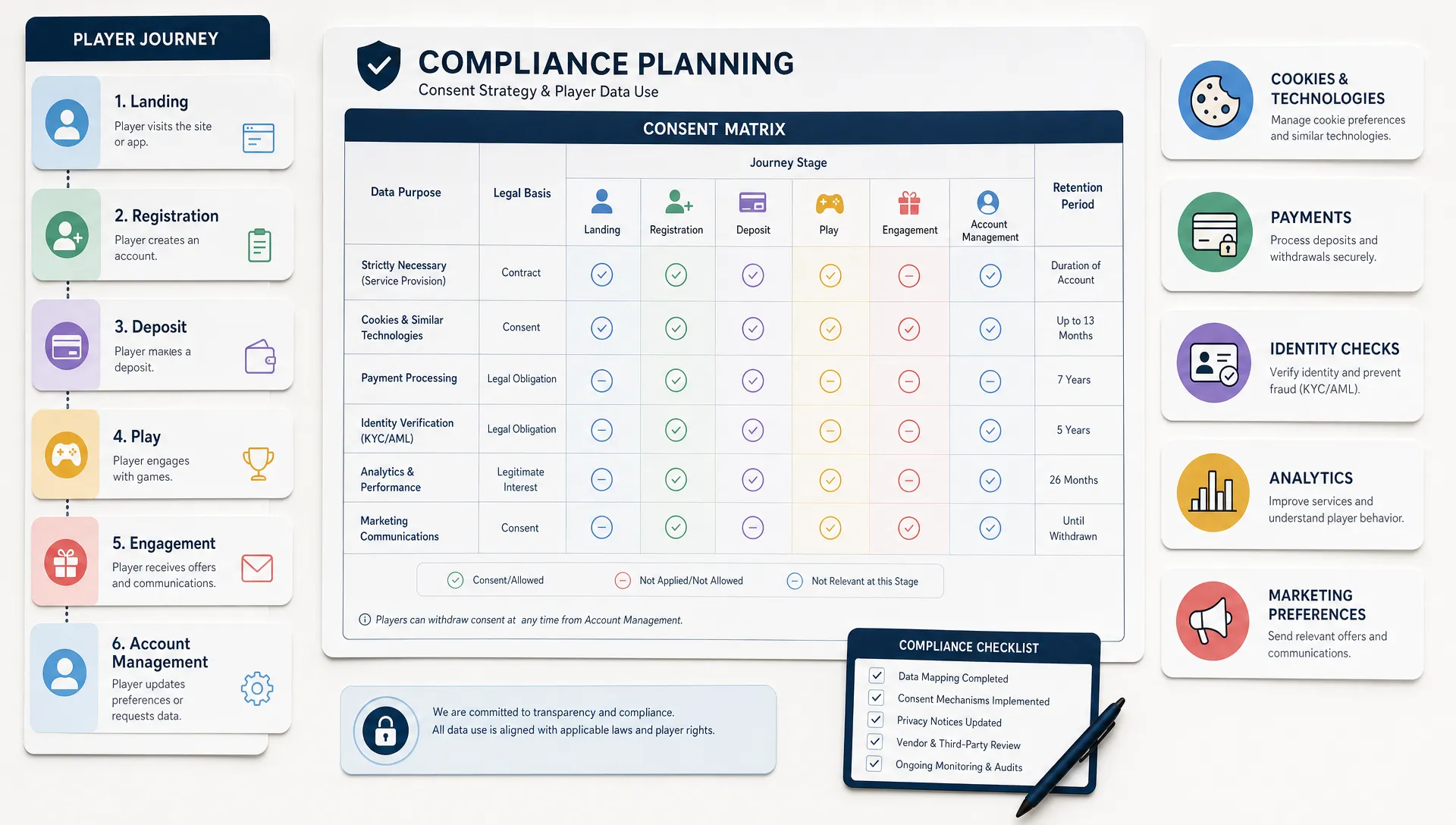
A GDPR-ready consent program starts by mapping where personal data is collected and why. For an online casino, the player journey usually includes more consent touchpoints than teams expect.
Before registration, the platform may process IP address, device data, referral source, affiliate ID, geolocation signals, language preference, and cookie identifiers. Some of this can be essential for security or jurisdictional blocking. Some of it, such as retargeting pixels or cross-site ad tracking, is optional and usually requires consent.
During registration, the player should see privacy information separate from the acceptance of terms and conditions. If marketing opt-ins are requested, they should be granular by channel. A player who accepts email promotions has not automatically accepted SMS, push notifications, WhatsApp, or personalized ad targeting.
At the cashier, a payment gateway, crypto onramp, wallet provider, fraud vendor, or card processor may receive personal data. In a crypto-ready solution, the privacy notice should be especially clear about which entities process payment and wallet data, what is recorded on-chain, what is held by custodial service providers, and what cannot realistically be erased from a public blockchain.
During gameplay, a game aggregator and game studios may receive session information, player identifiers, jurisdiction, currency, device data, and game activity. Operators should understand whether providers act as processors, independent controllers, or joint controllers in specific scenarios. The answer affects contracts, privacy notices, transfer mechanisms, and player rights handling.
After gameplay, marketing systems, affiliate platforms, analytics tools, bonus engines, support platforms, and risk engines may process player behavior. This is where consent drift often happens. A player opts out in the preference center, but the CRM, push provider, and affiliate suppression list do not update. A compliant design prevents that gap.
Build a consent model that engineering can enforce
Consent management needs more than a nice interface. The back end must store, version, and enforce the decision. If a regulator asks why a player received a bonus email after opting out, the operator should be able to reconstruct the record.
A practical consent model should connect each preference to a purpose, channel, jurisdiction, user identifier, notice version, timestamp, and source system. It should also distinguish between active consent, withdrawal, refusal, and unavailable consent.
| Consent record field | Why it matters |
|---|---|
| Player ID or pseudonymous ID | Links the choice to the right account or pre-login visitor. |
| Consent category | Separates analytics, advertising, email, SMS, push, personalization, and other purposes. |
| Purpose description version | Proves what the player was told at the time of the choice. |
| Country or jurisdiction | Supports local ePrivacy and gambling advertising rules. |
| Timestamp and source | Shows when and where the choice was made. |
| Affirmative action | Records whether the choice came from a toggle, checkbox, banner button, or account setting. |
| Withdrawal timestamp | Demonstrates that withdrawal is respected and tracked. |
| Downstream sync status | Shows whether CRM, analytics, ad tech, and affiliates received the update. |
This is where data governance becomes operational. Consent categories should align with policies, retention schedules, vendor contracts, and access rules. For a broader governance structure, review Spinlab's guide to casino data governance roles, policies, and controls.
The player interface should be simple, but the underlying model should be precise. A good preference center lets players manage optional choices without disturbing mandatory compliance processing. It also avoids vague language such as partner offers or improved experience unless those purposes are explained clearly.
Cookie and tag consent is the iGaming risk zone
Cookie consent is often the first visible layer of iGaming consent management. It is also one of the easiest places to fail, because tags can fire before the player makes a choice.
In Europe, cookie rules come from the ePrivacy framework and local implementations, while GDPR applies once cookies or similar technologies process personal data. The UK ICO's cookie guidance is a useful plain-English reference, although operators must still check the rules in each target market.
A compliant cookie setup should separate strictly necessary technologies from optional categories. Strictly necessary cookies may include session authentication, security, fraud prevention, language settings required for the service, and jurisdictional access controls. Optional categories often include analytics, personalization, retargeting, affiliate tracking, social media pixels, and heatmaps.
The banner should not use dark patterns. If Accept all is prominent, the reject or manage option should not be hidden. Pre-ticked boxes are not valid consent. Scrolling or continuing to browse is not enough for GDPR-standard consent. Nonessential tags should be blocked until consent is given.
For online casino acquisition teams, the biggest operational challenge is affiliate attribution. Affiliates want reliable tracking, but players must still receive lawful cookie choices. Operators should design consent-aware attribution, use server-side controls carefully, and avoid workarounds that recreate tracking without valid consent.
Marketing consent, bonuses, and affiliates
Marketing consent in iGaming is sensitive because gambling promotions are heavily regulated. A casino may need to prove not only that a player opted in, but also that the message was lawful for the player's jurisdiction, age, self-exclusion status, risk status, and channel.
Consent should be granular. Email, SMS, push notifications, phone calls, and personalized ad audiences should be separate choices. A single marketing checkbox is rarely enough for a mature online gambling platform, especially if the operator runs across multiple EU markets.
Bonus campaigns need extra care. If a player receives a free spins offer, reload bonus, or VIP promotion, the operator should be able to show why that player was eligible, what data was used, whether marketing consent covered the channel, and whether responsible gambling exclusions were checked. Consent does not override responsible gambling duties.
Affiliates create another layer of risk. The operator should define what consent evidence affiliates must collect, how leads are passed, how suppression lists are honored, and what happens when a player withdraws consent. Contracts should prohibit affiliates from buying unlawful lead lists, using misleading ad copy, or targeting excluded jurisdictions.
A clean workflow looks like this: the player opts in to email promotions, the CRM receives the consent status, the bonus engine checks eligibility, responsible gambling controls suppress restricted players, and the campaign system logs the message. If the player later opts out, the suppression propagates to CRM, push, SMS, affiliate reactivation lists, and ad audiences.
Profiling and automated decisions
Online casinos use profiling for many reasons: bonus abuse detection, fraud prevention, affordability checks, VIP segmentation, game recommendations, responsible gambling monitoring, and churn prediction. GDPR does not ban profiling, but it does require transparency, lawful basis, fairness, data minimization, and safeguards.
The legal basis depends on the purpose. Fraud scoring may rely on legitimate interests or legal obligations. Responsible gambling monitoring may be tied to regulatory duties. Personalized marketing may require consent, particularly if it uses detailed behavioral tracking or ad tech. If a decision is solely automated and produces legal or similarly significant effects, GDPR Article 22 concerns may arise.
Operators should not use consent to legitimize opaque or excessive profiling. Instead, they should document the purpose, data inputs, impact on players, review process, and opt-out rights where applicable. For high-risk processing, a Data Protection Impact Assessment is often appropriate, and in some cases required.
This is especially important when profiling affects withdrawals, bonus restrictions, account closures, affordability interventions, or safer gambling measures. Even if the purpose is legitimate, players deserve clear explanations and a route to human review where required.
Vendor and cross-border controls
Consent choices must travel through the vendor stack. An online casino may use a white label casino platform, game aggregator, payment processor, KYC vendor, AML screening provider, analytics tool, affiliate network, cloud host, CRM, live chat platform, and fraud engine. If one of those systems ignores consent, the operator can still be accountable.
Start by classifying each vendor as processor, controller, or joint controller for each processing activity. Then make sure Data Processing Agreements, subprocessor lists, audit rights, retention rules, and deletion procedures reflect the actual data flows. If personal data leaves the European Economic Area, assess transfer mechanisms such as Standard Contractual Clauses and supplementary measures.
Data residency can also affect consent operations. If player data is stored, replicated, backed up, or analyzed in multiple regions, withdrawals and deletion requests must be enforceable across those locations. Spinlab's data residency guide for online casinos explains how residency decisions connect to licensing, payments, KYC, analytics, and vendor management.
For operators targeting both Europe and Latin America, GDPR may not be the only privacy framework in scope. Consent language, legal bases, and player rights can differ across countries. If Brazil is part of the roadmap, it is worth comparing GDPR and LGPD requirements before designing a single global preference center.
Implementation checklist for 2026
Consent management works best when it is built before launch, not patched after campaigns are already live. For a new online casino or whitelabel casino rollout, the following implementation sequence is practical.
| Step | What to do | Owner |
|---|---|---|
| Data flow mapping | Identify all personal data collected from landing page to withdrawal, including vendors. | Compliance and product |
| Lawful basis assessment | Assign contract, legal obligation, legitimate interests, or consent to each purpose. | Legal and DPO |
| Cookie and tag audit | List every script, SDK, pixel, cookie, and server-side tracker. | Engineering and marketing ops |
| Preference center design | Create clear categories, channel-level opt-ins, and withdrawal controls. | Product and UX |
| Consent logging | Store versioned proof of each choice and withdrawal. | Engineering |
| Downstream enforcement | Sync choices to CRM, analytics, ad tech, affiliate systems, and backoffice tools. | Engineering and operations |
| Vendor review | Confirm contracts, roles, subprocessors, transfers, and retention periods. | Legal and procurement |
| QA testing | Test consent flows by country, device, language, and player status. | QA and compliance |
| Ongoing audits | Monitor tags, opt-out propagation, complaints, and campaign exceptions. | Compliance and marketing ops |
Testing should include real user scenarios. For example, a German player rejects advertising cookies but accepts email promotions. A French player withdraws SMS consent after receiving a bonus. A player closes an account and later makes a data access request. An affiliate lead arrives without consent evidence. Each case should produce predictable behavior.
Teams should also monitor practical metrics: percentage of nonessential tags blocked before consent, time to propagate opt-outs, number of campaigns blocked by missing consent, vendor sync failures, consent withdrawal rate, and privacy complaint trends. These metrics turn GDPR compliance from a static policy into an operational control.
Common mistakes to avoid
Many iGaming consent failures are avoidable. The most common mistake is treating acceptance of terms and conditions as consent for marketing, profiling, cookies, and third-party sharing. Those are separate decisions and should be presented separately.
Another frequent issue is loading analytics and ad tags before the player interacts with the banner. If the optional tracker already fired, the later refusal does not undo the initial processing. Tag governance and QA are essential.
Operators also get into trouble when consent withdrawal is easy in the UI but not respected downstream. A player may toggle off marketing in the account area, yet still appear in a VIP export, affiliate reactivation campaign, or ad audience. The preference center must be connected to real enforcement.
Other mistakes include vague purpose labels, missing notice versioning, poor mobile banner design, no audit trail, unclear vendor roles, relying on consent for mandatory KYC, and failing to localize consent flows by jurisdiction. In iGaming, these gaps are not just privacy issues. They can affect licensing reviews, payment partner confidence, and player trust.
Frequently Asked Questions
Is GDPR consent required for KYC checks in iGaming? Usually no. KYC and AML checks are typically based on legal obligations, not consent. Players should still receive clear privacy information, but they cannot opt out of mandatory compliance checks and continue using regulated services that require those checks.
Does an online casino need consent for cookies? Consent is generally required for nonessential cookies and similar tracking technologies, such as analytics, ad pixels, retargeting, and some affiliate tracking. Strictly necessary cookies do not usually require consent, but they should be explained in the cookie notice.
Can a casino refuse service if a player rejects marketing consent? In most cases, no. Marketing consent must be freely given. A casino can require data needed to provide the service, meet legal obligations, prevent fraud, and comply with gambling rules, but optional marketing should not be a condition of account access.
How long should casinos keep consent records? Keep consent records long enough to demonstrate compliance, manage disputes, and support regulatory inquiries, then apply a documented retention policy. The exact period depends on jurisdiction, limitation periods, and the nature of the processing.
Do affiliates need to collect GDPR consent? If affiliates use tracking cookies, collect leads, or send gambling promotions, they may need consent or another lawful basis depending on the activity. Operators should require affiliates to provide consent evidence, respect suppression lists, and follow local gambling advertising rules.
Is a consent management platform enough for GDPR compliance? No. A CMP is only one part of the control environment. Operators also need data mapping, lawful basis assessments, vendor contracts, privacy notices, security controls, retention policies, DPIAs where needed, and ongoing audits.
Build consent into the platform, not around it
For iGaming operators, consent management should be part of the platform architecture from day one. It has to connect with registration, payments, KYC and AML, game aggregation, analytics, bonus workflows, affiliate tracking, and backoffice operations. If it sits outside the stack, compliance teams will always be chasing exceptions.
Spinlab helps operators build and launch online casinos with a modular, crypto-ready platform that includes integrated payments, game aggregation, KYC and AML compliance support, real-time analytics, a customizable backoffice, and open API integration. Those capabilities make it easier to design consent-aware workflows across the systems that matter most.
If you are planning a new online casino or upgrading a white label casino platform, make GDPR consent management a launch requirement, not a later cleanup project. Explore Spinlab's modular iGaming platform and build a player experience that is faster to operate, easier to govern, and better prepared for regulated growth.