

A player data deletion request looks simple at first: a user asks you to remove their information, and your team deletes it. In iGaming, that is almost never the full story.
Online casino operators hold identity documents, payment records, gameplay logs, bonus history, device signals, fraud checks, responsible gambling markers, affiliate attribution, support tickets, and sometimes crypto wallet data. Some of that information can be deleted or anonymized. Some must be retained for AML, KYC, tax, licensing, dispute resolution, self-exclusion, or fraud prevention reasons.
The goal is not to say “yes” or “no” too quickly. The goal is to run a controlled process that respects privacy rights while preserving the records your online gambling platform is legally required to keep.
This guide explains how iGaming operators should handle player data deletion requests in a practical, defensible way.
What is a player data deletion request?
A player data deletion request is a request from a user to erase personal information held by your casino, sportsbook, or related service providers. Depending on the jurisdiction, it may be called a right to erasure request, deletion request, privacy request, or data subject request.
Under GDPR, the “right to erasure” is set out in Article 17 and is subject to important exceptions. The UK Information Commissioner’s Office guidance on the right to erasure is a useful overview of when deletion applies and when an organization can refuse or partially refuse. In California, the CCPA gives consumers deletion rights, also with exceptions for legal obligations, security, fraud prevention, and other permitted uses.
For an online casino, deletion requests usually arrive in one of four ways: through account settings, support chat, email, a privacy form, or a regulator-facing complaint process. The request might be clear, such as “delete my account and all my data,” or vague, such as “close my account” or “remove me from your system.” Your process should distinguish between account closure, marketing opt-out, self-exclusion, and legal deletion.
That distinction matters. Closing an account is a product action. Deleting personal data is a privacy action. Self-exclusion is a responsible gambling action. Each has different obligations, retention rules, and risks.
Why deletion is harder for iGaming than for most digital products
A standard ecommerce or SaaS company may be able to delete a user profile, anonymize analytics, and suppress future emails. An iGaming platform has a more complex data footprint because it operates in a regulated environment.
Operators need player data for identity checks, age verification, AML monitoring, chargeback defense, payment reconciliation, bonus abuse investigations, responsible gambling controls, licensing audits, and suspicious activity reporting. If your casino supports fiat and crypto payments, the complexity increases because payment gateway records, crypto onramp providers, custodial wallet data, blockchain references, and transaction monitoring tools may all sit in different systems.
A good deletion workflow therefore uses three outcomes, not one:
| Data category | Typical action after a valid deletion request | Why it matters |
|---|---|---|
| Marketing preferences and CRM segments | Delete, anonymize, or suppress from future campaigns | Usually no longer needed after opt-out or account closure |
| KYC documents and verification results | Retain only where required, then delete at the end of the retention period | AML, age verification, and licensing rules may require retention |
| Payment and withdrawal records | Retain where needed for financial, tax, chargeback, and AML obligations | Deleting too early can create audit and reconciliation risk |
| Gameplay and wagering history | Retain or anonymize depending on licensing, dispute, and reporting rules | Regulators may require game integrity and player balance records |
| Fraud, bonus abuse, and device risk signals | Retain in minimized form when necessary for security or legal claims | Prevents repeat abuse and supports platform safety |
| Self-exclusion and responsible gambling records | Usually retain in a suppression or exclusion system | Deletion must not allow a self-excluded player to re-register |
| Analytics events | Aggregate or anonymize where possible | Reduces privacy risk while preserving business insight |
The safest posture is data minimization. Keep what you must, delete what you can, anonymize what you no longer need in identifiable form, and document every decision.
The deletion workflow every online casino should have
A deletion request should not be handled casually by a support agent in a ticket queue. It should trigger a controlled workflow owned by compliance, privacy, legal, and operations.
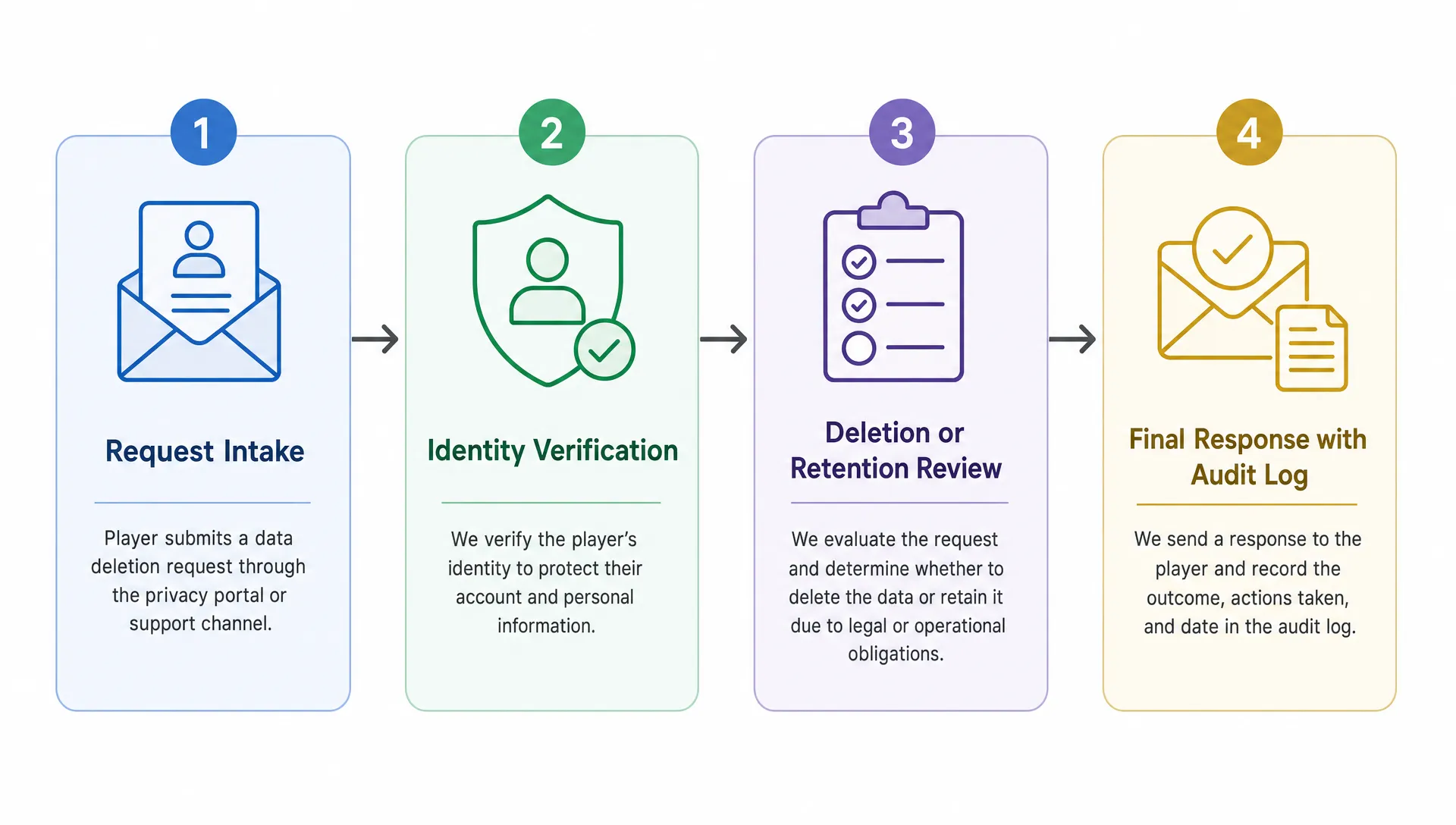
1. Confirm the request and verify identity
Before deleting anything, confirm that the requester is the account holder or an authorized representative. This is especially important for casinos because accounts may contain balances, pending withdrawals, bonus entitlements, tax documents, and sensitive identity files.
Verification should be proportionate. Do not ask for excessive new documents if the account is already verified, but do not act on a deletion request based only on an unverified email if the action could expose or compromise another player’s data.
Your intake form should capture the player ID, jurisdiction, request type, communication channel, date received, and any account status flags such as pending withdrawal, chargeback, self-exclusion, or active investigation.
2. Pause non-essential processing quickly
Even before the final deletion decision is made, stop unnecessary processing where practical. This may include removing the player from promotional campaigns, pausing personalized bonus targeting, and suppressing triggered emails.
Be careful with suppression. If you delete the email address from every system without retaining a minimal suppression record, the player may accidentally be re-added to marketing later through an affiliate upload, CRM sync, or re-registration flow. A hashed suppression record can be a privacy-preserving way to prevent future contact.
3. Check account status before deletion
Never run deletion in isolation from casino operations. Review whether the account has open items that affect retention or timing.
Common blockers include pending withdrawals, unresolved deposits, AML review, open chargebacks, active fraud investigation, open complaints, tax reporting, responsible gambling intervention, or self-exclusion status. A request can still be acknowledged, but your response may need to explain that certain records must be retained until a defined condition or legal retention period ends.
If your team is working on broader data architecture, the same discipline applies to residency, backups, and vendors. Spinlab’s guide to data residency for online casinos is a useful companion because deletion is much easier when you already know where player data lives.
4. Map every system that stores player data
Deletion requests fail when operators only delete the backoffice profile and forget the surrounding ecosystem. In a modern iGaming stack, player data may exist in many places: the player account database, KYC provider, payment gateway, fraud tool, game aggregator, affiliate platform, CRM, email service provider, data warehouse, customer support system, analytics platform, backup environment, and responsible gambling tooling.
Crypto-ready casinos should pay special attention to wallet and on-chain references. Public blockchain transactions generally cannot be deleted. The better architecture is to avoid putting personal data on-chain in the first place, store personal identifiers off-chain, and separate blockchain transaction references from directly identifying player profiles wherever possible.
A simple data inventory should answer five questions: what data exists, where it lives, who controls it, why it is retained, and how it can be deleted or anonymized.
5. Decide what to delete, anonymize, retain, or restrict
Once the data is mapped, classify each record. Deletion is not always the best or lawful answer. Anonymization may preserve business reporting without retaining personal data. Restriction may be appropriate where records must be preserved for legal claims or regulatory review but should not be used for marketing or personalization.
Your decision logic should be written into a retention schedule. For example, marketing attributes may be deleted quickly, while KYC and AML records may need to be retained for a legally required period. Many AML regimes require certain records to be kept for several years after the end of the business relationship, often around five years, but exact retention periods depend on the licensing jurisdiction and applicable law.
Document the legal basis for every retained category. “We might need it later” is not good enough. “Required for AML recordkeeping under applicable law” or “needed to establish, exercise, or defend legal claims related to a disputed withdrawal” is much stronger.
6. Notify processors and integrated vendors
If your casino uses third-party processors, the request may need to be passed to them. This includes KYC vendors, payment processors, CRM systems, support platforms, fraud tools, analytics providers, affiliate systems, and game aggregation partners if they process identifiable player data.
Your vendor contracts should define how deletion requests are submitted, how quickly vendors must respond, what evidence they provide, and how exceptions are handled. If the vendor is an independent controller for some data, your response should reflect that and direct the player appropriately when needed.
Open API integrations and webhook-driven systems can make this easier, but only if events are well defined. A deletion workflow should not depend on someone manually remembering every downstream tool. Event design also matters for data governance. If you are standardizing player identity, lifecycle events, and activation rules, Spinlab’s article on building a casino CDP explains the kind of event discipline that makes privacy operations more reliable.
7. Respond within the legal deadline and keep an audit trail
Set internal deadlines shorter than the legal deadline. For example, if a law gives you 30 or 45 days, your internal target might be to complete triage within a few business days and vendor outreach soon after. This gives your team time to handle exceptions, verify identity, and prepare a clear response.
A good final response should state what was deleted, what was anonymized, what was retained, why retained data is still necessary, how long it will be retained if known, and how the player can appeal or complain if applicable.
Keep a deletion audit log, but keep it minimal. The log should prove that you handled the request properly without recreating the full set of deleted personal data.
Build privacy into your iGaming platform architecture
The best time to prepare for deletion requests is before the first player signs up. Retrofitting deletion into a messy casino stack is expensive, slow, and risky.
A deletion-ready platform should have clear player identity keys, data category tagging, configurable retention rules, role-based backoffice access, vendor processing records, and an audit log for privacy actions. It should also separate operational records from marketing profiles so a player can be removed from promotions without damaging required financial or compliance records.
For a white label casino platform, this should be part of vendor due diligence. Ask the casino software provider how player data is structured, how KYC and AML records are handled, how payment data flows between fiat and crypto providers, how game aggregator data is stored, and how backups are managed. You do not need every answer to be identical across jurisdictions, but you do need a clear operating model.
Backups deserve special attention. Many operators cannot instantly delete a specific player from immutable backups. That may be acceptable if backups are encrypted, access-controlled, retained for a limited period, and not restored into production without reapplying deletion rules. Your privacy policy and internal procedures should reflect this reality.
What to say to players when you cannot delete everything
A common mistake is sending a vague refusal: “We cannot delete your data because of regulations.” That may be true, but it is not helpful and may not meet transparency requirements.
A better response is specific, calm, and category-based. For example, you might explain that marketing data and optional profile fields have been deleted, analytics have been anonymized where possible, and certain KYC, transaction, and responsible gambling records must be retained for legal, AML, licensing, or player protection reasons.
Avoid legal jargon where possible. Players do not need a lecture on every statute. They need to understand what happened, why some records remain, and whether those retained records will be used for anything beyond the required purpose.
This is also a trust moment. Many deletion requests come from frustrated players, not privacy experts. A transparent response can reduce complaints, support escalations, and regulator scrutiny.
Common mistakes to avoid
| Mistake | Why it creates risk | Better approach |
|---|---|---|
| Deleting the account before checking pending withdrawals | Can break reconciliation and create support disputes | Resolve financial obligations first, then delete or restrict eligible data |
| Removing self-exclusion records completely | May allow a vulnerable player to re-register | Keep a minimal exclusion record for responsible gambling enforcement |
| Forgetting vendors and data warehouses | Leaves personal data active outside the core platform | Maintain a vendor inventory and deletion playbook |
| Using analytics data without anonymization | Retains identifiable behavior longer than needed | Aggregate or anonymize old events where practical |
| Promising full deletion when legal retention applies | Creates compliance and trust issues | Explain partial deletion and retention reasons clearly |
| Ignoring crypto transaction immutability | Creates impossible deletion promises | Keep personal data off-chain and minimize wallet-linked identifiers |
The principle is simple: do not over-delete records that regulators require, and do not over-retain records because your systems are inconvenient.
Frequently Asked Questions
Do online casinos have to delete all player data when requested? Not always. Operators may need to retain certain records for AML, KYC, tax, licensing, payment disputes, fraud prevention, responsible gambling, or legal claims. The correct response is often partial deletion, anonymization, and restricted retention.
How fast should an iGaming operator respond to a deletion request? Deadlines depend on jurisdiction. GDPR and UK GDPR generally require a response within one month, with limited extensions for complex requests. CCPA timelines are generally 45 days, with possible extension. Operators should set shorter internal deadlines to allow time for verification and vendor coordination.
Can an online casino delete KYC documents immediately after account closure? Usually not if those documents are subject to AML, age verification, licensing, or financial recordkeeping obligations. The operator should retain them only for the required period, restrict their use, and delete them when the retention period expires.
What should happen to player analytics after a deletion request? Where possible, analytics should be anonymized or aggregated so the operator can keep business insights without retaining identifiable player behavior. If analytics are still tied to a player ID, they should be included in the deletion or anonymization review.
How should crypto casino operators handle deletion when blockchain data is immutable? They should avoid storing personal data on-chain, keep identifying information off-chain, and separate wallet or transaction references from personal profiles where possible. The player response should not promise deletion of public blockchain records that cannot technically be erased.
Make deletion requests operational, not chaotic
Player data deletion requests are now a normal part of running an online casino. The operators that handle them well are the ones with clear data maps, vendor processes, retention rules, and compliance-aware platform architecture.
Spinlab helps operators build and scale on a modular iGaming platform with integrated payments, KYC and AML compliance, game aggregation, real-time analytics, open API integration, and a customizable backoffice. If you are planning a new whitelabel casino or improving an existing operation, explore Spinlab and build privacy operations into the foundation from day one.