

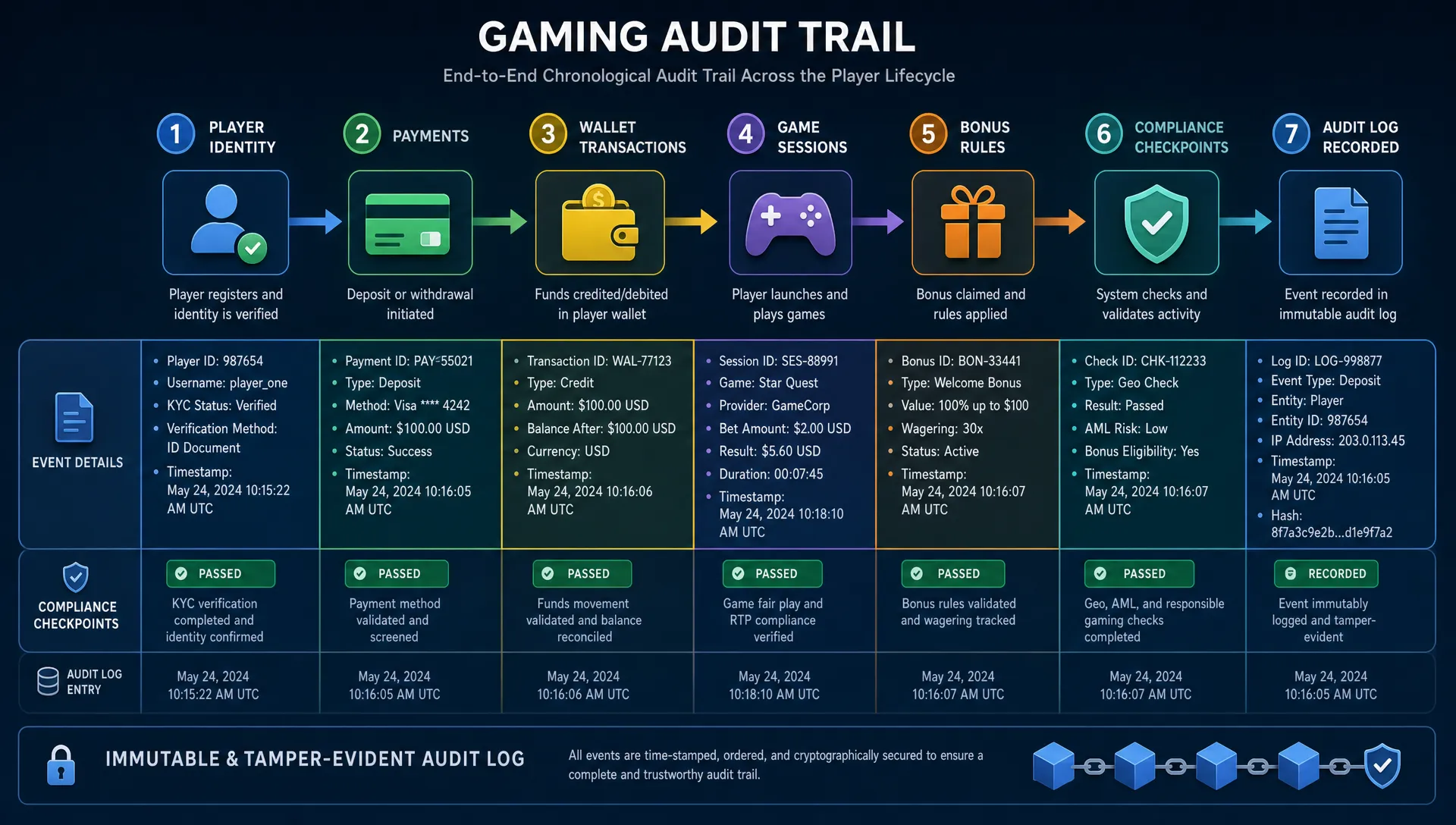
In an online casino, trust depends on being able to reconstruct what happened after money, identity, game results or player access changes hands. Audit logs are the evidence layer that makes this possible. They show who did what, when it happened, which system approved it, what changed and whether the action succeeded.
That sounds simple until you operate at scale. A single player session may touch account services, KYC checks, payment gateways, wallet balances, game providers, bonus rules, affiliate attribution, fraud controls and backoffice actions. If those events are logged inconsistently, investigations become slow, disputes become expensive and compliance reviews become harder than they need to be.
Online casino audit logs should not be treated as a developer afterthought. They are part of the operating model of a serious iGaming platform.
Why online casino audit logs matter
Audit logs help operators answer the questions that matter during licensing reviews, player disputes, fraud investigations and payment reconciliation. The goal is not to collect endless noise. The goal is to preserve reliable evidence for the actions that affect risk, money, access, player status and game outcomes.
A regulator may ask why a player withdrawal was blocked. A payment partner may ask how a duplicate deposit was handled. A player may dispute a bonus cancellation or game round outcome. A security team may need to know whether an admin account changed withdrawal limits before a suspicious payout. Without structured audit logs, each of those questions turns into a manual hunt across disconnected systems.
The NIST Guide to Computer Security Log Management frames logs as a security, operations and compliance resource. The OWASP Logging Cheat Sheet adds a useful software security lens: log enough context to understand events but avoid collecting secrets or sensitive data that creates new risk.
For online casinos, that balance is critical. You need enough detail to prove control but not so much raw personal, payment or game-security data that the log system becomes a liability.
Audit logs are not the same as application logs or the ledger
One common mistake is using the words “logs” and “ledger” interchangeably. They are related, but they do different jobs.
| System | Primary purpose | Typical examples | Main audience |
|---|---|---|---|
| Audit logs | Prove who did what, when, why and with what result | Admin role changes, KYC approvals, withdrawal holds, bonus overrides | Compliance, risk, security, operations |
| Application logs | Diagnose software behavior and technical errors | API latency, service exceptions, retries, queue failures | Engineering and SRE teams |
| Casino ledger | Record financial movements and balance-affecting events | Deposits, wagers, wins, reversals, settlements | Finance, reconciliation, audit teams |
| Analytics events | Understand user behavior and product performance | Funnel steps, session duration, campaign attribution | Product, CRM and growth teams |
Audit logs should reference ledger transactions when money moves, but they should not replace the ledger. The ledger is the system of financial truth. The audit log explains the surrounding decision, actor, approval path and context. For a deeper look at balance movements, reversals and settlements, Spinlab has a separate guide on casino ledger design for audit trails.
The cleanest setup is a connected model: each important event carries a shared correlation ID, player ID, session ID, transaction ID or game round ID so teams can move from audit log to ledger record to application trace without guessing.
Core principles for audit-grade logging
Before choosing event categories, define the standards every log event must meet. In an online casino, audit logs should be designed around evidence quality.
- Completeness: Log every material action that affects access, identity, funds, risk status, gameplay, bonuses, compliance controls or system configuration.
- Attribution: Capture the actor clearly, whether it is a player, admin user, automated rule, external provider, scheduled job or API integration.
- Time accuracy: Use synchronized server-side timestamps with timezone clarity, ideally in UTC, and avoid relying on client-side time for evidence.
- Immutability: Store audit events in an append-only pattern where edits and deletions are prohibited or separately recorded as new events.
- Correlation: Include identifiers that connect related activity across payments, wallet, games, KYC, fraud and backoffice systems.
- Outcome clarity: Record whether an action succeeded, failed, timed out, was rejected or was reversed.
- Data minimization: Do not log passwords, full card details, private keys, raw tokens or unnecessary identity documents.
The practical test is simple: if a trained reviewer had only the audit trail, could they understand the lifecycle of a decision without asking an engineer to interpret raw service logs?
What online casinos should record
The exact logging scope depends on licensing obligations, jurisdictions, payment methods and platform architecture. Still, most online casino audit logs need to cover the following categories.
1. Identity, login and access events
Access logs are the first line of accountability. Record successful and failed logins, password resets, multi-factor authentication changes, session creation, session termination, suspicious login attempts, IP changes and device changes. For backoffice users, log role assignments, permission changes, account creation, account suspension and privilege escalation.
This matters because many high-impact incidents begin with compromised access. If an operator cannot show which admin account changed a player limit, approved a withdrawal or disabled a fraud rule, the investigation is already weakened.
For casinos using centralized identity, audit logs should align with role-based permissions. Spinlab’s guide to casino SSO setup, roles and audit logs covers the access-control side in more detail.
2. Player account and profile changes
Player account records change throughout the lifecycle. Log registration, email or phone verification, profile edits, address changes, date-of-birth corrections, country changes, account closures, reactivations and status changes such as active, suspended, self-excluded or under review.
The most important detail is the before and after value for material changes, with sensitive values masked where needed. For example, a country change may affect licensing rules, game availability, bonus eligibility, tax treatment or payment routing. If that change later becomes part of a dispute, the audit log should show the original value, new value, actor, timestamp and approval path.
3. KYC, AML and compliance decisions
KYC and AML events need strong evidence because they explain why a player was allowed to deposit, blocked from withdrawal or escalated for review. Record identity verification status changes, document submission references, provider decision codes, sanctions or PEP screening outcomes, source-of-funds review status, manual review notes, approval decisions, rejection decisions and recheck timestamps.
Avoid storing full identity documents in audit logs unless your governance model requires it. In many cases, the audit event should store a document reference, verification provider ID, decision result and reviewer ID rather than duplicating sensitive files.
4. Payments, wallet activity and withdrawal decisions
Payments are one of the highest-risk areas for any online gambling platform. Audit logs should capture deposit attempts, payment gateway responses, failed authorizations, successful confirmations, withdrawal requests, withdrawal approvals, withdrawal rejections, payout batches, manual holds, refund decisions, chargebacks, reversals and balance adjustments.
For each event, record the payment method category, amount, currency, provider reference, internal transaction ID, player ID, status, risk decision and actor. If crypto payments are supported, include blockchain transaction references where appropriate, wallet movement references, custody status and confirmation milestones. Do not log private keys, seed phrases or raw credentials.
Payment auditability is bigger than event capture. Routing, reconciliation and PSP behavior also matter, which is why operators should periodically review the full stack. Spinlab’s guide on how to audit your casino payments stack explains that broader review process.
5. Game launch, game round and provider events
Game activity needs an audit trail that connects the player session to the provider, game, wallet transaction and result. Record game launch events, provider name, game ID, session ID, round ID, wager transaction ID, win transaction ID, rollback or cancel events, provider callback status, jackpot contribution references and settlement status.
For slot games and live casino games, you may not control every internal provider process, but you should still store enough provider references to reconcile the round. If a player disputes a spin, the operator should be able to find the round, compare wallet debits and credits, verify callback timing and escalate to the provider with a complete evidence pack.
6. Bonus, promotion and affiliate events
Bonus systems can create disputes quickly because eligibility rules, wagering requirements and expiry windows can be complex. Record bonus grants, opt-ins, wagering progress changes, expiry events, cancellations, abuse flags, manual credits, manual removals and override approvals.
Affiliate attribution should also be auditable. Log the original tracking reference, campaign identifier, attribution time, any later attribution change, commission-impacting player status changes and fraud-related exclusions. This protects both the operator and legitimate affiliates.
7. Risk, fraud and responsible gambling controls
Fraud systems and responsible gambling controls should leave a clear trail of automated and manual decisions. Record risk rule triggers, velocity alerts, device or IP risk changes, duplicate-account flags, bonus abuse indicators, account link analysis outcomes, withdrawal risk reviews, limit changes, cooling-off periods, self-exclusion events and responsible gambling interventions.
The reason is straightforward: these decisions affect both player protection and commercial risk. If a player is blocked from withdrawing, or if the operator permits continued play after a risk alert, the audit trail should show what rule fired, what evidence was reviewed and who approved the outcome.
8. Configuration, release and integration changes
Some of the most damaging casino incidents come from configuration mistakes rather than code defects. Log changes to game availability, jurisdiction rules, payment routing, currency settings, withdrawal thresholds, bonus templates, risk rules, affiliate commission settings, KYC provider settings, webhook endpoints, API keys, feature flags and admin permissions.
Release events also deserve audit coverage. Record deployment IDs, environment, service name, release owner, approval status, rollback events and configuration migrations. This allows teams to connect a spike in failed payments or game callback errors to a specific release or setting change.
Minimum fields every audit event should include
A consistent schema is what turns logs into usable evidence. If every service emits different field names, investigations slow down and reporting becomes unreliable.
| Field | What it captures | Why it matters |
|---|---|---|
| Event ID | Unique identifier for the audit event | Prevents ambiguity and supports deduplication |
| Event type | Standard name such as withdrawal.approved or role.updated | Enables filtering, alerts and reporting |
| Timestamp | Server-side event time in UTC | Supports sequencing and dispute reconstruction |
| Actor type | Player, admin, system, provider, API client or scheduled job | Shows who or what initiated the action |
| Actor ID | Internal ID of the actor | Creates accountability without relying on display names |
| Subject ID | Player, transaction, round, bonus, role or configuration item affected | Identifies what changed |
| Before and after values | Material change details with masking where needed | Explains the impact of the action |
| Outcome | Success, failure, rejected, pending, reversed or timed out | Shows what actually happened |
| Reason code | Rule, policy, error or reviewer reason | Explains why the outcome occurred |
| Correlation ID | Shared ID across related systems | Connects audit logs to ledger, payment and game records |
| Source | Service, IP address, device, provider or admin console | Helps with security and operational investigation |
Use controlled event names and reason codes wherever possible. Free-text notes can be useful for manual reviews, but they should not be the only way to understand a decision.
What not to put in audit logs
Audit logs often become widely queried by operations, compliance and support teams, so they should not become a secondary vault of sensitive secrets. Never log plaintext passwords, full payment card numbers, CVV values, private keys, seed phrases, session tokens, API secrets or raw authentication headers.
Be cautious with personal data too. A log entry can usually prove that a KYC document was reviewed by storing a provider reference, document type, decision and reviewer ID. It does not always need to duplicate the document image or full extracted identity data.
This is especially important under privacy regimes such as GDPR and similar data protection laws. Audit logs need retention, but they also need purpose limitation, access control and deletion or anonymization workflows where legally required. The right design separates immutable evidence from unnecessary exposure.
Retention, integrity and access controls
Retention periods vary by jurisdiction, license type, AML requirements, tax obligations and contractual duties with payment or game providers. Do not copy a generic retention number from another operator. Define retention by event category with legal and compliance input.
Financial events, KYC decisions and responsible gambling events often need longer retention than low-risk technical events. Security logs may need rapid access for incident response but also stricter restrictions because they contain IP addresses, device data and admin activity.
Integrity controls matter as much as retention. A credible audit log system should use append-only storage, restricted write paths, strong access controls, encryption at rest, monitored exports and tamper-evident mechanisms such as hash chaining or signed log batches where appropriate. If administrators can quietly edit or delete audit events, the logs lose evidentiary value.
Access should be role-based. Support agents may need to see player-facing account events but not raw KYC provider details. Compliance reviewers may need KYC and AML evidence but not production secrets. Engineers may need event metadata for debugging but not unmasked personal data.
Common audit log gaps that hurt operators
| Gap | What goes wrong | Better approach |
|---|---|---|
| Only logging successful actions | Failed withdrawals, rejected logins or blocked KYC checks disappear | Log attempts, failures and rejections with reason codes |
| Missing before and after values | Reviewers cannot tell what changed | Capture material old and new values with masking |
| No shared IDs across systems | Payments, games and wallet records cannot be connected quickly | Use correlation IDs, transaction IDs and round IDs consistently |
| Free-text reason fields only | Reporting becomes inconsistent and hard to search | Use standardized reason codes plus optional notes |
| Logs can be edited by admins | Evidence can be challenged | Use append-only storage and log any correction as a new event |
| Overlogging sensitive data | Audit tools become privacy and security risks | Store references, hashes and masked values where possible |
These gaps are common in fast-moving casino launches because teams focus on the front-end experience, game catalog and payment activation first. That is understandable, but retrofitting auditability later is painful. Event names, permissions, retention and evidence flows are much easier to design before launch.
A practical implementation checklist
If you are building or reviewing online casino audit logs, start with a small set of high-impact controls rather than trying to log everything at once.
- Define event categories for access, player account, KYC, payments, wallet, games, bonuses, fraud, responsible gambling and configuration.
- Create a standard event schema with actor, subject, timestamp, outcome, reason code and correlation ID.
- Classify sensitive fields and decide which values should be masked, referenced, hashed or excluded.
- Make the audit store append-only and restrict direct database access.
- Connect audit events to ledger transactions, payment provider references and game round IDs.
- Build reviewer-friendly search by player ID, transaction ID, round ID, admin ID, time range and event type.
- Test real scenarios such as disputed withdrawals, bonus cancellation, failed KYC, duplicate deposits and suspicious admin activity.
- Review retention policies by event category with compliance, legal and security stakeholders.
A good audit log design is not measured by how many events it stores. It is measured by how quickly a reviewer can reconstruct a material event and trust the evidence.
Frequently Asked Questions
What are online casino audit logs? Online casino audit logs are structured records of important actions across the platform, including access changes, KYC decisions, payments, wallet movements, game rounds, bonus activity, fraud reviews and configuration updates.
How are audit logs different from casino transaction logs? Transaction logs usually focus on financial movements such as deposits, wagers, wins and withdrawals. Audit logs explain the surrounding action and decision, including the actor, reason, approval path, timestamp and outcome.
Should player support agents be able to see all audit logs? No. Access should be role-based. Support teams may need player account and payment status history, but sensitive KYC, fraud, security and admin-permission events should be limited to approved roles.
How long should an online casino retain audit logs? Retention depends on licensing, AML, tax, privacy and contractual obligations. Operators should define retention by event category with legal and compliance input rather than using one generic rule for all logs.
Can audit logs include personal data? They can include personal data when there is a valid operational or compliance reason, but they should be minimized. Use masked values, references, provider IDs or hashes when those are enough to prove what happened.
Do crypto casino payments need special audit fields? Yes. Crypto-ready casinos should record wallet references, transaction hashes where appropriate, confirmation status, custody events, internal ledger transaction IDs and risk decisions. They should never log private keys, seed phrases or signing secrets.
Build auditability into the platform, not around it
Online casino audit logs are strongest when they are part of the core platform design. Access control, KYC, payments, game aggregation, wallet activity, bonuses and backoffice actions all need to produce consistent evidence from day one.
Spinlab offers a modular iGaming platform for operators building, launching and scaling online casinos, with crypto and fiat payment support, game aggregation, KYC and AML compliance, fraud prevention, analytics and customizable backoffice tools. If you are evaluating a whitelabel casino platform, make auditability one of the first requirements, not a cleanup project after launch.