

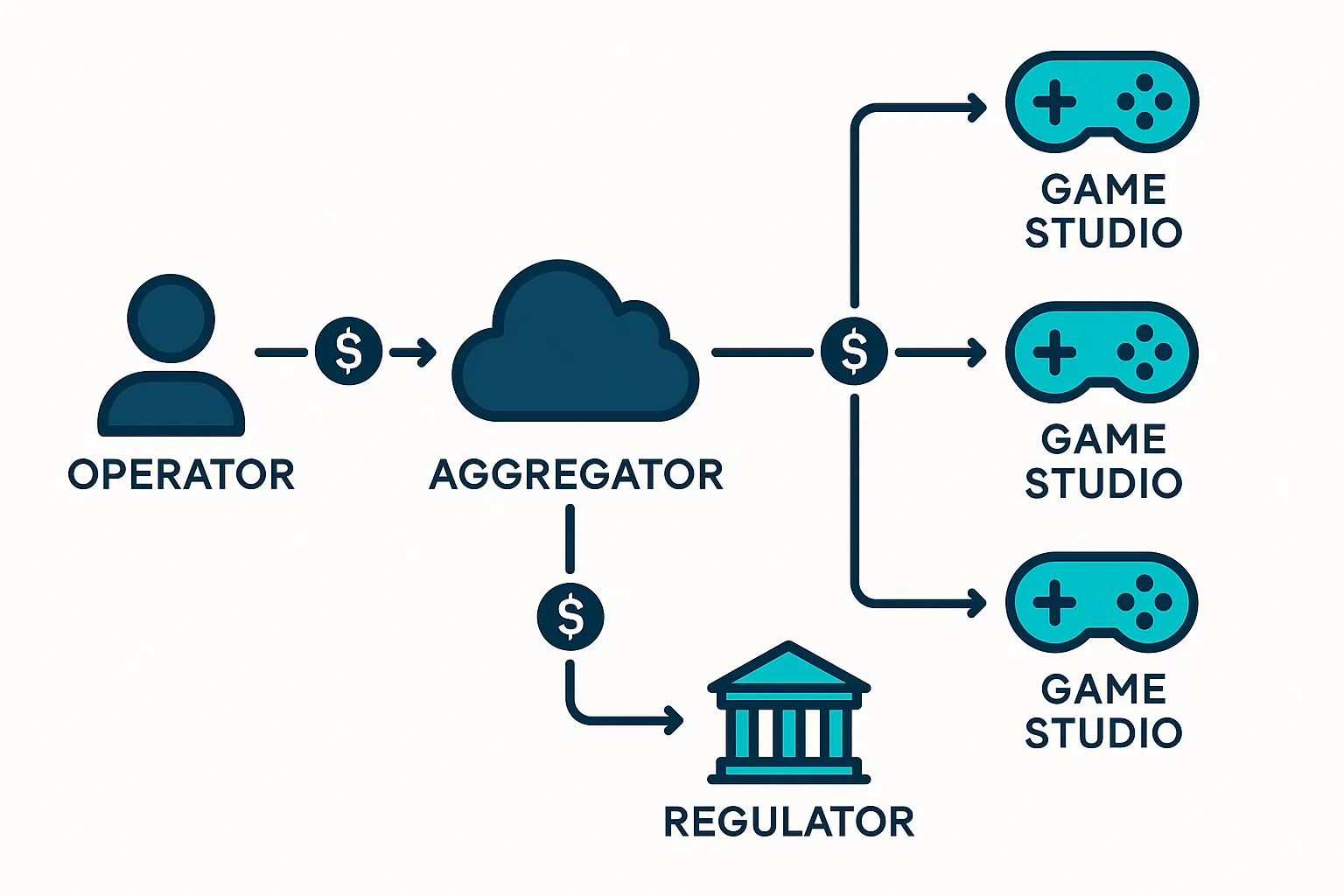
The promise of a game aggregator is seductively simple: integrate once, unlock thousands of slot and live casino titles, and get to market faster. Yet operators who only look at the headline rev-share often discover that the true cost of aggregation is far more complex. Between up-front license fees, tiered revenue splits, certification charges, and activity-based add-ons, the real number on your P&L can end up double what you first budgeted.
Why Aggregators Exist – and Why Their Economics Matter
According to Eilers & Krejcik Gaming, the average player session features titles from 7 different studios. No single developer can cover that breadth, so operators have two options:
- Sign and maintain dozens of direct integrations.
- Work with an aggregator that bundles those studios behind one API.
Aggregators clearly reduce engineering and compliance overhead. However, the convenience comes at a price that compounds as your traffic scales. Understanding every line item now prevents margin surprises later.
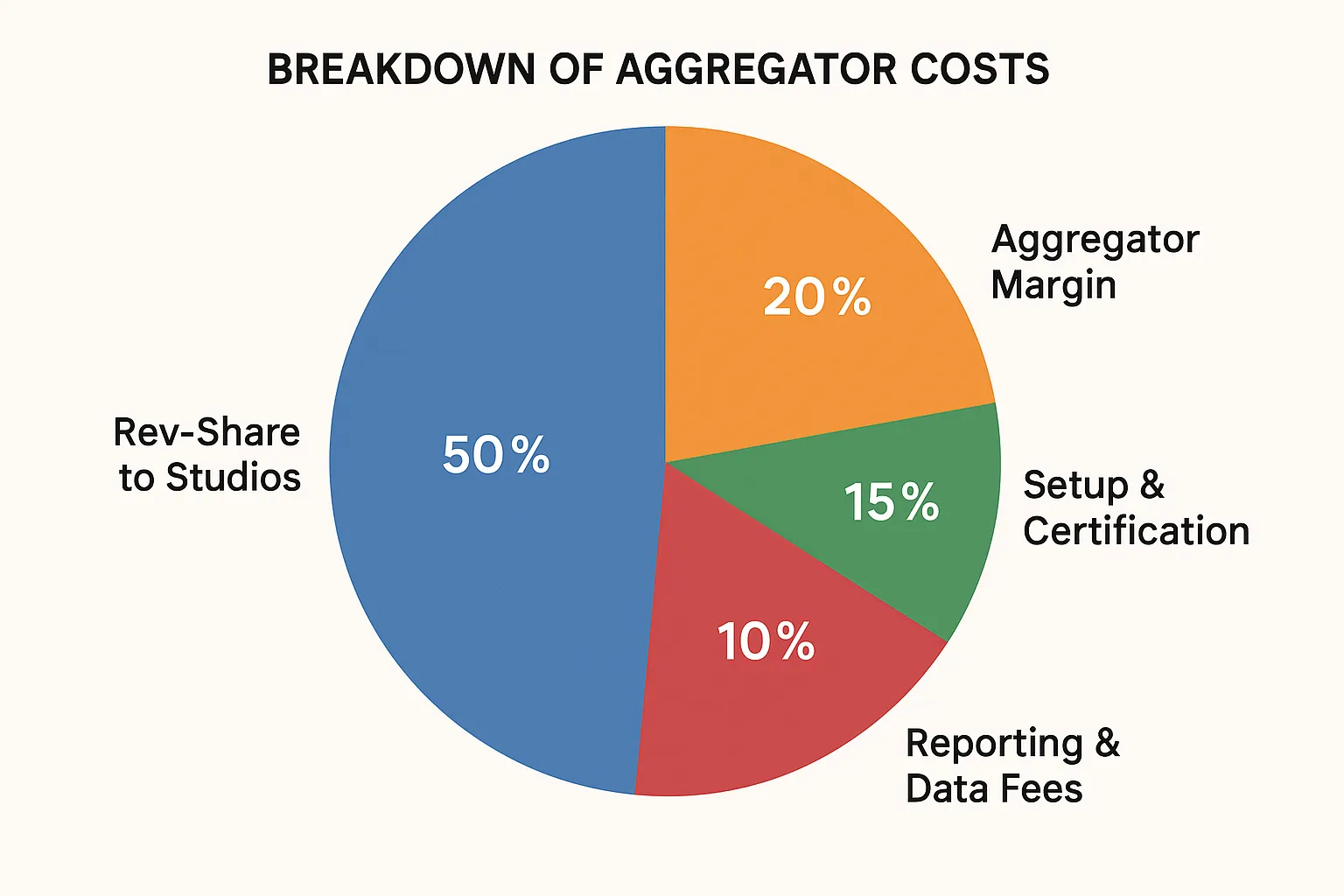
The Visible Costs: Setup and Standard Rev-Share
-
Integration or setup fee
Most tier-one aggregators charge between €10,000 and €40,000 for initial onboarding, test environment access, and certification packs. Some discount this to zero if you commit to a multiyear term. -
Revenue share
A common headline number is 15 % of Gross Gaming Revenue (GGR). What is often missed is that this sits on top of the studio’s rev-share. If a provider keeps 60 %, and the aggregator takes 15 %, the operator only sees 25 % of GGR before any bonus costs or payment fees.
| Cost Element | Typical Range | When It Applies |
|---|---|---|
| Setup / integration | €10k–€40k | One-off at contract signing |
| Aggregator rev-share | 10–20 % of GGR | Ongoing, after game provider share |
| Minimum monthly commit | €5k–€15k | If rev-share falls below floor |
| Game certification | €300–€800 per title per jurisdiction | Each new market entry |
| Report API calls | €0.002–€0.01 per call | Above free tier limits |
Hidden Extras That Inflate Your Monthly Invoice
Even seasoned operators are surprised by costs buried in the fine print.
-
Content tier surcharges
Market-leading studios such as Pragmatic Play or Hacksaw Gaming often sit in a “premium” tier. Access adds another 2–4 % rev-share or a fixed monthly fee. -
Territory uplifts
Operators targeting Spain, Ontario, or Germany pay higher certification and hosting fees because of each regulator’s technical requirements. Aggregators pass these on with a margin, inflating your expansion budget. -
Overage on game calls
Aggregators monetize API traffic. Once you exceed the included threshold (for example 20 M rounds per month), an overage rate kicks in. At €0.002 per round, an extra 10 M spins translates into €20,000. -
Feature gating
Real-time free-round campaigns, crash-game leaderboards, or blazing-fast in-round settlements may sit behind a paywall marked “Enterprise plan only”. -
Data and reporting
Detailed bet-level exports for BI platforms often incur €1,500–€3,000 monthly. Without them you rely on basic CSVs that delay your retention analytics. -
Rollback and jackpot fees
Progressive jackpot liquidity costs and forced participation in network promotions add both cash exposure and audit overhead.
A Quick Math Example
Assume an operator generates €1 M GGR this month:
- Providers keep 60 % → €600k.
- Aggregator takes 15 % of total GGR → €150k.
- Operator left with €250k.
Add €20k in API overage, €10k for premium studio access, and €5k for detailed reporting. Net margin drops to €215k. Your effective aggregator cost is now 18.5 % of GGR instead of the advertised 15 %.
Building Direct vs. Using a Platform with Native Aggregation
Some operators consider bypassing aggregators entirely. Direct integrations reduce margin leakage but create a different expense stack:
- Developer time: 3–4 weeks per provider, multiplied by 30 studios equals roughly 2 FTE years.
- Certification: You pay every lab fee yourself.
- Maintenance: Each studio upgrades its API annually, generating additional engineering tasks.
Spinlab’s Fullhouse platform, by contrast, bundles aggregation inside the core license with a flat module fee. Because we own the integration layer, operators avoid double rev-share while still receiving 7,000+ titles and one-click studio activation. That transparent model shortens time-to-launch and stabilizes gross margins.
(For a deeper dive into platform selection criteria, see The Ultimate Guide to Choosing an iGaming Platform for Emerging Markets.)
Negotiating an Aggregator Contract: 8 Questions to Ask
- What is the effective rev-share after including studio splits and surcharges?
- Does the setup fee cover all jurisdictions we plan to target in the next 24 months?
- Is there a minimum monthly guarantee and how is it calculated?
- What are the API call limits and the price tiers above them?
- How are premium studios classified and priced? Can that change mid-contract?
- Does the aggregator charge for historic data exports or BI connectors?
- What is the policy on responsible gaming and regulator reports? Are those billed separately?
- How quickly are new game releases added and are we billed per title?
Treat each answer as a line in your total cost of ownership model before signing.
Total Cost of Ownership (TCO) Scenario Analysis
| Scenario | Year-1 Cash Cost | Share of GGR (assumes €10 M GGR) | Pros | Cons |
|---|---|---|---|---|
| Stand-alone aggregator | €2.4 M | 24 % | Fast launch, one contract | High variable cost, overage risk |
| Direct studio deals | €1.7 M | 17 % | Lowest rev-share | Slow launch, heavy tech burden |
| Spinlab Fullhouse (aggregator included) | €1.3 M | 13 % | Flat module fee, zero overage, built-in BI | Requires platform migration |
Assumptions: 40 studios, 8 jurisdictions, 50 M annual game rounds, industry-standard bonus ratios.
The table illustrates how an all-in-one platform can reduce first-year cost by up to 46 % versus a classic aggregator contract, even before you account for saved DevOps headcount.
Regulatory Impact on Cost Structure in 2025
Regulations are tightening worldwide, and with them the hidden extras attached to aggregation:
- Dynamic RTP requirements in the UK and Netherlands increase certification frequency. Aggregators will charge pass-through fees per update.
- Crash game fairness audits across LatAm demand on-chain random number logging. Expect premium charges for blockchain nodes unless your platform already supports them natively. (Spinlab does; see Real-Time Analytics in iGaming for how we surface on-chain data.)
- Player data localization laws in Brazil and India can trigger region-specific hosting fees.
Operators planning multi-region launches should model these compliance costs now, not after receiving the first invoice.
Key Takeaways
- The headline 10–15 % aggregator rev-share only tells half the story. Add surcharges, overage, and compliance expenses to find your real margin impact.
- As your monthly GGR climbs, variable rev-share quickly outpaces the fixed cost of a bundled, platform-native aggregator.
- Build a TCO model that projects at least 24 months. Include growth in game rounds and new market entries.
- Negotiate contractual clarity on premium content, API limits, and data access. Anything vague today will appear as a hidden fee tomorrow.
- Platforms like Spinlab Fullhouse combine aggregation, payments, compliance, and analytics under one transparent license. For scaling operators, that structure protects gross margin while accelerating time-to-market.
Ready to see how much you could save with a flat-fee aggregation model? Compare your current quote against Spinlab’s open pricing and discover why emerging and tier-one operators alike are switching to a platform that makes costs predictable. Visit us at https://spinlab.studio to schedule a demo.