
Player habits are shifting fast, and the same recycled slot catalog no longer cuts through an ad-saturated market. In 2025, operators that control their own intellectual property (IP) enjoy meaningfully better margins, higher retention, and stronger brand equity. Yet buying or commissioning a game is a serious investment. Should you keep renting titles from large aggregators at 10–20 % revenue share, or should you own original slot IP outright?
This article breaks down the hard numbers—licensing fees, development budgets, certification costs, lifetime revenue, and optionality—to help operators make a data-driven choice.
Why Original Slot IP Matters Now
- Differentiation: More than 11 000 certified slot skins fight for lobby space. Owning IP guarantees exclusive shelf room and unique mechanics that affiliates can market aggressively.
- Player Economics: Spinlab benchmark data (Q2 2025) shows exclusive titles deliver 27 % higher Day-30 retention and 18 % higher average wager per session than non-exclusive rentals.
- Marketing Flexibility: You can run bespoke quests, community jackpots, or branded missions without negotiating every change with a third-party studio.
- Long-Term Asset Value: Successful IP can be reskinned for new themes, bundled in franchise deals, or licensed to other operators—turning a cost centre into a cash-producing asset.
Cost Structures: Renting vs Owning at a Glance
| Cost Component | Rent (Aggregator or Studio Rev-Share) | Own (Commission or Buyout) |
|---|---|---|
| Up-front Fee | $0–$15 000 setup per title | $60 000–$180 000 design & dev for a modern 3D slot |
| Ongoing Rev-Share | 10–20 % GGR to studio + 3–5 % to aggregator | 0 % (you keep 100 % GGR) |
| Platform/API Fees | Often bundled in rev-share | Spinlab integration included in platform fee |
| Certification & QA | Included | $8 000–$15 000 per market or bundled by Spinlab |
| Maintenance & Updates | Included but roadmap fixed by studio | $1 500–$3 000 per year per title |
| Time to Lobby | 24–48 h | 8–14 weeks (design to certification) |
| Exit Flexibility | Can be pulled with 30 days’ notice | You own code, artwork, math, and RNG |
Costs shown are mid-tier market averages compiled from Spinlab client RFPs and public studio price sheets (April–June 2025).
Revenue Impact Modelling
Let’s compare two scenarios over a 24-month window.
Inputs
- Monthly active players (MAP): 40 000
- Avg spins per MAP: 320
- Avg bet: $0.80
- RTP: 96 %
- House edge (HE): 4 %
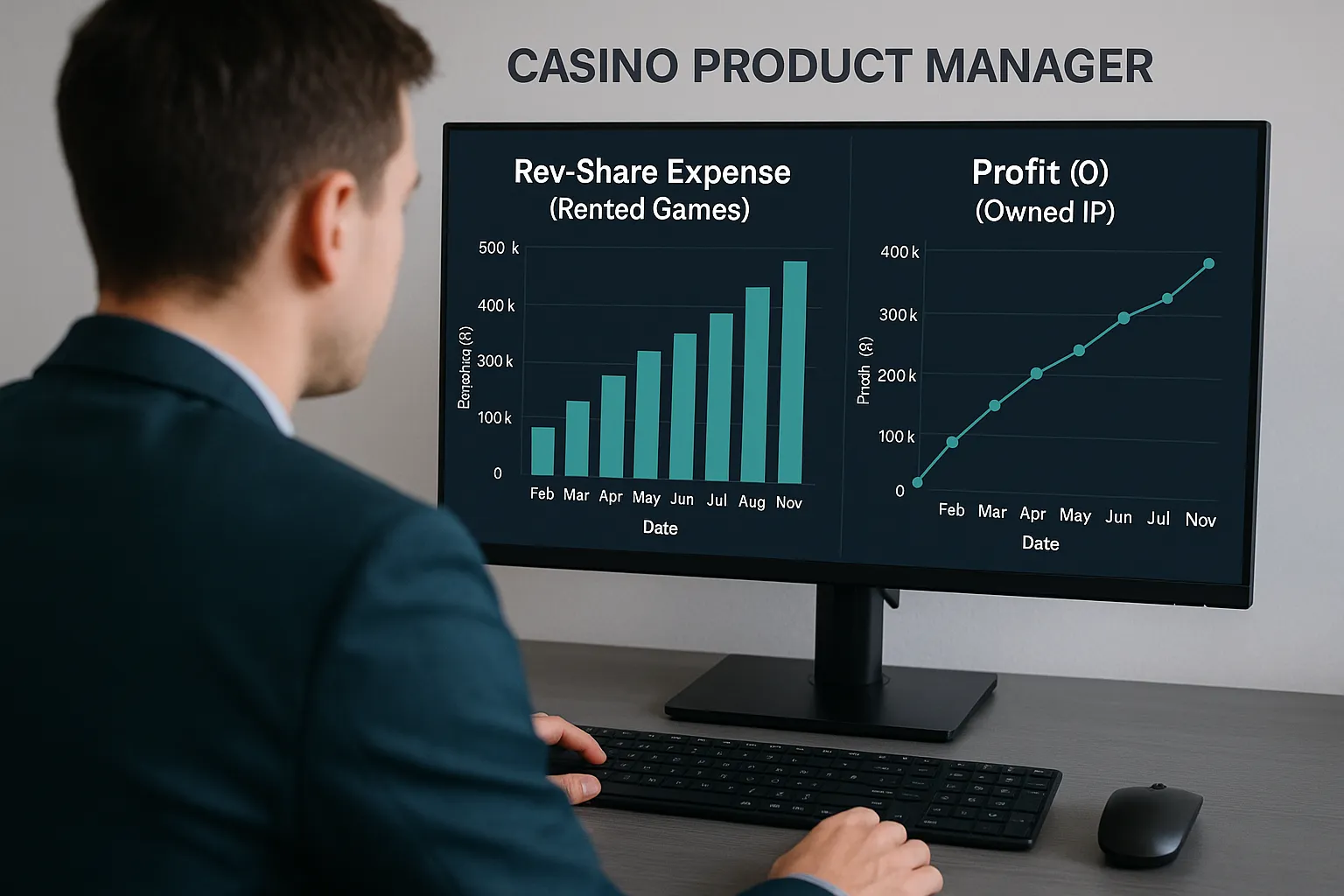
Scenario A: Rented Game (15 % studio rev-share + 4 % aggregator fee)
- GGR/month = 40 000 × 320 × $0.80 × 4 % = $409 600
- Fees = 19 % × $409 600 = $77 824
- Net/month = $331 776
- Net 24 months = $7.96 M
Scenario B: Owned Game
- GGR/month = same $409 600
- Fees = $0
- Net/month = $409 600
- Up-front build cost = $120 000 (mid-range)
- Certification (4 markets) = $48 000
- Maintenance 2 years = $4 000
- Net 24 months = $409 600 × 24 – $172 000 = $9.64 M
Result: Owning generates + $1.68 M in incremental EBIT over two years, even before factoring additional retention uplift.
Break-Even Month
Up-front investment ($172 000) ÷ incremental monthly profit ($77 824) ≈ 2.2 months. The economics flip very quickly when a title achieves moderate traction.
Hidden Variables That Change the Math
- Hit Rate Risk: Not every bespoke game becomes a blockbuster. Mitigate by running math simulations and A/B soft launches (see our Ultimate Checklist for Purchasing Original Game IP for details).
- Jurisdiction Expansion: Rented titles may already be certified in 20+ markets. When owning IP, budget for staggered approvals.
- Tech Debt: Legacy platforms struggle with new engines or features. Spinlab’s modular SDK prevents surprises, but operators on dated stacks should factor refactor costs.
- Licensing Leverage: Larger operators often negotiate rev-share down to 8–10 %. Small startups may pay the full card rate, making ownership relatively more attractive.
- Financing Structure: Treating game development as CapEx improves EBITDA optics, while SaaSising the cost (e.g., via Spinlab revenue-share financing) protects cash flow. See Budgeting for a Casino Startup: CapEx vs OpEx Explained.
Strategic Ownership Models
| Model | Up-front Cost | Ongoing Cost | Rights | Best For |
|---|---|---|---|---|
| Full Buyout | Highest | Maintenance only | 100 % perpetual | Brands seeking long-term franchise value |
| Co-Development | Moderate (shared) | Shared rev-share (5–8 %) | Joint | Mid-sized operators hedging risk |
| Time-Limited Exclusive | Low | Rev-share until exclusivity ends | 6–24 mo exclusive, then open | Promotional tie-ins or seasonal launches |
Spinlab supports all three via its in-house studio network and transparent contract templates.
Funding an Original Slot Without Blowing the Budget
- Revenue-Share Financing: Spinlab can front up to 70 % of development costs in exchange for a capped slice of post-launch GGR.
- Progressive Release Schedules: Stage payments on milestone delivery and early KPI performance to align incentives.
- Reusable Engines: Build a core math model once, then reskin at 30 % of the original cost for sequels.
On average, Spinlab clients launching a trilogy of owned titles recover their initial investment in 4.6 months and enjoy a 62 % margin uplift in year 1. (Internal analytics dashboard, July 2025).
Implementation Checklist
- Define revenue and retention KPIs (e.g., Day-30 retention, GGR uplift).
- Run math simulations with real player cohorts.
- Validate engine/API compatibility with your platform (Spinlab SDK v3).
- Lock artwork and localisation scope early to avoid scope creep.
- Pre-book certification labs for priority queues.
- Produce launch marketing assets (streamer packs, quests, press kits).
- Monitor post-launch KPIs in real time and iterate on volatility or bonus frequency by week 4.
Frequently Asked Questions
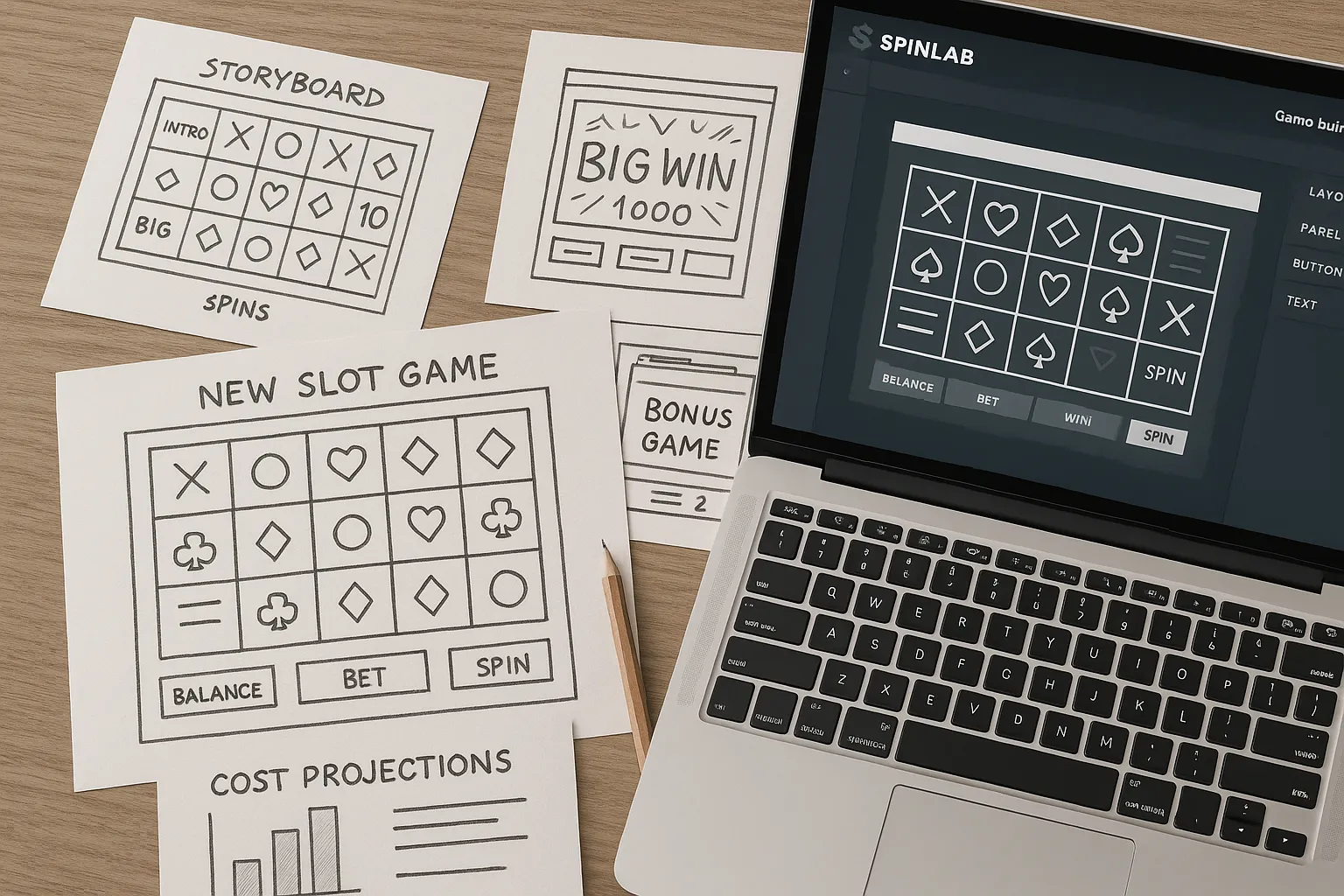
How long does it really take to build a bespoke slot? A small-to-mid scope 5-reel video slot typically takes 8–14 weeks from concept to certification when using Spinlab’s asset pipeline.
Can I convert an owned HTML5 slot into a crash or mines variant later? Yes, if you specify reusable game logic modules upfront. Spinlab’s engine allows you to swap math models while retaining core assets.
What happens if the game underperforms? You still own the IP and can reskin or license it elsewhere. Some operators create low-stakes or social-casino versions to recoup costs.
Is owning IP compatible with aggregator distribution? Absolutely. After any exclusivity window, you can supply the title through aggregators and earn supplier-side rev-share—turning competitors into customers.
Do I need separate RNG certification for each skin? Generally no if the underlying math and RTP are unchanged, but visual reskins may still require QA sign-off in certain jurisdictions.
Ready to Run the Numbers for Your Casino?
Spinlab’s Fullhouse platform offers a Shopify-like game builder, integrated certification workflows, and flexible financing so you can launch owned IP without enterprise-level budgets. Book a 30-minute ROI workshop and receive a customised break-even model for your player base.
Schedule your free consultation and turn your next slot launch into a long-term asset rather than another line item on your aggregator invoice.