

VIP players can represent 60 – 80 % of an online casino’s gross gaming revenue, yet many operators still rely on blunt, rule-based tiers such as “deposit >$5,000” to identify them. The result is overspending on bonuses for short-lived high rollers while missing quieter whales who build value over months. Predictive Lifetime Value (pLTV) models solve this problem by forecasting each player’s future net value from the moment they register, letting CRM teams trigger nurture flows that feel personal and stay profitable.
1. Why Predictive LTV Is the New VIP Superpower
According to the 2025 Eilers & Krejcik Global iGaming Benchmark, operators using pLTV-driven segmentation saw a 23 % higher net gaming revenue (NGR) per marketing dollar compared with those using historical spend alone. Two factors explain the uplift:
- Early visibility. A model can flag a potential VIP after a single session by analysing bet velocity, payment friction, device mix and even geo-risk signals.
- Cost control. Bonuses, cashbacks and host time concentrate on players whose projected profit, not just turnover, justifies the spend.
Spinlab clients who feed model scores into the Real-Time Analytics layer also report lower fraud losses because disposable burners rarely rank as high-value when future churn probability is factored in. Read more about live data pipelines here.
2. Gathering the Right Data for pLTV Accuracy
A credible pLTV model needs diverse signals that go beyond deposits and stakes. Table 1 summarises the data categories most operators already capture inside Spinlab’s event stream.
| Data category | Example fields | Why it matters |
|---|---|---|
| Transactional | stake amount, bet frequency, payout volatility | Core revenue drivers |
| Payment | method, approval latency, chargeback score | Correlates with long-term value & fraud |
| Gameplay | session length, game mix (slots vs live), RTP exposure | Reveals risk appetite and stickiness |
| Behavioural | time of day, device hops, cashier browsing | Early churn vs habit formation |
| Social / referral | affiliate tag, friend invite count | Viral coefficient component |
Spinlab’s open API allows operators to enrich this stream with external data such as VIP host notes or third-party credit scoring. More columns usually raise model lift, but quality beats quantity: missing or biased labels will hurt forecasts.
Quick data hygiene checklist
- Deduplicate user IDs across devices.
- Back-fill historical sessions at least 90 days; pLTV models struggle with cold starts.
- Tag bonus cost per spin and per wager so the model predicts net value.
3. Choosing a Modeling Technique
Several algorithms work well for LTV prediction in iGaming. Your choice depends on data volume, explainability needs and engineering skills.
| Model family | Typical use case | Pros | Cons |
|---|---|---|---|
| BG/NBD + Gamma-Gamma | Medium-size sites (<200k MAU) needing transparency | Easy to interpret, low compute | Assumes monetary value independent of churn, weaker with high promo noise |
| Gradient Boosting (XGBoost, LightGBM) | Fast iteration on large datasets | High accuracy, handles nonlinearities | Harder to explain to regulators |
| Deep Learning (Transformer or Wide & Deep) | Very large sites, real-time scoring | Captures complex patterns, auto-encodes sequences | Needs ML Ops maturity, risk of overfitting |
Whichever model you pick, ensure you optimise for profit uplift, not just RMSE. A common tactic is to evaluate the incremental NGR generated by campaigns that rely on the model compared with a hold-out group.
Minimal feature set for a baseline model
- First deposit amount
- Number of distinct payment methods
- Average bet size last 24 hours
- Slots vs live play ratio
- Cashier error count
- Country and currency
- Time since registration
A seven-feature Gradient Boosting model trained on 1.2 M anonymised Spinlab player records achieved AUC 0.83 in predicting top-decile LTV, enough to drive significant ROI.
4. Translating Predicted LTV into Actionable Segments
Raw dollar forecasts are hard for CRM teams to use. Converting scores into segments keeps campaigns manageable. A popular approach is decile ranking followed by business-friendly buckets:
| Segment | Predicted 12-month NGR | Typical population | Main objective |
|---|---|---|---|
| Platinum Whale | Top 1 % | 0.5-1 % | Personal host, bespoke limits |
| Gold Growth | Next 9 % | 8-10 % | Accelerate spend, early loyalty |
| Silver Steady | Middle 40 % | 40-45 % | Maintain ARPU, cost-efficient perks |
| Bronze Drift | Lower 40 % | 40-45 % | Prevent early churn |
| Red Flag | Bottom 10 % or high fraud risk | 4-6 % | Limit bonusing, enforce RG checks |
Spinlab’s Bonus & Quest Engine lets you store the segment as a dynamic property that updates after each model rescore, so a player can move from Gold to Platinum the second their projected value crosses your threshold.
5. Designing Nurture Flows That Match Each Segment
Once segments are live, automate multichannel journeys. If you need a refresher on automation techniques, revisit 9 Email Automation Flows Every Casino Should Deploy. Below is a segment-centric playbook.
Platinum Whale
- Trigger: first time predicted NGR >$25k
- Channels: dedicated VIP host call, WhatsApp, in-app overlay
- Offers: tiered reload bonuses with win-back insurance, higher withdrawal limits
- Guardrails: real-time RG score and manual AML check before bonus fire
Gold Growth
- Trigger: first deposit + consistent mid-five-figure NGR forecast
- Channels: personalised email, push, SMS during peak session hours
- Offers: mission ladder with escalating rewards, weekend cashback
- Guardrails: automated wagering requirements to protect margin
Silver Steady
- Trigger: monthly predicted plateau
- Channels: email digest, on-site banners
- Offers: low-cost free spins, surprise spin-back after a losing streak
- Guardrails: bonus cost <8 % of expected margin
Bronze Drift
- Trigger: churn risk score >0.6
- Channels: reactivation email at day 7, SMS voucher day 10
- Offers: frictionless promo code redeemable on mobile first deposit
- Guardrails: stop if self-exclusion signals appear
Red Flag
- Trigger: predicted negative LTV or fraud probability
- Action: KYC escalation, remove bonus eligibility, monitor velocity
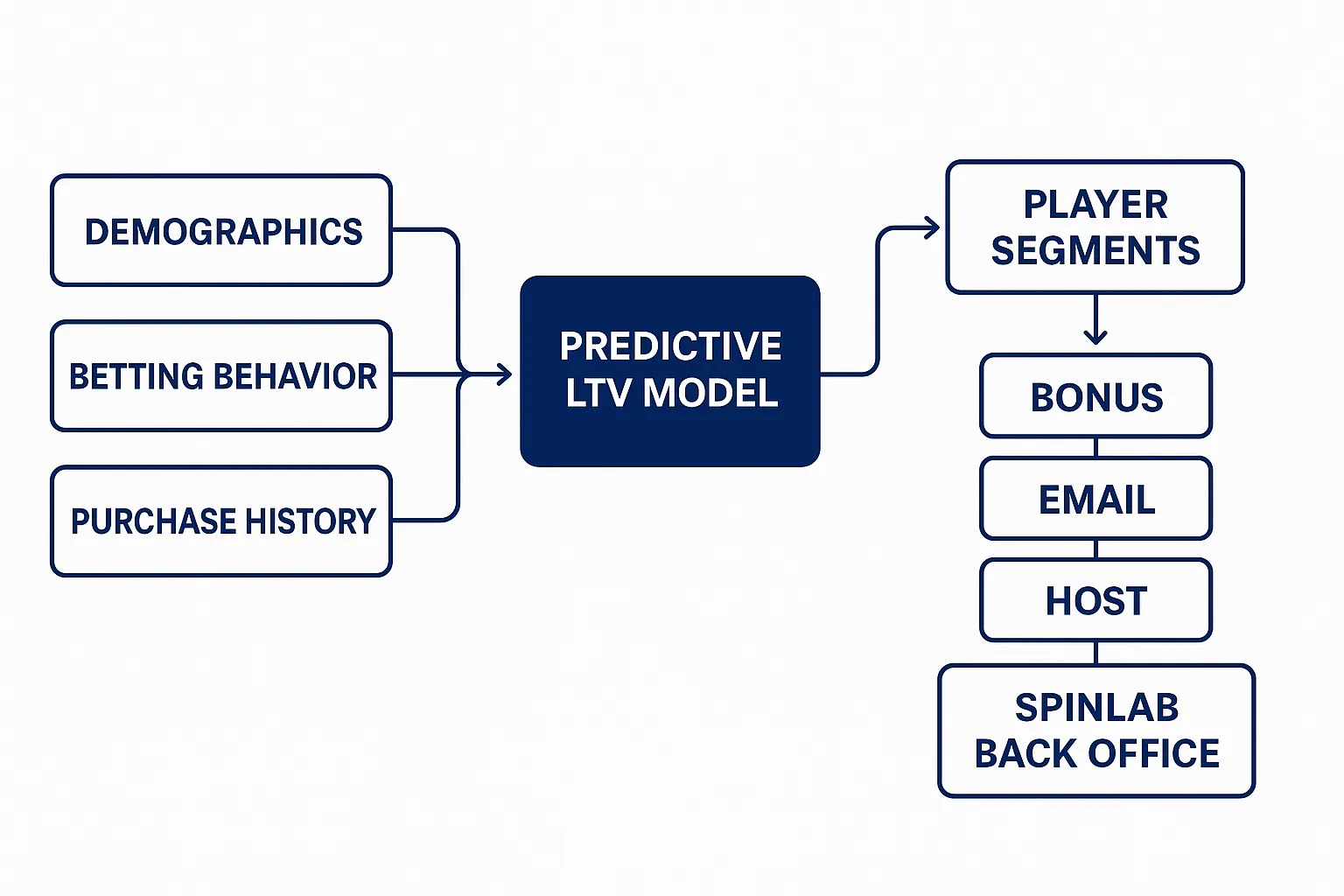
6. Integrating Model Scores into the Spinlab Stack
Spinlab exposes a POST /players/{id}/traits endpoint where you can deposit model outputs in real time. Below is a simplified workflow.
# pseudo-code: send pLTV score after every session close
def send_score(player_id, score):
    payload = {
        "trait_key": "predicted_ltv_12m",
        "trait_value": score,
        "timestamp": datetime.utcnow().isoformat()
    }
    requests.post(f"https://api.spinlab.studio/players/{player_id}/traits", json=payload, headers=auth)
A serverless function in AWS Lambda or Google Cloud Functions can consume your model’s event stream, score in under 200 ms, and call this endpoint. The moment the trait updates, Spinlab’s Campaign Orchestrator can fire webhooks to your ESP or on-site pop-ups, keeping communication latency under a second.
Security and compliance notes
- Use signed JWTs to secure trait updates.
- Log every score write to meet audit requirements.
- Store only the numeric score or segment label; avoid PII in model payloads.
7. Measuring Success and Refining the Model
Deploying pLTV-driven nurture flows is not a set-and-forget project. Review these KPIs each sprint:
| KPI | Target | Why it matters |
|---|---|---|
| Incremental NGR per player vs control | +15 % in 90 days | Shows business impact |
| Bonus ROI | >3× | Ensures promos pay for themselves |
| Model AUC on hold-out set | >0.80 | Keeps forecasts reliable |
| Segment drift velocity | <5 % churn per month | Prevents volatile VIP lists |
| Complaint rate per campaign | <0.3 % | Protects deliverability & RG compliance |
A/B test not only copy and bonus size but the segmentation thresholds themselves. You may discover that splitting the top 1 % even further (e.g., top 0.1 %) delivers more precise host allocation.
8. Roadmap: From Proof-of-Concept to Always-On Engine
- Week 0-2: Data audit and extraction using Spinlab’s ClickHouse notebook.
- Week 3-4: Train baseline Gradient Boosting model on historical data.
- Week 5: Deploy scoring microservice; sync scores via Spinlab API.
- Week 6: Launch nurture flows for two test segments (Gold and Bronze).
- Week 8: Analyse uplift; iterate feature set (add payment cohort, device model).
- Month 3: Expand to all segments; connect score to real-time bonus rules.
- Month 6: Graduate to an auto-retraining pipeline with feature store.
Operators following a similar plan on Spinlab’s platform typically see positive ROI within 8 weeks, even before full automation.
Frequently Asked Questions
How much historical data do I need to train a reliable pLTV model? Three to six months is usually sufficient, provided you have at least 50 k active players and include every transaction and bonus cost.
Do pLTV models conflict with responsible gaming rules? No, as long as you also predict and act on harm indicators. Many regulators encourage risk-based segmentation to reduce blanket high bonuses.
What is the best cadence for rescoring players? Daily rescoring covers most behaviour changes without overloading your pipeline. High-roller tables may benefit from hourly updates.
Can I use the same model for sports betting and casino? You can, but accuracy often improves with channel-specific models because bet dynamics differ.
How do I explain my model to regulators? Keep a feature importance chart, back-test results, and a plain-English policy document showing no protected attributes (age, gender) influence marketing decisions.
Turn Predictive Insight into VIP Revenue Today
Predictive LTV segmentation lets you identify whales before the competition and shower them with the right attention at the right cost. Spinlab’s modular iGaming platform already streams the real-time events, bonus rules and API hooks you need to operationalise your model in days, not months.
Ready to see how fast you can move? Book a 30-minute strategy call and get a live demo of traits, triggers and VIP dashboards tailored to your casino.