

Players see dozens of pop-ups every session—bonus pushes, tournament invites, cashback prompts. If your loss-limit alert looks just like the rest, it turns invisible. With tighter 2025 regulations from the UKGC, AGCO, and Curaçao’s new National Ordinance, “banner blindness” is no longer a UX nuisance; it’s a compliance and reputational landmine.
In this guide we break down the science and engineering behind loss-limit alerts that actually interrupt harmful play and keep regulators satisfied, without crushing revenue or user experience.
Why Most Loss-Limit Alerts Fail
- Poor timing – Batched once-per-day emails arrive hours after the limit is breached.
- Generic copy – Vague “You’re approaching your limit” messages don’t quantify risk.
- Visual noise – Modals use the same palette as promos, so players instinctively close them.
- No clear next step – Alerts lack a friction-light path to cooling-off, lowering limits, or cashing out.
- Regulatory overkill – Walls of legalese overwhelm players and sabotage comprehension.
The result? A 2024 Spinlab audit of 22 casinos found only 31 % of players acknowledged their loss-limit warning within 60 seconds; fewer than 8 % took protective action.
Behavioral Science Principles to Apply
- Salience: Unique color tokens and motion graphics draw the eye.
- Precise numeracy: Present absolute figures (“€450 of €500”) and remaining playtime.
- Choice architecture: Present three balanced options (continue, lower limit, cool-off) rather than a single “OK” button.
- Social proof: Short lines like “78 % of players who pause now lose less tomorrow” reduce friction.
- Commitment devices: Ask for an explicit typed confirmation when increasing limits to leverage effort cost.
Six Elements of a High-Impact Loss-Limit Alert
| Element | Best Practice | Common Pitfall |
|---|---|---|
| Trigger Logic | Fire at 50 %, 75 %, 90 %, and 100 % of daily/weekly limits using real-time ledger events | Relying on hourly cron jobs that miss rapid losses |
| Delivery Channel | In-game modal + simultaneous push/SMS for mobile breakouts | Solely email (opens <10 % during active sessions) |
| Copy & Tone | Plain-English, empathetic, numeric; 11–14 words per sentence | Legalistic jargon pasted from T&Cs |
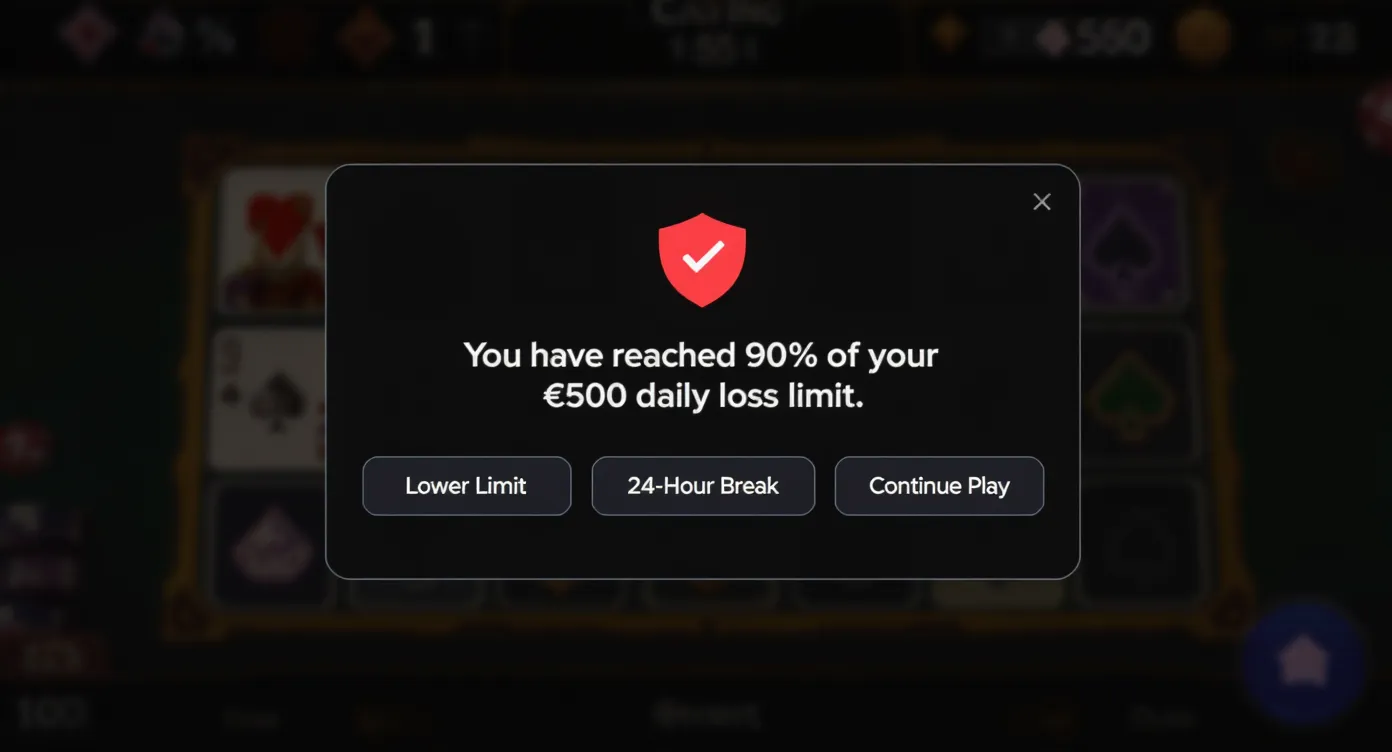
| Visual Design | Contrasting palette, iconography (red shield), focus lock (blur BG) | Promo-style banners with competing CTA flashes |
| Action Set | One-click: “Lower Limit”, “Take 24-h Break”, “Continue” (default no longer auto-selected) | Forcing logout without options (spikes churn) |
| Confirmation | Toast + email receipt + ledger note; store in immutable audit log | No proof of acknowledgment for regulators |
Example UI Wireframe
Engineering the Alert on a Modular iGaming Stack
- Event Stream – Publish wallet debits to Kafka topics in <50 ms.
- Real-Time Rule Engine – Evaluate cumulative losses per player/session against stored limits; emit
loss_alertevents. - Notification Service – Consume events, fetch language & channel prefs, push to WebSocket, FCM/APNs, SMS.
- Front-End Hook – Subscribe to WebSocket; render modal with focus trap, Light-DOM isolation, and ARIA tags.
- Audit & Analytics – Append signed JSON blob (timestamp, limit, response) to an immutable ledger (e.g., LedgerDB) for regulator export.
Spinlab’s Open API exposes each layer, while our Responsible Gaming SDK ships with pre-built React/Vue components and ISO-schema audit logs—cutting months of dev time.
Compliance Cheat-Sheet (2025 Updates)
| Jurisdiction | Mandated Checkpoint | Response Window | Data Retention |
|---|---|---|---|
| UK (UKGC SR 3.4.3) | 25 %, 50 %, 75 %, 100 % loss messages | Immediate | 7 yrs |
| Ontario (AGCO 4.35) | Real-time notification at 100 % | 5 min | 6 yrs |
| Curaçao (NOOG 2025-12) | Player-set limits + breach lockout dialog | N/A (forced) | 5 yrs |
| MGA (RG-17) | Breach warning + 5-click cooling-off max | Immediate | 10 yrs |
Note: “Immediate” means within the same playing session. Batch jobs are non-compliant.
Measuring Effectiveness: Key KPIs
| KPI | Target | Why It Matters |
|---|---|---|
| Alert Acknowledgment Rate | >85 % within 30 s | Shows players actually see it |
| Protective Action Rate | >20 % choose lower limit or cool-off | Direct harm-reduction metric |
| Post-Alert Net Loss | <5 % of prior session average | Tracks impact on spend |
| Regulator Incident Count | 0 quarterly | Compliance health |
| Churn vs Control | ≤2 % uplift | Ensures protection doesn’t kill revenue |
A/B Testing Framework
- Randomly assign at least 10 k players per variant.
- Test one variable at a time (color, copy, button order).
- Run for 14 days or until 95 % significance.
- Monitor compliance in real time—pull variant if KPIs slip.
- Ship winning variant to 100 % of traffic; archive data for audits.
Spinlab’s Real-Time Analytics module (see our article Turning Live Data into Bigger Profits) streams KPIs to a Grafana-style dashboard, enabling on-the-fly tweaks.
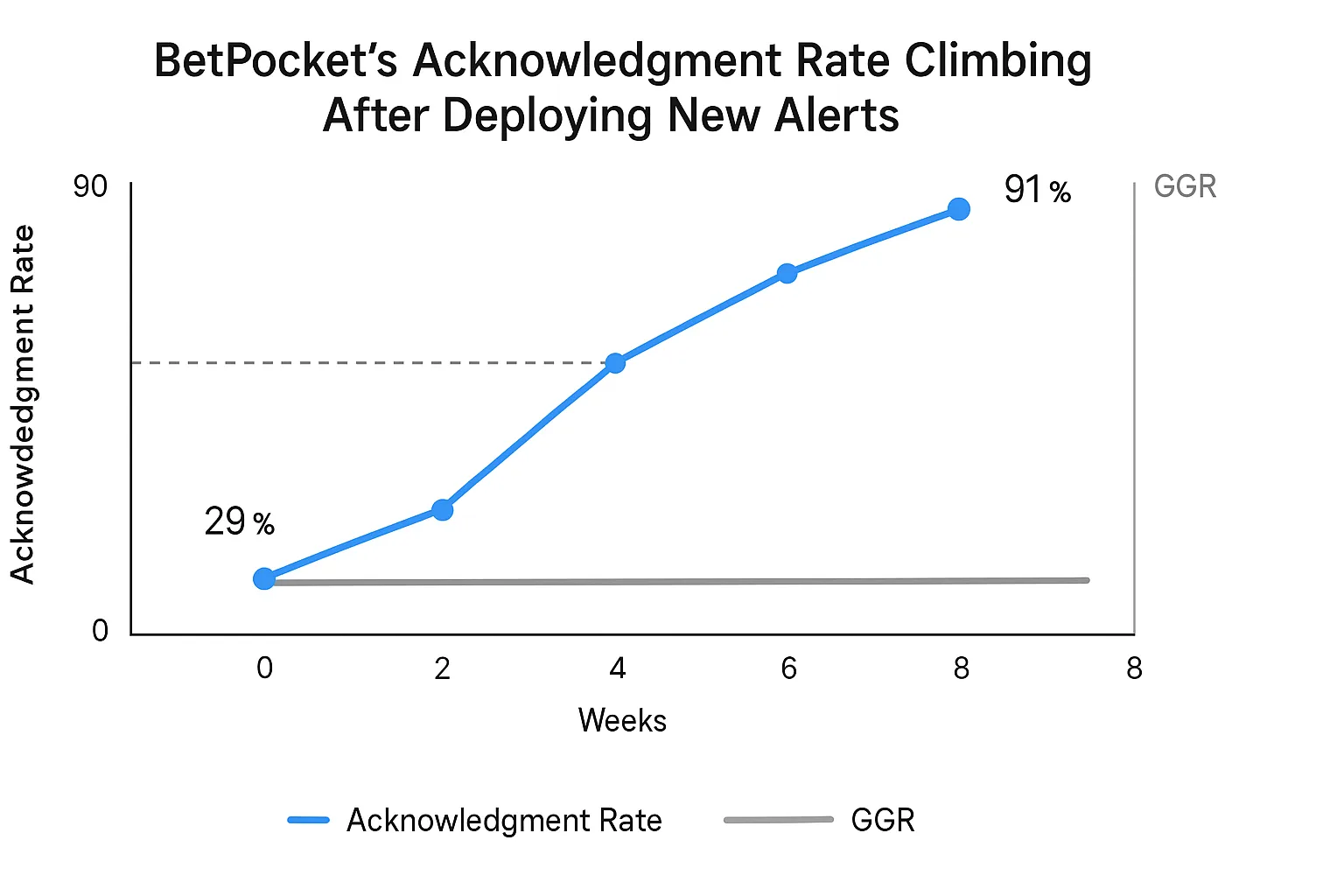
Micro Case Study: BetPocket
- Problem: Only 29 % of players responded to loss warnings; UKGC issued a notice.
- Solution: Migrated to Spinlab, deployed the SDK with personalized copy and multi-channel alerts.
- Results (60 days): 91 % acknowledgment, 24 % protective actions, 0 regulatory incidents, and no measurable drop in GGR thanks to re-engagement campaigns.
Integrating With Bonus & Quest Systems
Loss limits shouldn’t operate in isolation. Feed loss_alert events into your bonus engine to:
- Pause high-risk promos automatically.
- Offer low-risk free spins instead of cashbacks after a cool-off.
- Trigger ESG reporting for board dashboards (see our ESG article here).
Frequently Asked Questions
Do loss-limit alerts hurt revenue? Spinlab benchmarks show properly designed alerts reduce harmful losses without significant GGR impact when paired with re-engagement offers.
What’s the difference between deposit and loss limits? Deposit limits cap money added; loss limits track net negative play. Regulators increasingly require both.
How fast must alerts fire to be compliant? Most major regulators demand real-time or “within session” alerts—anything slower risks fines.
Can I reuse marketing pop-up components? Technically yes, but UX studies show distinct styling boosts acknowledgment; use a separate component library.
How do I localize alerts? Store copy variants in i18n JSON; include dynamic currency and date formatting. Always get legal review of local mandatory lines.
Ready to Ship Player-Centric Loss Limits?
Spinlab’s modular iGaming platform ships loss-limit alerts out of the box: real-time event triggers, pre-tested UI components, immutable audit logs, and drag-and-drop A/B testing. Book a 20-minute live demo and see how fast you can meet 2025 RG rules—without sacrificing player experience or profit.