

Planning a record-breaking jackpot weekend is exciting—until you realise a payout worth seven figures could crash your servers and leave players staring at an error page. Capacity bottlenecks quickly translate into lost deposits, broken trust and social-media firestorms. In this guide you will learn a repeatable framework to forecast server capacity for high-traffic casino events so you can scale confidently and keep the reels spinning when the stakes are highest.
Why Mega-Jackpot Weekends Are a Different Beast
Regular Friday-night peaks are predictable. Mega-jackpot campaigns are not. When the prize pool crosses a psychological threshold—often anything above USD 1 million—three factors amplify load in ways that normal trending algorithms miss:
- Viral share spikes: Paid ads produce linear growth; viral shares cause exponential surges within minutes.
- Session stickiness: Players stay logged in far longer as the jackpot climbs, driving high concurrency rather than just high visits.
- Heavy backend chatter: Progressive jackpot math, real-time leaderboards, chat and streaming multiply database and message-queue traffic.
Ignoring any one of these can create a perfect storm. A single overloaded API or partition-heavy database shard is enough to cascade latency across your cashier, game servers or KYC services.
Step 1 Measure the Right Baseline KPIs
Start with at least four weeks of event-level telemetry from previous campaigns. If you lack history, Spinlab’s Real-Time Analytics module can ingest and replay synthetic traffic to fill gaps.
Key metrics to pull:
- Peak Concurrent Users (PCU)
- Transactions Per Second (TPS) for critical microservices: game round, wallet debit/credit, promo engine, chat
- p95 and p99 latency for each endpoint
- Average Session Duration (ASD)
- External egress throughput (GB/s) to CDNs and game studio endpoints
Feed these into a capacity worksheet or an APM tool such as New Relic, Datadog or Spinlab’s native dashboard.
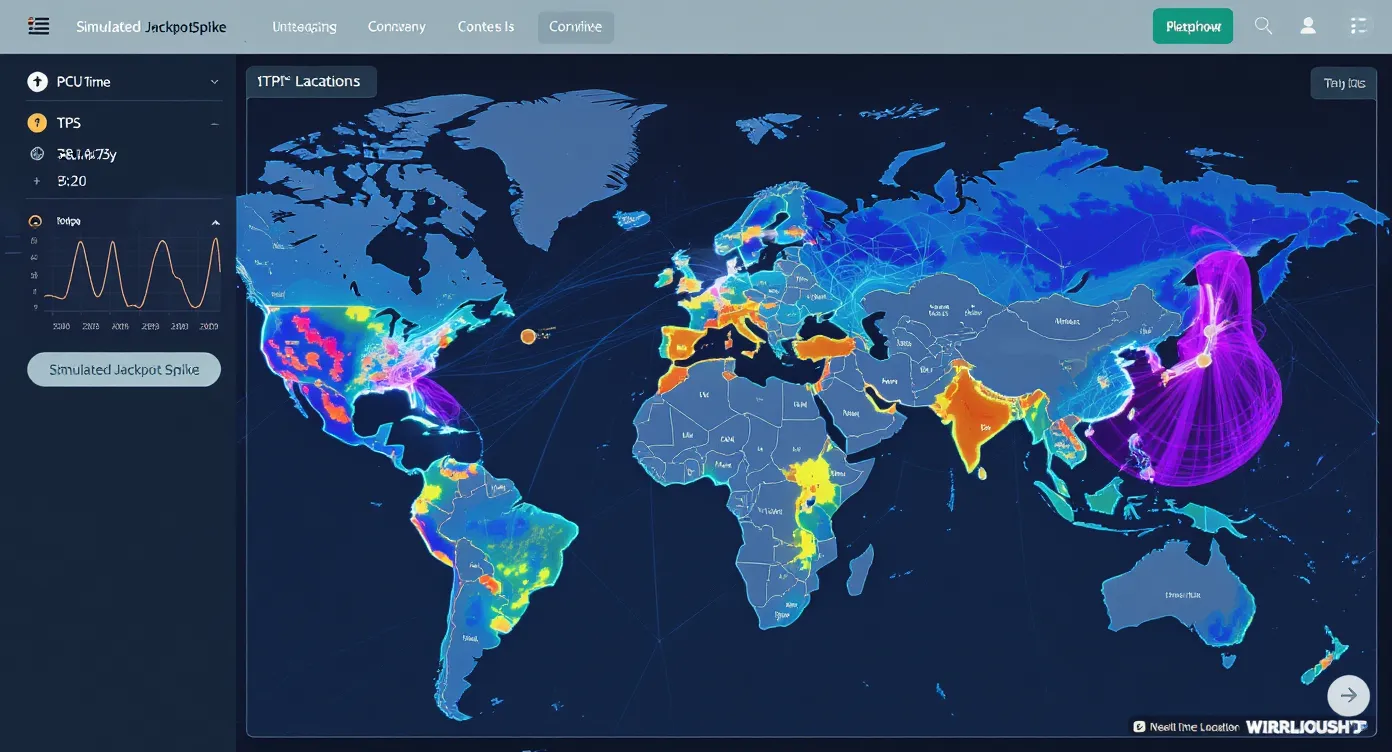
Step 2 Model Your Traffic Multiplier
Historic numbers alone will under-predict the surge. Instead, calculate a multiplier for each load driver.
| Driver | Multiplier Range | Estimation Method |
|---|---|---|
| Viral share uplift | 1.3–3× | Social mention volume vs DAU in prior promos |
| Press coverage | 1.1–1.5× | Impressions from PR tracking tools |
| Influencer streams | 1.2–2× | Average CCU from past streams |
| Jackpot rollover effect | 1.1–1.4× | Growth delta per rollover cycle |
| Affiliate flash promos | 1.05–1.2× | E-mail open & click-through history |
Multiply the baseline PCU and TPS numbers by the highest applicable uplifts, not the average. For example, a weekend boosted by both influencer streams (2×) and a rollover (1.2×) should plan for 2×, not 2.4×; overlapping audiences rarely stack perfectly.
Quick formula
Forecast PCU  = Baseline PCU  × Max(Viral, Press, Stream, Rollover, Affiliate)
Forecast TPS  = Baseline TPS  × same multiplier
Add headroom: Spinlab recommends +30 % above your computed forecast to absorb bot spikes and unplanned shout-outs from celebrity high-rollers.
Step 3 Stress-Test with Synthetic Loads
Once you have target numbers, validate the assumptions in a non-prod environment.
- Clone prod traffic patterns using pcaps or Spinlab’s event-replay tool.
- Increase concurrency gradually until you hit forecast PCU; then push 30 % further.
- Monitor saturation: look for CPU steal time, connection pool exhaustion, and DB lock waits.
- Document the failure mode—API time-outs, queue backlogs, or game provider rate limits.
If you cannot reproduce real-player behaviour (e.g., complex wager flows), generate protocol-level mocks for each game endpoint and wallet service. The goal is not realism but resource consumption fidelity.
Step 4 Implement Elasticity Guardrails
Even with precise forecasts, you still need safety nets for day-of volatility.
- Autoscaling policies: Use CPU, memory and custom queue-depth metrics. For jackpot traffic, queue depth is a leading indicator; CPU lags by seconds.
- Hot standby game servers: Keep instances warmed and loaded with RNG state to avoid cold-start delays.
- Circuit breakers & bulkheads: If the leaderboard API slows, do not let it block wallet debits.
- Progressive jackpot cache: Serve jackpot size from Redis or Spinlab’s in-memory edge cache with a TTL of 500 ms rather than hitting SQL on every pulsating update.
These patterns echo those in our article on 8 signs your casino tech stack is stunting growth—and how to fix it, specifically the traffic-surge failure section.
Step 5 Forecast Cost Before Green-Lighting Marketing
Finance teams will ask: How much will this spike cost? Cloud bills can double overnight. Use provider calculators or the FinOps tab in the Spinlab admin to estimate:
- Compute (vCPU hours)
- Bandwidth egress
- Managed DB read/write IOPS
- Third-party game API overage fees
Then compare against projected GGR uplift using the Incremental NGR Model:
Incremental Revenue  = (Projected wagers × Hold %) – Promo costs – Jackpot contribution
Net Margin Impact    = Incremental Revenue – Extra Infra Cost
Only launch the mega-jackpot when Net Margin Impact remains positive at the worst-case scaling scenario.
Step 6 Create a Game-Day Playbook
Preparation beats heroics. Draft a single-page runbook covering:
- Traffic checkpoints at 50 %, 75 %, 90 % of forecast PCU
- Roll-back criteria for promo pauses
- Real-time dashboards URLs & on-call rotation
- Rate-limit overrides for payment gateways and KYC providers
- Escalation matrix with direct Slack/Telegram handles for Spinlab support, cloud provider TAMs, and major game studios
Pin the runbook in your war-room channel. Review it 24 hours before launch.
Putting It All Together: A Mini Case Study
Fullhouse Casino wanted to grow weekend handle by 40 % with a USD 2 million progressive jackpot. Using the above framework they:
- Extracted a baseline PCU of 9 k and TPS of 3 200.
- Applied a 2× influencer spike multiplier → 18 k PCU.
- Added 30 % headroom → 23.4 k PCU target.
- Ran synthetic tests, uncovering a Redis max-memory misconfig that capped leaderboards at 15 k PCU.
- Deployed autoscaling with queue-depth triggers and hot standby game pods.
Result: peak traffic hit 21.9 k PCU, latency stayed under 180 ms p95 and the event generated 52 % higher GGR than the previous record without extra downtime. You can read the full details in our scaling case study.
Frequently Asked Questions
How much headroom should I plan for? We recommend at least 30 % above your highest forecast PCU/TPS. If you are using a fixed-capacity data centre, 50 % is safer.
Do I need separate database clusters for jackpot logic? Not always. Placing jackpot state in an in-memory cache with periodic persistence is usually sufficient, but high-value pooled jackpots may warrant a dedicated replica set to isolate load.
What if a content provider rate-limits my traffic? Negotiate burst allowances in advance and use Spinlab’s traffic-shaper to queue excess calls locally so gameplay remains fluid.
Can I rely solely on autoscaling? No. Autoscaling reacts; forecasts and synthetic tests are proactive. Combine both.
How early should I start forecasting? Begin at least four weeks before the event to gather baseline data and run two full load-test cycles.
Ready to Stress-Proof Your Next Jackpot?
Spinlab’s modular iGaming platform comes with real-time analytics, synthetic load tools and automated autoscaling blueprints so you can focus on growth, not firefighting. Book a 30-minute demo to see how we help operators survive (and monetise) their biggest traffic spikes.