

The best casino platform for crypto onramp integration is not simply the one that can connect to a crypto payment gateway. For an online casino, the onramp sits inside one of the highest-intent moments in the player journey: the cashier. If the experience is confusing, slow, or disconnected from compliance and wallet logic, players abandon before the first wager.
A strong platform should make fiat-to-crypto deposits feel as simple as any modern checkout flow while still giving operators the controls they need for KYC, AML, fraud prevention, reconciliation, bonus rules, and multi-currency accounting. In 2026, that usually means choosing a modular iGaming platform where payments, wallets, risk, games, and backoffice operations are designed to work together from day one.
For operators launching a crypto-ready online casino, the real question is not “Can this platform accept crypto?” It is “Can this platform convert players, manage risk, and scale across markets without forcing the team to stitch together critical systems manually?”
What crypto onramp integration means for an online casino
A crypto onramp lets a player buy cryptocurrency using fiat payment methods, often card, bank transfer, or local payment options, and use that crypto value to fund their casino balance. In practice, this can remove a major barrier for players who want the speed and flexibility of crypto but do not already have funds sitting in an external wallet.
This is different from a direct crypto deposit, where the player already owns crypto and sends it from a wallet to the casino. Both models can be valuable. Direct deposits are familiar to crypto-native players, while onramps can help convert mainstream users who prefer a simpler cashier flow. If you are comparing both models, Spinlab’s guide to crypto onramp vs direct deposit conversion is a useful starting point.
The best casino platform should support this deposit flow without treating it as an isolated plugin. It needs to coordinate the onramp provider, payment gateway, user wallet, player balance, transaction monitoring, bonus engine, and admin panel.
Why crypto onramp quality affects revenue
Crypto casino payments often get discussed as a technical topic, but the commercial impact is just as important. Every extra step in the cashier can reduce deposits. Every unclear fee, delayed balance update, or failed verification can create support tickets. Every reconciliation gap can slow finance and compliance teams.
A well-integrated onramp can improve the deposit journey in several ways:
- It allows non-crypto-native players to fund accounts without leaving the casino experience.
- It supports global acquisition where card acceptance, bank rails, or currency coverage vary by region.
- It gives operators a path to stablecoin-based balances, faster settlement, or multi-currency flexibility.
- It can reduce operational friction when payment, wallet, and compliance data are unified.
The key is that the onramp must be part of the broader online gambling platform architecture. A standalone payment widget may work for a test, but it is rarely enough for a scalable casino brand.
Core criteria for choosing the best casino platform for crypto onramp integration
When evaluating a casino software provider, start with the deposit journey and then work backward into the systems that support it. The strongest platforms combine payment flexibility with operational control.
| Evaluation area | What to look for | Why it matters |
|---|---|---|
| Payment architecture | Fiat, crypto, crypto onramp, direct deposits, and multi-currency support | Lets operators serve different player segments without rebuilding the cashier |
| Wallet and ledger logic | Accurate balance updates, custodial wallet support, transaction records, and reconciliation tools | Prevents accounting issues and player disputes |
| Compliance controls | KYC, AML workflows, risk rules, audit trails, and jurisdiction-specific configuration | Helps operators manage regulatory expectations and reduce exposure |
| Fraud prevention | Deposit monitoring, bonus abuse controls, suspicious activity detection, and withdrawal checks | Protects margins and reduces operational risk |
| Cashier UX | Mobile-optimized flow, clear fees, simple instructions, and fast feedback after payment | Improves deposit conversion and reduces abandoned transactions |
| Backoffice usability | Admin controls for payments, users, bonuses, analytics, and support | Helps lean teams operate without excessive manual work |
| Game and bonus readiness | Game aggregation, bonus engine, affiliate tools, and player segmentation | Converts successful deposits into active wagering and retention |
| API flexibility | Open API integration and modularity | Supports future providers, custom flows, and market expansion |
A good test is simple: if a player buys crypto through the cashier, how quickly and accurately does that value appear in their playable balance, and how easily can the operator explain, audit, and manage that transaction later?
The payment stack should support both fiat and crypto
An onramp is most valuable when it sits inside a hybrid payment strategy. Some players will still prefer cards, bank transfers, vouchers, or local payment methods. Others will prefer wallet-to-casino transfers. Crypto-curious players may need an onramp to bridge the gap.
This is why the best crypto-ready solution should not force operators to choose between fiat and crypto. It should support both under a unified operating model. That means the platform needs a cashier that can route users to the right payment method, a ledger that can handle multiple currencies, and a backoffice that gives the operator visibility across all transaction types.
For new operators, this can be the difference between a clean launch and a messy one. Spinlab’s overview of crypto casino payments for new operators explains the building blocks in more detail, including direct deposits, onramps, withdrawals, and operational considerations.
Compliance cannot be added as an afterthought
Crypto onramp integration touches regulated areas, including payments, identity checks, anti-money laundering controls, and potentially virtual asset service provider obligations depending on the market and operating model. The exact requirements vary by jurisdiction, licensing setup, payment partners, and player location.
Operators should treat KYC and AML as platform-level requirements rather than external paperwork. The Financial Action Task Force has long emphasized a risk-based approach to virtual assets and service providers in its guidance on virtual assets, and gaming operators should be prepared to document how funds, users, and risky behavior are monitored.
In practical terms, the casino platform should help teams answer questions like:
- Who made the deposit, and has the player passed the required verification level?
- What payment method or onramp provider was used?
- Which asset or currency entered the platform?
- Was the transaction connected to suspicious behavior, bonus abuse, or unusual withdrawal patterns?
- Can the operator export or review the history if a provider, auditor, or regulator asks?
The platform does not replace legal advice, licensing strategy, or compliance expertise. But it should make compliant operations easier instead of forcing teams to manage critical data across disconnected systems.
Cashier UX is where onramp integration wins or loses
Many operators underestimate the user experience challenge. A player may understand how to use Apple Pay or a card form, but they may not understand gas fees, network selection, wallet addresses, stablecoins, or confirmation times. Even crypto-native players can abandon if the flow is unclear or feels risky.
A high-converting onramp flow should make the next step obvious. It should show payment options clearly, explain expected fees before purchase, confirm what will happen after payment, and return the player to the casino balance without unnecessary friction. Mobile performance matters especially because casino discovery, affiliate traffic, and first deposits often happen on phones.
The platform should also support experimentation. Operators need analytics to see which payment methods convert, where users drop off, which markets need different options, and whether bonus prompts help or hurt the cashier flow. For more tactical guidance, Spinlab has a dedicated article on onramp UX tactics that boost crypto deposits.
Why modular architecture matters
Crypto payment infrastructure changes quickly. Onramp coverage, supported countries, card approval rates, stablecoin preferences, blockchain networks, and compliance rules can all shift. A casino platform that hardcodes one provider or one payment flow can become a constraint as the brand grows.
A modular platform gives operators more room to adapt. It can support different payment gateways, add new providers, connect custom services through APIs, and expand into new markets without replacing the entire casino stack.
This matters beyond payments. Once the player has deposited, the same platform needs to support slot games, live casino games, bonus campaigns, affiliate tracking, fraud checks, and customer operations. If the payment stack is modern but the backoffice is slow, the operator still loses efficiency.
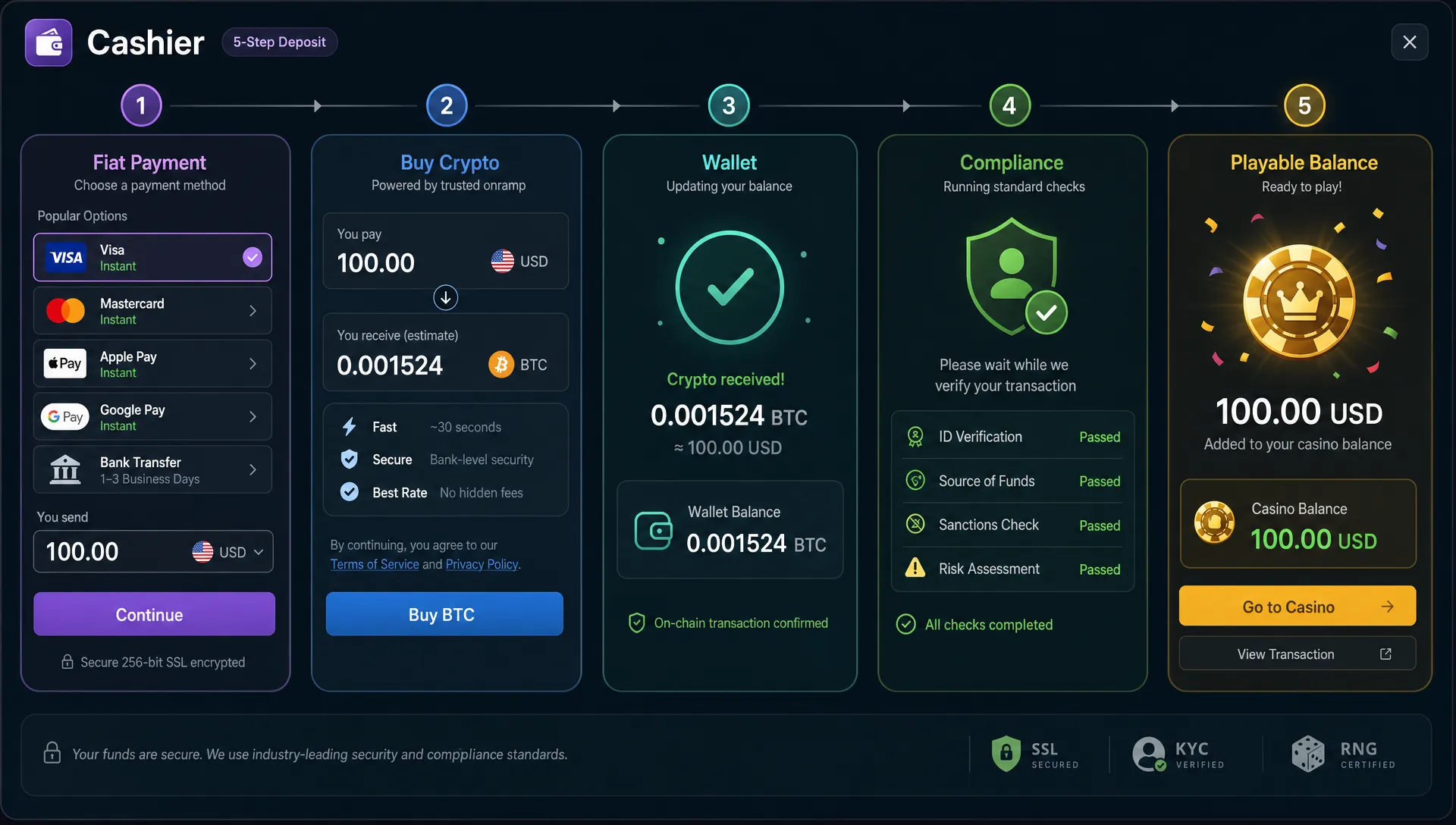
Why Spinlab is a strong fit for crypto onramp integration
Spinlab is built as an all-in-one, modular iGaming platform for operators that want to build, launch, and scale online casinos with crypto-ready infrastructure. For teams evaluating the best casino platform for crypto onramp integration, its value is that payments, compliance, game aggregation, analytics, and backoffice operations are designed to sit in one operating environment.
Based on Spinlab’s platform capabilities, operators can work with:
- Crypto and fiat payment support for hybrid cashier strategies.
- Crypto onramp solutions for players who need a simpler fiat-to-crypto funding path.
- Multi-currency support for global growth.
- Merchant custodial wallets for safekeeping funds.
- KYC and AML compliance tooling to support responsible operations.
- Advanced fraud prevention for payment and player risk management.
- Seamless game aggregation for casino content expansion.
- A mobile-optimized casino platform for players depositing and wagering on phones.
- A customizable backoffice admin panel for operational control.
- Real-time analytics dashboard visibility.
- Affiliate and bonus engine capabilities for acquisition and retention.
- Open API integration for flexibility.
- Original games that can be custom designed.
Spinlab is also positioned as the cheapest option on the market for whitelabel casino software and aims to provide a Shopify-like experience and user interface. That combination is especially relevant for founders and lean teams that want to launch quickly without taking on the cost and complexity of a fully custom build.
The ideal fit is an operator that wants a turnkey casino solution but does not want to be boxed into a rigid product. Spinlab’s modular approach gives teams a faster path to market while still supporting the payment and platform components that a crypto-ready brand needs.
White label, turnkey, or custom: which is best for an onramp casino?
The right model depends on budget, timeline, technical capacity, and regulatory strategy. For many crypto-focused casino startups, a white label or turnkey casino platform is the practical choice because it reduces time to launch and avoids rebuilding core infrastructure from scratch.
| Platform model | Best for | Main tradeoff |
|---|---|---|
| Basic white label casino | Fast launch with limited technical resources | May have less flexibility if payments and APIs are restricted |
| Modular turnkey casino platform | Operators that want speed plus room to customize | Requires careful vendor evaluation to confirm fit |
| Fully custom platform | Large teams with strong engineering and compliance resources | Higher cost, longer timeline, and more operational responsibility |
For crypto onramp integration, the middle path is often the most attractive: a turnkey casino solution with modular payment, wallet, compliance, and API capabilities. It gives operators the speed advantage of whitelabel iGaming software without making the cashier experience feel generic or disconnected.
Questions to ask before selecting a casino software provider
Before signing with a platform, ask questions that reveal how the onramp works in real operations, not just in a demo. A polished cashier screen is not enough if the underlying reporting, risk, and wallet logic are weak.
Important questions include:
- Which fiat payment methods and crypto assets can the platform support?
- Does the platform support direct crypto deposits as well as crypto onramp flows?
- How are balances updated after an onramp purchase?
- What happens when a payment succeeds with the provider but the balance update fails?
- Can the operator configure KYC and AML rules by market or user risk level?
- Are fraud, bonus abuse, and withdrawal checks connected to payment behavior?
- Can the backoffice show a full transaction history for support and finance teams?
- How quickly can the platform onboard new games, payment partners, or custom integrations?
These questions help separate a true iGaming platform from a website template with payment buttons attached.
A practical launch sequence for crypto onramp casinos
A successful launch does not require every payment feature on day one. It does require a clear sequence. Start with the markets you understand, the player segments you want, and the payment methods most likely to convert.
For example, a lean operator might begin with fiat payments, direct crypto deposits, and one well-supported onramp flow. From there, the team can analyze failed deposits, completed deposits, player lifetime value, bonus impact, and support tickets. Once the data is clear, the operator can add more currencies, local payment methods, or alternative onramp providers.
The goal is not to offer every possible payment method. The goal is to offer the right payment methods with a clean experience, reliable accounting, and enough operational visibility to improve over time.
Frequently Asked Questions
What is the best casino platform for crypto onramp integration? The best platform is one that combines crypto onramp support with fiat payments, direct crypto deposits, wallet management, KYC and AML controls, fraud prevention, game aggregation, analytics, and a usable backoffice. Spinlab is a strong option for operators that want a modular, crypto-ready, white label casino platform.
Is a crypto onramp the same as a crypto payment gateway? Not exactly. A crypto payment gateway usually helps process crypto transactions, while a crypto onramp helps players buy crypto with fiat and use it to fund their account. Many casinos benefit from supporting both onramps and direct crypto deposits.
Do crypto casinos still need fiat payments? In most cases, yes. Fiat payments remain important for mainstream players, local markets, and users who are not comfortable managing external wallets. A hybrid cashier with fiat, crypto, and onramp options usually gives operators broader coverage.
Why is KYC important for crypto onramp casinos? KYC helps operators verify users, manage risk, and support AML processes. Since crypto onramps connect fiat funding, virtual assets, and casino balances, identity and transaction controls are especially important.
Can a white label casino platform support crypto onramps? Yes, but quality varies. Operators should confirm that the platform supports the full operational flow, including payment routing, wallet updates, transaction history, compliance checks, fraud rules, and backoffice reporting.
What should lean teams prioritize first? Lean teams should prioritize a reliable cashier, accurate wallet and ledger logic, KYC and AML workflows, fraud controls, mobile performance, and clear analytics. Extra payment methods and advanced customizations can be added after the core deposit flow is proven.
Build a crypto-ready casino with fewer moving parts
Crypto onramp integration is too important to bolt on at the end. It affects conversion, compliance, support, finance, fraud prevention, and player trust. The best casino platform is the one that makes those systems work together without forcing your team to manage a fragile stack of disconnected tools.
Spinlab gives operators an all-in-one, modular iGaming platform with crypto and fiat payments, crypto onramp support, game aggregation, compliance tools, fraud prevention, analytics, affiliate and bonus capabilities, and a customizable backoffice. If you want a fast, flexible path to launching a crypto-ready online casino, explore Spinlab’s white label casino platform.