

Crypto payments can make an online casino faster, more global, and more attractive to players who prefer digital assets. But for a new operator, crypto casino payments are not just a wallet address on a deposit page. They involve cashier UX, blockchain monitoring, custody, AML controls, ledger design, reconciliation, withdrawal policies, and player education.
The good news is that you do not need to build every layer from scratch. What you do need is a clear mental model of how money moves, where risk appears, and which platform capabilities are non-negotiable before launch.
This guide explains the practical basics: how crypto deposits work, what a crypto onramp does, why stablecoins matter, how to think about custody, and what metrics to monitor once players start depositing.
Why crypto payments are different from card or bank deposits
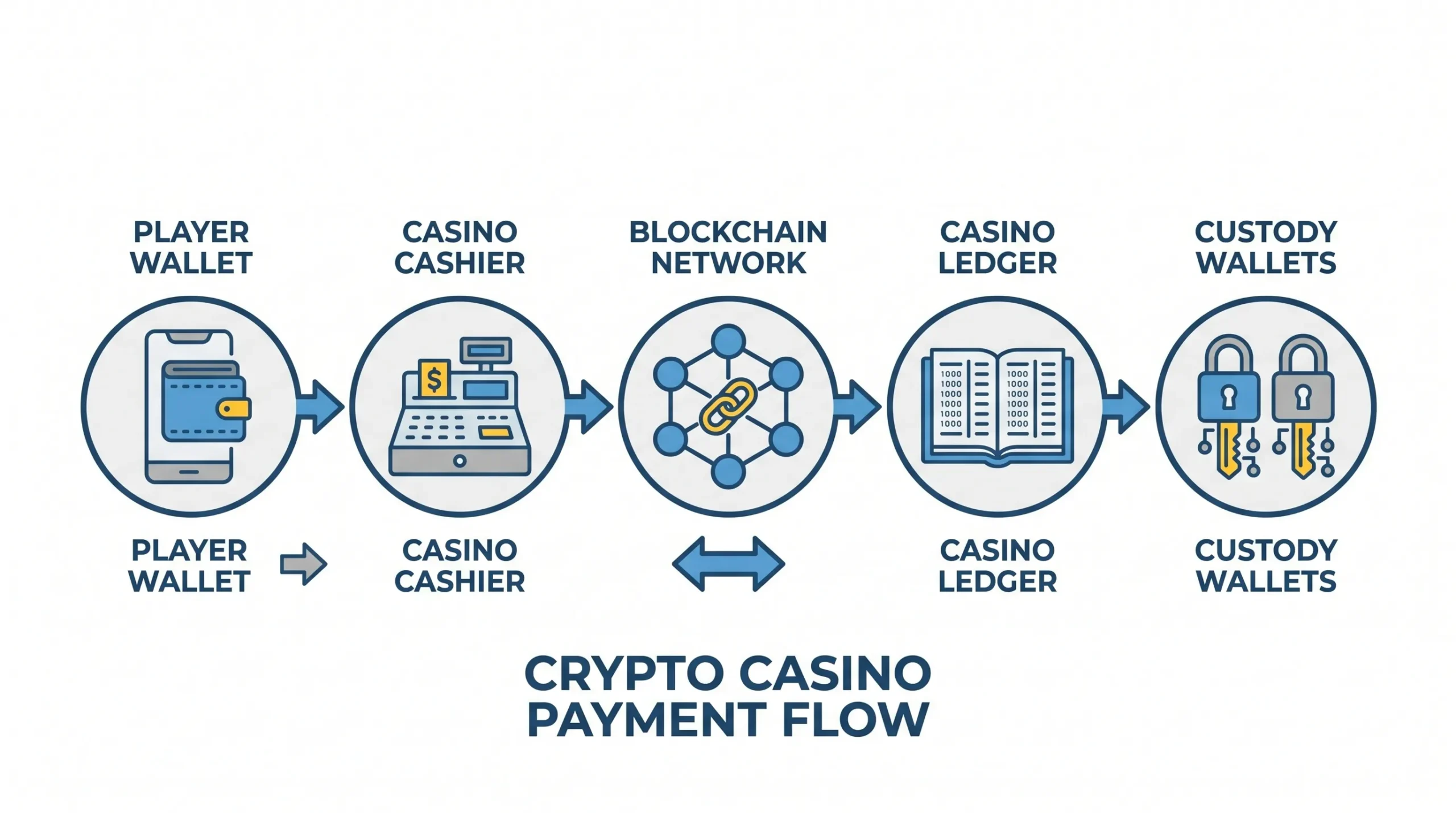
Traditional payment rails rely on banks, issuers, acquirers, and PSPs to authorize or reject a transaction. Crypto rails work differently. A player signs a blockchain transaction, the network confirms it, and the operator credits the player once the payment is detected and accepted under its risk rules.
That shift creates major advantages. Crypto can support cross-border deposits, faster withdrawals, lower chargeback exposure, and multi-currency operations. It also introduces new responsibilities. Operators must manage wallet addresses, network fees, confirmation thresholds, custody, sanctions screening, transaction monitoring, and reconciliation between on-chain activity and the casino ledger.
For a new operator, the most important mindset change is this: crypto payments are not anonymous payments. They are pseudonymous, traceable, and increasingly regulated. Your platform must connect wallet activity to verified player accounts, risk decisions, and audit-ready records.
| Payment rail | Typical operator benefit | Main operational challenge |
|---|---|---|
| Cards | Familiar UX and broad coverage | Chargebacks, 3DS friction, issuer declines |
| Bank transfer or open banking | Lower dispute risk and strong local coverage | Market-by-market integrations and settlement timing |
| Direct crypto deposit | Fast global deposits and fewer card-style chargebacks | Wallet monitoring, custody, AML, wrong-chain errors |
| Crypto onramp | Lets fiat users buy crypto inside the cashier | Provider UX, KYC handoff, fees, conversion tracking |
A mature casino payment strategy usually combines fiat and crypto instead of forcing one rail for every player. For more on that tradeoff, see Spinlab’s guide to crypto onramp vs direct deposit.
The three crypto payment models new operators should understand
Direct crypto deposits
A direct crypto deposit happens when a player sends an asset from an external wallet or exchange account to a casino deposit address. The operator detects the incoming transaction, waits for the required confirmation policy, screens the transaction for risk, and credits the player’s casino wallet.
Direct deposits are best for crypto-native players who already understand wallets, networks, gas fees, and transaction hashes. They can be extremely efficient, but the UX must prevent basic errors. If a player sends USDT on the wrong network, forgets a memo or tag, or underpays due to network fees, support tickets and reconciliation work can increase quickly.
Crypto onramps
A crypto onramp lets a player start with fiat, usually a card, bank transfer, or local payment method, and buy crypto through an integrated provider. The purchased asset is then delivered to the casino flow or to the player’s wallet, depending on the setup.
Onramps are useful when your acquisition channels include players who are curious about crypto but not yet comfortable with self-custody. They also allow you to offer crypto-style deposits without asking every player to leave your cashier and figure out exchanges on their own.
The tradeoff is that onramps add another provider, another KYC and fraud layer, and another point where the player can abandon. The best onramp UX explains fees, asset selection, expected timing, and identity checks before the player commits.
Crypto withdrawals
Withdrawals can be more sensitive than deposits because they combine player expectations, fraud risk, AML checks, and treasury liquidity. A player requests a payout, the casino evaluates account and transaction risk, confirms the destination wallet policy, signs the transaction, and posts the withdrawal to the ledger.
Some operators support withdrawals only to previously used wallets. Others allow self-custody withdrawals with wallet whitelisting and ownership checks. The right policy depends on your license, market, risk appetite, and payment architecture. Spinlab covers this topic in more depth in its guide to self-custody withdrawals without losing AML control.
Stablecoins, volatile coins, and why asset selection matters
For new operators, stablecoins are often easier to reason about than volatile assets. A stablecoin such as USDT or USDC is designed to track a fiat currency, usually the US dollar. That makes bonus pricing, player balances, accounting, and treasury planning simpler than accepting highly volatile assets only.
Volatile assets such as BTC, ETH, or SOL may attract certain player segments, but they require clear FX policies. If a player deposits BTC, do you keep their balance in BTC, convert to USD value at deposit time, or offer a separate coin-denominated wallet? Each option has accounting, UX, and margin implications.
A practical starting point is to support a limited set of assets and networks, then expand based on data. Too many assets at launch can create avoidable support burden, liquidity fragmentation, and reconciliation edge cases.
| Asset strategy | Best fit | Watchouts |
|---|---|---|
| Stablecoin-first | New operators needing pricing stability | Network choice, token issuer risk, regional rules |
| BTC or ETH support | Crypto-native acquisition and VIP appeal | Volatility, fees, confirmation timing |
| Multi-asset wallet | Mature operators with strong treasury operations | More reconciliation, FX policy, support complexity |
| Fiat display with crypto settlement | Players prefer local currency UX | Requires accurate rates, rounding rules, audit logs |
What happens during a crypto deposit
A crypto deposit looks simple to the player, but several backend systems must work together. The cashier creates a deposit intent, shows the correct asset and network, monitors the blockchain, screens the transaction, credits the player, and records every state change.
| Stage | What the player sees | What the operator systems do |
|---|---|---|
| Deposit intent | Player chooses crypto, asset, network, and amount | Cashier creates a unique intent and deposit address or memo |
| Payment instruction | QR code, address, network, minimum amount, and fee warning | Platform stores expected asset, chain, player ID, and expiration rules |
| Blockchain broadcast | Player sends funds from wallet or exchange | Monitoring service detects pending transaction and validates destination |
| Confirmation | Deposit status moves from pending to processing | System applies confirmation thresholds, reorg rules, and risk screening |
| Ledger credit | Player balance becomes playable | Casino ledger posts a credit and links it to the on-chain transaction |
| Reconciliation | Player sees completed deposit | Finance and ops match ledger, blockchain, and custody records |
The most common mistake is crediting balances based only on a detected transaction without a robust ledger model. Crypto networks can have pending states, reorganizations, duplicate webhooks, delayed indexers, and wrong-chain transfers. Your casino ledger must be the source of truth for player balances, not a blockchain explorer or a payment provider dashboard.
For a deeper technical view, read Spinlab’s guide to casino ledger design.
The crypto payment stack you actually need
New operators often underestimate how many components sit behind a working crypto cashier. A basic wallet integration may accept funds, but an operator-grade payment stack needs controls for conversion, risk, support, and auditability.
| Component | What it does | Why it matters |
|---|---|---|
| Cashier UI | Guides players through deposit and withdrawal flows | Reduces abandonment and support tickets |
| Address management | Generates and tracks deposit addresses or memos | Prevents attribution errors and lost deposits |
| Blockchain monitoring | Detects transactions and confirmation status | Enables timely credits and exception handling |
| Casino ledger | Records player balances and money movement | Creates audit-ready accounting and dispute evidence |
| Custody layer | Safekeeps operator and player funds | Reduces theft, signing, and treasury risk |
| KYC and AML tools | Links transactions to verified users and risk scores | Supports licensing and regulatory expectations |
| Fraud prevention | Detects abuse, multi-accounting, and suspicious behavior | Protects bonuses, withdrawals, and margins |
| Reconciliation | Matches blockchain, provider, ledger, and treasury data | Finds exceptions before they become finance problems |
| Analytics dashboard | Tracks conversion, failure, risk, and revenue metrics | Helps operators optimize payment performance |
This is where a modular iGaming platform can remove significant complexity. Spinlab’s platform is designed to combine crypto and fiat payment support, multi-currency operations, crypto onramp solutions, merchant custodial wallets, KYC and AML compliance, fraud prevention, real-time analytics, and an operator backoffice in one environment.
Compliance basics: crypto does not remove KYC and AML obligations
Crypto casinos still need compliance controls. The exact requirements depend on the license, target markets, payment model, custody structure, and counterparties involved. This section is practical guidance, not legal advice, and operators should work with qualified counsel before launch.
At minimum, new operators should be prepared for these areas:
- Player identity checks: KYC should verify who is depositing, withdrawing, and benefiting from gameplay activity.
- Transaction monitoring: Deposits and withdrawals should be screened for suspicious patterns, high-risk wallets, sanctions exposure, and unusual velocity.
- Travel Rule readiness: Depending on jurisdiction and transaction type, crypto transfers may require originator and beneficiary information exchange.
- Custody governance: Operators should document who can move funds, under what policy, with what approvals, and with what logs.
- Recordkeeping: Payment intents, wallet addresses, transaction hashes, risk decisions, ledger postings, and support actions should be retained in an audit-ready format.
- Responsible gambling controls: Crypto speed should not bypass deposit limits, cooling-off periods, self-exclusion, or affordability workflows where applicable.
Travel Rule and stablecoin rules are especially important for operators serving regulated markets. Spinlab has separate guides on Travel Rule compliance for crypto casinos and MiCA stablecoin rules for teams that need a deeper compliance roadmap.
Custody: where casino funds actually sit
Custody is the operational discipline of safekeeping crypto assets. In a casino context, custody must support fast deposits, controlled withdrawals, treasury liquidity, incident response, and audit trails.
A common structure uses hot, warm, and cold wallet tiers. Hot wallets handle day-to-day payouts and need strict limits. Warm wallets refill hot wallets under policy. Cold wallets hold larger reserves with slower, more controlled access.
| Wallet tier | Purpose | Typical controls |
|---|---|---|
| Hot wallet | Fast withdrawals and operational liquidity | Low limits, automated monitoring, policy checks |
| Warm wallet | Rebalancing and treasury buffer | Multi-approval workflows, restricted access |
| Cold wallet | Long-term safekeeping | Offline or highly controlled signing, strong segregation of duties |
New operators should avoid keeping too much liquidity in a hot wallet just to make withdrawals feel instant. A better model is to use withdrawal tiers. Low-risk, low-value payouts can be automated. Higher-risk or larger payouts can require additional checks, while still giving players clear status updates.
Custody also affects vendor selection. Ask whether your platform supports merchant custodial wallets, how signing policies work, how funds are segregated, what audit logs are available, and how emergency freezes or key rotation are handled. For an operational checklist, see Spinlab’s custodial wallet security guide.
Cashier UX: make crypto feel predictable
Many crypto payment failures are UX failures. Players need to know which network to use, how much to send, what fees apply, when funds will appear, and what to do if something goes wrong.
A strong crypto cashier should explain the process before wallet confirmation, not after a mistake has happened. This is a trust principle across regulated industries. For example, healthcare providers such as Move Well MD build confidence by explaining options and personalized care plans before a patient commits to care. Casino operators should apply the same clarity to financial flows, especially when players are moving irreversible funds.
Useful UX patterns include:
- Separate crypto-native and fiat-to-crypto paths: Show direct deposit for experienced users and onramp for players starting with fiat.
- Default to safer choices: Highlight supported stablecoins and lower-cost networks before more complex assets.
- Show total cost clearly: Display network fees, provider fees, minimum deposits, and estimated time-to-credit.
- Warn about wrong-chain deposits: Make the asset and network visually obvious at every step.
- Use deposit trackers: Show pending, confirming, under review, credited, or failed states in plain language.
- Offer recovery guidance: If a deposit is underpaid, missing a memo, or stuck pending, provide a self-serve next step before support escalation.
Gas fee transparency deserves special attention. A player who sees one amount in the cashier and another in their wallet may abandon or distrust the flow. Spinlab’s article on designing a crypto cashier that explains gas fees clearly gives more detailed patterns.
Fraud, abuse, and risk controls
Crypto reduces some risks, especially card chargebacks, but it does not eliminate fraud. In some areas, it creates different attack surfaces. Bonus abuse, multi-accounting, high-risk wallet exposure, and rapid deposit-withdrawal cycles can damage margins if controls are weak.
| Risk pattern | Signal to monitor | Practical control |
|---|---|---|
| Bonus farming | Many accounts using related wallets, devices, or IPs | Link wallet, device, KYC, and bonus eligibility signals |
| High-risk funds | Deposits from risky wallet clusters or sanctioned exposure | KYT screening and manual review thresholds |
| Rapid cycling | Deposit, minimal play, immediate withdrawal | Wagering checks, velocity rules, risk-based holds |
| Wrong-chain deposits | Funds sent on unsupported networks | Clear UX, network validation, exception workflow |
| Onramp chargeback risk | Fiat purchase reversed before crypto settlement risk is resolved | Provider risk rules, delayed credits, limits for new users |
| Account takeover | New wallet added after suspicious login changes | Step-up authentication and withdrawal cooldowns |
The key is to avoid blanket friction. If every crypto depositor is forced through heavy manual review, conversion and retention suffer. If every transaction is auto-approved, fraud and compliance exposure rise. The right approach is risk-based decisioning, where low-risk actions move quickly and suspicious actions receive step-up checks.
Reconciliation and accounting: the unglamorous part that saves you
Reconciliation is where many new operators discover whether their payment architecture is production-ready. A clean crypto flow should allow finance and operations teams to match every player-facing balance change to a ledger entry, a blockchain transaction, a custody movement, and a settlement or treasury record.
Crypto reconciliation can be tricky because fees, timing, network confirmations, token contracts, internal transfers, and provider reports may not line up perfectly. If your ledger only stores final balances, you will struggle to explain what happened during an audit or player dispute.
At minimum, store these fields for each crypto payment event:
- Payment intent ID: The internal reference created before funds move.
- Player ID and wallet ID: The account and payment source linked to the event.
- Asset, network, and amount: The exact token, chain, received amount, and credited amount.
- Transaction hash: The on-chain reference used for verification.
- Risk decision: The AML, fraud, and review result at the time of credit or payout.
- Ledger posting IDs: The accounting entries that changed playable or withdrawable balance.
- Operator action history: Any manual review, adjustment, refund, or support intervention.
This level of detail prevents small exceptions from becoming unresolved liabilities. It also makes it easier to scale beyond the first payment method without breaking wallet balances.
Metrics every new operator should track
A crypto-ready solution is only useful if you can see what is happening. New operators should monitor payment performance daily during launch and weekly once volume stabilizes.
| Metric | What it tells you | Why it matters |
|---|---|---|
| Deposit initiation rate | Share of cashier visitors who start a crypto deposit | Measures payment rail appeal and cashier clarity |
| Deposit completion rate | Share of started deposits that successfully credit | Reveals UX, network, or provider friction |
| Median time-to-credit | Time from player action to playable balance | Directly affects first-spin conversion |
| Wrong-chain or memo error rate | Share of exceptions caused by player transfer mistakes | Shows whether instructions are clear enough |
| AML referral rate | Share of transactions sent to review | Helps tune risk thresholds and staffing |
| Withdrawal approval time | Time from request to payout or review decision | Impacts trust and repeat deposit behavior |
| Reconciliation exception rate | Share of events that do not match cleanly | Indicates ledger, provider, or treasury issues |
| Crypto share of deposits | Portion of total deposits using crypto rails | Guides asset, network, and marketing priorities |
Do not optimize only for deposit volume. A payment method that converts well but creates high review load, reconciliation exceptions, or bonus abuse may be less profitable than it looks. Pair conversion metrics with risk, cost, and operational metrics.
A practical 30-day roadmap for adding crypto payments
A new operator does not need to accept every asset, build every withdrawal feature, and automate every treasury workflow on day one. A controlled launch is safer and easier to measure.
| Timeline | Focus | Output |
|---|---|---|
| Days 1 to 5 | Define markets, license constraints, and operating model | Payment policy, supported regions, KYC and AML baseline |
| Days 6 to 10 | Choose assets, networks, and custody structure | Stablecoin and network shortlist, hot-wallet limits, treasury rules |
| Days 11 to 15 | Design cashier and ledger flows | Deposit states, withdrawal states, ledger postings, error handling |
| Days 16 to 20 | Configure risk controls and monitoring | KYT rules, velocity thresholds, review queues, alerting |
| Days 21 to 25 | Test sandbox and staging scenarios | Wrong-chain tests, duplicate webhook tests, payout tests, reconciliation checks |
| Days 26 to 30 | Soft launch with limits | Small cohort rollout, daily monitoring, support playbook, KPI review |
The soft launch should include strict limits and clear rollback options. Start with a small set of assets, a small number of geographies, and a measurable cohort. Add more networks, higher limits, and more automation only after the data shows that your cashier, ledger, custody, and support processes are stable.
Vendor questions to ask before launch
If you are evaluating a white label casino platform or turnkey casino solution, crypto payments should be part of the core demo, not a future add-on described vaguely in sales materials.
Ask these questions before signing:
- Which assets and networks are supported today, and which are roadmap items? Avoid building your launch plan around unsupported rails.
- How are deposit addresses, memos, and wrong-chain errors handled? This reveals whether the platform is built for real crypto operations.
- What is the source of truth for balances? The correct answer should involve an audit-grade ledger, not only provider balances.
- How does the platform connect KYC, AML, fraud, wallet activity, and withdrawals? Crypto payments should not sit outside your risk model.
- What custody options are available? Confirm merchant custodial wallets, signing policies, access controls, and audit logs.
- Can operators configure limits, review rules, and asset availability without developer tickets? This matters for day-to-day operations.
- What analytics are available in real time? You should be able to see conversion, failures, risk reviews, and reconciliation exceptions.
- How does the platform support fiat and crypto together? A hybrid cashier is often stronger than a crypto-only or fiat-only setup.
Spinlab is built for operators who want a crypto-ready iGaming platform without assembling a fragmented stack. Its modular casino software supports crypto and fiat payments, game aggregation, real-time analytics, fraud prevention, KYC and AML workflows, multi-currency support, crypto onramp solutions, merchant custodial wallets, open API integration, and a customizable backoffice. For teams that want a Shopify-like operating experience, that combination can shorten the path from concept to launch.
Frequently Asked Questions
Do crypto casino payments remove chargebacks? Direct crypto transfers do not have card-style chargebacks, but that does not mean there is no risk. Onramp purchases, account takeovers, bonus abuse, compliance holds, and player disputes still need controls.
Should a new operator start with BTC or stablecoins? Many new operators start with stablecoins because pricing, accounting, bonuses, and treasury management are easier. BTC and other volatile assets can be added later if they fit the target audience and risk model.
How many blockchain confirmations should a casino require? It depends on the asset, network, deposit value, and risk policy. Lower-value stablecoin deposits on faster networks may need fewer confirmations than larger deposits on slower or higher-risk networks. The policy should be documented and consistently enforced.
What is the difference between a crypto onramp and a direct crypto deposit? A direct deposit is wallet-to-casino. A crypto onramp lets a player start with fiat and buy crypto through a provider during the cashier flow. Many operators offer both to serve different player segments.
Can crypto payments work with KYC and AML requirements? Yes, but only if wallet activity is connected to player identity, transaction monitoring, sanctions screening, risk scoring, and audit logs. Crypto should be part of the compliance workflow, not an exception to it.
What is the biggest mistake new operators make with crypto payments? The biggest mistake is treating crypto as a simple wallet plugin. A production-ready setup needs cashier UX, ledger discipline, custody controls, AML monitoring, fraud prevention, reconciliation, and support workflows.
Launch crypto payments with less operational friction
Crypto payments can improve speed, reach, and player trust, but only when the underlying platform handles the hard parts: custody, ledgering, compliance, risk, analytics, and cashier UX.
Spinlab helps new operators build, launch, and scale online casinos with a modular, crypto-ready platform that supports fiat and crypto payments, multi-currency operations, KYC and AML compliance, fraud prevention, game aggregation, real-time analytics, and a customizable backoffice.
If you want to launch a crypto-ready online casino without stitching together disconnected tools, explore Spinlab’s iGaming platform or book a demo to see how a modern white label casino setup can simplify payments from day one.