

Bonus abuse is not just “some free spins” leaking to deal hunters. At scale, it becomes a structural margin problem: you pay incentives to players who never intended to churn into real LTV, you overload risk and support queues, and you raise your exposure to chargebacks, money movement scrutiny, and affiliate disputes.
This guide breaks bonus abuse detection into three practical layers:
- Rules (what to block or step up immediately)
- Signals (what to measure and correlate)
- Playbooks (what your team does in the first 60 minutes, first day, and first week)
The goal is not to “catch cheaters.” The goal is to protect promo ROI while keeping friction low for legitimate players.
What “bonus abuse” looks like in 2026 (and why simple rules fail)
Most operators start with obvious filters, like one bonus per IP, one bonus per device, or a minimum deposit amount. Those controls still matter, but modern abuse patterns route around them:
- Multi-accounting at the identity layer: fresh emails, virtual numbers, residential proxies, emulator farms.
- Deposit and withdrawal loops: claiming rewards, minimal wagering, rapid cashout (sometimes via crypto rails) with low entertainment intent.
- Arbitrage and EV hunting: targeting promos that can be played “close to risk-free” when combined with game selection, volatility, or wagering loopholes.
- Affiliate-driven abuse: incentivized traffic, self-referrals, recycled cohorts, or lead laundering across brands.
- Promo code leakage: private codes posted in public groups, scraped by bots, or mass-shared in short-form social.
The common failure mode is single-signal decisioning. Bad actors can look clean on one dimension (IP) while being obviously abusive on another (timing, device graph, payment fingerprint, or play style).
The operating model: prevent, detect, respond
A durable bonus abuse program runs like a lightweight production system.
1) Prevent (low-cost friction at the edges)
Prevention is about reducing easy wins for bots and farms before incentives are paid out.
- Registration bot resistance (device checks, invisible challenges)
- Promo eligibility constraints (geo, KYC state, payment method, first-deposit requirements)
- Bonus mechanics that reduce pure extraction (staged rewards, partial unlocks)
If you want a deeper technical primer on linking devices and sessions, see Spinlab’s guide on device fingerprinting for casino fraud prevention.
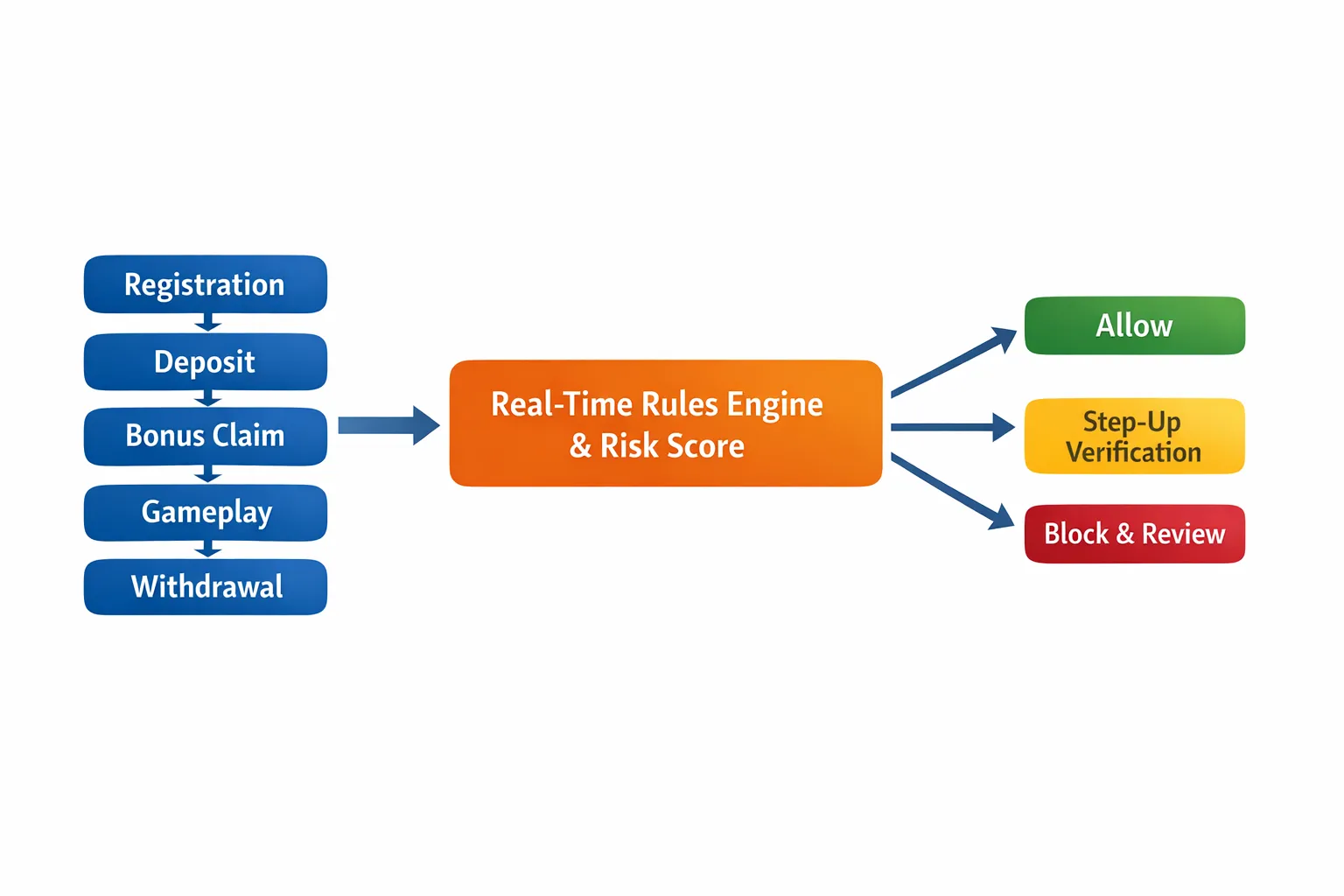
2) Detect (real-time scoring, not overnight reports)
Detection should happen at the moments that matter:
- bonus claim
- deposit credited
- wager pattern emerges (first 10 to 50 bets/spins)
- withdrawal request
The best setups treat these as streaming events, evaluate rules in milliseconds, and produce one of three outcomes: allow, step-up (ask for more proof), or block.
3) Respond (playbooks with consistent outcomes)
If your team needs to “figure it out from scratch” every time, you will either:
- over-ban and lose good players, or
- under-react and get farmed
Playbooks make actions consistent, auditable, and fast.
Signals that actually work (grouped by where they come from)
Bonus abuse detection is a correlation problem. You want a compact set of signals that are hard to fake together.
Account and identity signals
These are high-signal when you look at them in aggregates, not one-by-one.
- Account age at bonus claim (seconds or minutes is a red flag)
- Email pattern similarity, domain clustering, plus-addressing frequency
- Phone reuse or virtual number patterns (where permitted to check)
- KYC progression behavior (completes instantly across many accounts, or always stalls at the same step)
Device, network, and session signals
Abuse farms optimize for scale, which leaves consistent fingerprints.
- Device fingerprint reuse (same device, “new” account)
- Emulator characteristics, automation artifacts, abnormal screen sizes
- Proxy and hosting ASN patterns (especially when clustered)
- Session cadence (many registrations in tight windows, same “human” tempo)
If you use Cloudflare, you may also want to review Cloudflare Turnstile for casinos as a low-friction way to reduce automated registrations and promo scraping.
Payment and wallet signals
Payments are where bonus abuse turns into measurable loss.
- Same payment instrument across accounts (card fingerprint, bank account token, wallet address)
- Deposit splitting (many minimum deposits designed purely to qualify)
- Rapid “deposit -> bonus -> wager minimum -> withdrawal” loops
- Withdrawal destination reuse (multiple players cashing out to the same endpoint)
Gameplay and bonus utilization signals
These signals are especially strong because they reflect intent.
- Wagering only to satisfy minimum requirements, then immediate stop
- Narrow game selection focused on promo exploitation (for example, only low-variance or only a loophole game category)
- Abnormal bet sizing relative to bankroll, bonus type, and typical cohorts
- Repetitive patterns that look like scripts (fixed intervals, fixed bet ladder)
Marketing and attribution signals
Abuse is often created upstream.
- Promo code redemption spikes from a single channel or affiliate sub-ID
- Same creative or landing page producing unusually low post-bonus retention
- Country and language mismatches (claimed geo vs session reality)
If you run country-specific short-form acquisition, make sure your distribution matches your eligibility rules. For example, teams testing localized TikTok content sometimes use services that help them post TikToks in target countries (like TokPortal) so promos are shown to the intended audience rather than leaking into the wrong regions.
A practical rule stack (with actions that won’t wreck conversion)
Rules should be written to minimize false positives. The trick is to use graduated responses instead of permanent bans.
Here’s a compact rule stack you can adapt.
| Funnel moment | Example rule | Why it works | Recommended action |
|---|---|---|---|
| Registration | High-risk ASN + multiple signups in short window | Farms cluster on infrastructure | Allow account creation, but restrict bonus claim until step-up |
| Bonus claim | Device fingerprint seen on 3+ accounts in 7 days | Device reuse is hard to avoid at scale | Block claim, request verification or manual review |
| Deposit | Same payment token across multiple accounts | Strong indicator of identity reuse | Allow deposit, block bonus attachment, queue review |
| Early gameplay | Hits wagering minimum with minimal session variance | Extraction behavior | Reduce promo value (if policy allows) or hold withdrawals |
| Withdrawal | New account requests withdrawal within X minutes of bonus | Common cashout pattern | Step-up KYC + enhanced payment checks |
Two implementation notes:
- Prefer “eligibility gates” over “retroactive clawbacks.” Clawbacks create support tickets, reputational damage, and regulator questions.
- Log every decision. You need auditability for disputes (affiliate complaints, player escalations, payment processor reviews).
Building an abuse score (simple scoring beats complex ML for most teams)
You do not need an advanced ML system to get most of the value. A weighted score based on correlated signals often performs better operationally because it is explainable.
A common pattern:
- Assign weights to signal families (device, payments, identity, gameplay)
- Use hard blocks only for the strongest indicators (payment reuse, device reuse at scale)
- Use step-up actions for ambiguous risk (proxy suspicion, geo mismatch)
This is also where real-time analytics matter. If you only see a report the next day, the bonus cost is already paid.
For operators running hybrid fiat and crypto flows, make sure your AML posture and transaction monitoring are aligned. FATF’s risk-based guidance for virtual assets is a useful baseline reference for compliance teams: FATF Guidance for a Risk-Based Approach to Virtual Assets and VASPs.
Three playbooks your team should have written down
The 60-minute containment playbook (when you see a spike)
Use this when you notice a sudden surge in bonus claims, unusual conversion, or a single promo being drained.
- Freeze the specific promotion (pause claims, not deposits).
- Throttle eligibility (require KYC completed, restrict to one payment method type, or set tighter geo rules).
- Add temporary velocity limits (claims per IP range, claims per device fingerprint, claims per affiliate sub-ID).
- Start a “cohort snapshot” (export the last N claimants with device, payment, and withdrawal status).
Outcome you want: the drain stops without taking the whole casino offline.
The 24-hour investigation playbook (prove or disprove)
Within a day, you should be able to answer:
- Is this a bot/farm pattern, an affiliate issue, or organic deal hunters?
- Are withdrawals already in-flight?
- Which single control would have prevented 80% of the loss?
Practical approach:
- Build a quick identity graph: link accounts by device fingerprint, payment token, withdrawal destination, and IP/ASN clusters.
- Compare the cohort to a baseline segment (normal FTDs from the last 14 to 30 days).
- Review top games used during wagering and check for promo loopholes (excluded categories, max bet violations, or allowed providers you should restrict).
Outcome you want: a clear root cause and a small set of durable rule updates.
The weekly tuning playbook (keep it from coming back)
Bonus abuse evolves. Your rules must evolve with it.
Each week, review:
- False positive rate (how many legitimate players were stepped up)
- Manual review backlog (time to decision)
- Promo ROI by cohort (net gaming revenue versus bonus cost)
- New top linkages (new device clusters, new wallet reuse patterns)
Outcome you want: continuous improvement without “rule bloat.”
Common pitfalls that create more abuse (or more churn)
Over-blocking at registration
Blocking too early increases acquisition costs and pushes real users to competitors. A better pattern is: allow registration, restrict bonus eligibility until confidence improves.
Making promos too easy to extract
If a bonus is instantly liquid, it will be farmed. Consider structures that pay value in stages (for example, release rewards after authentic engagement milestones) while staying compliant with your jurisdiction.
Treating abuse as a risk-team-only problem
Most bonus leakage is created by a mismatch between:
- what marketing promises,
- what the bonus engine allows,
- what risk can monitor in real time
Operators who win here align marketing, product, and fraud into a shared weekly cadence.
What to look for in an iGaming platform (so you can actually run these controls)
Even a great risk strategy fails if the platform cannot execute it quickly.
In practice, you need:
- A bonus engine flexible enough to express eligibility, exclusions, and staged rewards
- Real-time analytics so risk actions happen during the session
- Fraud prevention hooks (device, velocity, payment risk)
- KYC and AML workflows that support step-up verification without breaking UX
- A backoffice that makes investigations fast (player timeline, linked entities, audit logs)
Spinlab is built as a modular iGaming platform with integrated payments (crypto and fiat), KYC/AML support, real-time analytics, and a configurable admin panel. The point of modularity is simple: you can tighten controls on a single promo, payment rail, or market without replatforming.
Frequently Asked Questions
What is bonus abuse in online casinos? Bonus abuse is any behavior designed to extract promotional value in a way the offer was not intended, such as multi-accounting, payment reuse, minimal wagering followed by rapid cashout, or coordinated promo exploitation.
What are the strongest signals for detecting multi-accounting? The highest-signal linkages are usually payment instrument reuse, device fingerprint reuse, withdrawal destination reuse, and tight timing clusters (many accounts behaving the same way within minutes).
Should you always block suspected abusers immediately? Not always. In many cases, it is better to step up verification (KYC, payment checks) or restrict bonus eligibility while allowing normal gameplay, so you avoid unnecessary false positives.
How do affiliate programs contribute to bonus abuse? Abuse can come from incentivized traffic, self-referrals, recycled player cohorts, or promo code leakage. Strong attribution, sub-ID monitoring, and consistent promo eligibility rules reduce these risks.
Does requiring KYC stop bonus abuse? It reduces some abuse, but it does not eliminate it. Farms can still use synthetic identities or mule networks. KYC works best when combined with device, payment, and gameplay signals.
Build bonus protection that scales with your promotions
If you are launching new offers weekly, expanding into new markets, or running crypto and fiat side by side, bonus abuse detection needs to be real-time, explainable, and operationally lightweight.
Spinlab helps operators launch and scale casinos with an all-in-one platform that includes fraud prevention, KYC/AML tooling, integrated payments, game aggregation, and a flexible bonus engine. If you want to see how these components fit together into an abuse-resistant promo stack, explore spinlab.studio and request a walkthrough.