

A casino disaster recovery plan is not just an IT document. For a live-money online casino, it is a revenue protection system, a player trust safeguard, and a compliance control all at once.
If a storefront is down, the operator loses deposits. If the wallet ledger is inconsistent, the operator may lose much more than revenue. If game rounds, withdrawals, KYC checks, bonuses, or affiliate tracking fail during recovery, the incident can become a regulatory and financial problem.
That is why casino disaster recovery should be designed around two measurable targets: RPO and RTO. These acronyms are often used casually, but in iGaming they need workload-by-workload definitions, test evidence, and runbooks that match real operating conditions.
What RPO and RTO mean for an online casino
Recovery Point Objective (RPO) defines how much data loss is acceptable after an incident. If the RPO for wallet transactions is 30 seconds, your architecture and recovery process must prove that you can recover to within 30 seconds of the failure point.
Recovery Time Objective (RTO) defines how long it should take to restore service. If the RTO for player login is 15 minutes, your team needs the infrastructure, automation, permissions, and runbooks to bring login back within that window.
In a casino environment, the mistake is treating the whole platform as one system with one generic RPO and RTO. A responsible disaster recovery plan separates the online casino into distinct workloads because each one has a different risk profile.
For example, a promotional banner can tolerate more downtime than the cashier. A game catalog cache can be rebuilt. A wallet ledger cannot be casually reconstructed without audit-grade evidence.
Why casino disaster recovery is different from standard SaaS recovery
A typical SaaS platform may prioritize availability, user records, and application state. A casino platform has those same concerns, plus live-money complexity.
Casino disaster recovery must account for:
- Player balances, deposits, withdrawals, bonuses, and wagering requirements
- Game rounds that may be open, settled, canceled, or pending provider confirmation
- Payment gateway callbacks that can arrive late, duplicate, or out of order
- KYC and AML status checks that may affect account access and withdrawals
- Fraud controls, risk scoring, velocity limits, and self-exclusion rules
- Affiliate attribution, commission logic, and campaign tracking
- Backoffice actions by operational, finance, compliance, and support teams
- Regulatory evidence, audit logs, and incident timelines
This is why disaster recovery for an iGaming platform should be designed with transaction integrity first, then service restoration. Fast recovery is valuable only if the recovered system is financially correct.
The U.S. National Institute of Standards and Technology discusses contingency planning as a lifecycle of planning, training, testing, and maintenance in NIST SP 800-34 Rev. 1. For online gambling platforms, that lifecycle should be adapted to include wallet reconciliation, provider settlement, payment status validation, and regulatory reporting.
Set RPO and RTO by workload, not by platform
Start by mapping critical casino workloads, then assign a target RPO and RTO to each. The table below shows example ranges. These are not universal requirements, but they illustrate how different casino systems should be prioritized.
| Casino workload | Example RPO target | Example RTO target | Recovery priority |
|---|---|---|---|
| Wallet ledger and balances | Near-zero to seconds | Minutes | Critical |
| Bets, game rounds, and settlement records | Seconds to minutes | Minutes | Critical |
| Deposits, withdrawals, and payment callbacks | Seconds to minutes | Minutes to under 1 hour | Critical |
| Player identity, KYC, AML, and limits | Minutes | Under 1 hour | Critical |
| Authentication and account access | Minutes | Minutes to under 1 hour | High |
| Game catalog and provider availability | Minutes to hours | Under 1 hour | High |
| Bonus engine and wagering requirements | Minutes | Under 1 hour | High |
| CRM, email, and promotional campaigns | Hours | Hours | Medium |
| Affiliate reporting | Hours | Same day | Medium |
| Analytics dashboards | Hours | Same day | Medium |
| Static content and marketing pages | Hours | Same day | Low to medium |
The most important takeaway is that money-moving systems need the strictest RPO. If your wallet, bet settlement, and payment data cannot be restored accurately, bringing the front end back quickly can make the incident worse.
Define your maximum tolerable downtime
RPO and RTO are operational metrics, but they should be grounded in business impact. Before setting targets, define the maximum tolerable downtime for each part of the casino.
Ask practical questions:
- How much revenue is lost per minute if deposits are unavailable?
- How many unresolved game rounds can support and operations handle manually?
- At what point does a cashier outage trigger regulator notification or internal escalation?
- Can players log in but not deposit, or should the platform enter maintenance mode?
- Should withdrawals be temporarily paused during recovery to prevent inconsistent payouts?
- Which jurisdictions, payment partners, or game providers require incident communication?
The answer is rarely “keep everything online at all costs.” In many casino incidents, the safest recovery state is controlled degradation. That might mean allowing logins and support access, while temporarily disabling deposits, withdrawals, bonuses, or selected game providers until reconciliation is complete.
Build a dependency map before writing the plan
A casino disaster recovery plan should include a dependency map that shows how systems fail together. Without this map, teams often recover components in the wrong order.
A simplified dependency chain might look like this:
| Layer | Typical dependencies | Disaster recovery concern |
|---|---|---|
| Edge and DNS | CDN, WAF, DNS provider, DDoS protection | Traffic routing and failover speed |
| Application layer | Front end, API gateway, session services | Player access and account actions |
| Core casino services | Wallet, bonus engine, game session manager | Financial consistency and gameplay continuity |
| Data layer | Primary databases, replicas, backups, event streams | RPO, restore time, data integrity |
| Payments | PSPs, crypto onramp, fraud checks, webhooks | Duplicate callbacks and reconciliation |
| Game aggregation | Game providers, live casino streams, slot sessions | Round state and provider settlement |
| Compliance | KYC, AML, limits, self-exclusion, audit logs | Regulatory controls and evidence |
| Operations | Backoffice, support tools, admin permissions | Safe recovery and customer handling |
This map helps your team make better recovery decisions. For instance, if the game aggregator is healthy but the wallet ledger is not, restoring gameplay may be unsafe. If the payment gateway is healthy but webhook processing is delayed, deposits may need to be queued or manually reconciled before balances are credited.
Architecture choices that support casino recovery targets
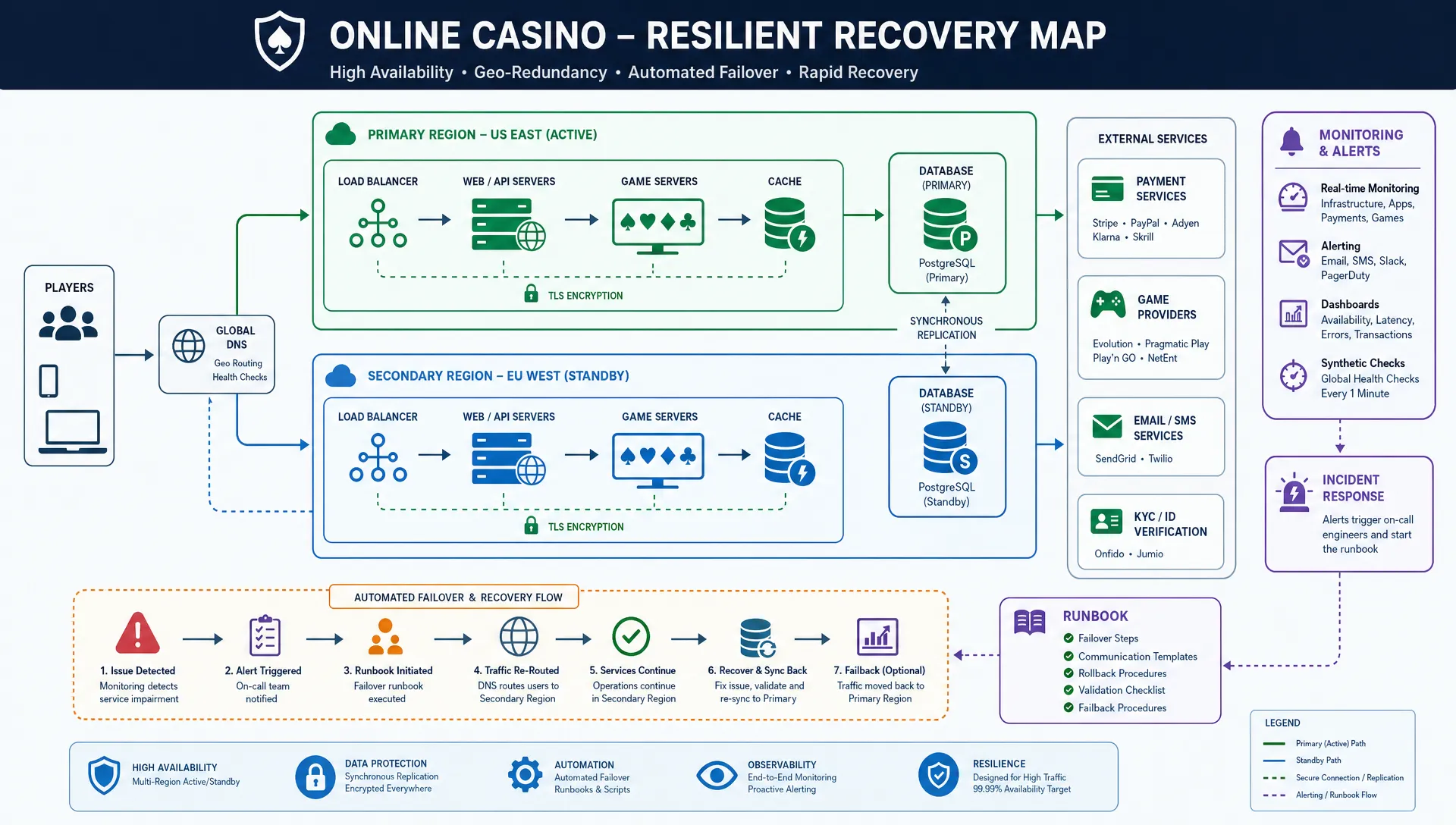
Disaster recovery is only achievable if the architecture supports it. A written plan cannot compensate for missing replication, untested backups, unclear ownership, or single-region dependencies.
Multi-zone and multi-region resilience
For most online casinos, the first level of resilience is multi-zone deployment inside one cloud region. This protects against local infrastructure failures and should be standard for critical components.
The next level is multi-region readiness. This can take several forms:
- Backup and restore: Lowest cost, slower RTO, suitable for less critical systems.
- Pilot light: Core infrastructure exists in the recovery region, but scaled down.
- Warm standby: A reduced-capacity version of the platform runs in another region.
- Active-active: Multiple regions serve production traffic, with more complex data consistency requirements.
The right model depends on market size, licensing geography, risk tolerance, and cost. If you are planning a jurisdictional expansion or regional failover, Spinlab’s casino cloud region migration checklist covers many of the practical issues operators should validate before moving live-money traffic.
Backup design and restore confidence
Backups should be encrypted, access-controlled, immutable where appropriate, and tested through real restores. Backup existence is not recovery capability. Your team must know whether backups can be restored within the RTO and whether the restored data satisfies the RPO.
For casino databases, consider backup design around:
- Transaction logs and point-in-time recovery
- Immutable or tamper-resistant storage for audit-critical records
- Separate backup credentials and restricted delete permissions
- Cross-region copies for critical datasets
- Restore drills using production-like data volumes
- Evidence that restored wallet and bet records reconcile correctly
For a deeper technical angle on backup architecture, see Spinlab’s guide to serverless backup patterns for casino databases.
Event logs, idempotency, and replay
Casino recovery depends heavily on event order. Deposits, bonus issuance, game rounds, wager settlements, and withdrawals should be designed so they can be replayed safely.
Idempotency is essential. If a payment provider sends the same successful deposit callback twice during a recovery window, the platform should not double-credit the player. If a game provider resends a settlement event, the round should not settle twice.
Event-driven architecture can help, but only if events are durable, ordered where necessary, traceable, and tied to reconciliation processes. Every critical event should include identifiers that let finance, support, and engineering trace what happened before, during, and after the incident.
Testing a casino disaster recovery plan
A disaster recovery plan that has never been tested is a hypothesis. Testing turns it into operational knowledge.
The goal is not only to prove that systems can fail over. The goal is to prove that people, permissions, monitoring, communication, and reconciliation procedures work under pressure.
Tabletop exercises
A tabletop exercise is a discussion-based simulation. It is useful for validating roles, escalation paths, and decision-making without touching production systems.
Example scenarios include:
| Scenario | What the exercise should validate |
|---|---|
| Primary database corruption | Who declares the incident, how restore point is chosen, and how wallet reconciliation is handled |
| Payment webhook backlog | Whether deposits are paused, queued, replayed, or manually reviewed |
| Game provider outage | How affected games are disabled and how open rounds are resolved |
| Regional cloud outage | Who initiates failover and how traffic is routed |
| DDoS attack during peak hours | How edge protection, rate limits, and incident communications are coordinated |
DDoS events are especially relevant for casinos because attackers often time them around peak deposit and sports or live casino periods. If this is a known risk for your brand, pair your recovery plan with a layered DDoS protection strategy rather than treating DDoS as a generic availability issue.
Technical failover tests
Technical tests validate whether infrastructure behaves as expected. These should begin in staging, then progress to carefully controlled production exercises.
Useful tests include database replica promotion, DNS failover, cache rebuilds, backup restoration, payment callback replay, game provider disablement, and backoffice access validation.
For each test, capture actual results:
| Test metric | Why it matters |
|---|---|
| Actual recovery time | Confirms whether RTO is realistic |
| Data loss window | Confirms whether RPO is being met |
| Manual steps required | Shows automation gaps and operational risk |
| Reconciliation differences | Identifies financial integrity issues |
| Alert quality | Shows whether teams detect the right problem quickly |
| Customer impact | Helps support and compliance prepare accurate messaging |
If the target RTO is 30 minutes but the test takes 82 minutes, the plan has done its job by exposing the gap. The next step is to reduce manual work, improve automation, simplify dependencies, or revise the target honestly.
Restore-from-backup drills
Many teams test failover but forget full restoration. This is dangerous because ransomware, accidental deletion, schema corruption, or bad deployments may require restoring from backup rather than switching to a replica.
A restore drill should answer four questions:
- Can we restore the data within the required time?
- Can we prove the restored data is complete enough for the stated RPO?
- Can we reconcile player balances, bets, payments, and bonuses after restore?
- Can the restored environment safely resume live traffic?
For casinos, a restore drill is incomplete until finance and operations validate the recovered ledger, not just engineering.
Recovery runbooks: what to include
A runbook is the step-by-step operating manual for an incident. It should be short enough to use under stress but detailed enough to prevent improvisation.
A strong casino disaster recovery runbook includes:
| Runbook section | What it should define |
|---|---|
| Incident triggers | Conditions for declaring disaster recovery mode |
| Roles and owners | Engineering, operations, compliance, support, payments, vendors |
| System freeze rules | When to pause deposits, withdrawals, gameplay, bonuses, or admin actions |
| Failover steps | Exact commands, approvals, dashboards, and validation checks |
| Reconciliation steps | Wallet, payment, game round, bonus, and affiliate validation |
| Communication plan | Internal updates, customer support scripts, vendor notices, regulator escalation |
| Rollback criteria | Conditions for returning to primary systems or remaining in recovery mode |
| Evidence capture | Logs, timestamps, screenshots, decisions, and post-incident reports |
Avoid runbooks that depend on one senior engineer’s memory. Disaster recovery often happens at the worst possible time, such as during a traffic spike, a vendor outage, or an attack. Documentation should be accessible, version-controlled, and available even if primary systems are unavailable.
Special recovery rules for payments, wallets, and games
The cashier and wallet deserve their own recovery procedures because they are the highest-risk parts of the platform.
During an incident, define clear rules for payment handling. Deposits may need to be accepted but not credited until callbacks are verified. Withdrawals may need temporary review or pause rules. Crypto transactions may require additional confirmation logic depending on the asset, chain, custody model, and onramp process.
Game recovery also needs specific controls. If a slot round or live casino session is interrupted, the platform must know whether the provider has settled the round, whether the player balance changed, and whether the result was already recorded. Game aggregator integrations should support reconciliation reports and provider-level status checks.
Bonus recovery is often underestimated. If a wallet is restored but wagering requirement state is stale, players may receive incorrect withdrawal eligibility, duplicate free spins, or invalid bonus progress. Include bonus state in RPO planning, not just core balances.
Incident communications and compliance evidence
Disaster recovery is partly a communications exercise. Players want to know whether their money is safe. Support teams need approved language. Compliance teams may need timelines and evidence.
Your plan should define who communicates, when they communicate, and what they can say. Avoid overly specific promises before reconciliation is complete. It is better to say that deposits are being verified than to claim all balances are correct before evidence supports it.
Evidence collection should include:
- Incident start time and detection source
- Systems affected and business impact
- Decisions to pause or resume services
- Failover and restore timestamps
- Data validation and reconciliation results
- Payment and provider communication records
- Customer support impact and complaint categories
- Root cause and corrective actions
The AWS Well-Architected Reliability Pillar emphasizes testing recovery procedures and learning from failures. For casino operators, that learning should always include financial reconciliation and compliance review.
How often should a casino test disaster recovery?
Testing frequency should reflect risk and change velocity. A rapidly growing whitelabel casino, crypto-ready solution, or multi-provider game aggregation setup changes often, so annual testing is usually not enough.
A practical cadence might look like this:
| Test type | Suggested cadence |
|---|---|
| Tabletop exercise | Quarterly |
| Backup restore drill | Quarterly or after major schema changes |
| Payment callback replay test | Quarterly and after PSP changes |
| Game provider outage simulation | Quarterly |
| Full regional failover test | Semiannually or annually, depending on risk |
| Runbook review | After every major release or incident |
| Access and permissions review | Monthly or quarterly |
The more automated the casino platform, the easier it becomes to test frequently. But automation should not remove human validation. In live-money systems, humans still need to confirm whether recovery was safe, not merely fast.
Common mistakes in casino disaster recovery planning
The most common mistake is writing a plan that only engineering understands. Casino disaster recovery affects payments, support, compliance, finance, product, fraud, VIP teams, and executive leadership.
Other frequent problems include:
- Using one RPO and RTO for the entire platform
- Testing failover without testing restore from backup
- Ignoring bonus, affiliate, and promotion state
- Failing to reconcile game rounds with provider records
- Allowing payment callbacks to replay without idempotency controls
- Depending on DNS failover that has never been timed
- Keeping runbooks inside systems that may be unavailable during an outage
- Forgetting vendor contacts, escalation paths, and support SLAs
- Measuring uptime while ignoring financial correctness
A mature disaster recovery program treats every test as a chance to reduce uncertainty. The best plans are living systems, updated after incidents, platform changes, new payment gateway integrations, new game providers, and jurisdictional expansion.
Choosing casino software with recovery in mind
Disaster recovery is much easier when the underlying casino software is designed for modular operations, clear integrations, and operational visibility.
When evaluating an iGaming platform or turnkey casino solution, operators should ask vendors how they handle wallet integrity, payment reconciliation, game aggregation failures, fraud controls, KYC and AML dependencies, multi-currency operations, and backoffice permissions during incidents.
Spinlab offers an all-in-one, modular iGaming platform for building, launching, and scaling online casinos, with crypto and fiat payment support, game aggregation, compliance features, fraud prevention, analytics, and customizable backoffice capabilities. For operators who want a flexible, cost-conscious whitelabel casino platform, recovery planning should be part of the platform conversation from day one, not an afterthought.
Frequently Asked Questions
What is a good RPO for an online casino wallet? A wallet ledger should usually target near-zero data loss or the shortest technically and commercially feasible RPO. The exact target depends on architecture, transaction volume, licensing requirements, and reconciliation capability.
What is a good RTO for a casino platform? Critical services such as wallet, authentication, payments, and game sessions often need recovery measured in minutes, while analytics, CRM, and marketing systems can usually tolerate longer recovery windows. The right RTO should be based on business impact and regulatory obligations.
How is disaster recovery different from backups? Backups are one component of disaster recovery. A full disaster recovery plan also includes failover, restore procedures, incident roles, communication plans, reconciliation, compliance evidence, and regular testing.
Should a casino pause withdrawals during recovery? In some incidents, temporarily pausing or reviewing withdrawals may be the safest option until wallet, payment, and bonus state are verified. The policy should be defined in advance and reviewed by compliance and operations.
How often should a casino test disaster recovery? Critical recovery procedures should be tested at least quarterly in many operating environments, with full regional failover tested semiannually or annually depending on risk, complexity, and regulatory expectations.
Build recovery into the platform, not around it
A casino disaster recovery plan is strongest when it is supported by the platform’s architecture, data model, payment flows, game integrations, and operational tooling.
If you are building, launching, or scaling an online casino and want a modular platform with crypto-ready payments, game aggregation, compliance controls, analytics, and a customizable backoffice, Spinlab can help you plan for growth with resilience in mind.