

In 2025, a single hour of casino downtime can cost anywhere from USD 75,000 to USD 250,000 in lost wagers, chargebacks, and loyalty churn according to recent Spinlab benchmark data. Database corruption or ransomware remains the fastest path to that nightmare. Modern operators therefore face a blunt question: can your backups survive a disaster, restore in minutes, and still pass a regulator’s audit?
Traditional VM-based backups rarely hit those marks. The rise of serverless backup patterns offers a more resilient, cheaper, and fully automated alternative that is tailor-made for fast-moving iGaming brands. This guide breaks down how serverless backups work, the architecture choices that matter, and the concrete KPIs every casino CTO should track in 2025.
Why Legacy Backup Strategies Put Casino Revenue at Risk
- Fixed capacity and slow scaling – Scheduled snapshots on a single backup server struggle once daily active players surge past expectations, a growth story familiar to anyone who read our Fullhouse scaling case study.
- High CapEx and opaque OpEx – Buying backup appliances and paying for idle replica VMs inflates CapEx. Rising egress fees add hidden OpEx with every additional jurisdiction you enter.
- Manual runbooks invite human error – Updating cron schedules after a schema change or licence-driven log requirement is tedious. One missed step can delete weeks of transaction history.
- Single-region exposure – Many operators still copy to the same data center, turning backups into collateral damage when physical disasters or network outages hit.
- Audit friction – Pulling point-in-time data for a Responsible Gambling or AML review is painful when snapshots are opaque disk images.
A 2024 UKGC enforcement report showed that 63 % of fined operators failed to meet Recovery Point Objectives (RPO) stated in their own policies. Clearly, fresh thinking is required.
What Exactly Is a Serverless Backup?
Serverless backup leverages event-driven, fully managed cloud functions and storage tiers instead of always-on servers. Key properties:
- On-demand execution – Code only runs when a new WAL, binlog, or change data capture (CDC) event fires.
- Micro-billing – You pay per millisecond of execution and per GB stored, eliminating idle hours.
- Built-in autoscaling – Functions scale from zero to thousands of concurrent invocations without capacity planning.
- Deep object storage integration – Snapshots land in durable, versioned buckets such as Amazon S3, Google Cloud Storage, or Backblaze B2 with twelve-nines durability.
- Policy-as-code – Lifecycles, retention, and cross-region replication are defined in Terraform or CloudFormation, reducing manual toil.
The result is a stateless, immutable, and self-healing backup layer that maps perfectly to the bursty traffic patterns of online casinos.
iGaming-Specific Requirements to Capture
Not all databases are equal. A typical casino stack contains:
| Data Store | Typical Workload | Key Backup Challenges |
|---|---|---|
| Player Ledger (PostgreSQL, MySQL) | Deposits, wagers, balance updates | High write velocity, need sub-second RPO |
| Game Event Stream (Kafka, Pulsar) | Millions of bet-level messages per hour | Large volume, requires CDC not nightly dumps |
| Analytics Warehouse (ClickHouse, BigQuery) | Real-time dashboards, fraud models | Petabyte scale, cost of cold storage |
| Authentication & KYC (MongoDB, DynamoDB) | PII, documents, audit logs | GDPR erase requests vs retention duties |
Meeting regulator and payment-scheme rules means backups must be:
- Encrypted in transit and at rest with keys managed in a Hardware Security Module (HSM).
- Immutable for at least 30 days (UKGC) or 180 days (Ontario AGCO).
- Geo-diverse – primary copy outside the licensing jurisdiction plus an optional air-gapped tier.
- Rapidly test-restorable – monthly restore drills with evidence retained, a best practice we also covered in our risk matrix guide.
A Reference Architecture for Serverless Casino Backups
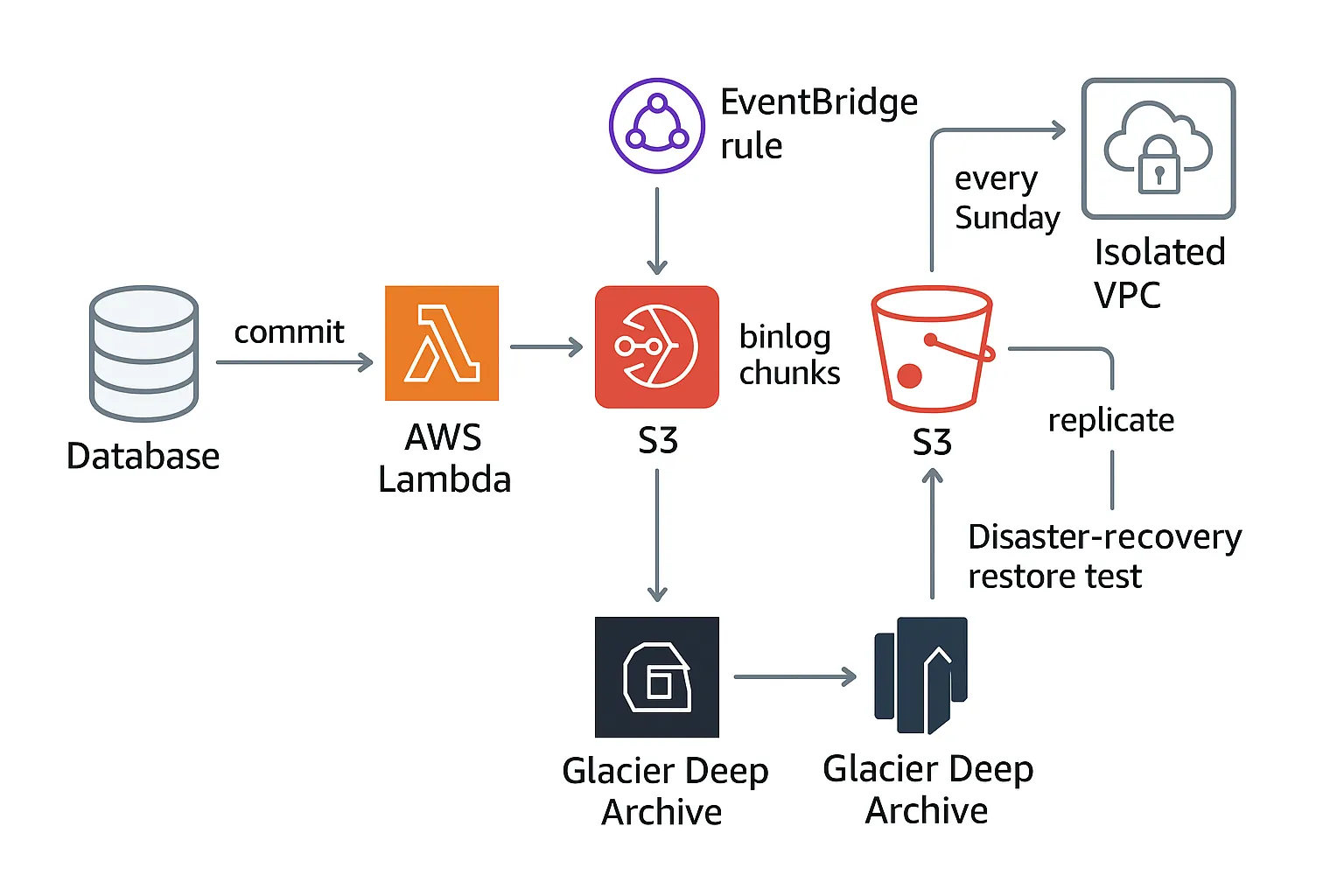
- Change Event Trigger – MySQL binlog or Postgres WAL segments land in an encrypted queue (SQS, Pub/Sub).
- Serverless Processor – A lightweight function (AWS Lambda, Cloud Functions) compresses, encrypts, and stamps metadata.
- Primary Object Store – Data is written to S3 with object-lock set to Compliance mode for the chosen retention period.
- Automated Replication – Cross-Region Replication (CRR) sends objects to a secondary region. A second lifecycle rule moves data older than 90 days to Glacier Deep Archive at <1 USD/TB-month.
- Restore Orchestrator – A Step Functions workflow spins up an isolated RDS replica weekly, replays logs, runs checksum tests, then destroys the sandbox. Results feed into a Slack and Jira ticket.
- Policy Enforcement Layer – AWS Backup Audit Manager or GCP Backup Vault exports compliance reports on demand.
Cost Snapshot (July 2025, AWS us-east-1)
| Component | Volume | Monthly Cost |
|---|---|---|
| Lambda compute | 80 M invocations, 512 MB, 300 ms | USD 11.20 |
| S3 Standard | 3 TB | USD 69.90 |
| S3 CRR | 3 TB | USD 21.60 |
| Glacier Deep Archive | 20 TB | USD 18.00 |
| Total | – | USD 120.70 |
That is often 70–85 % cheaper than maintaining a warm replica and nightly EBS snapshots.
Calculating Your 2025 RPO and RTO Targets
Regulators no longer accept vague SLAs. The table below shows realistic targets Spinlab sees across Tier-1 clients:
| Data Category | Recommended RPO | Recommended RTO |
|---|---|---|
| Player Ledger | 30 seconds | 15 minutes |
| Game Event Stream | 2 minutes | 30 minutes |
| KYC & AML Logs | 15 minutes | 1 hour |
| Analytics Warehouse | 1 hour | 4 hours |
Serverless pipelines comfortably achieve these numbers because every micro-batch is handled in parallel, and restore jobs can launch multiple replay workers simultaneously.
Security and Compliance Checklist
- Key rotation – automate KMS key rotation every 90 days; export rotation logs for PCI DSS record keeping. For more context see our plain-English PCI guide.
- Immutable audit trail – hash each backup chunk and anchor the Merkle root on a low-fee Layer-2 like Polygon. This notarization proves tamper-evidence without heavy on-chain storage.
- Segregation of duty – use separate IAM roles for backup creation and deletion. Deletion privileges should require multi-party approval through an identity governance system.
- GDPR Right to Erasure workflows – store pointer indices separately so deleting a player does not break chain-of-custody for the broader snapshot.
Implementation Playbook in 7 Steps
- Inventory data stores – Map every production database, volume, and retention policy. Classify by criticality.
- Define policy-as-code – Express RPOs, retentions, and replication rules in Terraform modules versioned in Git.
- Pilot one workload – Start with your game event log, which is append-only and easy to replay.
- Set up automated restore tests – Nothing is backed up until it has been restored. Schedule weekly sandboxes.
- Measure and alert – Export function duration, failure counts, and lag to Prometheus or Datadog.
- Roll out to remaining stores – Tackle ledger and KYC databases next, adding stricter encryption policies.
- Audit and document – Generate monthly compliance packs and link them to your internal Confluence or GRC tool.
Mini Case Snapshot: PhoenixBet Switches to Serverless Backups
PhoenixBet, a mid-tier crypto casino running on Spinlab’s platform, moved from a manual rsync system to a fully serverless pipeline in Q1 2025.
- RPO drop – from 15 minutes to 25 seconds.
- RTO drop – from 2 hours to 11 minutes (measured during a scheduled drill).
- Cost saving – 78 % reduction in backup OPEX after decommissioning two m6i.2xlarge replica servers.
- Audit win – Curacao audit finished two days early because restore evidence was one API call away.
How Spinlab Accelerates the Journey
Spinlab’s Fullhouse platform already ships with:
- Event stream hooks for PostgreSQL, MySQL, and MongoDB exposing WAL and CDC payloads.
- Terraform blueprints that deploy the reference architecture on AWS, GCP, or Azure in under an hour.
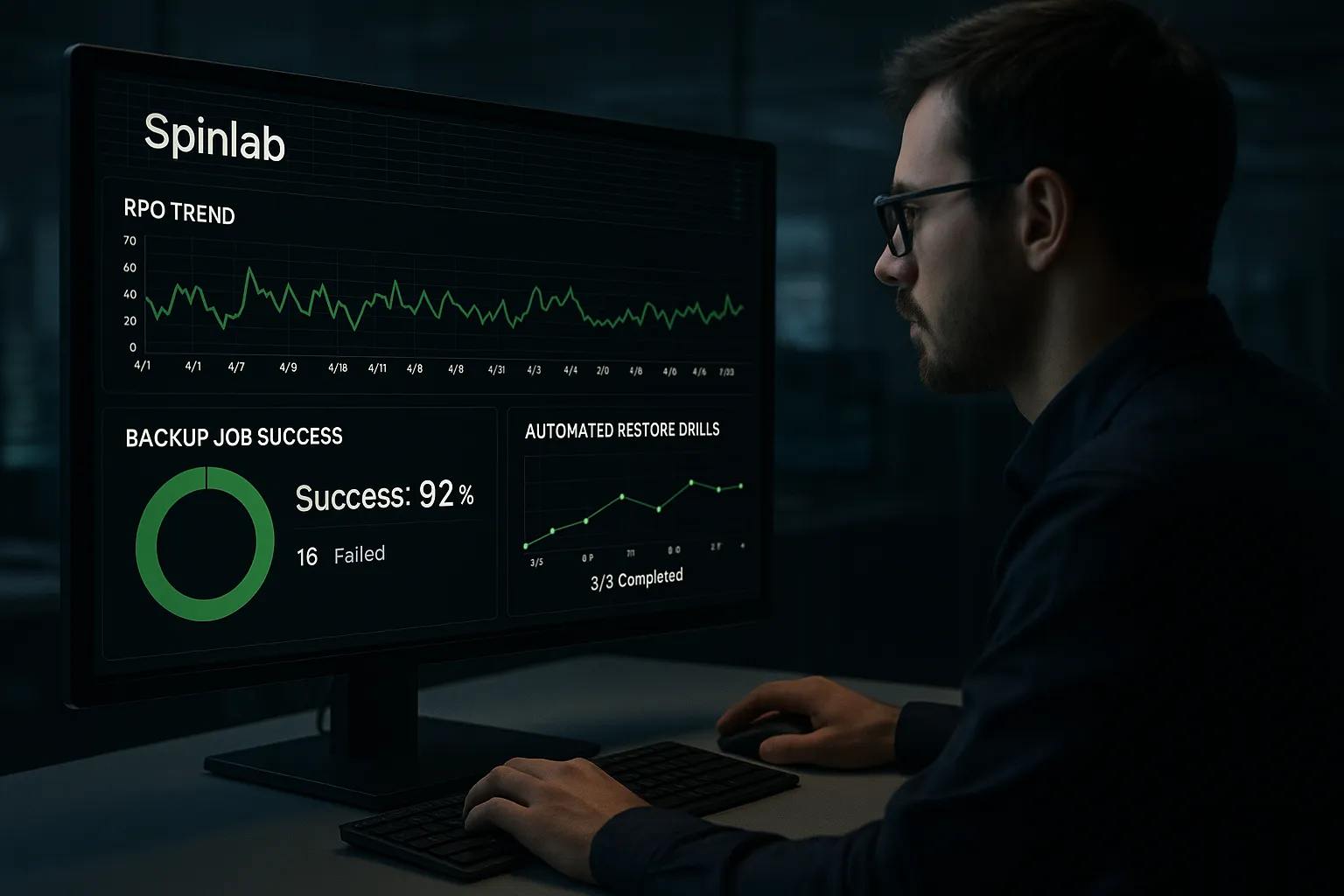
- Real-time backup health dashboards inside the admin panel, leveraging the same analytics layer discussed in our post on real-time data for bigger profits.
- Compliance report generator exporting UKGC, MGA, and PCI evidence packs as PDF or JSON.
Operators can adopt these modules à la carte or as part of a turnkey deployment when migrating to Spinlab. Either way, you keep full ownership of encryption keys and storage accounts while offloading the orchestration brainwork.
KPIs to Monitor Post-Go-Live
- Backup ingestion lag (seconds) – time between a log commit and object store confirmation.
- Restore drill success rate (%) – monthly target of 100 %.
- Average recovery duration (minutes) – track against the RTO budget from the table above.
- Storage cost per TB (USD) – should trend down as data ages into colder tiers.
- Audit pack generation time (minutes) – the quicker you can satisfy a regulator request, the lower the business disruption.
Looking Ahead: 2026 and Beyond
- AI anomaly detection – LLM-powered agents will soon predict backup drift or silent data corruption before it hits production.
- Confidential computing – Expect cloud providers to extend TEEs (Trusted Execution Environments) to serverless runtimes, adding another encryption layer for in-process data.
- Zero-ETL recovery – Emerging database engines like Neon and AlloyDB Omni promise instant restore to any point-in-time without log replay.
Smart operators are already budgeting for these upgrades. Those who wait risk playing catch-up with compliance fines and bitter player reviews.
Next Step: Validate Your Backup Posture
Serverless backups turn disaster recovery from a moonshot project into a utility service. If you want a deeper look at how the reference design maps onto your current stack – or if your board needs proof that RPO 30 seconds is attainable without blowing up the budget – book a 30-minute strategy session with the Spinlab solutions team. We will review your architecture, run a cost and risk gap analysis, and share the Terraform blueprints used by brands already handling millions of bets per hour.
Safeguarding player trust and regulator confidence begins with bulletproof data resilience. In 2025, that resilience is serverless.