

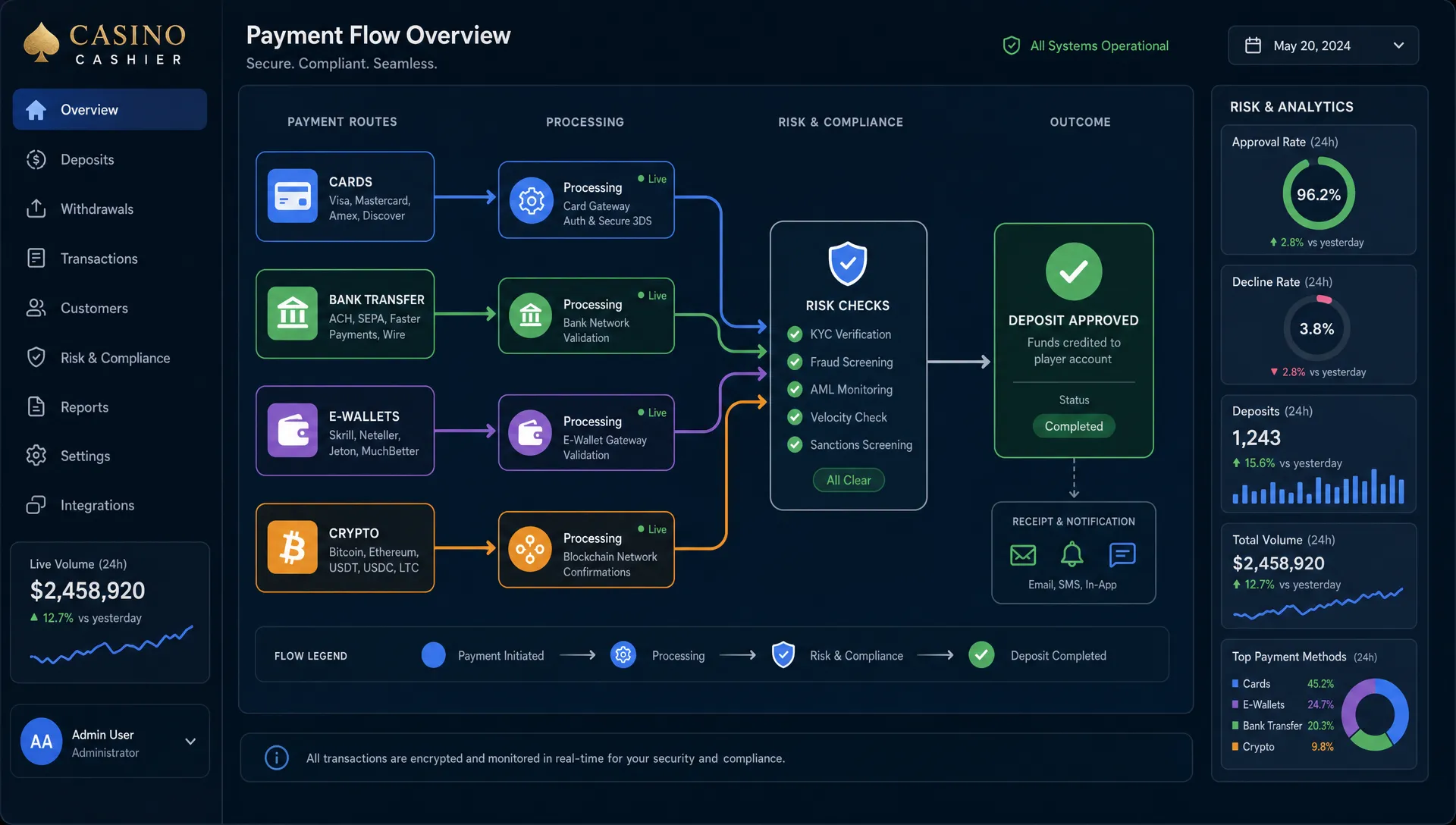
Deposit conversion in an online casino rarely fails for one reason. A player may have the right intent, enough funds, and a working card, yet still abandon the cashier because the payment path is too slow, the method is not trusted locally, the issuer declines the transaction, or a fallback creates confusion.
That is why casino payment routing strategies matter. Routing is not only a technical decision about which payment gateway receives a transaction. It is a commercial system that connects market fit, risk controls, compliance, cashier UX, costs, and operational reliability. Done well, it helps more legitimate players complete deposits without weakening fraud prevention or creating reconciliation problems.
This guide focuses on practical routing choices that improve conversion after a player has already decided to deposit. If you need a broader foundation first, Spinlab has a useful primer on casino payment orchestration and routing for higher approval. Here, we will go deeper into the strategic decisions that turn routing into a growth lever.
Start with the right conversion definition
Many teams look only at approval rate. Approval rate is important, but it is not the full conversion picture. A route with high approvals can still underperform if the cashier is confusing, if 3DS challenges time out, if players cannot use their preferred local method, or if the route creates too many fraud losses later.
For online casino operators, the better question is: how many eligible deposit intents become settled, usable balances with acceptable risk and clean ledger records?
That definition forces payments, product, fraud, compliance, and finance teams to look at the same funnel. It also prevents a common mistake: pushing every transaction toward the route with the highest short-term acceptance, then discovering that chargebacks, manual reviews, or settlement exceptions erased the gain.
| Metric | What it tells you | Routing decision it improves |
|---|---|---|
| Deposit attempt conversion | Whether players who open the cashier complete a deposit | Method ordering, cashier UX, fallback visibility |
| Authorization or payment approval rate | Whether the provider, bank, or rail accepted the transaction | Gateway selection, issuer routing, local method coverage |
| Soft decline recovery rate | How often a retry or fallback saves a failed payment | Retry logic, alternate PSP routing, payment method prompts |
| 3DS challenge completion | Whether authentication is helping or blocking conversion | Exemption logic, challenge routing, device optimization |
| Payment latency | Whether slow responses are causing abandonment | Provider ranking, timeout settings, backup routes |
| Fraud and chargeback rate | Whether approvals are safe and sustainable | Risk-based routing, step-up checks, velocity controls |
| Reconciliation exceptions | Whether deposits match ledger and settlement records | Idempotency, webhook handling, provider rollout quality |
The most profitable routing strategy is rarely the one that maximizes one metric. It is the one that improves the full deposit journey while staying compliant in every market you serve.
Route by market first, not by provider preference
A payment gateway can be excellent in one geography and mediocre in another. Player expectations vary dramatically by market, and conversion usually improves when routing starts with local fit.
In some regions, cards remain the default. In others, open banking, instant bank transfer, e-wallets, vouchers, or crypto rails may convert better. Even within cards, approval can vary by issuing bank, BIN range, card type, currency, and transaction descriptor.
A practical market-first routing model should consider:
- Country and licensing jurisdiction
- Player currency and language
- Device type and operating system
- First deposit versus repeat deposit
- Payment method availability and local trust
- Provider approval history by issuer or rail
- Risk tier, KYC status, and AML requirements
This is where an online gambling platform needs more than a list of payment methods. It needs a routing layer that can rank options based on context. For example, a returning player with verified KYC and a history of successful bank transfers should not necessarily see the same route as a first-time mobile player attempting a high-value card deposit from a new device.
If you are expanding across multiple jurisdictions, align routing with the broader payment stack from the beginning. Spinlab covers this market-by-market approach in its guide to online casino payments setup for global markets.
Use card routing intelligence instead of generic card processing
Cards can be a major source of volume, but generic card processing often leaves conversion on the table. Different issuers respond differently to gaming transactions, cross-border acquiring, MCC configuration, 3DS flows, and transaction descriptors.
The first step is to build a decline taxonomy. Not all declines are equal. A hard decline, such as a stolen card indicator or invalid account, should not be retried aggressively. A soft decline, such as issuer unavailable, timeout, insufficient authentication, or temporary technical failure, may be recoverable through a different route or a cleaner retry.
Card routing should use data such as BIN, issuer country, card brand, debit versus credit, previous player success, amount, and risk score. Over time, you can identify patterns such as one acquirer performing better for domestic debit cards while another performs better for international credit cards.
3DS strategy also belongs inside routing, not outside it. In regulated markets, strong customer authentication and risk checks are part of the deposit experience. The goal is not to avoid authentication at all costs. The goal is to apply the right level of authentication at the right moment, then route authenticated transactions through providers that handle the flow reliably on mobile.
Security standards matter here. Operators handling card payments should understand their obligations under the PCI Security Standards Council and avoid building shortcuts that expose sensitive data or create compliance gaps.
Apply risk-based routing, not one-size-fits-all friction
Higher conversion does not mean approving everything. In iGaming, the best routing systems reduce unnecessary friction for low-risk players while adding targeted controls for risky behavior.
A risk-based model can separate players and transactions into practical tiers. Low-risk deposits may go through the fastest available route. Medium-risk deposits may require 3DS, KYC completion, lower limits, or additional checks. High-risk deposits may be blocked, sent to manual review, or routed away from methods with higher chargeback exposure.
Signals that can influence risk-based routing include account age, KYC status, device fingerprint, IP location, payment method ownership, deposit velocity, failed attempt patterns, bonus abuse indicators, withdrawal history, and previous chargebacks.
This approach helps avoid two expensive extremes. The first is over-friction, where every player is treated like a threat and legitimate deposits drop. The second is under-control, where short-term approval gains produce fraud, AML concerns, and payment partner problems.
For casino operators, compliance should be designed into routing rules from the start. KYC and AML checks are not just backoffice tasks. They affect which routes should be available, what limits should apply, and when funds can be used or withdrawn.
Build fallback rules that save deposits safely
Fallback routing can significantly increase conversion, but only if it is controlled. A failed payment should not automatically trigger multiple blind retries. That can frustrate players, increase issuer suspicion, create duplicate authorization risk, and make reconciliation harder.
A safe fallback model starts with clear rules for failure types. If a transaction fails because of invalid card data, the best next action may be to ask the player to correct the details. If it fails because of a provider timeout, routing to another processor may be appropriate. If it fails because the issuer requires authentication, the route should support a clean 3DS recovery.
The player experience matters as much as the routing logic. Avoid vague errors like payment failed. Tell the player what they can do next without exposing sensitive risk rules. For example, suggest another saved method, a local bank transfer, or a crypto onramp when appropriate.
Behind the scenes, fallback needs strict transaction controls. Use idempotency keys, reliable webhooks, clear pending states, and ledger safeguards so the same player action cannot create duplicate balances. If your team is adding new payment methods quickly, the operational side is just as important as the conversion upside.
Make currency and amount part of the route
Currency mismatch is a quiet conversion killer. Players are less likely to complete deposits when they see unexpected FX, unfamiliar denominations, or a final amount that differs from what they intended to deposit.
Whenever possible, present deposit options in the player’s local currency and route to providers that can process that currency efficiently. If settlement happens in another currency, make the exchange rate and fees clear before confirmation.
Amount also affects routing. Some methods perform well for small deposits but are inefficient for high-value transfers. Others are ideal for larger bank payments but too slow or cumbersome for a quick first deposit. Suggested deposit presets should reflect local purchasing behavior, bonus thresholds, and method limits.
For example, a low-value first deposit may route to a mobile wallet or card path optimized for speed. A larger repeat deposit may route to bank transfer, open banking, stablecoin, or another lower-cost rail if that method is trusted in the player’s market.
Optimize crypto routing for player intent
Crypto can improve payment coverage, especially for players who prefer digital assets or operate in markets where traditional rails are limited. But crypto-ready does not automatically mean high conversion. The route has to match the player’s starting point.
There are two common crypto journeys. One player already has a wallet and wants to deposit directly. Another player has fiat and needs an onramp to buy crypto inside or alongside the cashier. Treating these journeys the same creates friction.
Direct crypto deposits should prioritize clear wallet instructions, supported networks, minimum confirmations, address accuracy, and real-time status updates. Onramp flows should reduce steps, clarify fees, explain what the player will receive, and return the player to the casino balance smoothly after purchase.
Routing can decide when to show direct crypto first, when to suggest an onramp, and when to keep fiat methods ahead of both. For a deeper comparison, Spinlab breaks down crypto onramp versus direct deposit conversion in more detail.
Stablecoins deserve special attention. In some contexts, they can reduce volatility concerns and simplify value expectations. Still, operators need clear policies for custody, AML monitoring, network selection, and settlement. Crypto routing should be treated as part of the regulated payment stack, not a side channel.
Connect routing with cashier UX
Even the best routing engine underperforms if the cashier displays the wrong options. Players do not care which PSP is behind the transaction. They care whether their preferred method is visible, trustworthy, fast, and easy to complete.
Your cashier should use routing intelligence to decide what the player sees first. Do not present every available method equally. Prioritize the methods most likely to convert for that player’s country, currency, device, verification status, and previous behavior.
A strong cashier experience should hide unavailable methods, label processing times clearly, show relevant trust signals, preserve entered information after recoverable errors, and make fallback choices obvious. On mobile, every extra field and redirect can reduce completion, so the routing decision must account for the actual front-end flow.
This is closely tied to deposit form design. If your routing is strong but the form is slow, you still lose players. Spinlab’s guide to optimizing deposit forms for 3-second checkout is a good companion for product teams improving the cashier layer.
Use cost-aware routing only after protecting approval and trust
Payment cost matters, especially at scale. But routing every transaction to the cheapest provider can damage conversion if that provider has weaker approvals, slower responses, poor mobile authentication, or limited local trust.
A better approach is contribution-aware routing. Start with the routes that meet your approval, risk, compliance, and reliability thresholds. Then optimize cost within that qualified set.
For example, if two routes perform similarly for a specific player segment, the lower-cost route may be the right default. But if the cheaper route causes more abandonment or soft declines, the apparent savings may be false. Deposit conversion, lifetime value, fraud losses, payment fees, and support costs should be evaluated together.
This is especially important for bonus-heavy acquisition. A first-time depositor may justify a more expensive but higher-converting route because the value of activating that player is high. For a low-margin repeat transaction, cost optimization may carry more weight.
Monitor routing like a live growth system
Payment routing is never finished. Issuers change behavior, PSP performance shifts, fraud patterns evolve, new local methods emerge, and player preferences move. A rule that worked last quarter can become a bottleneck today.
Operators should review routing performance by segment, not just globally. A single blended approval rate can hide major problems in one country, issuer, device, method, or player cohort.
A useful weekly routing review should include conversion by market, top decline reasons, PSP latency, 3DS completion, fallback recovery, fraud signals, chargeback trends, failed webhook rates, and reconciliation exceptions. Real-time analytics make this process much faster because teams can spot route degradation before it becomes a revenue problem.
It is also worth running controlled experiments. Test method ordering, provider priority, timeout thresholds, fallback prompts, and amount presets. Keep tests narrow enough that finance and risk teams can measure the impact cleanly.
A practical 90-day routing roadmap
If your current setup is basic, do not try to rebuild everything at once. Start with the routes and markets where the revenue impact is highest.
| Timeline | Focus | Outcome |
|---|---|---|
| Days 1 to 30 | Audit funnel data, decline codes, provider performance, cashier drop-offs, and reconciliation issues | Clear view of where deposits are being lost |
| Days 31 to 60 | Launch market-specific method ordering, soft decline fallback, and basic risk-based routing | Higher recovery without broad risk expansion |
| Days 61 to 90 | Add deeper issuer analysis, crypto route segmentation, cost-aware optimization, and structured A/B tests | Scalable routing strategy tied to growth metrics |
The key is to move from static routing to adaptive routing. Static routing asks which provider should process payments. Adaptive routing asks which route is best for this player, in this market, with this method, at this risk level, right now.
Common routing mistakes to avoid
The most common mistake is treating routing as a PSP configuration task rather than a cross-functional operating model. Payments teams can configure routes, but product, fraud, compliance, finance, and support all influence the result.
Another mistake is retrying too aggressively. More retries do not always mean more conversion. They can increase issuer declines, create player anxiety, and complicate ledger accuracy. Smart retries depend on decline type and player context.
Operators also lose conversion when they add payment methods without a clear role. More options can help, but only if they are ordered and routed intelligently. A cluttered cashier can reduce trust, especially for first-time depositors.
Finally, many teams optimize deposits while ignoring withdrawals. Players are more likely to deposit when they trust that withdrawals will work. Deposit routing, KYC flows, wallet structure, and payout reliability should be designed as one financial experience.
Frequently Asked Questions
What is casino payment routing? Casino payment routing is the logic that decides which provider, rail, method, authentication flow, or fallback path should handle a deposit or withdrawal based on player, market, risk, and performance data.
How does payment routing increase deposit conversion? It increases conversion by sending transactions to the route most likely to approve safely, showing players the most relevant methods, recovering soft declines, reducing latency, and avoiding unnecessary friction.
Should casinos always route to the provider with the highest approval rate? Not always. Approval rate must be balanced with fraud, chargebacks, fees, compliance requirements, settlement quality, latency, and reconciliation reliability.
Is crypto routing different from fiat routing? Yes. Crypto routing must account for wallet ownership, network selection, confirmations, onramp flows, custody, AML monitoring, and player education. Fiat routing is more focused on local payment methods, issuers, banks, and card authentication.
How often should payment routing rules be reviewed? High-volume operators should monitor routing daily and review performance formally every week. Smaller operators can start with weekly or biweekly reviews, but any major provider issue, fraud spike, or market launch should trigger an immediate review.
Turn routing into a conversion advantage
Higher casino deposit conversion comes from a payment system that is local, adaptive, compliant, and easy for players to complete. The winning strategy is not one gateway, one rule, or one payment method. It is a routing framework that learns from real transaction data and keeps improving.
Spinlab helps operators build, launch, and scale online casinos with a modular, crypto-ready iGaming platform that includes integrated payment support, compliance tools, game aggregation, real-time analytics, and a customizable backoffice. If you want a flexible whitelabel casino foundation designed for fast onboarding and global growth, explore Spinlab’s casino platform.