

Casino treasury controls are where finance, risk and product operations meet. In an online casino, money moves nonstop through card deposits, crypto onramp deposits, player withdrawals, refunds, chargebacks, jackpot payouts, affiliate settlements, game aggregator invoices and transfers between wallets or bank accounts.
A weak approval model does not always fail dramatically. It often fails quietly: a manual credit is granted without enough evidence, a payment gateway setting is changed without review, a hot wallet top-up is rushed outside policy, or a reconciler is asked to approve the same batch they prepared. Over time, those gaps become fraud exposure, audit exceptions, liquidity surprises and player trust issues.
This guide focuses on two control pillars every casino operator should design before volume scales: approval rules and segregation of duties. The aim is not to slow down legitimate payments. The goal is to let low-risk flows move quickly while giving high-risk or high-value actions the right level of review.
Why casino treasury controls need their own design
Casino treasury is not the same as a generic e-commerce finance function. A whitelabel casino, crypto casino or full turnkey casino solution has continuous player activity, multi-currency balances, bonuses, game provider settlements and withdrawals that players expect to receive quickly.
That creates a difficult balance. If approval rules are too loose, the operator can lose money through internal abuse, account takeover, bonus exploitation, settlement errors or unauthorized wallet transfers. If controls are too rigid, legitimate withdrawals sit in manual review, deposit issues go unresolved and VIP players lose confidence.
The COSO Internal Control Integrated Framework is not casino-specific, but its principles apply well to iGaming: define control activities, segregate duties where practical, maintain reliable information and monitor whether controls keep working. For casino operators, those control activities need to map directly to deposits, withdrawals, wallet movements, settlements and manual balance changes.
If you are still designing the wider treasury architecture, including ledgers, settlement flows and wallet structure, Spinlab’s guide to building a crypto-ready casino treasury is a useful companion. This article goes deeper on the operating controls that sit on top of that architecture.
What an approval rule should actually define
An approval rule is a documented condition that decides whether a treasury action can proceed automatically, needs one approval, requires dual approval or must be blocked. Good rules are clear enough to configure in a backoffice and specific enough for an auditor, compliance officer or finance lead to understand after the fact.
Every approval rule should define these elements:
- Scope: The event covered, such as withdrawal, refund, manual balance credit, wallet transfer, settlement correction or payment gateway configuration change.
- Trigger: The condition that changes the handling path, such as amount, risk score, jurisdiction, payment method, wallet alert or unusual velocity.
- Decision path: Whether the action is auto-approved, queued for review, escalated for dual approval or rejected.
- Approver role: The role that can approve the action, not just the individual employee name.
- Evidence required: The documents, logs, notes or system checks needed before approval.
- Audit result: The timestamp, user, rule version, decision reason and final status recorded after the decision.
The mistake many operators make is using amount thresholds as the whole control model. Amount matters, but it is only one risk signal. A small withdrawal to a newly changed payout method after a password reset can be riskier than a larger withdrawal from a long-tenured, verified player with a consistent payment history.
| Control dimension | What it helps detect | Example trigger |
|---|---|---|
| Amount | Financial impact and liquidity risk | Transaction exceeds an internal tier limit |
| Player risk | Account takeover, fraud or bonus abuse | New device, recent credential change or unresolved fraud flag |
| AML and compliance | Regulatory and sanctions exposure | Screening alert, incomplete KYC or unusual transaction pattern |
| Payment rail | Channel-specific risk | New bank account, new card, crypto address alert or pending dispute window |
| Operational change | Internal misuse or configuration error | New payment gateway credential, bank account update or wallet whitelist change |
| Ledger exception | Accounting and reconciliation risk | Negative balance, reversal mismatch or unexplained settlement variance |
Approval rules should be risk-based, but they should not be improvised. If staff have to decide from scratch every time, your control framework depends too much on individual judgment. The better model is a rule set that handles routine cases automatically and gives reviewers clear escalation paths for exceptions.
A practical approval matrix for casino treasury operations
A matrix turns policy into day-to-day workflow. The exact thresholds depend on your license, payment providers, jurisdictions, liquidity profile and risk appetite, but the structure below gives operators a practical starting point.
| Treasury event | Can usually be automated when | Requires approval when | Suggested independent approver |
|---|---|---|---|
| Player withdrawal | KYC is complete, wagering rules are satisfied, no fraud or AML alerts exist and the payout method is known | Amount exceeds internal limit, payout method is new, account details changed recently, wallet screening flags risk or player activity is unusual | Payments or fraud lead, with compliance escalation for AML concerns |
| Manual player balance credit | Credit is system-generated from a resolved payment incident and evidence is attached | Credit is manually requested, tied to a complaint, tied to VIP retention or exceeds an internal limit | Customer support manager plus finance or risk reviewer |
| Refund or reversal | Refund matches the original deposit rail and is within policy | Refund goes to a different method, is partial without clear reason, relates to a dispute or creates a negative player balance | Payments lead or finance reviewer |
| Chargeback handling | Case follows a standard representment or write-off policy | Large exposure, repeated chargebacks, organized fraud pattern or manual balance correction needed | Payments lead plus risk reviewer |
| Hot wallet top-up | Replenishment follows preapproved limits and destination is whitelisted | Amount is above limit, destination is new, liquidity pressure is abnormal or request occurs outside normal operating procedure | Treasury lead plus senior operations or finance approver |
| Cold wallet sweep | Sweep follows scheduled procedure and destination is preapproved | Emergency transfer, new custody destination, unusual asset movement or manual override required | Dual approval from treasury and senior management |
| Payment provider settlement variance | Variance is within tolerance and explained by fees, reserves or timing | Variance exceeds tolerance, cannot be explained, affects player balances or repeats across settlement cycles | Finance reviewer independent from payment operations |
| Affiliate or vendor payout | Invoice or commission calculation matches approved terms and reconciliation | New beneficiary, changed bank details, large adjustment or disputed commission | Finance lead plus commercial owner |
This type of matrix helps the team move quickly without making approval feel arbitrary. It also protects reviewers. A staff member who escalates a payout because the rules require it is not being difficult, they are following the control model.
Two details matter when building the matrix into your iGaming platform. First, approvals should be tied to roles and permissions, not personal relationships or chat messages. Second, the system should record why the transaction was approved, not only that it was approved. Without reason codes and evidence, the audit trail becomes a timestamp rather than a control.
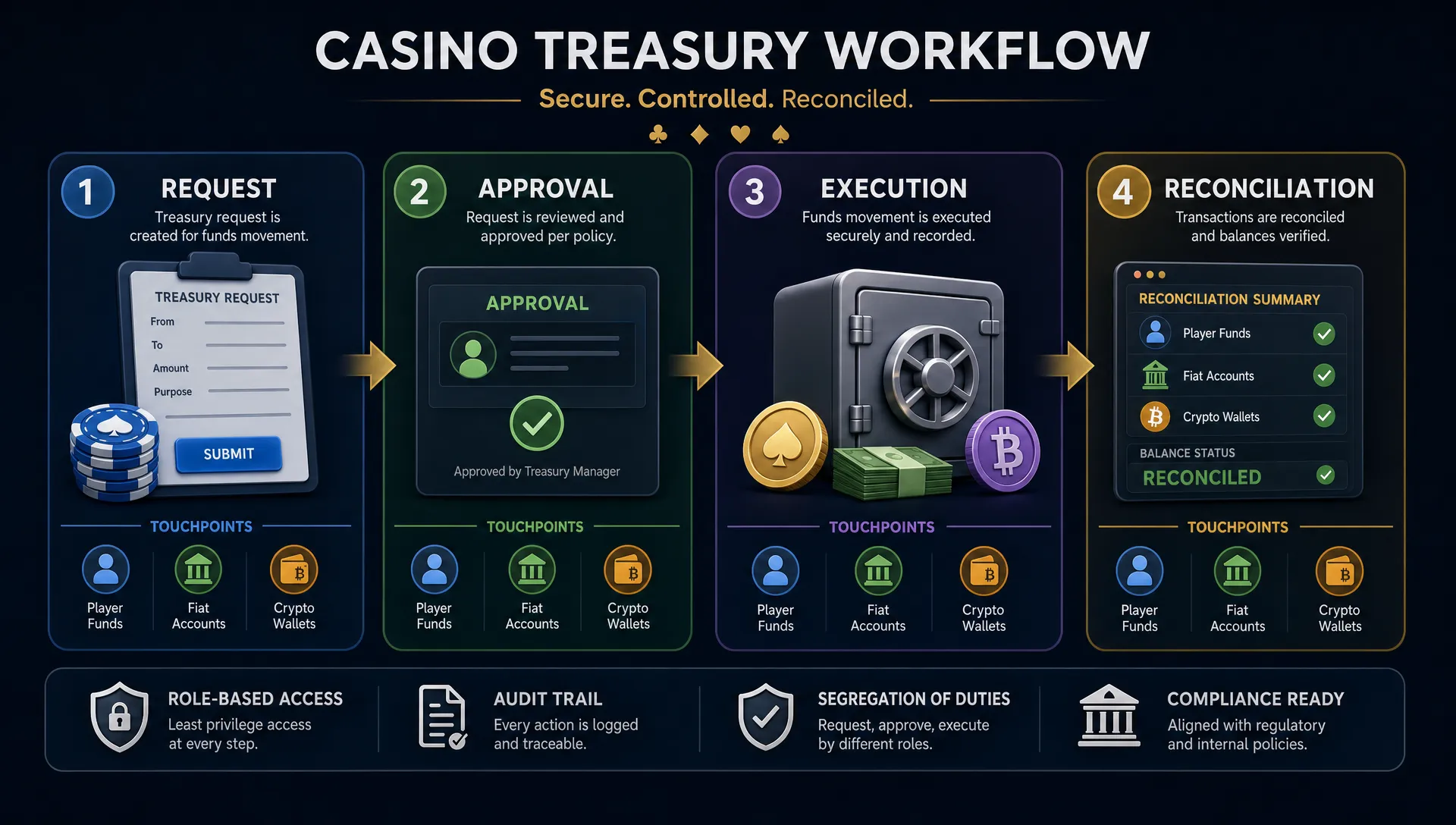
Segregation of duties: the control that prevents single-person failures
Segregation of duties means no one person can initiate, approve, execute and reconcile a sensitive financial action alone. In casino treasury, this matters because the backoffice often gives staff access to powerful tools: player balance adjustments, withdrawal queues, bonus grants, payment gateway settings, KYC status changes and wallet operations.
The point is not to assume employees are dishonest. The point is to design the operating model so mistakes and abuse are harder to hide. A tired employee can make a configuration error. A support agent can be socially engineered. A privileged admin account can be compromised. Segregation reduces the blast radius.
| Role | Primary responsibility | Should be separate from |
|---|---|---|
| Requester | Creates a payout batch, balance adjustment, settlement correction or wallet transfer request | Final approval and independent reconciliation |
| Approver | Reviews evidence and approves or rejects the request | Creating the original request or editing the underlying player record |
| Executor | Sends the approved payment, transfer or operational change | Approving the request and reconciling the outcome |
| Reconciler | Matches ledger entries, provider reports, bank statements and wallet activity | Preparing or approving the same batch being reconciled |
| System administrator | Manages permissions, roles and sensitive configuration | Performing routine treasury approvals without oversight |
| Compliance reviewer | Reviews AML, sanctions, KYC and suspicious activity concerns | Overriding payment controls without a documented business owner |
| Auditor or read-only reviewer | Inspects logs, approvals and control evidence | Editing transactions, roles or ledger records |
In a larger operator, these roles may sit in separate departments. In a lean whitelabel casino team, they may be split across fewer people. Complete separation is not always realistic at launch, but the riskiest combinations still need compensating controls.
For example, if one finance lead must both prepare and execute a payout batch, require a second person to approve the batch before execution and require a daily read-only reconciliation review by someone outside the payment workflow. If one founder holds emergency admin access, make that access time-limited, logged and reviewed after every use.
Strong segregation depends heavily on permissions. This is where role-based access control in casino backoffices becomes more than an IT feature. RBAC is the enforcement layer that stops users from bypassing the approval matrix when pressure builds.
Make approval rules enforceable in the backoffice
A policy document is useful, but it does not stop a bad transaction by itself. Treasury controls become reliable when they are configured directly inside operational systems: the casino backoffice, payment gateway, wallet tooling, ledger and analytics dashboard.
At minimum, sensitive actions should produce a durable record containing:
- Unique transaction or event ID
- Initiating user, role and timestamp
- Previous value and new value when a setting or balance changes
- Triggered approval rule and rule version
- Reviewer identity, timestamp and decision
- Reason code and supporting notes
- Linked evidence, such as KYC result, payment provider message or settlement report
- Final execution status and reconciliation status
For audit-grade operations, the ledger and audit trail should be hard to rewrite. If an employee reverses a transaction, the original entry should remain visible and the reversal should create its own entry. Spinlab has a deeper explanation of this approach in its article on casino ledger design for audit trails, reversals and settlements.
Operators should also avoid approval by chat. Messaging tools are useful for coordination, but they are poor systems of record. If a senior person approves a large wallet movement in a chat thread, the backoffice still needs the formal approval record, rule trigger, evidence and reconciliation result.
Fiat and crypto controls are different, even in one treasury
A modern online gambling platform often supports both fiat and crypto. The control framework should cover both, but it should not pretend the rails behave the same way.
Fiat payments involve card networks, bank transfers, acquirers, alternative payment methods, reserves, refunds and chargebacks. Crypto payments involve address attribution, wallet screening, custody, private key controls, gas fees, network confirmations and often irreversible transfers. A crypto-ready solution needs unified oversight without flattening those differences.
| Area | Fiat treasury control | Crypto treasury control |
|---|---|---|
| Deposit monitoring | Match payment gateway confirmations to player ledger credits | Match onchain deposits to assigned addresses and credited player balances |
| Withdrawal risk | Validate payout method, fraud signals, KYC status and dispute exposure | Validate wallet address, screening result, network, asset and confirmation policy |
| Settlement | Reconcile processor reports, bank statements, fees and reserves | Reconcile wallet balances, custody reports, onchain activity and internal ledger |
| Configuration | Approve changes to merchant accounts, routing rules and settlement bank details | Approve wallet whitelists, custody destinations, signing policy and transfer limits |
| Exceptions | Manage refunds, chargebacks, failed payouts and provider reversals | Manage stuck transactions, wrong-network deposits, dusting risk and failed broadcasts |
Compliance rules also differ by jurisdiction. The FATF Recommendations set global expectations around AML controls such as customer due diligence, record keeping and suspicious transaction reporting. Local gambling regulations, payment provider terms and virtual asset rules may add more specific requirements.
From a treasury control perspective, the key point is simple: fiat and crypto should share governance, but not identical workflows. A card refund and an onchain withdrawal can both need approval, but the evidence, risk signals and operational consequences are different.
Emergency approvals need rules too
Every casino treasury eventually faces urgent situations: a payout backlog before a weekend, a payment processor outage, a stuck wallet transaction, a sudden spike in withdrawals after a major jackpot or a settlement issue affecting liquidity. These moments are exactly when teams are tempted to bypass controls.
Emergency access should exist, but it should be designed as a controlled exception rather than an informal shortcut. A good emergency approval process defines who can invoke it, what events qualify, what limits apply, how long access lasts and who reviews the action afterward.
Break-glass access should be time-boxed and heavily logged. If an administrator temporarily receives permission to change payment routing, wallet limits or withdrawal settings, the system should capture the approval, the exact changes, the business reason and the post-event review. Emergency actions should not become permanent permissions.
Common failure patterns to avoid
The most common treasury control failures are not exotic. They usually come from operational shortcuts that seemed harmless when volumes were low.
Approving exceptions through chat is one of the biggest issues. It may feel efficient, but it separates the decision from the transaction record. Six months later, the operator may know a withdrawal was approved, but not which rule applied or what evidence supported the decision.
Another pattern is combining payment administration and reconciliation. If the same person can change payment gateway settings, process refunds and reconcile settlements alone, errors or misuse can stay hidden for too long. A second reviewer does not need to slow every payment, but they should review the control points that affect funds movement and reporting.
Operators also forget non-player treasury flows. Affiliate payouts, game provider invoices, bonus liabilities, chargeback write-offs, platform fees and vendor payments can all create financial exposure. Casino treasury controls should cover the whole money cycle, not only player withdrawals.
Finally, dormant privileged accounts are a quiet risk. Former contractors, inactive admins and unused test accounts should not keep treasury permissions. Access reviews need to be recurring, documented and tied to role changes.
Implementation checklist for operators
The fastest way to improve treasury controls is to map your current money flows, assign owners and then configure approval rules around the highest-risk events first. Do not start with a 40-page policy that no one uses. Start with the actions that can move money, change balances or hide errors.
| Phase | What to do | Output |
|---|---|---|
| Map flows | List deposits, withdrawals, refunds, reversals, wallet transfers, settlements and vendor payouts | Treasury event inventory |
| Classify risk | Group each event by value, compliance risk, fraud risk and operational impact | Risk-ranked control map |
| Define approvals | Set auto-approval, single approval, dual approval and block conditions | Approval matrix |
| Separate roles | Identify who can request, approve, execute, reconcile and administer systems | Segregation of duties model |
| Configure systems | Implement permissions, limits, reason codes, logs and alerts in the backoffice | Enforced workflow |
| Test exceptions | Simulate failed payouts, wallet transfer requests, settlement variances and manual credits | Evidence that controls work |
| Monitor performance | Review approval times, false holds, exceptions, overrides and reconciliation breaks | Control improvement backlog |
A strong control framework should also include review cadence. Weekly exception reviews help catch operational issues quickly. Monthly limit reviews help adjust thresholds as volume changes. Quarterly access reviews help remove stale permissions. Incident reviews help convert near misses into better rules.
Frequently Asked Questions
What are casino treasury controls? Casino treasury controls are the policies, permissions, approval workflows, audit trails and reconciliation processes that govern how funds move in and out of an online casino. They cover player withdrawals, deposits, refunds, wallet transfers, settlements, manual balance changes and vendor payouts.
How many approval levels should an online casino use? Most operators use a mix of auto-approval, single approval, dual approval and blocked actions. The right level depends on transaction value, player risk, payment method, compliance status, wallet risk, jurisdiction and whether the action changes balances or treasury configuration.
Can player withdrawals be auto-approved safely? Yes, if the operator has clear rules and reliable data. Auto-approval is usually appropriate for low-risk withdrawals where KYC is complete, wagering requirements are satisfied, no fraud or AML alerts exist and the payout method is known. Higher-risk withdrawals should route to manual review.
How does segregation of duties work in a small casino team? Small teams can use compensating controls when full department-level separation is not possible. Examples include dual approval for high-risk actions, read-only reconciliation review by someone outside the payment workflow, time-limited admin access and documented post-event reviews.
Do crypto casinos need different treasury approval rules? Yes. Crypto flows need controls for wallet screening, address management, custody, signing policy, confirmation rules and irreversible transfers. Fiat and crypto can share governance, but the evidence and approval triggers should reflect the specific rail.
Build treasury controls into your casino from day one
Treasury controls are easier to build before volume, affiliates, VIPs and multiple payment rails create operational pressure. If you are launching or replacing a whitelabel casino platform, approval rules and segregation of duties should be part of the platform conversation, not an afterthought.
Spinlab provides a modular iGaming platform for building, launching and scaling online casinos with crypto and fiat payment support, KYC and AML compliance, advanced fraud prevention, real-time analytics, customizable backoffice tools, open API integration, game aggregation and merchant custodial wallet capabilities.
If you want a Shopify-like operating experience without losing control over treasury risk, Spinlab can help you launch with the workflows, permissions and payment infrastructure needed to scale more safely.