

Chargebacks are one of the few operational line items that can quietly erase an iGaming operator’s margin twice, once through lost revenue and again through fees, manual workload, and risk-scoring damage with PSPs and issuers. The good news is that many disputes are winnable when your team treats chargeback representment as a repeatable process, not an ad hoc scramble for screenshots.
This guide breaks down representment for online casinos in practical terms: how the dispute lifecycle works, what evidence actually moves the needle, how to build “chargeback-ready” data trails, and how to decide when to fight versus refund.
What chargeback representment means (in plain English)
Representment is the act of challenging a chargeback by sending evidence back through your PSP/acquirer to the card network and issuer to prove the transaction was valid, authorized, and fulfilled according to your terms.
In casino payments, representment is most often used to contest:
- Friendly fraud (player claims “I didn’t do this” but did)
- True fraud where the transaction was actually authenticated and risk-controlled
- “Service not provided” claims when gameplay occurred and access was delivered
- Refund/credit claims when your records show no valid refund obligation existed (or a refund was already processed)
Representment is not a magic button. It works when you can produce a clear, consistent story with strong artifacts, aligned to network rules and submitted within strict timelines.
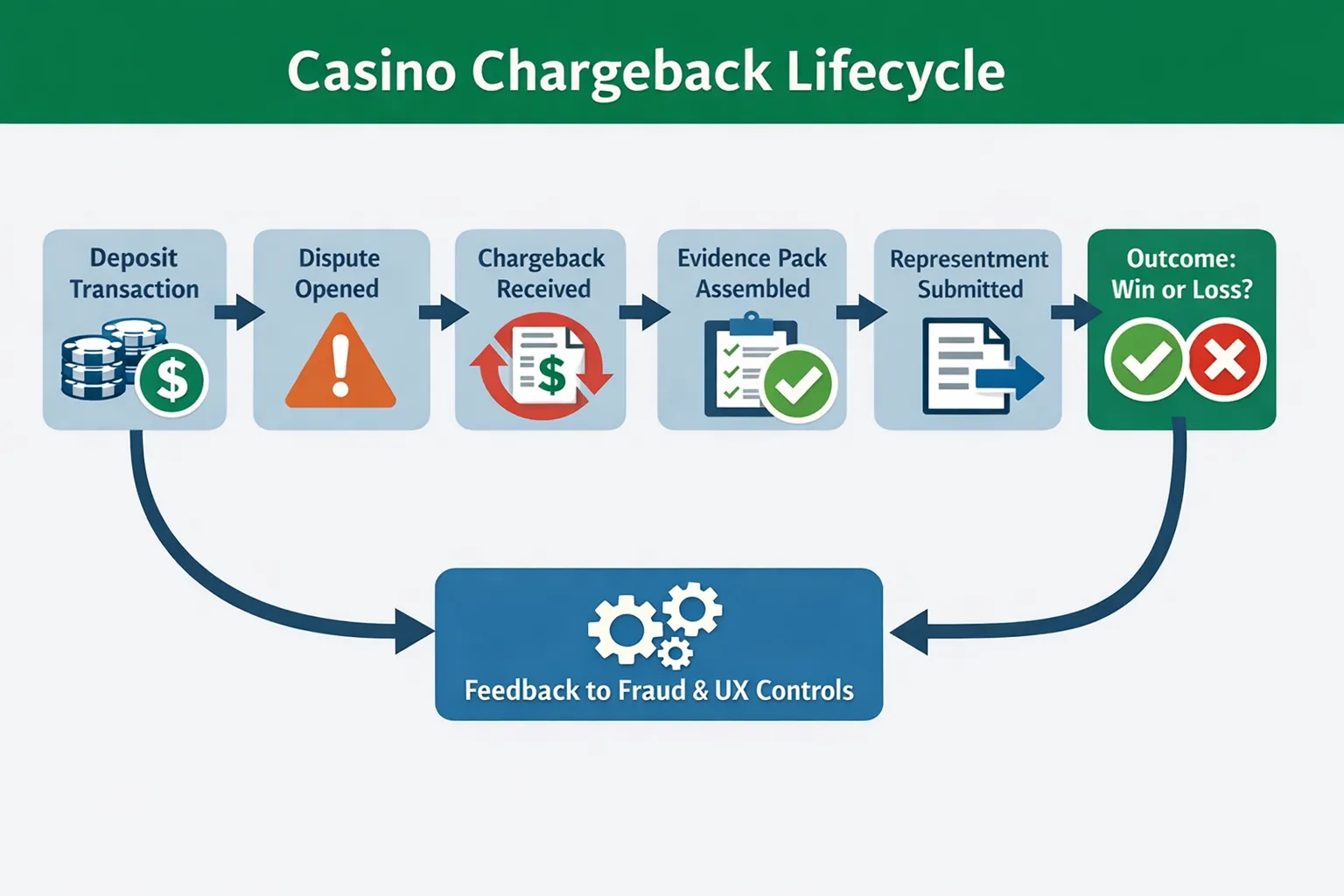
The dispute lifecycle casinos should design for
Exact steps vary by PSP and network, but the structure is usually consistent. The key is to understand where you can influence outcomes.
| Stage | What happens | Your leverage point |
|---|---|---|
| Transaction | Deposit is authorized and captured | Authentication (3DS/SCA where applicable), fraud controls, clean descriptors |
| Dispute initiated | Cardholder contacts issuer | Your support and refund policies can prevent escalation |
| Chargeback filed | Funds are pulled back | Fast triage, evidence assembly, representment decision |
| Representment submitted | You challenge the chargeback | Quality of evidence pack, timeline clarity, compliance alignment |
| Second review / escalation | Issuer may uphold or reverse | Better documentation, sometimes pre-arbitration handling |
| Final resolution | Funds stay with issuer or return to you | Post-mortem, prevention tuning |
A useful mental model: representment is downstream of product, cashier UX, compliance logging, and risk engineering. The earlier layers determine how often you can win later.
The dispute types casinos see most, and what usually wins
Instead of obsessing over specific “reason codes” (which differ by network and evolve), structure your playbook around dispute narratives. Issuers decide based on whether your evidence disproves the narrative.
| Dispute narrative | What the player claims | Evidence that tends to win | Prevention that boosts future wins |
|---|---|---|---|
| Unauthorized / fraud | “Not my deposit” | Strong authentication proof, device continuity, KYC match, usage after deposit | Adaptive fraud scoring, 3DS/SCA strategy, device fingerprinting |
| Cardholder doesn’t recognize merchant | “I don’t know this merchant” | Clear billing descriptor, receipts, support logs, player account ownership | Better descriptors, confirmation emails, wallet ledger clarity |
| Service not delivered | “I paid but got nothing” | Game-session logs, balance ledger before/after, access timestamps, error logs | Uptime monitoring, incident comms, compensations policy |
| Refund not processed | “They promised a refund” | Refund policy acceptance, support decision trail, payout attempts, refund timestamps | Ticketing discipline, clear refund SLAs, automated receipts |
| Duplicate / incorrect amount | “Wrong amount charged” | Authorization/capture records, single transaction IDs, ledger reconciliation | Idempotency keys, anti-duplicate controls, payment monitoring |
Two iGaming-specific realities matter here:
- Your “proof of fulfillment” is digital (account access, gameplay events, wallet ledger movements). If you do not log it cleanly, you will struggle to win.
- Compliance artifacts can strengthen your case (KYC/AML checks, geo checks, responsible gaming actions). Not because they replace payment evidence, but because they show a controlled, auditable operation.
If you want a related prevention playbook, Spinlab’s guide on preventing card testing attacks on your cashier pairs well with representment because card testing often precedes dispute spikes.
Build a “chargeback-ready” evidence pack (before you need it)
The fastest way to lose disputes is to assemble evidence manually after the chargeback arrives, from mismatched systems, with gaps in time, identity, and device data.
A casino-grade representment pack should be generated from a repeatable data model.
Evidence categories that matter most
Identity and account ownership
- KYC status and timestamps (pass/fail, verification provider reference)
- Player PII match summary (name, DOB, address if collected and permissible)
- Account creation timestamp and registration IP
Authentication and risk signals
- 3DS/SCA result when used (and the authentication status provided by your PSP)
- Device and session continuity (same device used to log in, deposit, and play)
- IP geolocation consistency (with your geo-allowed markets)
Wallet and gameplay fulfillment
- Ledger entries showing deposit credited
- Balance changes tied to wagers
- Game-session events (login, game launch, bet placement timestamps)
Player communications
- Support tickets and chat transcripts relevant to the dispute
- Email/SMS confirmations (deposit confirmation, account notices)
Terms acceptance and policies
- Timestamped acceptance of Terms, bonus rules, and key policy pages
- Any rule enforcement logs (bonus abuse flags, self-exclusion, limits)
How to structure it so issuers can read it
Issuers do not want raw dumps. They want a short, coherent timeline with supporting attachments.
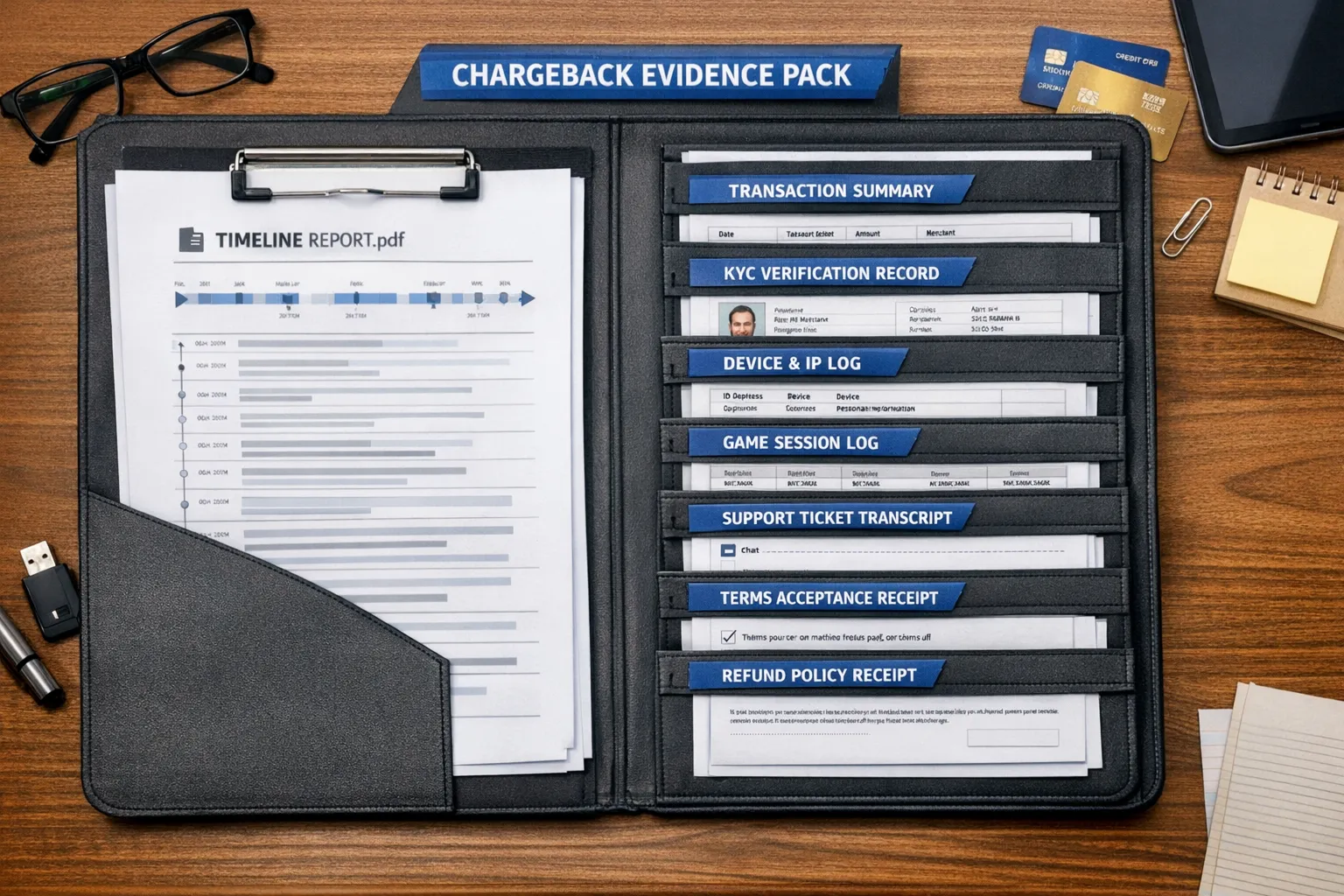
A strong pack usually contains:
- A one-page timeline (registration, deposit, login, gameplay, withdrawals, support contacts)
- A transaction summary (amount, date, descriptor, auth result)
- A fulfillment proof section (game sessions and ledger)
- A policy acceptance section (Terms and refund policy acceptance)
- A support section (if relevant)
Data retention and PCI scope: don’t create new problems
Representment requires recordkeeping, but you should avoid storing sensitive payment data unnecessarily.
- Use PSP-provided transaction references instead of storing PAN.
- Store only what you need, with access control and audit logs.
- If you handle card data directly, align with PCI DSS 4.0 requirements. A practical starting point is Spinlab’s PCI DSS for iGaming guide.
For network-level background, see Visa Claims Resolution and Mastercard’s chargeback resources (often published as acquirer-facing guides).
Writing the representment response: clarity beats volume
A common mistake is sending 40 pages of screenshots without an explanation. Another is making legal claims instead of factual ones.
A high-performing representment letter is:
- Short (think one page of narrative)
- Specific (dates, times, amounts, IDs)
- Consistent (no conflicting timestamps across documents)
- Mapped to the claim (every attachment exists to refute a statement)
A simple structure your team can reuse
- Statement of dispute: What the cardholder claims.
- Your position: Transaction was authorized and service was delivered.
- Timeline: Bullet timeline of key events.
- Evidence index: Attachment list with 1-line descriptions.
- Closing: Request reversal based on included documentation.
Avoid emotional language. Avoid jargon like “we have logs.” Show the logs (in issuer-friendly form).
Decide when to fight vs refund (a decision matrix)
Not every chargeback is worth contesting. Fighting weak cases can waste labor and increase scrutiny with processors.
Use a simple decision matrix your risk team can apply consistently.
| Factor | Low | Medium | High |
|---|---|---|---|
| Evidence strength | Missing key artifacts | Partial timeline, some gaps | Strong authentication and clear gameplay/ledger trail |
| Amount | Small | Moderate | Large |
| Player value | Low LTV, high risk | Unclear | High LTV, low risk history |
| Compliance risk | Edge-case jurisdiction, policy ambiguity | Some ambiguity | Clean KYC, clean geo, clean policy acceptance |
| Operational cost | Manual, slow | Semi-automated | Automated pack and fast submission |
General guidance that works well operationally:
- Refund fast when you clearly failed (duplicate charge, confirmed outage with no compensation, policy mistake).
- Represent when you have strong identity continuity and fulfillment proof.
- Escalate internally when the player is high value or the case suggests organized abuse.
Automate representment like a production system
Casinos that “win more disputes” do two things well:
- They standardize evidence packs.
- They measure representment performance like a funnel.
KPIs that actually change outcomes
Track these at minimum:
- Chargeback rate by PSP, BIN country, payment method, affiliate source
- Representment rate (what percent you contest)
- Win rate on contested disputes
- Time to submit (from notification to representment)
- Top dispute narratives (fraud, refund, not recognized) and their win rates
- Net recovery (reversed amount minus fees and labor estimate)
If you already run real-time dashboards and event pipelines, treat disputes as another observable stream. Spinlab’s platform positioning includes real-time analytics, KYC/AML, and fraud prevention, which are exactly the systems that make representment evidence fast to produce (without stitching five vendors together).
You can also reduce disputes by shifting some volume to rails with lower chargeback exposure, for example APMs and bank transfers, as discussed in APMs: Why Businesses Need More than Just Cards and Direct Bank Transfer vs Open Banking.
Casino-specific evidence that often makes or breaks the case
Issuers are used to e-commerce fulfillment proofs. For iGaming, you need to translate “service delivered” into auditable artifacts.
The three signals that tend to correlate with wins
1) Strong continuity
A consistent chain from signup to deposit to play:
- Same device fingerprint (or highly consistent device profile)
- Same region and plausible geo movement
- Same account, same email/phone, no sudden identity changes
2) Post-deposit usage
If a player deposited and then immediately played, launched games, or attempted withdrawals, it is hard for “I never authorized this” narratives to survive.
3) Clean compliance trail
A controlled environment supports credibility:
- KYC completed (or appropriately staged depending on jurisdiction)
- AML monitoring signals recorded
- Responsible gaming controls available and not bypassed
If you are operating in the EU and adjacent markets, keep an eye on dispute and authentication expectations evolving under PSD3/PSR. Spinlab’s explainer on PSD3 and PSR for iGaming payments is a good operational reference.
Common representment mistakes casinos should eliminate
These errors show up repeatedly in lost disputes:
- Missing a clear timeline (attachments exist, but the issuer cannot connect them)
- Inconsistent timestamps (UTC vs local time, different formats across systems)
- No proof of gameplay (only KYC and payment logs)
- Terms not provably accepted (no timestamped acceptance record)
- Over-sharing sensitive data (creating privacy and compliance risk)
- Late submissions (even strong cases lose if submitted late)
A practical fix is to store a canonical, timestamped “player session ledger” that can be exported as a dispute-ready PDF.
Where Spinlab fits (without changing your whole operation)
If representment feels painful, it is usually because evidence lives across disconnected tools: PSP portal screenshots, KYC vendor dashboards, game aggregator data, CRM tickets, and internal wallet tables.
Spinlab positions itself as a modular white label casino platform with integrated payments, compliance, fraud tooling, and analytics. In representment terms, that matters because you can:
- Centralize the wallet and transaction ledger (crypto and fiat)
- Produce consistent KYC/AML and risk audit trails
- Pull real-time gameplay and session evidence via platform data
- Reduce manual work with APIs and backoffice exports
If you are already using Spinlab or evaluating platforms, treat “chargeback readiness” as a platform requirement, not just a PSP feature.
Frequently Asked Questions
What is chargeback representment in online casinos? Chargeback representment is the process of disputing a chargeback by submitting evidence (through your PSP/acquirer) showing the deposit was authorized and the casino service was delivered, for example gameplay access and wallet ledger activity.
What evidence is strongest for winning casino chargebacks? Strong wins typically combine authentication results (when applicable), identity continuity (KYC and consistent device/IP signals), and clear proof of fulfillment such as game-session logs and wallet ledger entries showing post-deposit usage.
Should casinos fight every chargeback? No. You should refund obvious operator errors (duplicate charges, proven outages without delivery) and represent only when evidence is strong and the expected recovery outweighs fees, labor, and compliance risk.
How do I prove “service delivered” for digital gambling? Use a timeline plus artifacts: account login timestamps, game launch events, wager events, and wallet balance changes. Present them in a readable summary, not raw database dumps.
Do alternative payment methods reduce chargebacks? Often yes, especially rails that do not support classic card chargebacks in the same way. A mixed payment strategy (cards plus APMs/open banking and, where compliant, crypto) can reduce exposure and improve unit economics.
How can we reduce manual representment work? Standardize a dispute evidence pack template, centralize logging (KYC, risk, wallet, gameplay), and automate pack generation and routing based on dispute narrative, amount, and evidence strength.
Want to win more disputes with less manual work?
If your team is spending hours per case assembling screenshots from multiple dashboards, the bottleneck is usually your stack, not your rebuttal letter. Spinlab is built as a modular iGaming platform with payments, compliance, fraud controls, and real-time analytics in one environment, which makes it easier to generate dispute-ready evidence consistently.
Explore the platform at Spinlab or book a call to discuss how to improve your chargeback representment workflow using centralized wallet data, KYC/AML logs, and real-time session analytics.