

Card testing is the most common, most expensive attack on iGaming cashiers because it weaponizes your payment rail to validate stolen cards at scale. Attackers use bots and scripts to fire thousands of micro authorizations, then resell the “live” cards for high‑value fraud elsewhere. The result for operators is spiking decline fees and acquirer fines, polluted analytics, strained support, false positive blocks on real players, and in the worst cases, a frozen MID.
This guide gives iGaming‑specific, field‑tested tactics to stop card testing on your cashier without crushing conversion for legitimate players. It combines layered defenses, real‑time signals, and operational playbooks you can deploy this week.
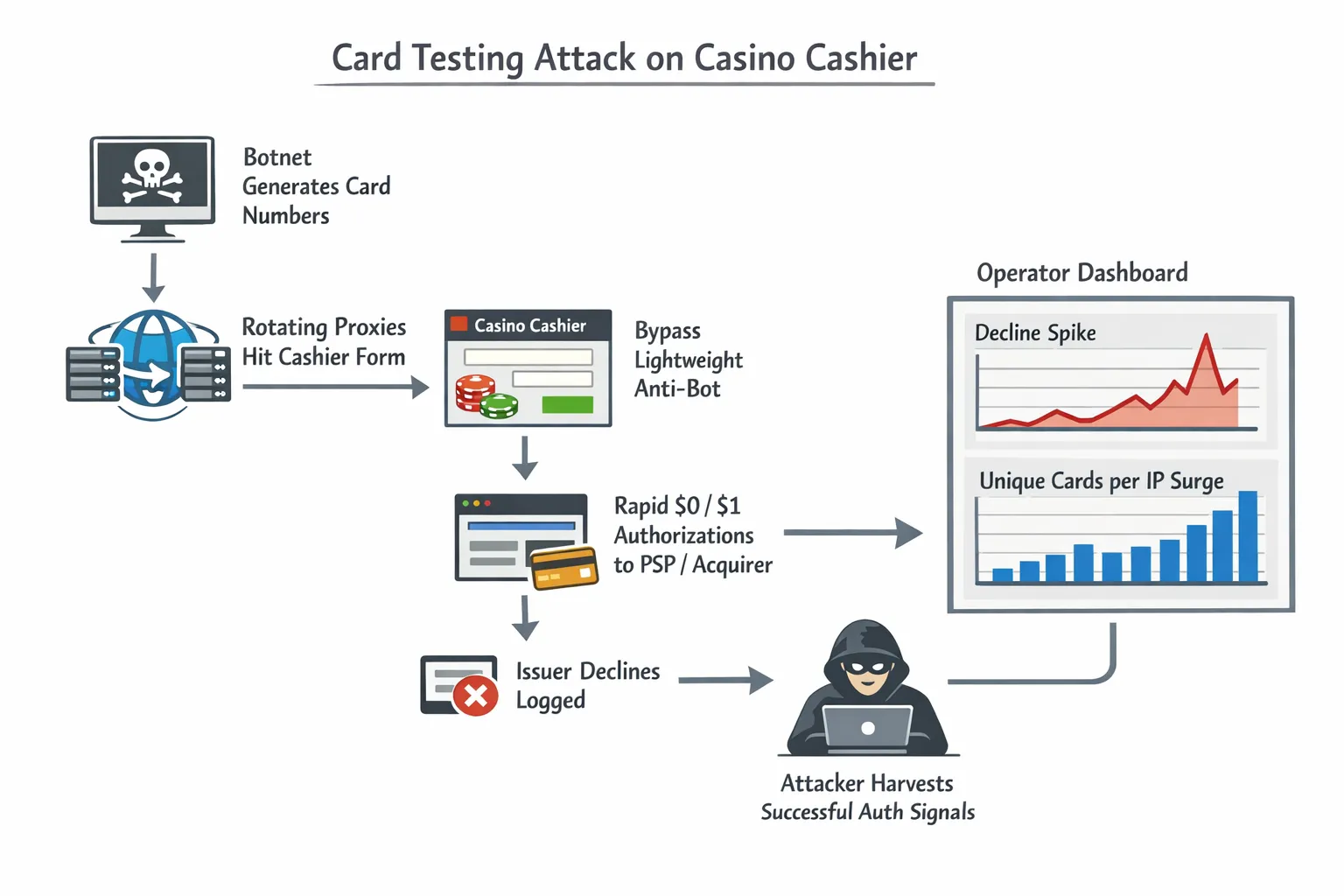
How card testing hits casino cashiers
Attackers typically rotate a few patterns:
- Enumeration at the cashier, where scripts guess PAN, expiry, and CVC by probing your error messages and authorizations until a combination passes validation.
- Micro‑deposit verification, where $0 or small value authorizations are used to check card status, often timed for off‑hours when monitoring is thin.
- Tokenization abuse, where vaulted payment methods are created via headless browsers if you expose a direct tokenization endpoint without strict anti‑automation.
Casinos are attractive targets because traffic spikes mask velocity, many brands allow low minimum deposits, and some PSP setups optimize for approval rate rather than risk on day one. All of that creates room for high‑throughput testing.
Early warning signals to watch
You do not need a full fraud platform to spot a test wave. A handful of ratios and distribution shifts will give you a 10 to 30 minute head start.
| Signal to monitor | Why it matters | What a test wave looks like | Immediate action |
|---|---|---|---|
| Decline rate on card authorizations | Tests create heavy decline volumes | Sudden step‑up in declines concentrated in first‑time deposit attempts | Switch suspicious cohorts to step‑up 3DS, raise min deposit temporarily |
| Unique card fingerprints per IP or device in 10 minutes | Card testers rotate cards faster than humans | 5 to 20 unique last‑4 per IP or device rapidly | Throttle per IP and device, challenge with bot defense |
| CVV mismatch and invalid PAN code mix | Enumeration tends to fail CVV first | Error code distribution tilts to “invalid CVC” and “invalid number” | Mask failure reasons to players, enforce retry cool‑downs |
| Average deposit amount and variance for new users | Testers choose round, small values | Narrow band of amounts just above your minimum | Raise minimum for untrusted segments, disable $0 validations |
| Datacenter ASN and proxy usage | Botnets lean on known ASNs | Spike from known hosting ASNs and new geos | Block or step‑up ASNs, geo‑throttle out‑of‑market traffic |
Instrument these from your payment event stream and PSP webhooks. If you run a modern real‑time stack, pipe the signals into a dashboard with alerting. If not, a scheduled SQL over the last 15 minutes and a Slack alert is a good start.
For an example of moving from descriptive dashboards to live risk signals, see Spinlab’s article on real‑time analytics in iGaming: Real-Time Analytics in iGaming: Turning Live Data into Bigger Profits.
The 60‑minute containment plan
When a spike begins, the goal is to slow throughput, raise attacker costs, and preserve your MID reputation while minimizing collateral friction for real players.
- Flip on universal 3DS for suspicious cohorts. Use rules such as new accounts under 24 hours, unverified email or phone, datacenter IPs, or devices with low trust scores. EMV 3‑D Secure documentation is available at EMVCo.
- Raise minimum card deposit for untrusted segments. Attackers target the cheapest authorizations. A modest floor increase for high‑risk cohorts cuts their ROI immediately. Keep normal floors for trusted players.
- Enforce per‑device and per‑IP velocity caps. Token bucket limits like 3 attempts per 10 minutes with exponential backoff are effective. Return generic “Try again later” messaging with a link to alternative rails.
- Turn on invisible bot checks at the cashier. Cloudflare Turnstile or similar challenges block most headless browsers without adding friction to humans. Implementation guidance for casinos is here: Cloudflare Turnstile for Casinos: Bot Protection Without CAPTCHA Rage.
- Mask granular decline reasons. Avoid telling attackers whether PAN, expiry or CVV was wrong. Show a single generic error and route specifics to logs only.
- Notify your PSP or acquirer risk team. Share a short incident snapshot with time ranges, IPs, and error distribution. They can help mitigate fees and avoid network scrutiny.
- Promote alternative rails in‑flow. Suggest open banking, Apple Pay or tokenized wallets that are harder to abuse and have near zero chargeback risk on A2A. See: 7 Ways Open Banking Will Transform Casino Deposits and Accepting Apple Pay in Curacao-Licensed Casinos: Technical Checklist.
A layered, casino‑ready defense architecture
Think in three layers that start before the form, continue through submission, and end at the PSP decision. Each layer should be able to stop an attack on its own, with minimal overlap.
1) Pre‑form gating
- Invisible bot screening. Use a non‑interactive challenge on registration, login, and cashier load to keep automation out before it touches payment inputs.
- Device and network fingerprinting. Collect stable device IDs, TLS and JA3 fingerprints, and basic IP intelligence. Block or step‑up datacenter ASNs, anonymizers, and known bad IPs.
- Account hygiene. Require verified email or phone before first card attempt. Progressive friction works well, for example, verification only if a risk score is high.
- Geo and license alignment. Deny or step‑up traffic from outside your licensed footprint to avoid attackers hiding in low‑risk geos.
2) In‑form safeguards
- Error message hardening. Always show a generic failure. Never reveal which field failed. This is a core control in the OWASP Automated Threats guidance.
- Client telemetry. Log dwell time, typing cadence, paste rates, and field focus patterns. Bots fill fields instantly and paste CVVs from lists.
- Honeypot fields and token traps. Add hidden fields or decoy endpoints that legitimate users do not touch. Block any session that fills the honeypot.
- Minimum amounts and risk‑based floors. Set a higher minimum deposit for untrusted sessions, then ratchet down after the first successful deposit.
- BIN routing and allowlists. Consider blocking high‑risk prepaid BINs on day one, or route them to strict 3DS policies.
3) Gateway and issuer‑side controls
- Adaptive 3DS. Step up based on a composite risk score, not a blanket rule. Issuers reward consistent step‑up on high‑risk patterns with fewer soft declines.
- Network tokenization first. Promote Apple Pay or Google Pay. Tokenized credentials are harder to collect and rotate.
- Disable $0 verifications for card‑on‑file until trust is established. $0 auths are cheap for attackers. Use a single $1 auth with immediate reversal for untrusted cohorts if your PSP supports it, then enable $0 only for returning, trusted players.
- Velocity at the edge. Enforce per‑card, per‑BIN, per‑IP, and per‑device attempt limits at your edge as well as via PSP rules. Do not rely solely on the PSP side.
- Generic mapping of decline codes. Normalize PSP decline codes into a small set of internal reasons so your rules trigger consistently across providers.
For EU operators, expect stronger SCA enforcement under PSD3 and the PSR. Our explainer has a hands‑on roadmap: PSD3 and PSR Explained for iGaming Payments.
Signals that drive a practical risk score
A simple additive score is enough to route most sessions:
- New account age under 24 hours
- Unverified email or phone
- IP in a hosting ASN or known anonymizer
- Device first seen in the last hour
- Five or more unique card attempts on one device
- Deposit amount equals the minimum
- Error code trail contains invalid PAN or CVV mismatches
- Repeated declines across multiple BINs
Route low scores to frictionless flows and high scores to 3DS challenge, open banking, or a cool‑down. Always backtest to ensure you are not over‑challenging legitimate players.
PSP configuration that closes the biggest holes
You can shut down most testing waves with disciplined PSP settings and form UX.
- Use hosted fields or tokenization from your PSP to keep PAN out of PCI scope and gain access to network‑level risk checks. See PCI DSS for iGaming: A Plain-English Compliance Guide for 2025.
- Enforce CVV on every card attempt and decline missing CVV outright. Never store or replay CVV.
- Turn on BIN‑level and card‑level velocity rules at the PSP, in addition to your own limits.
- Require 3DS challenge for first deposit on risky segments. If challenge rates get too high, consider steering those users to open banking.
- Configure generic decline messaging templates. Do not leak issuer codes to the front end.
- Reconciliation and idempotency. Make all cashier posts idempotent, and guard PSP retry logic to avoid accidental duplicates that look like testing.
The Payment Card Industry standards are maintained at the PCI Security Standards Council. You can consult the source documents here: PCI Security Standards.
UI and copy choices that reduce abuse
- Remove “try a smaller amount” hints. Attackers adopt your smallest recommended amount immediately.
- Show trusted alternatives inline. Bring “Pay by Bank” or Apple Pay above the fold for high‑risk sessions.
- Keep error copy gentle and generic. Specific wording trains attackers.
- Use a clean, fast cashier so legitimate players complete in seconds. Slow UIs increase abandonments and give attackers more time to blend in. If you are tuning for speed, start here: Cashier Conversion Hacks: Optimizing Deposit Forms for 3-Second Checkout.
Run attack drills in staging
You will only know if your defenses work when you simulate abuse. In your sandbox:
- Use PSP test cards to run high‑velocity declines and confirm rate limits and 3DS routing trigger correctly.
- Verify that error masking works and that honeypot events block sessions.
- Replay webhooks at speed to ensure idempotency.
If you need a blueprint, follow this guide: Creating a Sandbox Environment for PSP Test Cards and Crypto Faucets.
A sample rule set you can copy today
- Per device and IP: maximum 3 card attempts in 10 minutes, then 30 minute cool‑down
- Per account under 24 hours old: enforce 3DS challenge and a higher minimum deposit
- Per BIN: if decline ratio exceeds baseline by a fixed threshold in 15 minutes, require 3DS challenge or temporarily throttle that BIN
- Per session: block on any honeypot field submission or hidden endpoint touch
- Per country outside your licensed markets: disable card rail and route to open banking where permitted
- Network tokens: prefer Apple Pay or Google Pay for mobile sessions by default
- Error policy: always generic failure copy to user, detailed mapping to logs only
Review and tune weekly. Attach KPIs so product, risk, and payments teams can see trade‑offs in real time.
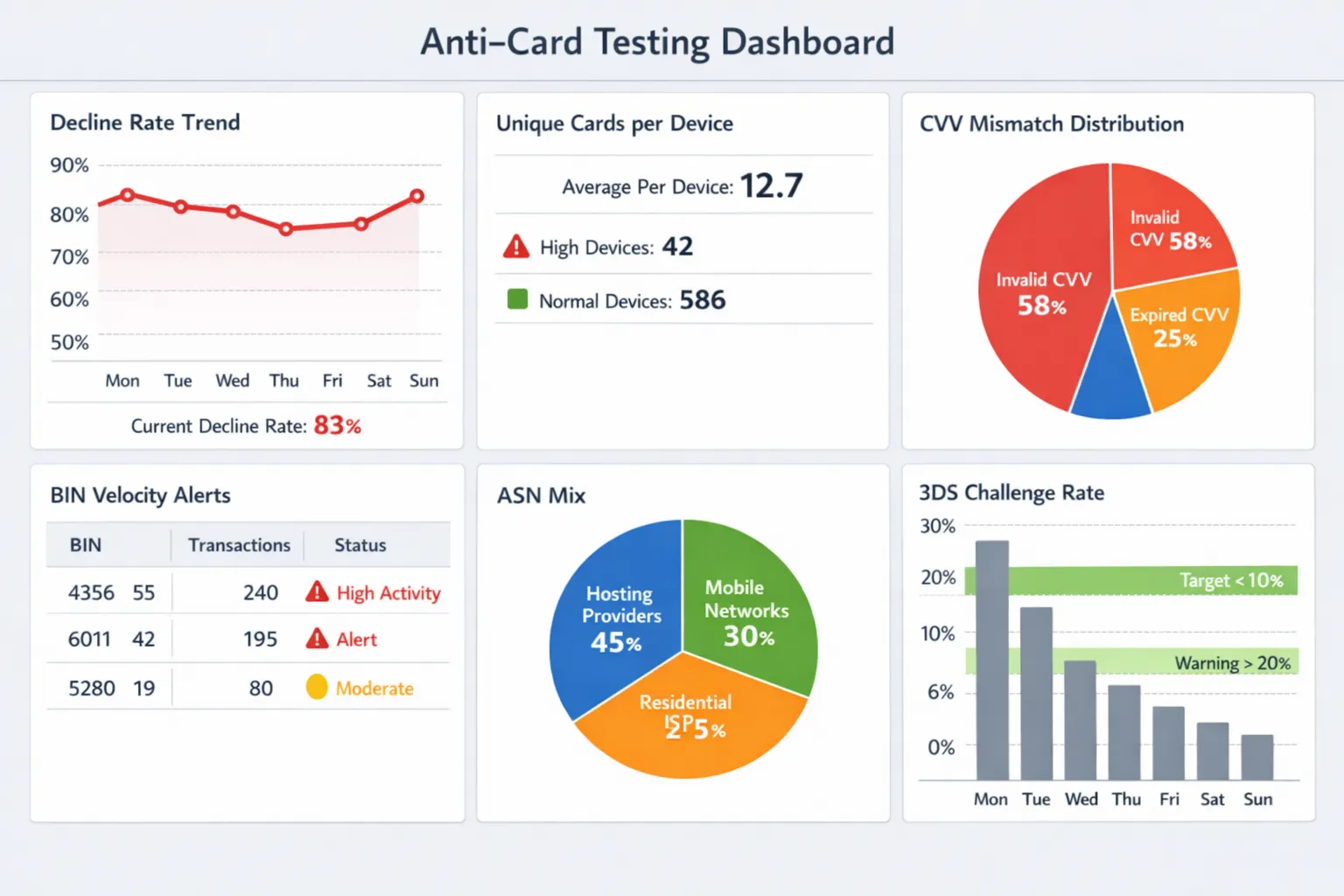
KPIs that prove your controls work
- Decline rate trend compared to pre‑defense baseline
- Unique cards per IP or device distribution
- CVV mismatch share of total declines
- 3DS challenge rate and completion rate by segment
- Successful first‑deposit rate for legitimate traffic segments
- Fees per 1,000 auth attempts and acquirer risk notifications
You want sharp reductions in abuse indicators with stable or improving first‑deposit rates among known good segments.
Compliance notes
- Document your card testing controls and incident response. Regulators and acquirers expect evidence of layered defenses and timely mitigation.
- Keep detailed audit logs for KYC, AML, and payment attempts. Attackers often pivot to bonus abuse and account takeovers when the cashier is hardened. Related reading: 10 Common KYC & AML Mistakes New Casino Operators Make—and How to Fix Them.
14‑day rollout plan
Week 1, hardening and instrumentation
- Add invisible bot screening to registration, login, and cashier load
- Implement device fingerprinting and IP intelligence collection
- Normalize PSP decline codes into an internal schema
- Add minimum deposit logic by risk tier and mask all error reasons
- Wire alerts for the five early warning signals listed above
Week 2, adaptive policies and drills
- Ship adaptive 3DS routing and BIN‑level throttles
- Enforce per‑device and per‑IP velocity with exponential backoff
- Add honeypot fields and decoy endpoints to the cashier
- Promote open banking and tokenized wallets for risky segments
- Run a full sandbox drill and a small canary in production during off‑peak hours, then review metrics
For safe production rollouts of payment code, use staged releases with real‑time rollbacks: Canary Releases in iGaming: Rolling Out New Wallet Code Safely.
Frequently Asked Questions
Will forcing 3DS on all card deposits stop card testing? It will slow most attacks but can also depress conversion for legitimate players. A risk‑based step‑up policy that targets suspicious cohorts is usually the best balance.
Should we block prepaid and gift card BINs entirely? Blocking high‑risk BINs is effective during attacks, but blanket bans can hurt real users in some markets. Consider routing those BINs to 3DS or alternative rails rather than a permanent block.
Are alternative rails really safer? Open banking A2A payments have no chargebacks and are hard to automate at scale. Tokenized wallets like Apple Pay are also resilient because attackers cannot mint valid tokens easily.
Is it worth raising the minimum deposit site‑wide? Broad increases can hurt conversion and ARPPU. A targeted higher floor for untrusted sessions is usually enough to crush attacker ROI without punishing good players.
What about $0 authorizations to verify cards? $0 auths are cheap for attackers to spam. Prefer a reversible micro‑auth for untrusted users and reserve $0 auth for known, returning players.
Which standards or references should we follow? For web threat models, refer to the OWASP Automated Threats project. For payment authentication, see EMVCo 3‑D Secure. For card data handling, follow PCI DSS requirements from the PCI Security Standards Council.
Ready to harden your cashier without sacrificing conversion? Spinlab’s modular iGaming platform combines a hybrid cashier for cards, open banking, and crypto with real‑time analytics and advanced fraud prevention. Our team can help you ship the layered defenses in this guide quickly, then tune them against live traffic.
Book a no‑pressure walkthrough to see how Spinlab can protect your cashier and grow approvals at the same time: Request a demo.