

Affiliate traffic can make an online casino look scalable very quickly. It can also expose every weak point in the platform: unclear attribution, slow deposits, bonus abuse, partner disputes, weak reporting, and manual payout work that becomes impossible to manage once campaigns start moving volume.
That is why choosing casino software for affiliate-first growth is different from choosing software for a brand that plans to grow mainly through paid ads, organic search, or a closed player community. Affiliates create a distributed acquisition network. Your platform has to measure that network accurately, convert traffic efficiently, and protect margin before commission payments go out.
The right casino software is not simply the system with the largest game catalog or the best-looking lobby. For an affiliate-led online casino, the right platform connects tracking, payments, bonus logic, fraud prevention, compliance, analytics, and backoffice workflows into one operating loop.
Affiliate-first growth changes the software brief
Affiliate-first does not mean launching an online casino and adding an affiliate module later. It means your acquisition model should influence the platform decision from day one.
In practical terms, your casino software needs to answer questions that a standard product demo may not cover. Which partner sent the player? Which campaign, landing page, promo code, and device started the journey? Did the player pass KYC? Did they deposit with fiat or crypto? Did bonus cost erase the margin? Is the commission event valid, or is there a fraud signal that should hold the payout?
If those answers live in separate spreadsheets, support tickets, payment dashboards, and affiliate reports, the business becomes difficult to scale. Worse, disputes with partners can become a recurring operational cost.
For a deeper look at how partner tracking, commission rules, and payout operations work together, Spinlab has a dedicated guide on how affiliate systems help online casinos grow. This article focuses on the software selection side: what to evaluate before you choose a casino software provider.
Start with the affiliate model you plan to run
Before comparing vendors, define how your affiliate program will actually make money. The same casino platform may perform well for one model and create problems for another.
For example, a CPA-heavy program needs tight qualification rules because you pay partners upfront for a defined action, often a first-time deposit or verified depositing player. A revenue-share model needs accurate net gaming revenue calculations, transparent deductions, and reliable player-level reporting over time. A hybrid model needs both.
Here is a simple way to translate your commercial model into software requirements.
| Affiliate model | What the casino software must support | Main risk if it does not |
|---|---|---|
| CPA | Clear qualifying events, hold periods, fraud checks, and deposit validation | Paying for low-quality, duplicate, or bonus-driven players |
| Revenue share | Accurate player revenue, bonus cost, refunds, chargebacks, and commission history | Partner disputes over net gaming revenue calculations |
| Hybrid | Combined CPA and revenue-share logic with configurable rules by partner or market | Manual reconciliation and inconsistent payout treatment |
| Sub-affiliate | Multi-level partner hierarchy and clean attribution across referral chains | Unclear ownership of traffic and commission leakage |
| Promo code or influencer | Code-based attribution, campaign mapping, and account-level tracking | Players convert without being linked to the right partner |
Net gaming revenue, often shortened to NGR, is especially important in affiliate programs. If the platform cannot show how gross gaming revenue, bonuses, fees, refunds, and other deductions affect commissionable revenue, both operators and affiliates will lose trust in the numbers.
If you are still mapping your wider product requirements, compare your affiliate needs against the broader must-have features in casino platform software so you do not over-focus on acquisition and under-build the core operation.
Evaluate attribution beyond the first click
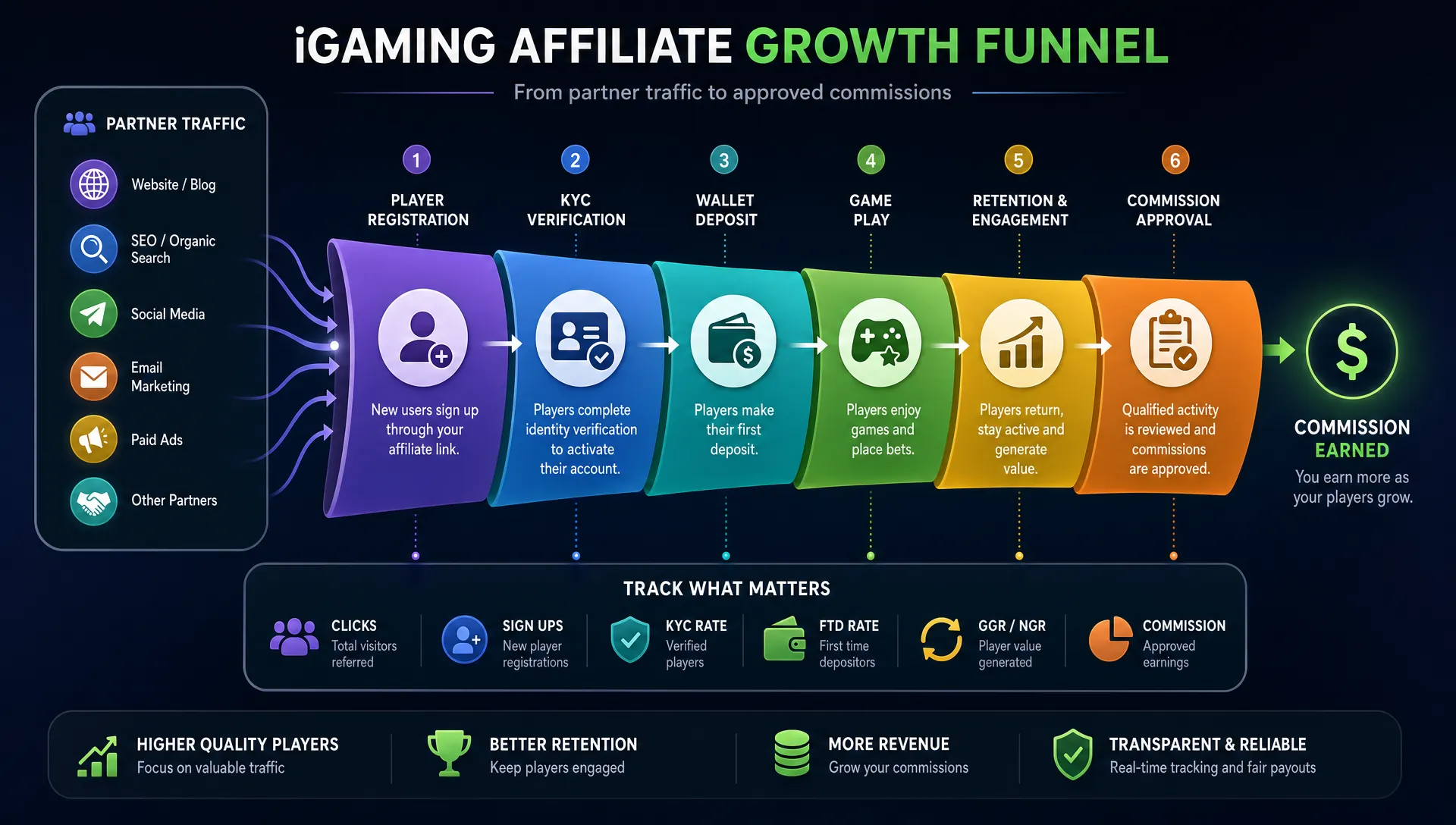
Affiliate-first growth depends on attribution that survives the real player journey. A player may click from a comparison page, return later through a branded search, use a promo code on mobile, complete KYC after registration, and deposit with a different payment method the next day.
Basic click tracking is not enough. When choosing casino software, look for the ability to connect source data with the full player lifecycle: visit, registration, verification, deposit, gameplay, retention, and commission event.
Strong attribution usually includes a mix of campaign IDs, UTM parameters, referral links, promo codes, postbacks, account-level tracking, and backoffice reporting. The exact setup will depend on your markets and partners, but the key requirement is consistency. If the affiliate report says one thing, the payment system says another, and the player database says something else, your team will spend too much time reconciling data.
Privacy and consent also matter. If you operate in markets subject to GDPR or similar privacy frameworks, tracking should align with lawful processing, data minimization, and user rights. The European Commission provides a useful overview of EU data protection rules, but operators should always get jurisdiction-specific legal guidance.
Make bonus and commission rules work together
Many affiliate losses come from treating bonus logic and commission logic as separate systems. Affiliates drive players toward offers. If those offers are poorly controlled, you may acquire signups while losing money on bonus abuse, low-value deposits, or traffic that never becomes durable revenue.
A platform built for affiliate-first growth should let operators connect acquisition source, bonus eligibility, wagering requirements, player status, geography, and commission rules. It should also make it easy for the backoffice team to see whether a partner is generating real value or simply triggering short-term incentives.
This is especially important when different affiliates promote different angles. Some may focus on slot games, some on live casino games, some on crypto deposits, and some on no-friction signups. Each traffic source can behave differently. Your casino software should make those patterns visible rather than forcing every partner into the same reporting view.
The best setup is not necessarily the most complex one. It is the one your commercial, compliance, finance, and support teams can operate without creating shadow spreadsheets.
Put fraud prevention before payout operations
Affiliate fraud is not always obvious at registration. It can appear as multi-accounting, self-referrals, fake leads, duplicate KYC attempts, coordinated bonus abuse, payment fraud, chargeback patterns, VPN-heavy traffic, or a sudden wave of players who meet the minimum CPA trigger and never return.
This is why fraud controls need to sit before the first affiliate payout, not after the finance team notices strange results. Casino software should help you review partner quality before money leaves the business.
Useful controls can include risk scoring, duplicate detection, suspicious device or payment patterns, KYC and AML checks, bonus abuse monitoring, and payout holds for traffic that needs manual review. Not every operator needs the same setup, but every affiliate-first operator needs a clear policy for when a commission is approved, held, adjusted, or rejected.
For a practical fraud-focused workflow, the guide on detecting affiliate fraud before your first payout is a strong companion to use when building your internal controls.
Treat payments as part of affiliate conversion
For affiliate-led casinos, payments are not just a finance feature. They directly affect conversion, player trust, campaign economics, and partner satisfaction.
A high-intent player who arrives from an affiliate review may still abandon if the payment gateway does not support their preferred method, currency, or deposit flow. The same is true for crypto audiences. If your acquisition strategy includes crypto-native players, your software should support crypto-ready payment flows, wallet accuracy, onramp options, and clear transaction visibility.
Multi-currency support is also important for global affiliate campaigns. Partners often specialize in specific regions, languages, or payment behaviors. If your platform cannot support the right fiat and crypto rails for those markets, your affiliate program may look strong on clicks and weak on first-time deposits.
Crypto-focused operators should also understand how virtual asset rules apply in their target jurisdictions. The Financial Action Task Force publishes guidance on virtual assets and virtual asset service providers, but implementation varies by market. Casino software should make compliance workflows easier, not push every sensitive decision into manual operations.
Check game aggregation through an affiliate lens
Game aggregation matters for more than catalog size. Affiliates sell reasons to click. That could be a live casino experience, a slot campaign, a crypto casino angle, a tournament, a bonus offer, or a page targeting new releases.
If your partners build content around new Pragmatic slots, new Hacksaw slots, live casino games, or niche game categories, delayed game availability can reduce conversion. A strong game aggregator should help you launch relevant content quickly, organize the lobby in a way that supports campaigns, and keep the player journey consistent across desktop and mobile.
Ask how the platform handles provider integrations, game availability by jurisdiction, mobile performance, game search, categories, and reporting by game or provider. You do not need every game in the market. You need the right games for the audience your affiliates can actually acquire.
Casino original games can also be useful when the brand needs differentiation, especially in competitive crypto or streamer-driven markets. If this is part of your plan, verify whether the software provider can support custom game design, integration, and reporting without weakening the core platform operation.
Require analytics that operators can act on daily
An affiliate-first online gambling platform should give operators fast answers to operational questions. Which partners are sending depositing players? Which campaigns are creating bonus-heavy cohorts? Which geos have strong registrations but weak KYC completion? Which payment methods convert best for each source? Which partners are profitable after bonus cost and withdrawals?
A real-time analytics dashboard can be valuable, but only if the underlying data is trusted. Look for reporting that connects acquisition, player behavior, payments, risk, and revenue. If your team has to export five reports to understand whether a partner is profitable, the platform is slowing down decisions.
Backoffice usability is just as important. Affiliate-first growth creates frequent operational changes: new campaigns, new promo rules, new partner tiers, fraud reviews, payout approvals, compliance checks, and support escalations. A customizable backoffice admin panel can reduce dependency on developers and help non-technical teams move faster.
This is where the Shopify-like experience matters in casino software. Founders and operators need enough control to manage the business without waiting weeks for every adjustment, while still maintaining governance around payments, compliance, and risk.
Use a weighted scorecard before vendor demos
Vendor demos can be persuasive, but affiliate-first growth needs a structured evaluation. A weighted scorecard keeps the conversation focused on the parts of the platform that directly affect acquisition quality and margin.
Use the table below as a starting point, then adjust the weights based on your market, licensing context, and growth model.
| Evaluation area | Suggested weight | What good looks like |
|---|---|---|
| Attribution and affiliate reporting | 20% | Player lifecycle tracking from click or code through deposit, gameplay, and commission event |
| Fraud, KYC, and AML controls | 20% | Risk checks before payouts, clear review workflows, and compliance-ready player verification |
| Payments, wallets, and currencies | 15% | Fiat and crypto support, multi-currency handling, reliable deposits and withdrawals, and transaction visibility |
| Bonus and commission flexibility | 15% | Configurable rules by partner, campaign, market, player status, and performance quality |
| Analytics and backoffice usability | 15% | Real-time operational reporting and admin tools that commercial teams can use daily |
| Game aggregation and mobile experience | 10% | Campaign-relevant games, mobile-optimized play, provider coverage, and content availability controls |
| APIs and integration readiness | 5% | Open API access for external tools, data workflows, and future platform extensions |
The exact weights are less important than the discipline of scoring each vendor against the same operating model. If a platform scores high on game catalog but low on attribution, fraud controls, and payments, it may not be the right turnkey casino solution for affiliate-first growth.
Ask these questions before choosing a casino software provider
A good vendor conversation should go beyond screenshots. Ask questions that reveal how the platform behaves under real affiliate volume.
- Can the platform attribute a player from referral link or promo code through registration, KYC, deposit, gameplay, and commission event?
- Can commission rules be configured for CPA, revenue share, hybrid, and partner-specific agreements?
- How are bonus costs, refunds, chargebacks, and adjustments reflected in affiliate reporting?
- What fraud signals can be reviewed before an affiliate payout is approved?
- Does the platform support both crypto and fiat payments, plus the currencies required for target markets?
- How quickly can new games, providers, or campaign-relevant categories be launched?
- Can non-technical operators manage promotions, affiliates, payments, and reporting from the backoffice?
- What data is available through dashboards, exports, webhooks, or open API integrations?
- How does the platform support KYC, AML, responsible gambling, and market-specific compliance requirements?
If a vendor cannot answer these clearly, the risk is not only technical. It is commercial. Affiliate growth amplifies small operational weaknesses into expensive problems.
Watch for red flags
Some casino software looks attractive during launch planning but becomes restrictive once affiliates start delivering traffic. Be especially cautious when the platform treats affiliate operations as an add-on rather than a core growth system.
| Red flag | Why it hurts affiliate-first growth |
|---|---|
| Affiliate data only available through manual exports | Teams cannot react quickly to campaign quality, fraud, or payout disputes |
| No clear link between player revenue and commission logic | Partners and operators argue over payout calculations |
| Limited fraud review before payout | CPA campaigns become vulnerable to fake or low-quality traffic |
| Weak payment method coverage | Good affiliate traffic fails to convert into deposits |
| Bonus rules cannot be controlled by partner or campaign | Promotional spend becomes difficult to manage profitably |
| Backoffice requires developer help for routine changes | Campaign launches and operational adjustments slow down |
| Game catalog is large but poorly organized | Affiliates send interested players into a lobby that does not match the promise of the campaign |
The best casino software reduces operational ambiguity. It should make it clear where traffic came from, what players did, how much value they created, and whether a partner should be paid.
Where Spinlab fits for affiliate-first operators
Spinlab offers an all-in-one, modular iGaming platform for building, launching, and scaling online casinos. For affiliate-first teams, the most relevant parts are the affiliate and bonus engine, crypto and fiat payment support, seamless game aggregation, real-time analytics dashboard, advanced fraud prevention, KYC and AML compliance, mobile-optimized casino platform, customizable backoffice admin panel, open API integration, multi-currency support, crypto onramp solutions, custodial wallet support, and the option to create custom casino original games.
That combination matters because affiliate growth is cross-functional. Marketing needs attribution. Finance needs payout accuracy. Compliance needs verification and AML workflows. Product needs games and mobile performance. Operations need a backoffice they can manage quickly. A modular white label casino platform should help those teams work from the same source of truth.
For founders who want a cost-conscious and fast onboarding path, Spinlab is designed to provide a Shopify-like experience for launching and operating a whitelabel casino without forcing every operational change through a custom development queue.
Frequently Asked Questions
What is affiliate-first casino software? Affiliate-first casino software is a platform built to support partner-led acquisition from the start. It connects affiliate tracking, commission rules, payments, bonus logic, fraud controls, KYC, analytics, and backoffice workflows so operators can scale partner traffic profitably.
Is an affiliate module enough for an online casino? Not always. A basic affiliate module may track clicks and registrations, but affiliate-first growth also requires revenue reconciliation, fraud prevention, payout controls, payment visibility, and campaign-level analytics.
Which commission model is best for a new online casino? There is no universal best model. CPA can accelerate acquisition but increases fraud and quality risk. Revenue share aligns long-term incentives but requires trusted NGR reporting. Hybrid models can work well if the platform supports clear and configurable rules.
Why do payments matter for affiliate growth? Affiliates can send high-intent traffic, but players still need a deposit flow that feels familiar and trustworthy. Fiat and crypto payment support, multi-currency handling, fast transaction visibility, and reliable withdrawals can all affect conversion.
How should operators prevent affiliate fraud? Operators should review fraud signals before payouts, not after. Useful controls include KYC checks, duplicate account detection, payment risk monitoring, bonus abuse rules, traffic quality analysis, and payout hold periods for suspicious cohorts.
What should crypto casino startups prioritize when choosing software? Crypto casino startups should prioritize wallet accuracy, crypto onramp options, fiat compatibility, AML workflows, transaction reporting, game aggregation, mobile performance, and affiliate tracking that connects deposits to partner performance.
Build affiliate-first growth on software that can handle it
Affiliate growth rewards speed, but only when the platform can protect attribution, conversion, compliance, and margin. Before choosing casino software, define your affiliate model, score vendors against real operational needs, and test how the platform handles the full journey from partner click to approved payout.
If you want a modular, crypto-ready, white label casino platform built for fast onboarding and affiliate-led scale, explore Spinlab.