

Migrating an online casino is not just a technical project. It is a business continuity decision that touches player balances, deposits, withdrawals, game sessions, bonuses, compliance records, affiliate tracking, and customer trust.
That is why the most important work happens before the migration plan. Before you commit to a new casino platform, you need to prove that it can run your actual operating model, not just look good in a sales demo.
A strong evaluation process answers three questions:
- Will this platform reduce operational friction after migration?
- Can it protect revenue, player funds, and compliance continuity during cutover?
- Will it support the next stage of growth without forcing another rebuild?
This guide gives you a practical framework for evaluating a casino platform before you migrate, with the evidence to request, the red flags to watch for, and the areas that deserve deeper testing.
Start With the Real Reason You Are Migrating
Many migrations begin with a symptom: slow payments, limited game content, poor reporting, weak bonus tools, high platform costs, or a backoffice that forces too much manual work. But symptoms are not enough to choose a better platform.
Before evaluating vendors, document the business outcome you expect from the migration. For example, your goal might be to launch in additional markets, support crypto and fiat payments in one cashier, reduce manual compliance checks, add more slot games and live casino games, improve mobile conversion, or give your team cleaner operational controls.
This step matters because a platform that is excellent for a startup casino may not fit a multi-brand operator. A platform that is strong for fiat-only markets may be weaker for crypto-heavy audiences. A platform with a broad game aggregator may still fail your needs if provider availability, certification, or wallet integration does not match your target jurisdictions.
A simple pre-evaluation brief should include:
- Current pain points that triggered the migration
- Target markets and licensing requirements
- Payment methods, currencies, and crypto assets required
- Game providers and content categories that must be supported
- Player account, wallet, bonus, affiliate, and reporting data that must move
- Required launch timeline and acceptable downtime window
- Internal team capacity for migration, QA, and post-launch operations
Once this is clear, you can evaluate the platform against your future operating model instead of comparing generic feature lists.
Build a Casino Platform Evaluation Scorecard
A scorecard keeps the process objective. Without one, teams often overvalue polished demos and undervalue hard operational details such as reconciliation, audit logs, dispute handling, rollback planning, and data portability.
Use a scoring model that separates must-have capabilities from nice-to-have features. A missing must-have should block the migration decision unless there is a credible, tested workaround.
| Evaluation area | What to verify | Evidence to request |
|---|---|---|
| Wallet and ledger | Balance accuracy, bonus funds, locked funds, transaction history, reconciliation | Sample ledger exports, reconciliation workflow, test migration results |
| Payments | Fiat, crypto, onramp, withdrawal flows, PSP routing, failed payment handling | Cashier demo, sandbox transactions, settlement reports |
| Compliance | KYC, AML, responsible gambling, audit trails, data retention | Workflow demo, permissions model, audit log examples |
| Game aggregation | Provider coverage, game launch flow, session handling, jackpots, live casino support | Provider list, sample integrations, test game sessions |
| Backoffice | Player management, bonuses, affiliates, fraud review, reporting | Role-based demo using real operator scenarios |
| Performance | Mobile speed, peak load handling, deployment process, uptime monitoring | Load test results, architecture overview, observability demo |
| APIs and integrations | Open API quality, webhooks, CRM, BI, affiliate, payment, and compliance integrations | API documentation, sandbox access, sample payloads |
| Support | Incident response, SLAs, escalation paths, maintenance windows | SLA document, incident process, support coverage details |
| Commercial model | Setup, subscription, revenue share, provider fees, custom work, support | Full cost breakdown and assumptions |
The best vendors can show how the platform behaves under real conditions. If a provider can only speak in broad claims, treat that as a signal to test deeper.
Evaluate Architecture for Scale, Not Just Launch
A migration should not only solve today’s problems. It should remove the constraints that made the current platform difficult to grow.
Start by asking how the platform handles traffic spikes, game launches, payment peaks, and large reporting queries. A casino can look stable during normal activity but struggle during tournaments, bonus campaigns, sports event traffic, streamer-driven spikes, or major provider releases.
You do not need every architectural detail, but you do need enough confidence to understand how the system behaves when the business is under pressure. Ask about deployment practices, rollback procedures, uptime monitoring, incident communication, data backups, and separation between player-facing systems and admin workflows.
APIs are also critical. A modern iGaming platform should not trap your team inside a closed system. If you use external CRM, BI, fraud tools, affiliate systems, payment providers, or custom front-end components, the platform’s API and webhook model should be tested before migration. Documentation alone is not enough. Request sandbox access and have your technical team run real use cases.
If growth is a primary migration driver, it is worth comparing your requirements against a broader framework for choosing a casino platform for fast growth, then narrowing your evaluation to the parts that directly affect your migration risk.
Audit Wallet, Ledger, and Payment Capabilities First
The wallet is the most sensitive part of a casino migration. If balances, bonuses, locked funds, pending withdrawals, or transaction histories are mishandled, the issue becomes operational, financial, and reputational at the same time.
Evaluate the wallet before you evaluate cosmetic features. The platform should support clear ledger logic, transaction traceability, and reconciliation workflows that your finance team can understand. Every balance-changing event should be auditable, including deposits, withdrawals, bonus credits, bonus conversions, manual adjustments, refunds, chargebacks, crypto deposits, and failed payment reversals.
For payment gateway evaluation, test both the happy path and the messy path. Deposits are only part of the story. Withdrawals, pending states, failed KYC, abandoned payments, duplicate callbacks, PSP outages, crypto confirmation delays, and settlement mismatches are where operational quality becomes visible.
If you need a crypto-ready solution, verify more than the ability to accept crypto. Ask how the platform handles multi-currency accounting, exchange-rate display, crypto onramp flows, deposit confirmations, withdrawal approvals, merchant wallets, transaction monitoring, and AML review. Crypto support should be integrated into the same operational controls as fiat payments, not bolted on as a separate process.
Useful test scenarios include:
- A player deposits in fiat, receives a bonus, wagers partially, and withdraws remaining cash funds
- A player deposits crypto, the network confirmation is delayed, and the support team needs to trace the transaction
- A withdrawal is approved, rejected, retried, and reconciled against the ledger
- A bonus is canceled after partial wagering and the wallet must calculate the correct remaining balance
- A payment provider sends duplicate or delayed callbacks and the platform must prevent double-crediting
A platform that performs well in these scenarios is more likely to survive the realities of migration and day-to-day operation.
Verify Game Aggregation and Content Continuity
Game aggregation is often treated as a content question: which slot games, live casino games, and studios are available? That matters, but migration creates a second question: how smoothly can existing player journeys continue on the new platform?
If your current casino has popular games, favorites, recently played lists, tournaments, jackpots, or provider-specific promotions, you need to know what can be preserved and what must be rebuilt. Game IDs, provider configurations, jurisdictional restrictions, RTP variants, bonus contribution rules, and free spin logic can vary between integrations.
A strong game aggregator should make it easy to add and manage content, but your evaluation should include operational details. Can your team enable or disable games by market? Can you segment content by currency, jurisdiction, or player group? How are broken game launches detected? What happens if a provider has downtime? How are game rounds, unfinished sessions, and disputed results investigated?
This is especially important if your growth strategy depends on frequent new content releases. Whether you are promoting new Pragmatic slots, new Hacksaw slots, casino original games, or live dealer tables, your platform needs a clean process for adding, testing, publishing, and monitoring content without creating support chaos.
Test Compliance, Security, and Data Ownership
Compliance cannot be evaluated as a checkbox. For real-money casinos, it affects onboarding, deposits, withdrawals, responsible gambling, reporting, player disputes, and regulator communication.
At minimum, review how the platform supports KYC, AML workflows, audit logs, player risk flags, document review, responsible gambling controls, self-exclusion, session limits, deposit limits, and role-based access. The exact requirements depend on your operating markets, but the platform should give your team clear controls and traceable records.
The Financial Action Task Force recommendations remain an important global reference point for AML and counter-terrorist financing controls. Your legal and compliance advisors should translate applicable obligations into platform requirements before you migrate.
Security review should include admin permissions, two-factor authentication, access logs, API authentication, encryption practices, vulnerability management, backup and restore procedures, and incident response processes. Do not only ask whether the platform is secure. Ask how security events are detected, escalated, documented, and resolved.
Data ownership is another key point. You should know what data you can export, in what format, how often, and under what conditions. Player records, transaction history, KYC status, bonus history, affiliate attribution, game activity, and communication preferences may all be needed for operations, reporting, or a future migration.
Evaluate the Backoffice Like an Operator, Not a Buyer
A casino platform may look impressive during a guided demo, but the true test is whether your team can run the business efficiently after migration.
Ask the vendor to demonstrate real operator workflows rather than feature menus. For example, have them show how a support agent investigates a missing deposit, how a fraud analyst reviews suspicious activity, how a marketing manager launches a bonus campaign, how an affiliate manager checks partner performance, and how a finance user reconciles daily payment activity.
The backoffice should reduce manual work, not move it into spreadsheets. Strong operational usability usually includes searchable player profiles, clear wallet history, permission-based controls, bonus configuration, affiliate tracking, payment review queues, fraud indicators, and real-time analytics that show what is happening across the business.
This is where a modular iGaming platform can be valuable. You want enough flexibility to support your operating model, but not so much complexity that every change requires development work. If your team is lean, pay special attention to how many workflows can be handled by non-technical users.
For a deeper look at operational usability, the article on what makes a casino platform easy to run is a useful companion to this evaluation process.
Run a Proof Process Before You Sign
A serious platform evaluation should include proof, not just promises. The goal is not to complete a full migration during vendor selection. The goal is to test enough of the risky areas to know whether the migration is realistic.
A useful proof process might include a sandbox environment, sample player data import, wallet transaction testing, payment gateway testing, game launch testing, backoffice workflow testing, API integration review, and a mock cutover discussion. If the vendor supports it, include a small performance test or at least review prior load testing methodology.
The proof process should involve the people who will operate the platform after launch. Product, payments, compliance, support, finance, affiliate, marketing, and engineering teams will each see different risks. A platform that satisfies only the executive buyer may still frustrate the teams responsible for daily operations.
| Red flag | Healthier signal |
|---|---|
| Vendor avoids sandbox testing | Vendor provides sandbox access and guided test scenarios |
| Demo focuses only on front-end design | Demo includes wallet, payments, compliance, and backoffice workflows |
| Migration answer is “we handle everything” | Vendor explains responsibilities, dependencies, risks, and timelines |
| No clear rollback discussion | Vendor can describe rollback options and cutover decision points |
| API documentation is incomplete | API docs, sample payloads, and technical support are available |
| Costs are vague beyond setup | Vendor explains recurring, usage-based, and third-party costs |
The more business-critical the migration, the more evidence you should require.
Review Support and SLAs Before You Need Them
Support quality becomes most visible when something breaks. Unfortunately, that is the worst time to discover that escalation paths are unclear or that the SLA excludes the systems you care about most.
Evaluate support as part of the platform, not as an afterthought. Ask how incidents are classified, who can escalate them, what response and resolution targets apply, and whether payment, wallet, game provider, and infrastructure incidents are covered differently. Also ask how maintenance is scheduled and communicated, especially if you operate across multiple time zones.
A good support review should include examples of incident communication, post-incident reporting, and responsibilities when the issue involves a third party such as a payment provider or game studio. If a vendor cannot explain how support works during a high-severity incident, that uncertainty should affect your score.
You can go deeper using this guide to evaluating casino platform support and SLAs before making a final vendor decision.
Compare Total Cost, Not Just Migration Cost
Setup fees are only one part of the commercial picture. A cheaper migration can become expensive if the platform creates high operational overhead, limits payment options, charges heavily for integrations, or requires custom development for routine changes.
Build a three-year cost view that includes platform fees, revenue share, game aggregation fees, payment processing costs, crypto onramp costs, support tiers, hosting or infrastructure charges, compliance integrations, data migration services, custom development, and internal staffing needs.
Also consider opportunity cost. If your current platform slows down market launches, provider integrations, payment expansion, or campaign execution, staying put may be more expensive than migrating. On the other hand, migrating to a platform that does not fit your operating model can create a second migration sooner than expected.
The right comparison is not “which platform has the lowest setup fee?” It is “which platform gives us the best operating leverage at the lowest acceptable risk?”
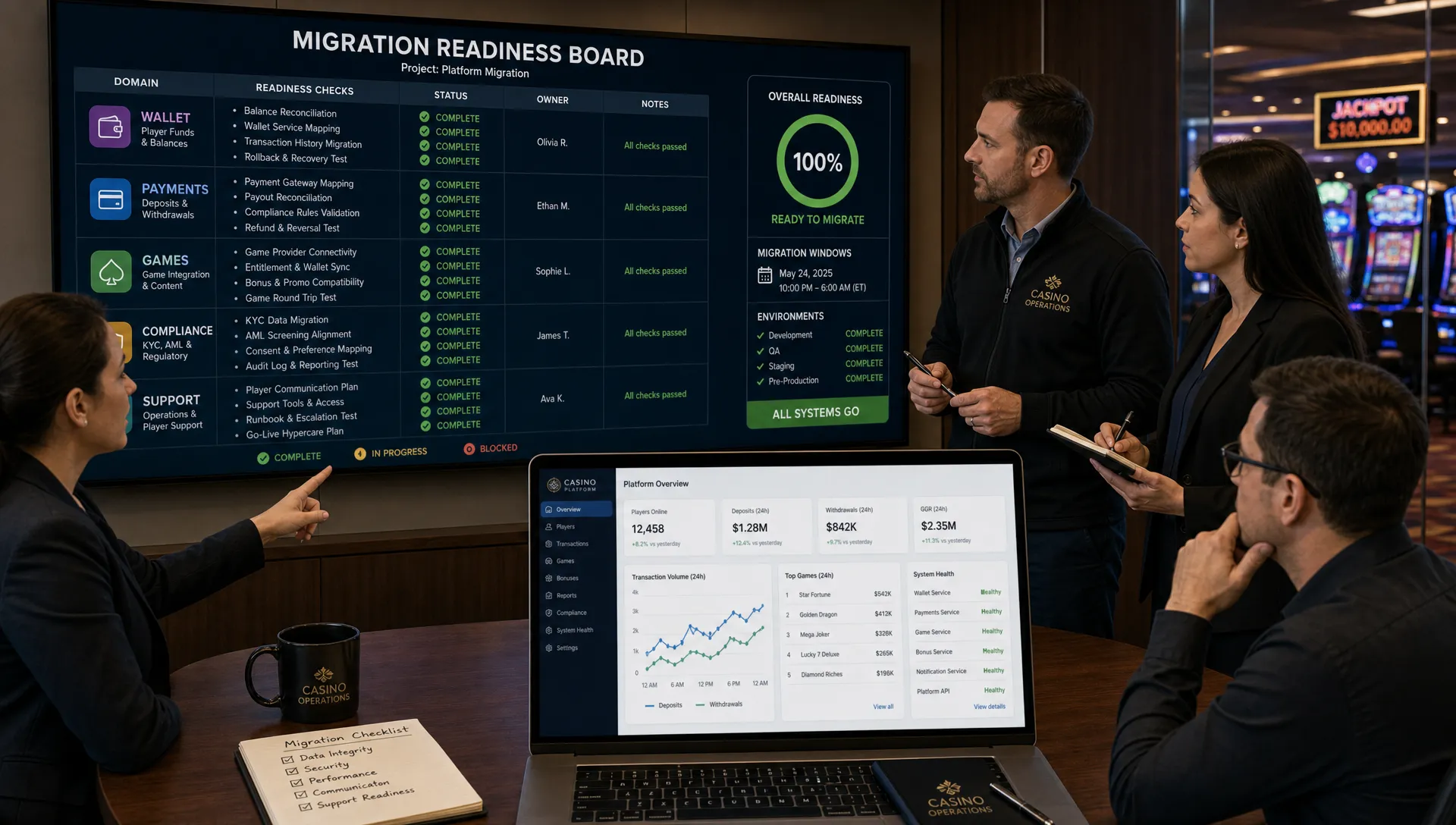
Ask Migration Readiness Questions Before Planning Cutover
Once a casino platform passes product, technical, compliance, support, and commercial evaluation, then it is time to study migration execution in detail. But even before that stage, you should ask readiness questions that expose whether the vendor has handled real migration complexity.
Important questions include:
- What data must be mapped before import?
- How are player balances validated before and after cutover?
- What happens to pending withdrawals, open bets, active bonuses, and incomplete KYC reviews?
- Can the platform support a phased rollout, market-by-market migration, or limited player cohort test?
- What is the expected freeze window for wallet-changing activity?
- What rollback options exist if reconciliation fails?
- Who signs off on go-live from the operator and vendor side?
The answers will help you decide whether the platform is truly migration-ready. When you reach detailed planning, use a dedicated casino platform migration checklist for growing brands to structure the execution phase.
A Simple Decision Framework
After evaluation, avoid making the decision based on a single overall impression. Score each platform by category and assign risk levels. A vendor might have excellent games and pricing but weak ledger controls. Another might have strong compliance and payments but require more front-end work. The right choice depends on which trade-offs your business can safely accept.
A practical final review can use four categories:
| Category | Decision question |
|---|---|
| Strategic fit | Does the platform support our growth model, markets, currencies, and content strategy? |
| Operational fit | Can our team run payments, bonuses, compliance, support, fraud, and reporting efficiently? |
| Migration risk | Can player data, wallet balances, games, payments, and compliance records move safely? |
| Commercial fit | Does the total cost make sense once setup, revenue share, integrations, support, and operations are included? |
If a platform scores well in three categories but fails migration risk, do not proceed until that risk is resolved. Migration risk is not theoretical. It becomes player tickets, delayed withdrawals, reconciliation gaps, compliance exposure, and lost confidence.
Frequently Asked Questions
How long should a casino platform evaluation take before migration? The timeline depends on platform complexity, number of integrations, target markets, and internal approvals. A serious evaluation usually needs enough time for stakeholder demos, technical review, sandbox testing, commercial review, and migration readiness discussions.
What is the biggest risk when migrating an online casino? Wallet and ledger accuracy is usually the highest-risk area because it affects player balances, withdrawals, bonuses, finance reconciliation, and trust. Payments, KYC status, open bets, and active promotions are also high-risk migration areas.
Should we choose a turnkey casino solution or a modular platform? A turnkey casino solution can reduce launch complexity, while a modular platform may offer more flexibility for brands with specific payment, game, compliance, or integration needs. The better choice depends on your team size, target markets, and growth plan.
How do we evaluate a crypto-ready casino platform? Look beyond accepting crypto deposits. Evaluate crypto onramp support, wallet controls, transaction monitoring, AML workflows, exchange-rate handling, confirmations, withdrawal approvals, reconciliation, and how crypto activity appears in player and finance records.
Do we need to migrate every player at once? Not always. Some operators prefer a phased migration, market-by-market rollout, or limited cohort test when the business model allows it. The best approach depends on licensing, data complexity, platform architecture, and player communication requirements.
Choose a Platform That Makes Migration Worth It
A migration should leave your casino easier to operate, easier to scale, and safer to manage. If the new platform only replicates your current limitations in a different interface, the project is not worth the risk.
Spinlab offers an all-in-one, modular iGaming platform for operators building, launching, and scaling online casinos. The platform brings together crypto and fiat payment support, game aggregation, real-time analytics, fraud prevention, KYC and AML workflows, mobile optimization, affiliate and bonus tools, a customizable backoffice, open API integration, multi-currency support, crypto onramp capabilities, merchant custodial wallets, and custom casino original games.
If you are evaluating a whitelabel casino platform before migration, Spinlab is built for teams that want a flexible, performance-focused, crypto-ready solution with a more streamlined, Shopify-like operating experience.