

Launching an online casino with fiat and crypto from day one is not just a payment decision. It affects licensing, wallet architecture, KYC, AML monitoring, bonus rules, game availability, withdrawals, support workflows, and the way finance reconciles every transaction.
The upside is significant. Fiat payments give mainstream players familiar options such as cards, bank transfers, and local methods. Crypto payments can reduce cross-border friction, support faster settlement, and attract players who already prefer digital assets. When both are built into the operating model from the start, you avoid the expensive rebuild that happens when crypto is bolted on after launch.
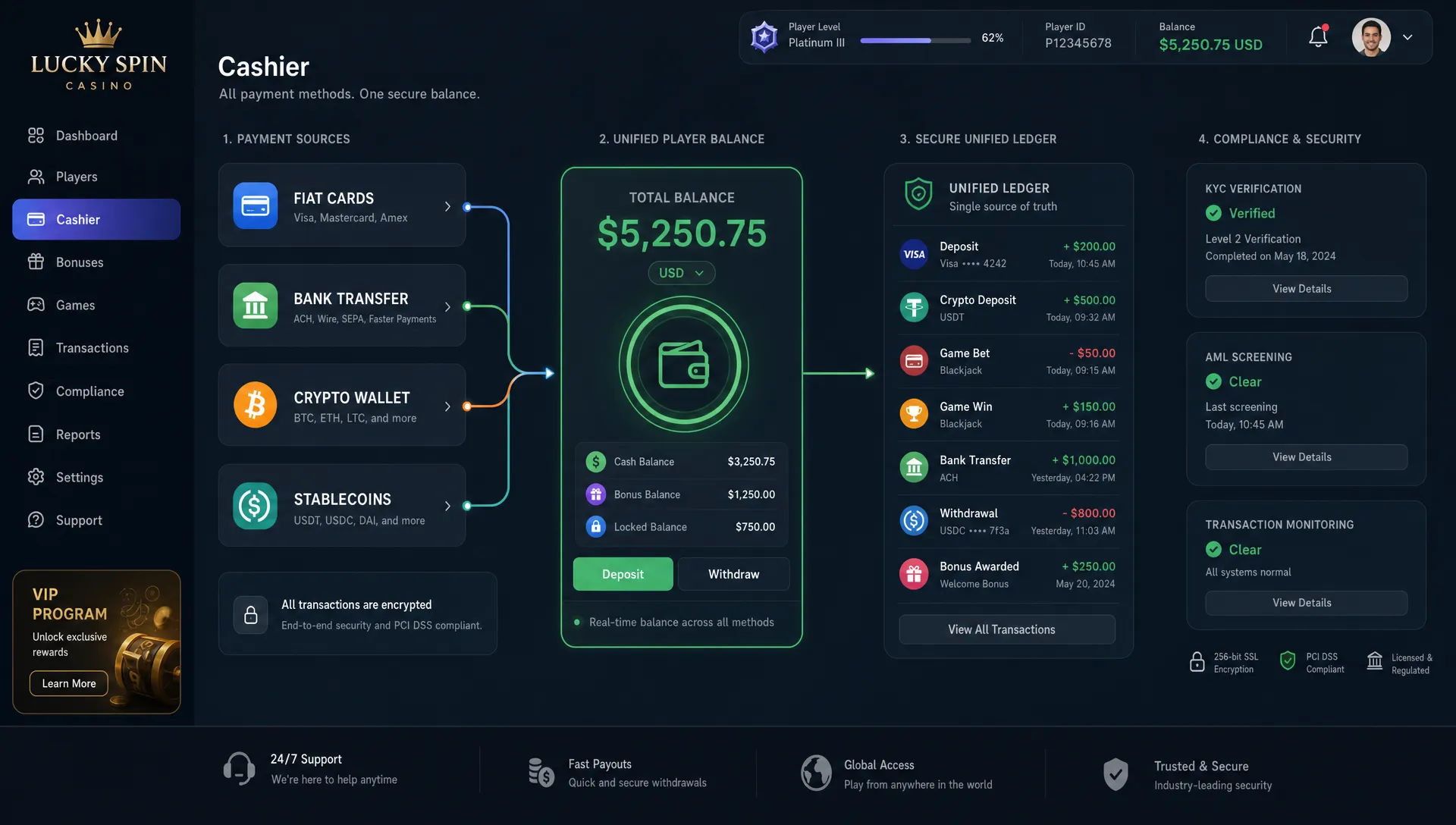
The goal is simple: one casino brand, one player account, one risk framework, and a cashier that can handle both fiat and crypto without confusing the player or the operations team.
Start with the operating model, not the payment logo
Before choosing an iGaming platform or payment gateway, define how money will move through the business. Many founders begin by asking which coins they should accept. A better first question is: what payment experience should the player have, and what obligations does that create for the operator?
A day-one hybrid casino usually has one of three models.
| Model | Best fit | Key operational requirement |
|---|---|---|
| Fiat-first with crypto deposits | Mainstream online casino brands adding digital assets | Strong PSP setup plus crypto deposit monitoring |
| Crypto-first with fiat onramp | Web3-native brands that still want card or bank-funded users | Onramp partner, wallet controls, and clear asset conversion rules |
| True hybrid cashier | Operators targeting multiple markets and player preferences | Unified ledger, multi-currency accounting, KYC, AML, and fraud workflows |
For most new operators, the true hybrid cashier is the strongest long-term foundation. It lets the brand test player demand without splitting the business into two separate casinos. A player may deposit with card, top up with stablecoins later, and withdraw through an approved method based on risk rules and market policy.
If you are still deciding whether both rails are necessary, Spinlab has a deeper comparison of fiat vs crypto casino payments that can help clarify the tradeoffs.
Decide your jurisdictions and compliance scope early
Payment strategy depends heavily on where you plan to operate. A method that works in one market may be unavailable, restricted, or commercially impractical in another. Crypto can add another layer of complexity because regulators may treat digital assets differently from traditional payment instruments.
At minimum, you need clarity on four areas before launch:
- Target markets: The countries or regions where you will actively acquire players.
- Licensing path: The license, sublicense, or B2B setup that supports your operating model.
- Allowed payment methods: The fiat rails, crypto assets, and onramp flows permitted under your compliance framework.
- Player verification rules: The KYC, sanctions screening, AML checks, affordability triggers, and withdrawal controls required for your markets.
Global standards are moving toward tighter monitoring of digital asset flows. The Financial Action Task Force expects virtual asset businesses and related operators to apply risk-based controls, including customer due diligence and transaction monitoring where applicable. In gambling, that expectation sits alongside gaming-specific AML, responsible gambling, and player protection requirements.
The practical lesson is that compliance cannot be added after growth begins. If fiat and crypto are both available on day one, your policies need to explain how deposits, conversions, bonuses, withdrawals, chargebacks, suspicious activity, and account closures work across both rails.
Build one cashier and one source of truth
The biggest mistake hybrid casino founders make is treating fiat and crypto as two separate products. That usually creates messy balances, inconsistent bonus eligibility, manual reconciliation, and support tickets that finance cannot resolve quickly.
A stronger architecture uses a single player wallet experience with a ledger behind it. The player may see balances in a preferred display currency, but the backoffice tracks every movement with precision: deposit method, original currency, exchange rate if relevant, bonus impact, wager activity, withdrawal request, risk status, and settlement result.
For fiat, your payment gateway setup may include cards, bank transfer, e-wallets, vouchers, or local payment methods depending on your geography and provider approvals. If you process card payments, your payment partners and technical setup should account for PCI DSS obligations. The PCI Security Standards Council maintains the standards used across the card payments ecosystem.
For crypto, the core choices are different. You need to decide whether to support direct wallet deposits, a crypto onramp, stablecoin-first payments, volatile assets such as BTC or ETH, or a mix. You also need policies for confirmations, failed deposits, underpayments, overpayments, refunds, chain support, and withdrawal review.
This is where wallet design matters. A hybrid online gambling platform needs clean separation between player balances, operator funds, bonus funds, pending withdrawals, and treasury reserves. If you want a deeper operational breakdown, review Spinlab's guide to casino wallet setup for crypto and fiat operations.
Make crypto easy without making risk invisible
A crypto-ready solution should not force every player to understand seed phrases, gas fees, or exchange mechanics. For many casino brands, the best user experience is to offer crypto as a funding method while keeping gameplay simple.
A crypto onramp can help bridge that gap. Instead of requiring the player to arrive with assets already in a wallet, an onramp can let eligible users buy crypto through supported payment methods and fund their casino account through a controlled flow. This can reduce friction for mainstream players who are curious about crypto but not fully native to it.
The tradeoff is that onramps introduce partner dependencies. You need to evaluate supported countries, accepted payment methods, asset coverage, KYC requirements, transaction limits, approval rates, settlement timing, fees, and how failed transactions are handled. The onramp also needs to fit your compliance and ledger model, not sit outside it as a black box.
For operators evaluating this path, Spinlab's crypto onramp setup guide for casinos explains the integration and risk questions in more depth.
Choose a platform that can operate both rails from day one
A payment strategy is only as strong as the platform underneath it. If your casino software provider supports fiat but treats crypto as an external plugin, you may face limitations when you try to scale. If it supports crypto but lacks strong backoffice controls, game aggregation, bonus logic, and reporting, you may struggle to run a real-money casino professionally.
A launch-ready white label casino platform should support the full operating stack:
- Payments: Fiat payment gateway integrations, crypto payments, multi-currency support, and onramp compatibility.
- Compliance: KYC, AML workflows, fraud prevention, audit trails, and configurable risk controls.
- Games: Slot games, live casino games, original games, and aggregation across approved suppliers.
- Operations: Backoffice admin tools, real-time analytics, bonus management, affiliate tracking, and customer support workflows.
- Technical scale: Mobile optimization, open API integration, security controls, and a modular architecture.
Spinlab is designed around this all-in-one model. Its modular iGaming platform supports fiat and crypto payment operations, game aggregation, real-time analytics, fraud prevention, KYC and AML workflows, a customizable backoffice, affiliate and bonus tooling, crypto onramp support, merchant custodial wallets, and custom-designed casino original games. The product is also built to feel closer to a Shopify-like setup experience than a traditional enterprise software implementation.
That matters for speed. A first-time founder does not need a platform that requires months of custom engineering before the first test deposit. They need a turnkey casino solution that can launch quickly, then scale without forcing a rebuild.
Create a day-one launch sequence
A hybrid launch should follow gates. Each gate proves that the next part of the casino can operate safely. Skipping straight to marketing before payments and withdrawals are tested is one of the fastest ways to damage trust.
| Launch gate | What must be ready | Why it matters |
|---|---|---|
| Market and license scope | Target geographies, legal review, allowed payment methods | Prevents launching with unsupported traffic or risky payment flows |
| Platform configuration | Player accounts, wallet rules, currencies, admin roles | Creates the foundation for deposits, games, bonuses, and reporting |
| Fiat payment testing | Deposit success, failed payments, refunds, chargeback process | Confirms mainstream payment reliability before paid acquisition |
| Crypto payment testing | Address generation, confirmations, onramp flow, withdrawal review | Reduces errors around irreversible transactions |
| Compliance testing | KYC triggers, sanctions checks, AML alerts, responsible gambling controls | Ensures risky accounts are handled consistently |
| Game and bonus testing | Provider access, bet settlement, bonus wagering, excluded games | Prevents balance disputes and bonus abuse |
| Soft launch | Limited traffic, real player journeys, support monitoring | Finds operational issues before full marketing spend |
A good soft launch should include fiat depositors, crypto depositors, bonus users, mobile users, first-time KYC cases, withdrawal requests, and edge cases such as failed deposits or mismatched payment names. The goal is not just to confirm that the happy path works. It is to prove that your team can identify and resolve exceptions.
Plan the player experience around trust
Players do not care how complicated the backend is. They care whether deposits are clear, balances are accurate, games load quickly, bonuses are understandable, and withdrawals feel fair.
For fiat users, trust often comes from familiar logos, predictable payment steps, transparent fees, and clear withdrawal timelines. For crypto users, trust comes from supported networks, visible confirmation status, accurate address handling, stablecoin options, and clear rules on conversion or volatility.
Your cashier should answer the player's main questions before support needs to intervene:
- Which payment methods are available in my country?
- What are the minimum and maximum deposit amounts?
- Are there fees or exchange rate effects?
- How long will my deposit or withdrawal take?
- Do I need to verify my identity before withdrawing?
- Can I use a bonus with this deposit method?
The same clarity should apply to games. If you offer slots, live casino games, and casino original games, make sure bonus eligibility, restricted play, and provider-specific rules are visible. Hybrid payments can attract players, but transparent gameplay and withdrawals keep them.
Reconcile every day, especially after launch
In the first weeks after launch, reconciliation should be a daily discipline. You are proving that payment provider reports, blockchain transactions, platform ledger entries, bonus balances, game settlements, and bank or wallet balances match.
For fiat, reconcile approved deposits, declined payments, refunds, chargebacks, settlement batches, and PSP fees. For crypto, reconcile transaction hashes, confirmations, asset amounts, network fees, exchange rates if used, internal ledger credits, and withdrawal approvals.
Real-time analytics can help operators spot issues faster, but finance still needs a formal close process. If a player balance is wrong, the cause should be traceable. If a withdrawal is delayed, support should know whether the issue is KYC, risk review, provider settlement, chain congestion, or treasury approval.
This is also where fraud prevention becomes practical rather than theoretical. Watch for repeated failed deposits, bonus abuse patterns, multi-accounting, suspicious wallet links, mismatched identity data, unusual withdrawal behavior, and rapid deposit-wager-withdraw cycles. The earlier these rules are tuned, the less manual cleanup you will need later.
Common mistakes to avoid
The most common failure is launching crypto as a marketing feature without operational depth. A homepage badge that says crypto accepted means very little if the cashier, ledger, compliance process, and support team are not ready.
Another mistake is offering too many assets too soon. Supporting every popular coin may sound attractive, but each asset adds network, liquidity, reconciliation, support, and risk complexity. Many operators are better off starting with a focused set of stablecoins and major assets, then expanding based on real demand.
A third mistake is separating fiat and crypto bonus logic. If the bonus engine cannot handle both rails cleanly, players will find loopholes or encounter unfair restrictions. Either outcome hurts the brand.
Finally, do not underestimate withdrawals. Fast deposits create expectations. Slow or confusing withdrawals create complaints. Your withdrawal policy should be clear, compliant, and operationally realistic before the first player deposits.
Frequently Asked Questions
Can you launch an online casino with fiat and crypto at the same time? Yes, if your platform, license scope, payment partners, KYC and AML workflows, wallet setup, and reconciliation process are designed for both rails from the start. The key is to run fiat and crypto through one controlled operating model rather than two disconnected systems.
Do crypto casino payments remove the need for KYC? No. Crypto does not remove compliance obligations. Depending on your license, market, risk profile, and payment flow, you may need customer due diligence, sanctions screening, transaction monitoring, source of funds checks, and withdrawal controls.
Should a new casino accept volatile crypto or stablecoins first? Many operators prefer stablecoins for day-one launch because they reduce balance volatility and make accounting easier. Volatile assets such as BTC or ETH can still be useful, but they require clear conversion, pricing, and treasury rules.
What is the difference between a crypto payment gateway and a crypto onramp? A crypto payment gateway helps accept crypto transactions from users who already hold assets. A crypto onramp helps eligible users buy crypto through supported payment methods, often card or bank-based, before funding the casino flow.
Is a white label casino platform enough to launch? A white label casino platform can accelerate launch, but you still need the right licensing approach, payment approvals, compliance setup, game content, brand strategy, support process, and operational controls. The best platform reduces complexity without replacing operator responsibility.
Launch with a hybrid-ready casino platform
If your goal is to launch a casino with fiat and crypto from day one, build the money system, compliance workflow, games, and backoffice together. That is how you avoid fragmented payments, manual reconciliation, and player trust issues after launch.
Spinlab offers a modular, cost-efficient white label casino platform built for fast onboarding, fiat and crypto payments, game aggregation, compliance workflows, fraud prevention, analytics, and scalable casino operations. If you want a Shopify-like way to build and launch a hybrid online casino, Spinlab is designed to help you move from concept to live operation with fewer moving parts.