

When operators compare fiat vs crypto casino payments, the real question is not which rail is “better.” It is which payment mix fits your market, license, player profile, fraud risk, treasury setup, and launch budget.
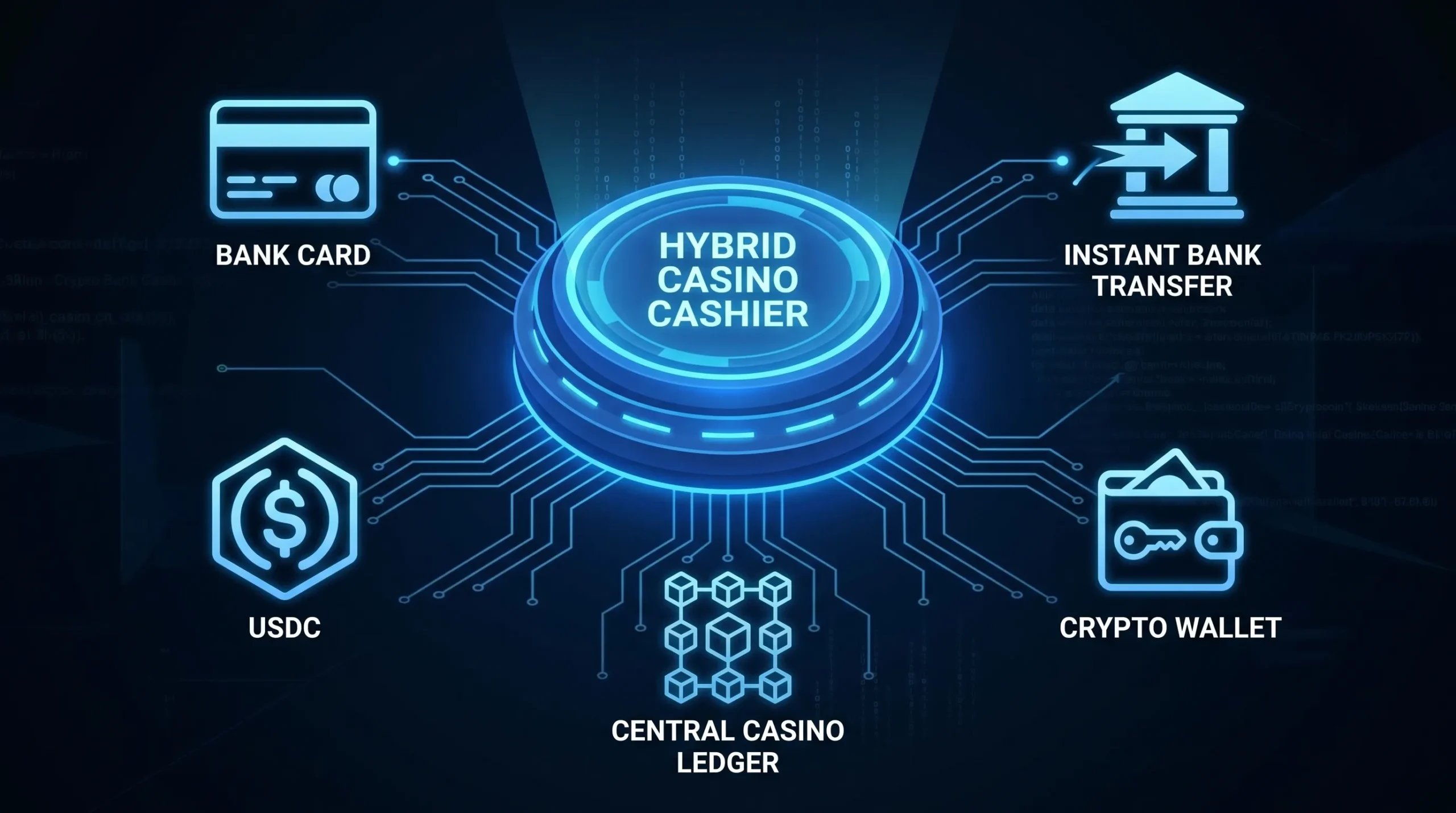
For most online casinos in 2026, the practical answer is a hybrid cashier: fiat for mainstream trust and local conversion, crypto for fast settlement, global reach, stablecoin payouts, and crypto-native player acquisition. The mistake is treating them as two separate products. They should run through one ledger, one risk layer, one compliance workflow, and one player-friendly cashier.
Short answer: offer both if your target jurisdictions, licensing position, and operational controls allow it. Start with the rail your first players already trust, then add the other rail through a controlled, measurable rollout.
What “fiat” and “crypto” payments mean in an online casino
Fiat casino payments include traditional money rails such as cards, bank transfers, instant bank payments, e-wallets, vouchers, and local alternative payment methods. They are usually processed through a payment gateway or PSP, then reconciled to your casino wallet and bank accounts.
Crypto casino payments include direct blockchain deposits, stablecoin deposits, crypto withdrawals, wallet-to-wallet transfers, and fiat-to-crypto onramps inside the cashier. A crypto-ready solution may also include custodial wallets, address management, blockchain monitoring, on-chain risk scoring, and Travel Rule workflows.
The difference is deeper than the currency. Fiat payments are built around banks, card schemes, chargebacks, local consumer expectations, and regulated settlement. Crypto payments are built around wallet ownership, blockchain confirmations, irreversible transfers, network fees, custody controls, and on-chain monitoring.
That is why the right answer depends less on ideology and more on operating model.
Fiat vs crypto casino payments: quick comparison
| Decision factor | Fiat payments tend to win when… | Crypto payments tend to win when… |
|---|---|---|
| Player familiarity | You target mainstream players who expect cards, bank transfers, or local wallets | You target crypto-native users, cross-border players, or stablecoin users |
| Deposit conversion | Local payment rails are trusted and approval rates are strong | Card declines are high or banking access is limited |
| Withdrawal speed | Your PSP supports instant bank or wallet payouts | You can safely automate stablecoin or crypto payouts |
| Fraud profile | You have strong card fraud tools and chargeback controls | You want irreversible settlement and lower chargeback exposure |
| Compliance workload | Your team is ready for PCI, 3DS, SCA, and PSP audits | Your team is ready for KYT, sanctions screening, custody, and Travel Rule controls |
| Treasury complexity | You prefer bank-led settlement and standard accounting flows | You can manage hot, warm, and cold wallet liquidity plus crypto reconciliation |
| Market expansion | Local acquiring and APMs cover your target markets | Traditional rails are fragmented, expensive, or unavailable in your markets |
| Best operating model | Regulated, mainstream, local-market casino | Crypto-first, emerging-market, or global multi-currency casino |
Where fiat casino payments still win
Fiat remains the default for a reason. Most players do not want to think about wallet addresses, network selection, gas fees, seed phrases, or stablecoin types before their first deposit. They want a cashier that feels familiar, fast, and safe.
That expectation is not unique to iGaming. Online buyers have been trained by mainstream e-commerce experiences, whether they are booking travel, buying electronics, or browsing modern home lighting online, to expect a checkout flow that supports the payment method they already use. If your casino cashier feels unfamiliar at the exact moment money is involved, trust drops.
Fiat is stronger for mainstream trust
Cards, bank transfers, and local payment methods carry built-in familiarity. In many markets, a first-time player is more likely to complete a deposit if they see a trusted local rail, a recognizable bank flow, or a one-tap mobile wallet.
This matters most for acquisition campaigns aimed at casual players. If your marketing traffic comes from affiliates, SEO, social media, or broad paid campaigns, a fiat-first cashier can reduce cognitive friction. Players do not need to learn a new payment behavior before trying your product.
Fiat is often better aligned with mature regulation
In heavily regulated markets, fiat rails may also be easier to explain to banks, auditors, and licensing counterparties. Card deposits, pay-by-bank, and local e-wallets come with established KYC, transaction monitoring, dispute, and reporting practices.
That does not mean fiat is simple. Card processing can pull your platform into PCI DSS scope, and markets with strong customer authentication rules may require careful 3DS handling. But the compliance vocabulary is familiar to many regulators and financial partners.
Fiat supports local payment habits
Payment preference is local. A player in one country may trust cards, while another expects instant bank transfer, UPI, PIX-style payments, Interac, SEPA Instant, or a local e-wallet. If you only support crypto, you may exclude high-intent players who are willing to deposit but not willing to change how they pay.
This is why fiat should not mean “cards only.” A modern online casino should treat fiat as a portfolio of local rails, then route players to the option most likely to approve, clear, and reconcile cleanly.
If you are designing that routing layer, Spinlab’s guide to casino payment orchestration covers the core patterns operators use to lift approval rates without increasing fraud.
Where crypto casino payments win
Crypto payments are not just a marketing badge. Used correctly, they can solve specific payment problems that fiat rails struggle with, especially around cross-border access, stablecoin settlement, chargeback exposure, and payout speed.
Crypto can unlock players fiat rails fail to serve
In some markets, card approval rates are weak, banks restrict gambling transactions, local payment coverage is fragmented, or cross-border settlement is slow and expensive. Crypto can give players another route to fund their account, particularly when stablecoins are already used for everyday digital transfers.
A crypto-ready cashier can also support players who hold assets in self-custody and do not want to cash out to a bank before depositing.
Stablecoins reduce volatility concerns
For casino operations, volatile assets introduce accounting and treasury complexity. A player who deposits BTC or ETH may see their asset value move significantly before settlement, refund, or withdrawal. Stablecoins can reduce that problem by keeping balances closer to fiat-denominated accounting.
This is one reason many operators now think of crypto casino payments as stablecoin-first rather than “support every token.” Fewer supported assets can make UX, compliance, liquidity, and reconciliation easier to control.
Crypto reduces chargeback exposure, but does not remove fraud
Crypto transfers are generally irreversible once final. That can reduce classic card chargeback risk and friendly fraud. However, it does not eliminate risk. Crypto casinos still face stolen funds, sanctioned wallets, mixer exposure, bonus abuse, multi-accounting, phishing, and account takeover.
Crypto fraud controls are different. Instead of card-testing rules and chargeback representment, operators need wallet screening, transaction monitoring, withdrawal risk scoring, and strong custody controls.
For a deeper operator-level introduction, see Spinlab’s guide to crypto casino payments for new operators.
The costs operators often underestimate
The cheapest rail on paper is not always the cheapest rail in production. A card processing fee is visible, but chargebacks, reserves, decline recovery, manual reviews, and reconciliation exceptions can quietly reduce margin. Crypto network fees may look low, but custody, KYT tooling, onramp fees, liquidity buffers, and accounting work also matter.
| Cost category | Fiat payment cost considerations | Crypto payment cost considerations |
|---|---|---|
| Processing | PSP fees, acquirer fees, scheme fees, APM fees | Network fees, gateway fees, onramp fees, swap fees |
| Fraud and disputes | Chargebacks, representment, card testing, refunds | Irreversible mistaken transfers, wallet risk reviews, scam proceeds exposure |
| Compliance | PCI, 3DS/SCA, KYC, AML, PSP due diligence | KYC, AML, KYT, sanctions, Travel Rule, custody governance |
| Treasury | Bank settlement delays, rolling reserves, FX costs | Hot wallet liquidity, stablecoin reserves, wallet rebalancing, volatility policy |
| Reconciliation | PSP reports, bank statements, chargeback adjustments | Blockchain confirmations, transaction hashes, address mapping, chain reorg handling |
| Player support | Declines, pending bank transfers, refund questions | Wrong network, missing memo/tag, gas fees, delayed confirmations |
The key is to model total cost of ownership, not just transaction pricing. A rail that improves conversion but creates manual reconciliation work may become expensive as volume grows. A rail that lowers chargebacks but requires complex custody may be worth it only if you have the controls and liquidity to operate it safely.
Compliance and risk: different rails, different controls
A common myth is that crypto payments are less regulated than fiat payments. In practice, regulated operators need strong controls for both.
For fiat, the control stack usually includes KYC, AML monitoring, fraud scoring, 3DS rules where required, payment velocity limits, chargeback evidence, and card data security. Operators also need clean ledgers so every deposit, reversal, payout, bonus credit, and settlement adjustment can be explained.
For crypto, the control stack includes KYC, wallet screening, sanctions checks, source-of-funds review for higher-risk cases, Travel Rule workflows where applicable, custody policy, and blockchain transaction monitoring. The FATF guidance on virtual assets has shaped how many jurisdictions expect businesses to assess and transmit risk information for crypto transfers.
The main lesson is simple: do not add crypto as a shortcut around compliance. Add it as a first-class payment rail with the same level of operational discipline as fiat.
If your team is still separating identity checks from ongoing monitoring, Spinlab’s KYC vs AML in iGaming guide explains how these workflows differ across the player lifecycle.
When should you offer fiat only, crypto first, or both?
Most operators should move toward hybrid payments, but launch sequencing matters. The right first rail depends on your acquisition strategy and regulatory environment.
| Operator scenario | Recommended payment strategy | Why |
|---|---|---|
| Mainstream casino in a mature regulated market | Fiat first, then add crypto only if licensing and banking partners support it | Familiar rails usually convert best, and regulatory review may be more straightforward |
| Emerging-market casino with weak card coverage | Hybrid from day one | Local fiat rails capture mainstream players, while crypto covers gaps in access and settlement |
| Crypto-native casino brand | Crypto first with fiat onramp support | The core audience expects wallet deposits, but onramps help users without existing crypto |
| Affiliate-led startup testing markets | Start with the highest-trust local fiat rails, then add stablecoins after fraud baselines are known | You need clean early data before adding more operational complexity |
| High-value international player base | Hybrid with strong stablecoin payout controls | Fast payouts and multi-currency support can become a retention advantage |
| Lean white label launch | Choose a platform that supports both, even if you enable one at launch | Replatforming later is more expensive than configuring rails gradually |
When fiat-only makes sense
Fiat-only can be the right starting point if your target market is mainstream, your license or banking partners restrict crypto, your team is not ready for custody operations, or your launch depends on trust signals from familiar local payment rails.
The risk is future rigidity. If your platform cannot support crypto later, you may lose flexibility when expanding to new markets or serving players who prefer stablecoins.
When crypto-first makes sense
Crypto-first can work if your brand positioning, acquisition channels, player community, and licensing strategy are built around digital assets. This is common for casinos targeting wallet-native users, stablecoin-heavy regions, or Web3 communities.
The risk is narrowing your audience. If you do not provide a fiat-to-crypto onramp, many interested players may abandon before the first deposit because they do not already hold the right asset.
Why hybrid is usually the strongest long-term model
Hybrid payments give operators the flexibility to localize by market and segment. A new player may deposit by card or bank transfer, a VIP may prefer stablecoin withdrawals, and a crypto-native player may deposit directly from a wallet. The platform should support all of these without creating separate wallets, separate reporting, or separate risk silos.
Spinlab’s guide to crypto onramps vs direct deposits explains how these two crypto paths serve different player types.
How to build a hybrid cashier without operational chaos
The biggest mistake is adding crypto as a plugin beside an existing fiat cashier. That creates fragmented balances, duplicate fraud logic, inconsistent KYC triggers, and painful reconciliation.
A hybrid cashier should be designed around a unified money movement architecture:
- Use one ledger of record: Every deposit, bonus, wager, withdrawal, fee, reversal, and settlement adjustment should post to a single audit-grade ledger.
- Normalize payment intents: Cards, bank transfers, e-wallets, onramps, and crypto deposits should all start as rail-agnostic payment intents with consistent states.
- Separate seen funds from playable funds: Especially for bank transfers and crypto confirmations, your system should distinguish detected transactions from funds that are safe to credit.
- Apply risk-based KYC and AML: Do not force the same friction on every player, but do escalate based on geography, amount, velocity, wallet risk, and behavior.
- Offer smart cashier defaults: Show the most relevant rail by player country, currency, device, deposit history, risk profile, and provider health.
- Make reconciliation a product requirement: Every PSP event, blockchain transaction, bank settlement, and ledger posting needs traceable IDs.
- Measure rail-level performance: Track deposit initiation, completion, approval, time-to-credit, withdrawal time, fraud rate, support tickets, and net margin per rail.
If your ledger is not ready for multi-rail complexity, address that first. Spinlab’s casino ledger design guide explains the audit trail, reversal, and settlement patterns operators need before scaling payments.
UX rules for fiat and crypto cashier design
Payment UX is not only about speed. It is about reducing uncertainty at the point of deposit and withdrawal.
For fiat, make decline recovery clear. If a card fails, offer a relevant alternative instead of a generic error. If bank transfer settlement is pending, show status and expected timing. If 3DS is required, make the handoff mobile-friendly and return the player to the cashier cleanly.
For crypto, prevent avoidable mistakes. Show supported networks clearly, warn players about wrong-chain deposits, convert gas fees to a familiar currency, display confirmation progress, and explain when funds become playable. If a memo, destination tag, or reference is required, make it impossible to miss.
For both, avoid burying fees. Operators sometimes try to hide payment cost in the flow, but surprise fees create distrust and support tickets. A clean cashier shows the amount deposited, fees if any, credited balance, estimated timing, and verification requirements before the player commits.
A practical 30-day rollout plan
| Timeline | Focus | Output |
|---|---|---|
| Days 1-5 | Map markets, player segments, licensing constraints, and existing payment performance | Rail priority list and compliance requirements |
| Days 6-10 | Audit ledger, KYC, AML, fraud, reconciliation, and support workflows | Gap list before adding or changing rails |
| Days 11-15 | Configure fiat rails, crypto rails, limits, routing rules, and cashier copy | Testable hybrid cashier flow |
| Days 16-20 | Run sandbox and staging tests across success, failure, reversal, delayed, and duplicate events | Evidence that balances and states remain correct |
| Days 21-25 | Launch a controlled pilot by market, segment, or deposit limit | Real player data without full operational exposure |
| Days 26-30 | Review KPIs, support tickets, fraud cases, reconciliation exceptions, and conversion | Decision to scale, adjust, or pause specific rails |
This phased approach is especially important for lean teams. You do not need to enable every rail on day one. You need a platform that lets you add rails safely when the business case is clear.
What to look for in an iGaming payment platform
A casino platform should not treat payments as an afterthought. Payments touch onboarding, fraud, bonuses, affiliates, game access, withdrawals, reconciliation, analytics, and compliance.
At minimum, look for support across fiat and crypto rails, multi-currency wallets, payment orchestration, KYC and AML workflows, fraud prevention, real-time analytics, and a backoffice that lets operations teams resolve issues without engineering help.
For crypto specifically, ask about onramps, supported assets and networks, custody model, merchant custodial wallets, wallet screening, Travel Rule readiness, withdrawal policies, and how blockchain events map to the casino ledger.
For fiat, ask about PSP coverage, local payment methods, 3DS controls, chargeback evidence, settlement reporting, retry logic, and reconciliation exports.
Frequently Asked Questions
Should a new online casino offer crypto payments immediately? Not always. If your first market is mainstream and heavily regulated, fiat rails may be the safer launch priority. If your brand targets crypto-native players or markets with weak card coverage, crypto or stablecoins may need to be available from day one.
Are crypto casino payments legal? It depends on your jurisdiction, license, target markets, assets, custody model, and compliance controls. Crypto payments do not remove the need for licensing, KYC, AML, sanctions screening, responsible gambling controls, or audit trails.
Is crypto cheaper than fiat for casinos? Sometimes, but not automatically. Crypto can reduce chargebacks and certain processing costs, but operators still pay for custody, blockchain monitoring, onramps, liquidity management, reconciliation, and compliance tooling.
Which crypto assets should casinos support first? Many operators start with major stablecoins because they reduce volatility and simplify player understanding. The right asset list depends on your markets, liquidity, compliance requirements, and custody setup.
Do fiat payments convert better than crypto payments? For mainstream players, fiat usually has the familiarity advantage. For crypto-native users, direct wallet deposits can convert better because they match existing behavior. A hybrid cashier lets you test conversion by segment instead of guessing.
Can crypto payments reduce chargebacks? Crypto transfers are generally irreversible, so they can reduce traditional card chargebacks. However, they do not eliminate fraud, AML risk, account takeover, or support issues caused by wrong-chain deposits and unclear cashier UX.
Should withdrawals use the same rail as deposits? Not necessarily. Some operators use same-rail withdrawals for simplicity and fraud control, while others offer faster alternatives such as stablecoin payouts for eligible players. The policy should be risk-based, compliant, and clearly explained.
Build a cashier that can support both worlds
Fiat and crypto payments are not enemies. They solve different problems for different players. Fiat builds mainstream trust and local market fit. Crypto adds speed, global reach, stablecoin flexibility, and chargeback-resistant settlement. The strongest operators design one cashier that can support both without fragmenting compliance, ledgers, or operations.
Spinlab Studio provides a modular iGaming platform with crypto and fiat payment support, multi-currency capabilities, crypto onramp solutions, merchant custodial wallets, KYC and AML compliance, advanced fraud prevention, real-time analytics, and a customizable backoffice admin panel. If you want a Shopify-like way to launch and operate a flexible online casino, explore Spinlab’s iGaming platform and see how a hybrid payment stack can fit your market strategy.
BetsVIP, como suena de interesante. Si eres VIP, debes probar este sitio, a lo mejor te da suerte. Visiten betsvip y me dicen que tal es.
Alright gamers, check out milwingameapk.com! Looks like it’s about getting an APK for a milwingame. If that’s your thing, download milwingameapk there.
cx777gamelogin, saved me a ton of hassle with the login. Much appreciated. Peep this cx777gamelogin