

Launching an online casino no longer requires a large engineering department, a custom platform build, and a year of runway. A lean team can get to market quickly if it makes the right strategic tradeoffs: narrow the first version, use a reliable white label casino platform, avoid custom development where it is not essential, and keep compliance, payments, and player operations under tight control.
The key is not to do everything with fewer people. The key is to design an operating model where fewer people can run the right things well.
For a founder, operator, or small iGaming team, that means separating what must be owned internally from what should be handled by your platform, vendors, and specialist partners. Your internal team should focus on brand, market, risk decisions, customer experience, and growth. Your platform should absorb as much technical complexity as possible, including game aggregation, payment gateway integrations, KYC and AML workflows, fraud controls, backoffice tools, analytics, and mobile performance.
Below is a practical framework for launching an online casino with a lean team, without turning your first six months into a hiring race.
What a lean online casino team actually needs
A lean team does not mean one person doing compliance at midnight and customer support in the morning. It means every role has a clear owner, and every operational dependency is either automated, outsourced, or handled inside your iGaming platform.
For most early-stage online casino launches, the lean model revolves around six functions:
| Function | Main responsibility | Can it be outsourced or platform-supported? |
|---|---|---|
| Founder or general manager | Strategy, vendor decisions, budget, market focus | No, this needs internal ownership |
| Compliance and risk lead | Licensing path, KYC, AML, responsible gambling, fraud escalation | Partly, with legal counsel and platform workflows |
| Payments and finance owner | Payment gateway setup, settlements, reconciliation, chargebacks, crypto flow | Partly, with payment providers and platform reporting |
| Casino product and CRM owner | Game lobby, bonuses, campaigns, player lifecycle | Partly, with game aggregation and bonus tools |
| Customer support lead | Player questions, verification issues, disputes, retention signals | Partly, with trained outsourced agents |
| Platform partner | Technical infrastructure, integrations, uptime, admin tools | Yes, if using a turnkey casino solution |
The biggest mistake lean teams make is hiring around complexity they could have avoided. If your platform requires developers for every bonus change, game update, payment setting, or reporting view, you are not running lean. You are just postponing payroll pain.
That is why platform selection is one of the most important operating decisions you will make. If you are still evaluating what should be included, Spinlab's guide to the best casino platform features for lean teams is a useful companion to this article.
Start with the smallest viable casino, not the biggest possible one
A lean launch works best when the first version has a sharp concept. You do not need every market, every payment method, every provider, every bonus type, and every game category on day one. In fact, trying to launch too broadly usually creates more operational risk than revenue.
A focused launch should answer five questions before you configure anything:
- Which jurisdiction, licensing route, and player market are you targeting first?
- What is your core positioning, such as crypto-first, VIP slots, casual casino, live casino, or niche community brand?
- Which payment methods are essential for your first player segment?
- Which game categories will drive the first 80 percent of player engagement?
- What level of support coverage can you realistically provide from day one?
For example, a crypto-ready online casino might prioritize a simple cashier, multi-currency support, fast KYC decisioning, fraud monitoring, and a curated lobby of high-demand slot games and live casino games. A local fiat-first casino might prioritize regional payment gateway integrations, localized responsible gambling flows, and payment reconciliation.
Both models can be lean. Neither should be vague.
Use a white label casino platform to replace technical overhead
A lean team should not spend its first months building wallet logic, integrating game providers one by one, creating reporting dashboards, or maintaining admin panels. Those are platform problems, not brand problems.
A white label casino platform or modular turnkey casino solution gives you the infrastructure to launch faster while keeping your team focused on commercial execution. This is especially important in iGaming, where the product is not just a website. It is a money movement system, compliance workflow, game delivery layer, risk engine, reporting environment, and player experience all working together.
A strong platform should reduce the need for internal specialists across several areas:
| Platform capability | Why it matters for a lean team |
|---|---|
| Game aggregator | Lets you access casino content without managing separate provider integrations manually |
| Crypto and fiat payment support | Reduces the complexity of running separate cashier systems for different player preferences |
| KYC and AML compliance workflows | Helps standardize verification, monitoring, and evidence collection |
| Fraud prevention tools | Supports risk review without requiring a large fraud operations department at launch |
| Customizable backoffice | Lets non-technical operators manage users, games, payments, bonuses, and settings |
| Real-time analytics dashboard | Gives the team fast visibility into deposits, withdrawals, player activity, and campaign performance |
| Mobile-optimized platform | Avoids separate mobile development work for the first launch version |
| Open API integration | Preserves flexibility when you need to connect external tools later |
Spinlab is designed around this kind of lean operating model, with an all-in-one modular iGaming platform that supports crypto and fiat payments, game aggregation, KYC and AML processes, fraud prevention, analytics, affiliate and bonus tools, and a customizable backoffice. Its Shopify-like approach is especially relevant for operators who want to run a casino brand without constantly relying on developers.
If your team has no in-house engineers, this related guide on how to launch a casino brand without a tech team goes deeper into the no-developer operating model.
Treat compliance as a core function, not a launch checkbox
Compliance is one area where lean teams cannot afford to cut corners. Online gambling is highly regulated, and requirements vary by jurisdiction, licensing model, player location, product type, and payment method. Before accepting real-money wagers, operators should work with qualified legal and licensing advisors.
At minimum, your operating model should define how you will handle:
- Player identity verification and age checks
- AML screening and transaction monitoring
- Responsible gambling tools and escalation policies
- Bonus terms and promotional transparency
- Suspicious activity reviews
- Player complaints and dispute records
- Data protection and access controls
The Financial Action Task Force emphasizes a risk-based approach to AML controls, which is especially relevant for gambling operators handling deposits, withdrawals, wallet balances, and potentially crypto transactions. Regulators such as the UK Gambling Commission also publish guidance on AML responsibilities for gambling businesses.
Even if you do not operate under those specific regulators, their frameworks show the direction of travel: online casinos are expected to know their customers, monitor behavior, document decisions, and respond to risk signals.
For a lean team, the solution is not to manually review everything. The solution is to configure clear workflows, use platform-supported KYC and AML tools, define escalation thresholds, and keep an audit trail from the start.
Keep payments simple at launch
Payments are one of the fastest ways to overload a small team. Every new payment method adds setup work, testing, reconciliation, support questions, failed transaction handling, withdrawal review, and risk exposure.
A lean launch should start with the payment methods that matter most to the first market. That may mean fiat card payments and bank transfers. It may mean stablecoin deposits, a crypto onramp, and custodial wallet support. It may mean a mix of both if your brand is built for global or crypto-friendly players.
What matters is not the number of options. What matters is whether your team can reliably manage the full payment lifecycle:
| Payment area | Lean-team question to answer |
|---|---|
| Deposits | Can players fund accounts easily on mobile and desktop? |
| Withdrawals | Who approves withdrawals, and what triggers extra review? |
| Reconciliation | Can finance match payment activity to player balances and provider settlements? |
| Chargebacks and disputes | Who owns investigation, evidence, and response? |
| Crypto flow | How are wallet custody, conversion, onramp, and withdrawal rules handled? |
| Fraud controls | Which behavior patterns trigger limits, holds, or manual review? |
The cashier should be boring in the best possible way. Players should understand it quickly. Support should be able to explain it. Finance should be able to reconcile it. Risk should be able to review it.
If your payment setup requires constant developer involvement, custom scripts, or manual spreadsheets from day one, it will slow the entire business down.
Curate the game lobby instead of launching with everything
Game aggregation gives small teams access to a broad library of slot games, live casino games, table games, and sometimes casino original games. That does not mean every game should be promoted equally at launch.
A lean casino lobby should be curated around player intent. New players need fast discovery, familiar categories, clear mobile navigation, and a reason to come back. A smaller, well-organized lobby usually performs better than a crowded one that feels generic.
For launch, focus on a balanced lobby structure:
| Lobby area | Purpose |
|---|---|
| Featured games | Highlight your strongest first-session experiences |
| New releases | Showcase fresh content, including new slot drops when available |
| Popular slots | Help players find familiar, high-engagement games quickly |
| Live casino | Serve players looking for dealer-led, social, real-time play |
| Originals or exclusive games | Differentiate the brand if custom casino original games are part of the strategy |
| Promotions-linked games | Connect bonuses to specific player actions without confusing terms |
This is where the product and CRM owner matters. The job is not just to turn on games. It is to shape the first player journey, test what gets clicks, watch retention by category, and remove friction from the lobby.
Build the launch in parallel workstreams
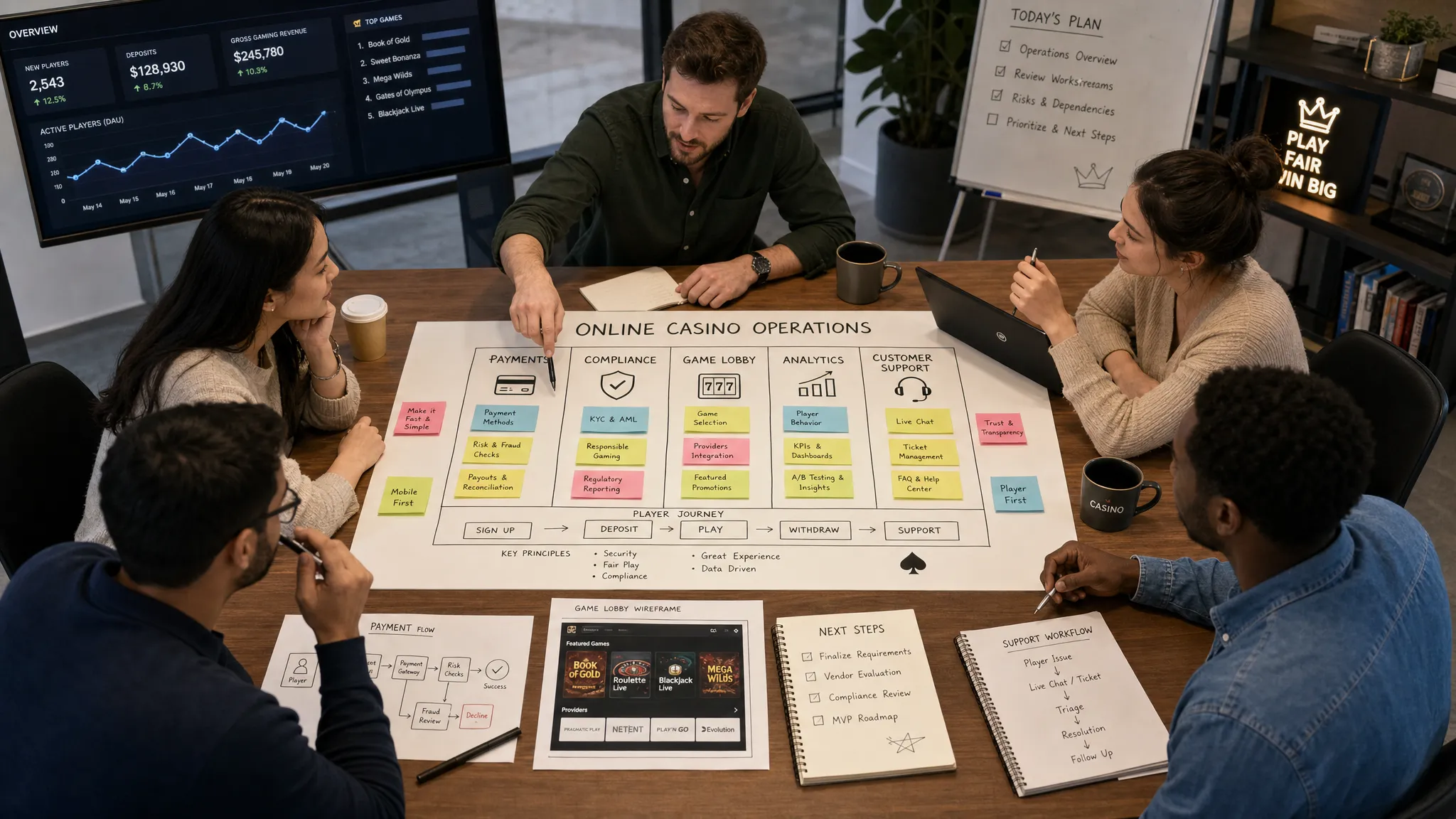
Lean teams lose time when they treat launch like a sequence where one task starts only after another ends. In practice, compliance, platform setup, payments, game selection, brand assets, support policies, and marketing preparation should move in parallel.
The founder or general manager should run a weekly launch meeting around workstreams, blockers, owner names, and decision deadlines. A simple structure is enough, as long as every task has an accountable owner.
| Workstream | Main output before launch | Typical owner |
|---|---|---|
| Licensing and compliance | Market rules, KYC flow, AML policy, responsible gambling setup | Compliance lead |
| Platform configuration | Brand settings, backoffice access, games, wallet, admin roles | Platform partner and product owner |
| Payments | Gateway setup, crypto onramp if needed, withdrawal rules, reconciliation process | Payments owner |
| Casino content | Game categories, lobby order, bonus-linked games, launch promotions | Product and CRM owner |
| Support operations | Help center, escalation paths, refund and dispute process, tone of voice | Support lead |
| Marketing readiness | Landing pages, affiliate setup, tracking, launch campaigns | Founder or marketing owner |
| Analytics | KPI definitions, dashboard access, daily reporting rhythm | Founder and platform partner |
A lean team should not try to create a perfect operating manual before launch. But it should document the decisions that affect money, identity, risk, and player promises. Those are the areas where ambiguity becomes expensive.
For teams that want a tighter timeline, Spinlab's 30-day launch plan for new online casinos gives a more detailed week-by-week structure.
Hire slowly, but assign ownership early
When a casino launch starts gaining traction, the temptation is to hire quickly across support, marketing, CRM, VIP, payments, compliance, and content. Some hiring may be necessary, but premature hiring often hides process problems.
Before adding headcount, ask whether the workload is caused by real growth or by poor setup. If support volume is high because bonus terms are unclear, fix the terms. If withdrawal reviews take too long because risk thresholds are vague, fix the workflow. If campaign reporting takes hours because data is scattered, fix the dashboard and naming conventions.
A practical lean hiring sequence often looks like this:
| Stage | First hiring pressure | Better first response |
|---|---|---|
| Pre-launch | Too many setup decisions | Use a stronger platform partner and clearer launch scope |
| First players | Support and verification questions | Improve help content, KYC flow, and escalation rules |
| First campaigns | Manual bonus and affiliate work | Standardize campaign templates and tracking |
| Early growth | Payment and withdrawal workload | Add payment operations support or automate review queues |
| Scaling | Retention and VIP complexity | Hire CRM or VIP talent once player segments are proven |
The right platform gives you time to hire deliberately. The wrong platform forces you to hire defensively.
Track the metrics that matter in the first 90 days
A lean online casino team needs a short daily dashboard, not a hundred disconnected reports. The goal is to spot problems early and make decisions quickly.
In the first 90 days, focus on metrics that show whether the operation is healthy:
| Metric | Why it matters |
|---|---|
| Registration to first deposit rate | Shows whether onboarding and cashier flow are working |
| Deposit success rate | Reveals payment gateway friction and failed transaction issues |
| KYC approval time | Affects player trust, withdrawals, and support volume |
| Withdrawal processing time | Directly impacts retention and reputation |
| Bonus cost as a share of net gaming revenue | Helps prevent promotion-led losses |
| Game category engagement | Shows which content deserves lobby priority |
| Support tickets per active player | Reveals confusion, product friction, or risk issues |
| Fraud and abuse flags | Helps evaluate acquisition quality and bonus vulnerability |
| Day 1, day 7, and day 30 retention | Shows whether players are returning after the first session |
Real-time analytics matter because a lean team cannot wait until the end of the month to discover that a payment method is failing, a bonus is being abused, or a game category is underperforming. Daily visibility turns a small team into a faster team.
Common mistakes lean casino teams should avoid
Most lean launches fail for predictable reasons. They do not fail because the team is small. They fail because the scope is too wide, the operating model is unclear, or the platform does not remove enough complexity.
Watch for these traps:
| Mistake | Why it hurts | Better approach |
|---|---|---|
| Launching too many markets | Multiplies compliance, payment, language, and support complexity | Start with one clear market focus |
| Over-customizing before revenue | Burns time on unproven assumptions | Validate the player journey first |
| Treating crypto as only a marketing feature | Creates custody, AML, conversion, and support questions | Design the full crypto payment lifecycle |
| Running bonuses manually | Increases errors, disputes, and abuse risk | Use structured bonus tools and clear terms |
| Ignoring backoffice usability | Makes every change dependent on technical help | Choose a customizable admin panel built for operators |
| Measuring only deposits | Hides retention, withdrawal, fraud, and support problems | Track the full player lifecycle |
A lean launch should feel controlled, not fragile. If every small change creates a new emergency, the team is not lean. It is under-supported.
Why Spinlab fits lean casino launches
Spinlab is built for operators who want to launch and run an online casino without assembling a large technical team first. Its modular platform combines the core components a lean team needs, including crypto and fiat payment support, game aggregation, KYC and AML compliance, fraud prevention, real-time analytics, affiliate and bonus tools, multi-currency support, crypto onramp solutions, custodial wallet options, and a customizable backoffice.
The practical advantage is that your team can focus on the business layer: positioning, campaigns, player experience, risk decisions, and growth. You are not starting from a blank technical canvas.
For founders comparing white label iGaming software, the most important question is not simply which vendor has the longest feature list. It is which platform lets a small team launch safely, operate clearly, and scale without rebuilding everything later.
Frequently Asked Questions
Can a small team really launch an online casino? Yes, if the team uses a white label casino platform or turnkey casino solution that handles core infrastructure such as payments, game aggregation, KYC, AML, fraud prevention, analytics, and backoffice operations. The team still needs clear ownership across compliance, payments, support, product, and growth.
How many people do you need to launch an online casino? A lean launch can often be operated by a small core team covering general management, compliance and risk, payments, casino product, CRM, and support, supported by a strong platform partner and external legal or licensing advisors. The exact number depends on jurisdiction, launch scope, support hours, and payment complexity.
What should a lean casino team avoid building from scratch? Most lean teams should avoid building wallet systems, game integrations, payment gateway connections, admin panels, bonus engines, fraud tooling, and reporting dashboards from scratch unless they have a specific strategic reason and enough technical capacity. These are usually better handled by a proven iGaming platform.
Is crypto useful for a lean online casino launch? Crypto can be useful when it matches the target audience and the operator has the right controls for onboarding, wallet custody, AML monitoring, conversion, withdrawals, and support. A crypto-ready solution should simplify operations, not create unmanaged risk.
What is the biggest risk when launching with a lean team? The biggest risk is underestimating operational complexity. Compliance, payments, withdrawals, fraud, bonuses, and support all need defined workflows before launch. A lean team can move fast, but only if the platform and processes reduce manual work.
Launch lean, but launch with the right foundation
A lean team can launch an online casino successfully when it stays focused, chooses the right platform, and treats compliance, payments, and player operations as core business systems from day one.
If you want a Shopify-like way to build, launch, and scale a casino brand, Spinlab provides a modular white label casino platform with the tools lean operators need to move faster without carrying unnecessary technical overhead.