

In online casino operations, retention is won or lost in moments: a failed deposit, a confusing bonus, a game lobby that does not match the player’s intent, a slow KYC step, or a support issue that goes unanswered. Monthly reports can tell you what happened, but they are usually too late to change the outcome.
Real-time data changes the retention model. Instead of waiting for a churn report, casino teams can detect friction, intent, and risk while the player is still active, then respond with a relevant action. That action might be a payment recovery prompt, a better game recommendation, a low-cost mission, a support escalation, or a responsible gaming safeguard.
The goal is not to push players harder with bigger bonuses. The goal is to build a retention loop that makes the casino experience smoother, more personal, more trustworthy, and measurable.
Treat retention as a live operating system
Casino retention is often reduced to one metric, such as D30 active users or repeat deposit rate. Those numbers matter, but they hide the live signals that create them. A player who fails a first deposit, exits after three game launches, or abandons KYC is already showing intent and friction. If your team only sees that pattern next week, the retention opportunity is gone.
A better approach is to define retention outcomes by lifecycle stage. New players need trust and activation. Returning players need continuity. VIP players need recognition and service quality. Dormant players need a reason to come back. At-risk players need safeguards, not more promotional pressure.
| Retention outcome | What it tells you | Real-time signal to watch | Best first response |
|---|---|---|---|
| First session completion | Whether onboarding is working | Registration completed, KYC status, first game launched | Reduce friction and guide the next step |
| Second session return | Whether the player found value | Session ended, no return after expected interval | Send a relevant reminder or saved-game prompt |
| Repeat deposit | Whether payment trust is forming | Deposit approved, failed, or abandoned | Offer payment support, not a generic bonus |
| Game continuity | Whether the player found preferred content | Repeated category, provider, or game launches | Surface similar games or missions |
| Bonus efficiency | Whether offers create real engagement | Bonus claimed, wagering progress, repeat behavior | Adjust offer type and cost caps |
| Healthy engagement | Whether retention remains sustainable | Sudden intensity, self-exclusion signals, support flags | Suppress promos and apply responsible gaming workflows |
This distinction matters because not every retention problem should be solved with a bonus. A failed crypto onramp, a delayed identity check, or a confusing lobby is an experience problem. Real-time data helps you fix the right problem at the right moment.
Build a clean real-time event foundation
Real-time retention starts with event quality. If your data is delayed, duplicated, or hard to connect across systems, your triggers will feel random. A player might receive a welcome offer after they already deposited, or a reactivation email while they are currently in session. That erodes trust.
At minimum, an online casino should connect events from registration, identity, payments, gameplay, marketing, bonuses, support, fraud prevention, and responsible gaming systems. The important part is not collecting everything. It is collecting the events that explain the player’s current state and the next useful action.
| Data stream | Useful real-time events | Retention question it answers |
|---|---|---|
| Account and identity | Registered, email verified, KYC submitted, KYC approved, KYC pending | Can this player continue smoothly? |
| Payments | Deposit started, deposit approved, deposit failed, withdrawal requested, payment method changed | Is money movement creating trust or friction? |
| Gameplay | Game opened, category played, session duration, provider preference, game exit | Did the player find the right content? |
| Bonus and loyalty | Offer shown, offer claimed, mission started, mission completed, cashback credited | Is the incentive useful or wasteful? |
| Marketing | Email opened, push clicked, SMS delivered, unsubscribe, frequency cap reached | Which channel still has permission and attention? |
| Risk and support | Fraud score changed, AML review, support ticket opened, responsible gaming flag | Should the system intervene, pause, or escalate? |
Identity resolution is the key that makes this usable. The same player may interact through mobile web, email, wallet, affiliate campaign, payment gateway, and support. Your retention logic should recognize one player profile, not separate fragments. If you are still designing this layer, Spinlab’s guide to building a casino CDP explains how events, identity, and activation fit together.
Find the moments where players actually churn
Most players do not churn because of a single dramatic issue. They leave because small points of friction compound. Real-time data helps operators identify those moments before they become silent churn.
Payment friction is one of the clearest examples. If a player starts a deposit and the transaction fails, the retention action should be immediate and practical. Show an alternative payment method, explain whether the transaction is pending, or route the player to support. If the player is using crypto, clear wallet status and crypto onramp visibility can reduce uncertainty.
Game mismatch is another common retention leak. A player who launches five games in two minutes may not be disloyal. They may be searching. A useful response is not necessarily a bonus. It may be a better lobby module showing similar slot games, live casino games, new provider releases, or saved favorites.
KYC and AML reviews are also retention-sensitive. Compliance steps are non-negotiable, but communication can be improved. If a player is waiting for verification, real-time status messages and document guidance can prevent frustration. The retention goal is to preserve trust while meeting regulatory requirements.
Withdrawals deserve special attention. Operators should never use retention logic to create unnecessary withdrawal friction. Instead, real-time data should make the process clearer: confirm the request, show status where appropriate, and detect support needs. Trust after withdrawal is one of the strongest foundations for long-term retention.
Segment players by live intent, not static labels
Traditional segmentation often groups players by historical behavior: new, active, VIP, dormant. That is useful, but incomplete. A high-value player can be payment-frustrated today. A new player can be highly engaged but stuck in KYC. A dormant player can return through a specific game launch.
Real-time segmentation updates the player’s state as events happen. This allows operators to trigger actions in seconds rather than after a batch update. For a deeper technical view, Spinlab has covered real-time segmentation and how low-latency decisioning can power faster offers.
For retention, the most useful segments are often based on immediate context:
- Lifecycle stage: visitor, registered, first depositor, repeat depositor, loyal player, dormant player.
- Current intent: browsing slots, searching live casino, trying payments, completing KYC, claiming a mission, contacting support.
- Friction state: failed deposit, abandoned registration, bonus confusion, repeated game exits, withdrawal question.
- Value and cost profile: expected lifetime value, bonus sensitivity, payment reliability, margin contribution.
- Risk state: fraud review, AML flag, responsible gaming marker, self-exclusion status, cooling-off request.
The final segment is especially important. Real-time data should not only decide who receives an offer. It should also decide who should not receive one. If behavior suggests potential harm, operators should suppress promotions and follow responsible gaming procedures.
Turn signals into retention actions
Once the data foundation is in place, retention improves through specific playbooks. A playbook is a rule or model that connects a live signal to a useful response, a channel, and a measurement plan.
Payment recovery
When a deposit fails, the player is already showing intent. A generic next-day campaign is too slow. A better playbook detects the failed transaction and responds in-session with available alternatives, clear status messaging, or support routing. If the platform supports both fiat and crypto payments, the recovery logic can present the most relevant next option based on jurisdiction, player settings, and compliance rules.
The key is to solve the payment problem first. Adding a bonus before the player can deposit may waste budget and create frustration.
First-session guidance
The first session should help players understand what the casino offers. Real-time data can detect whether the player has launched a game, filtered by provider, opened the cashier, or abandoned the lobby. Based on that path, the casino can show a simple next step: continue a recently opened game, explore a preferred category, complete verification, or save a favorite.
This is where game aggregation becomes a retention advantage. A large catalog is only useful if players can find relevant content quickly. Real-time recommendations can use live browsing behavior to reduce lobby overload.
Game discovery and content drops
New slot games, live casino tables, tournaments, and casino original games can all support retention when they match player intent. The mistake is broadcasting every launch to everyone. Real-time data allows operators to target content announcements based on demonstrated category interest, provider affinity, session timing, and channel engagement.
A player who repeatedly plays high-volatility slots may respond to a new release announcement. A live casino loyalist may care more about table availability or scheduled events. The retention value comes from relevance, not volume.
Loyalty without bonus inflation
Bonuses can retain players, but they can also train players to wait for discounts. Real-time data helps operators use lower-cost incentives, such as missions, XP progress, streaks, content unlocks, cashback thresholds, and personalized reminders.
For example, if a player is close to completing a mission, a real-time nudge may be more effective than a large deposit bonus. If a player has not responded to three offers, the better action may be to reduce frequency and test a content-based message.
Support and trust triggers
Support events are retention events. If a player opens a ticket after a failed withdrawal, KYC delay, or payment issue, that player should not continue receiving promotional messages as if nothing happened. Real-time data can pause marketing, prioritize service workflows, and resume normal communication only after the issue is resolved.
This is one of the most overlooked retention levers. A fast, consistent support experience can retain players without increasing bonus spend.
Use predictive signals to protect bonus budget
Real-time data becomes more powerful when it feeds predictive models. The purpose is not to guess the future perfectly. It is to rank the next best action more intelligently than a flat campaign calendar.
A basic model can estimate churn risk, expected lifetime value, bonus sensitivity, and preferred channel. More advanced operators can combine this with game preference, payment reliability, and responsible gaming safeguards. The output should be simple enough for marketing and operations teams to act on.
| Predictive signal | How it helps retention | Safer retention action |
|---|---|---|
| Declining session frequency | Shows early disengagement | Send content-based reminders or saved favorites |
| Repeated deposit failure | Shows intent blocked by friction | Trigger payment guidance or support |
| High game switching | Shows discovery problem | Improve lobby recommendations |
| Bonus-only behavior | Shows weak organic engagement | Cap offer cost and test non-bonus value |
| Strong provider preference | Shows content affinity | Promote relevant new games or tournaments |
| Sudden intensity or risk marker | Shows possible harm or compliance concern | Suppress promos and trigger responsible gaming review |
The most profitable retention program is usually not the one with the highest bonus budget. It is the one that spends only where it changes behavior, avoids subsidizing players who would have returned anyway, and protects players who should not be targeted.
Measure retention with incrementality, not vanity metrics
Real-time retention can produce impressive short-term engagement numbers, but operators need to prove incremental value. If a campaign increases clicks but lowers net gaming revenue after bonus cost, it is not a retention win. If a trigger increases wagering but also increases support complaints or responsible gaming flags, it needs review.
Use holdout groups wherever possible. A holdout is a small group of eligible players who do not receive the trigger, allowing you to compare behavior against those who did. This prevents teams from crediting a campaign for returns that would have happened naturally.
| Test type | Question it answers | Metrics to monitor |
|---|---|---|
| Payment recovery test | Does real-time guidance recover failed deposits? | Deposit success rate, support tickets, repeat deposit rate |
| Game recommendation test | Does personalization improve second-session return? | Game launches, session return, favorites saved, NGR |
| Mission test | Do low-cost challenges beat deposit bonuses? | Completion rate, bonus cost, active days, repeat play |
| Channel timing test | Which message timing reduces churn? | Open rate, return rate, unsubscribes, frequency cap hits |
| Responsible gaming suppression test | Are safeguards working as intended? | Promo suppression, RG interactions, escalations, compliance review |
Retention measurement should include both commercial and experience metrics. D1, D7, and D30 retention are useful, but they should sit beside repeat deposit rate, net revenue after bonus cost, support resolution time, payment success, withdrawal satisfaction, and compliance outcomes.
Make real-time data operational
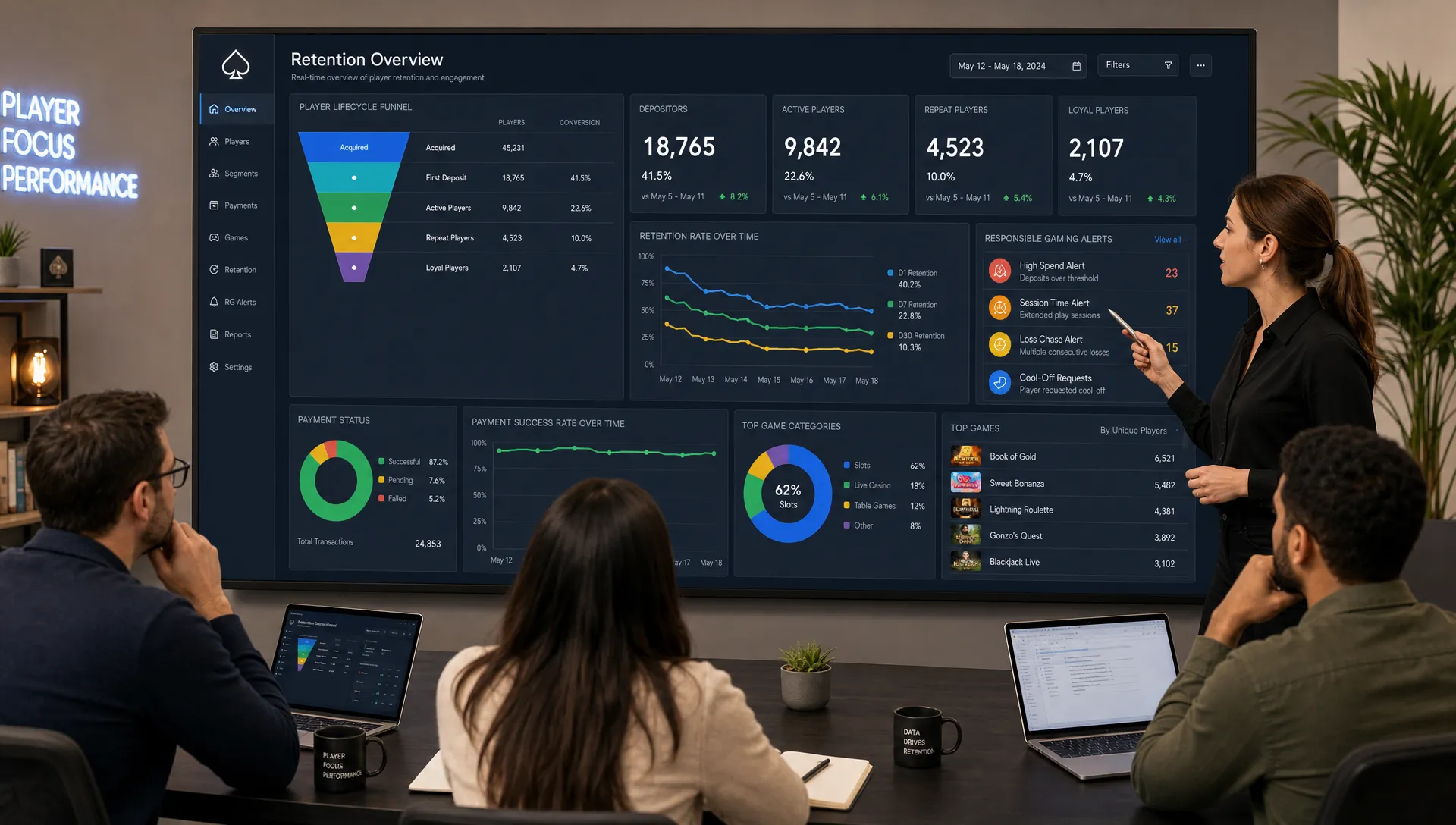
Dashboards are useful, but dashboards alone do not improve retention. Someone needs to act, and ideally the platform should automate repeatable decisions. The most effective casino teams connect real-time analytics to workflows across lifecycle marketing, payments, support, risk, VIP, and game operations.
A practical operating model answers four questions. Who owns the signal? What action happens automatically? When does a human review the case? How is the outcome measured?
For example, a failed deposit may be owned by payments, trigger an in-session recovery prompt, escalate to support after two failures, and be measured by recovered deposits and repeat activity. A responsible gaming marker may be owned by risk, suppress promotions automatically, escalate for review, and be measured by policy adherence.
This is where platform architecture matters. Real-time data has more impact when it is connected to the payment gateway, game aggregator, bonus engine, KYC and AML tools, fraud prevention, backoffice controls, and marketing channels. If those systems are disconnected, every retention idea becomes a custom integration project.
Compliance should be built into the workflow from the start. Operators need clear consent management, jurisdiction rules, audit logs, access controls, and responsible gaming protections. Regulators such as the UK Gambling Commission emphasize customer interaction and identifying risk indicators, which makes responsible use of real-time data a business and compliance priority.
A 30-day roadmap to improve casino retention with real-time data
Operators do not need to rebuild everything at once. A focused 30-day plan can create momentum and reveal where the highest-value retention opportunities are.
| Timeline | Focus | Output | Retention impact |
|---|---|---|---|
| Days 1 to 7 | Audit events and lifecycle metrics | Confirm tracking for registration, KYC, deposits, gameplay, bonuses, support, and risk | Establish a reliable baseline |
| Days 8 to 14 | Identify top churn moments | Rank friction points by volume and revenue impact | Prioritize the highest-value fixes |
| Days 15 to 21 | Launch three trigger playbooks | Payment recovery, first-session guidance, and game discovery | Improve retention without large bonus spend |
| Days 22 to 30 | Add testing and holdouts | Measure incrementality, cost, and risk outcomes | Scale only what proves value |
Start with the moments closest to intent. Failed deposits, abandoned KYC, first-session exits, and repeated game switching are usually easier to act on than broad churn predictions. Once those playbooks are working, add more advanced LTV modeling, bonus optimization, and VIP personalization.
Common mistakes to avoid
The first mistake is treating real-time data as a reason to message more often. More messages can create fatigue, unsubscribes, and lower trust. The better use of live data is to message less often but with higher relevance.
The second mistake is optimizing only for gross gaming revenue. Retention should be measured after bonus cost, payment cost, support burden, chargebacks, fraud risk, and compliance outcomes. Net value matters more than activity volume.
The third mistake is ignoring negative signals. A player with a support issue, withdrawal concern, AML review, or responsible gaming marker should not be treated like a standard promotional target. Suppression logic is just as important as offer logic.
The fourth mistake is overcomplicating the first version. You do not need hundreds of segments to improve retention. A few reliable signals, connected to clear actions, can outperform a complex system that no one trusts.
Frequently Asked Questions
What real-time data is most useful for casino retention? The most useful data usually comes from payments, KYC status, game launches, session behavior, bonus engagement, support events, fraud signals, and responsible gaming markers. These events show whether a player is engaged, blocked, confused, or potentially at risk.
How fast does real-time need to be? Some triggers, such as payment recovery or in-session game recommendations, should happen within seconds. Others, such as reactivation campaigns, can run on hourly or daily windows. The right speed depends on whether the player is still active in the moment.
Can real-time data reduce bonus costs? Yes. Real-time data helps operators avoid sending expensive offers to players who would return anyway, bonus hunters with low organic engagement, or players who should be excluded for risk reasons. It also supports lower-cost tactics such as missions, reminders, and better game discovery.
How do casinos use real-time data without creating compliance risk? Build compliance into the decisioning layer. Use jurisdiction rules, consent controls, AML and KYC status, responsible gaming suppressions, audit logs, and human review workflows. Real-time data should improve player protection, not bypass it.
Do smaller white label casinos need real-time analytics? Yes, but they should start simple. A smaller operator can begin with payment recovery, first-session guidance, and basic lifecycle segmentation before adding predictive models. The priority is reliable data connected to actions.
Build a retention loop your team can actually run
Real-time retention is not about chasing every player with a bigger promotion. It is about understanding what is happening right now, choosing the next useful action, and measuring whether that action creates healthier long-term value.
Spinlab’s modular iGaming platform is designed for operators that want an all-in-one, crypto-ready foundation for launching and scaling an online casino. With integrated payments, game aggregation, real-time analytics, fraud prevention, KYC and AML support, bonus tools, and a customizable backoffice, teams can turn live player signals into retention workflows without stitching together every component from scratch.
If your casino retention strategy still depends on weekly reports and broad bonus blasts, the next step is clear: connect your live data, act on the highest-intent moments, and build retention around relevance, trust, and responsible growth.