

Virtual reality has finally crossed the novelty threshold and is entering the real-money gaming mainstream. In 2025, Goldman Sachs projects that more than 41 million consumers will regularly use a VR headset for entertainment. Online casino operators that move early can secure pole position in a channel where competition and acquisition costs are still low. But VR gambling also raises the hardware bar on both the player and operator sides.
This guide explains exactly what you need—headsets, PCs, GPUs, network and edge infrastructure—to deliver a smooth, low-latency, fully compliant real-money VR experience.
Why Hardware Still Matters in a Cloud-First World
Streaming technologies, headless front-ends and cloud GPUs reduce local friction, yet VR remains highly sensitive to compute and latency budgets. A dropped frame at 90 Hz is a minor glitch on a 2D slot but a nausea trigger in an immersive roulette pit. Hardware, therefore, is not a box-ticking exercise; it is a revenue protection layer.
Key thresholds to remember:
- Motion-to-photon latency under 20 ms to avoid motion sickness
- Refresh rate 90 Hz minimum, 120 Hz preferred for fast-paced table games
- Binocular resolution of at least 1832 × 1920 per eye to ensure crisp text and chip stacks
Spinlab’s latency tests (Q2 2025) show that every extra 10 ms of perceived lag reduces average bet size by 6.3 % in multiplayer blackjack sessions. Hardware planning touches the P&L.
Player-Side Hardware: Headsets, Controllers and Optional PCs
The good news: most modern headsets already meet VR casino baselines. The table below compares the four most commercially relevant options.
| Headset (2025) | Chipset / GPU | Refresh Rate | Resolution per Eye | Wi-Fi | Retail Price* |
|---|---|---|---|---|---|
| Meta Quest 3 | Snapdragon XR2 Gen 2 | 120 Hz | 2064 × 2208 | Wi-Fi 7 | US $479 |
| Apple Vision Pro | Apple M2 + R1 | 100 Hz | 2160 × 2400 | Wi-Fi 6E | US $3,299 |
| Pico 5 | Snapdragon XR2 Gen 2 | 120 Hz | 2160 × 2160 | Wi-Fi 6E | US $599 |
| HTC Vive XR Elite | Custom XR2 | 90 Hz | 1920 × 1920 | Wi-Fi 6E | US $1,099 |
*Retail prices as of October 2025.
Stand-Alone vs PC-Tethered
- Stand-alone: Quest 3 and Vision Pro run fully on-device. Operators must optimise textures, shaders and animations to fit a mobile GPU envelope (~2 TFLOPs). Unity’s Adaptive Performance toolkit is a must.
- PC-tethered: SteamVR and Vive XR Elite can stream from a gaming PC. This allows photorealistic live-dealer tables rendered on an RTX 4080, but operators must ship a low-latency encoder (e.g., NVIDIA NVENC) and invest in Wi-Fi 6E routers for gigabit throughput.
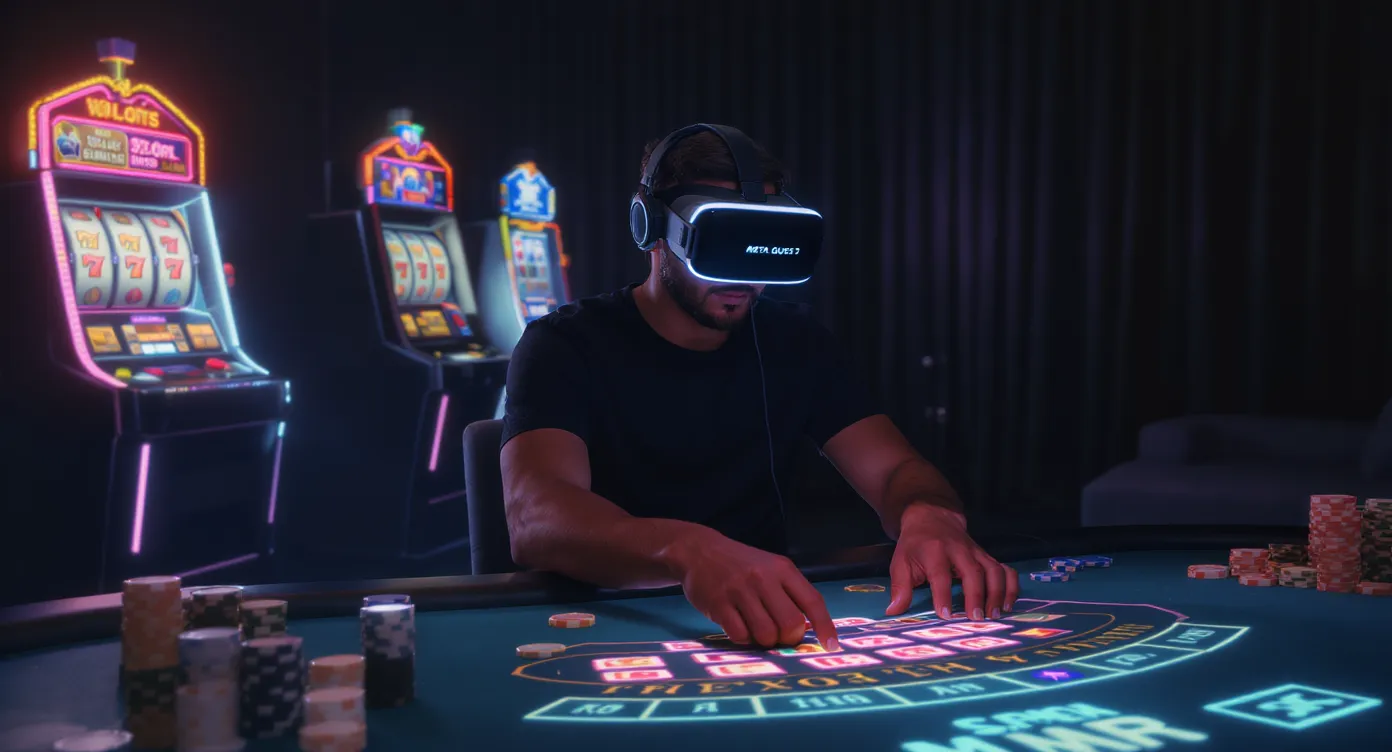
Controller Ergonomics
Real-money gaming demands precise, button-light input. Simple pinch gestures and tracked hand positions reduce mis-bets compared with six-axis gamepads. For slot play, air-tap is adequate; for blackjack, articulated controllers with haptic feedback improve chip placement accuracy by 12–15 % according to Spinlab’s QA labs.
Network and Connectivity Requirements
Whether graphics are rendered locally or streamed, deterministic network performance is non-negotiable.
- Wi-Fi 6E minimum; Wi-Fi 7 preferred for 120 Hz cloud streaming.
- Target round-trip time (RTT) < 30 ms between headset and nearest edge pop to maintain overall motion-to-photon under 20 ms.
- Packet loss under 0.5 %; employ Forward Error Correction (FEC) if streaming via UDP.
Operators deploying multi-player tables should co-locate authoritative game servers in the same region as their media edge to avoid desync events. Our benchmark article on WebRTC vs HLS (https://spinlab.studio/webrtc-vs-hls-for-live-casino-streaming-performance-benchmarks/) offers detailed latency metrics and scaling advice.
Operator-Side Compute: Sizing Your GPU Fleet
The arrival of photorealistic dealers and 4K stereo streams pushes server budgets into GPU territory. A basic setup for 5,000 concurrent VR seats looks like this:
| Layer | Example Hardware | Concurrency per Node* | Qty (5k CCU) | Notes |
|---|---|---|---|---|
| Rendering / Dealer Simulation | NVIDIA L40S (48 GB) | 120 seats | 42 nodes | Unreal 5; AI dealer animation at 90 fps |
| Encoding | NVIDIA A10G | 200 seats | 25 nodes | WebRTC H.265, 30 Mbps stereo |
| Physics + Game Logic | AMD Epyc 64-core | 500 seats | 10 nodes | State replication via Redis cluster |
| Session Orchestration | Kubernetes control plane | n/a | 3 nodes | Autoscale based on seat demand |
*Measured in Spinlab load tests, August 2025.
Total 1-year GPU OPEX at Frankfurt rates (~US $1.10/hr per L40S spot instance) sits around US $390k, a fraction of potential NGR if seat utilisation exceeds 35 %. For cost optimisation, operators can dynamically down-scale rendering nodes during low-traffic windows and migrate casual content (e.g., VR slots) to less expensive RTX 4000 Ada GPUs.
Edge vs Centralised Rendering
- Edge Rendering (WebRTC): Sub-second latency, higher egress cost. Suitable for blackjack, roulette, PvP poker.
- Central DC Rendering (HLS): 2–3 s latency, lower cost, fine for single-player slot cabinets.
Spinlab’s Fullhouse XR module auto-routes sessions based on game type and player geography, letting operators balance cost and UX without manual intervention.
Storage and Asset Pipelines
VR assets weigh more than 2D equivalents. A single high-detail roulette wheel with PBR textures can hit 180 MB. Plan for:
- Object storage with multi-part upload and global CDN push.
- Delta patching to avoid forcing players to download 1 GB updates on a 5G connection.
- Version locking of shaders to meet regulatory checksum requirements.
Payment, Security and Compliance Hardware Hooks
- FIDO2 biometrics: Quest 3 and Vision Pro integrate pass-through fingerprint or face unlock. Enforcing biometric confirmation before large wagers ticks both PSD2 SCA and UKGC guidelines.
- Trusted Execution Environments (TEE): Apple’s Secure Enclave and Qualcomm’s Trusted Zone allow on-device nonce signing to mitigate spoofed bet calls.
- Anti-fraud sensors: 6-DOF head tracking plus controller IMU data can feed behavioural analytics. Abnormal hand jitter or impossible reach distances often flag bot activity sooner than transactional heuristics.
From a compliance standpoint, the hardware’s telemetry can enhance your KYC/AML stack—see our post on risk matrices (https://spinlab.studio/building-a-risk-matrix-prioritizing-threats-in-online-casinos/) for scoring ideas.
Regulatory Snapshot (Oct 2025)
| Jurisdiction | VR Gambling Status | Key Hardware Mandates |
|---|---|---|
| Isle of Man | Permitted | Must log headset ID in RNG audit trail |
| Malta (MGA) | Pilot phase | 90 Hz min, motion-sickness disclosure |
| New Jersey (DGE) | Under review | Require FOV-static RG overlays |
| Ontario (AGCO) | Permitted | Age verification via biometric unlock |
Staying hardware-compliant is easier when headsets expose stable device identifiers and cryptographic attestation APIs. Spinlab’s compliance bridge captures these signals and funnels them into audit logs alongside existing game events.

Six-Step Hardware Readiness Checklist
- Map your target device mix using market-share data. Prioritise Quest 3 and Vision Pro for 2025–26.
- Benchmark motion-to-photon latency locally and across your planned edge POPs.
- Size GPU clusters based on seat concurrency, content complexity and regional demand curves.
- Implement Wi-Fi 6E/7 routers or enterprise mesh in any brick-and-mortar VR lounge.
- Integrate FIDO2 or platform biometrics for payments and large-bet flows.
- Document headset IDs and driver versions in compliance logs ahead of your first regulator audit.
Future-Proofing for 2026 and Beyond
- Eye-tracked foveated rendering may reduce GPU load by 40 %, letting you repurpose older A10G cards for another cycle.
- AV1 hardware encoding in next-gen Qualcomm XR3 chips will cut bandwidth needs by 30 %, widening viable emerging-market reach.
- Mixed-reality overlays will blur the line between VR pits and live camera feeds. Prepare your CMS to blend WebRTC inputs with local geometry.
Spinlab’s open API and modular cashier already support these trajectories. Our roadmap includes an XR SDK that plugs into Unity or Unreal, auto-instrumented with responsible-gaming overlays and low-latency payment deeplinks.
Bottom Line
Hardware decisions for VR gambling are strategic—not tactical. Choose headsets that minimize friction, provision enough GPU headroom to maintain 90 Hz at scale, and treat network latency as a core KPI. The operators that master this trifecta will own the next growth curve in iGaming.
Need a shortcut? Book a 30-minute strategy call with Spinlab’s solutions team to review your VR hardware plan and see how Fullhouse XR can cut your time-to-market by months.
Just wanted to give a shoutout to phfierylogin. Super easy and quick login process. No hassles at all! Makes getting back to the games a breeze. If you’re having trouble finding it, here’s the link: phfierylogin
Just stumbled upon pk345.info the other day. Seems like a fairly standard setup for online games. I haven’t won big yet, but the experience has been good so far. Maybe it’s up to luck. Here’s the link: pk345
I was able to easily login with the ggpanalologin site. I played a few games and was able to enjoy it. The site is secure also and easy to navigate. ggpanalologin