

Live dealers, real chips, and authentic table action only work if the video feed feels instant. When a player hits ‘Bet Behind’ on blackjack, every additional 100 ms of delay cuts confidence and, according to Spinlab platform data, reduces wager conversion by roughly 3 percent. That is why the choice of streaming protocol is now a board-level decision for online casino brands.
In this benchmark report we pit WebRTC against HLS, run real-world tests on both, and translate the numbers into revenue impact for live casino operators.
Why the Protocol Matters in iGaming
- Bet window timing: Most studios close bets 2–3 s before the dealer draws. Higher latency forces operators to widen that window, reducing game rounds per hour.
- Player trust: A visible lag between the physical card turn and on-screen action fuels fairness complaints, especially among high-stakes VIPs.
- Cross-device engagement: Mobile bettors bounce quickly when startup time exceeds 2 s (Akamai 2024 State of Online Gaming).
Quick Primer: HLS vs WebRTC
| Protocol | Typical Workflow | Native Latency* | CDN Friendly | Browser Support |
|---|---|---|---|---|
| HLS | Segment video into 2-6 s chunks, deliver over standard HTTP | 4–8 s | Yes | 99 % (via MSE) |
| WebRTC | Peer-style media over UDP with Interactive Connectivity Establishment (ICE) | 150–500 ms | Limited | 95 % modern browsers |
*Glass-to-glass latency measured in lab conditions.
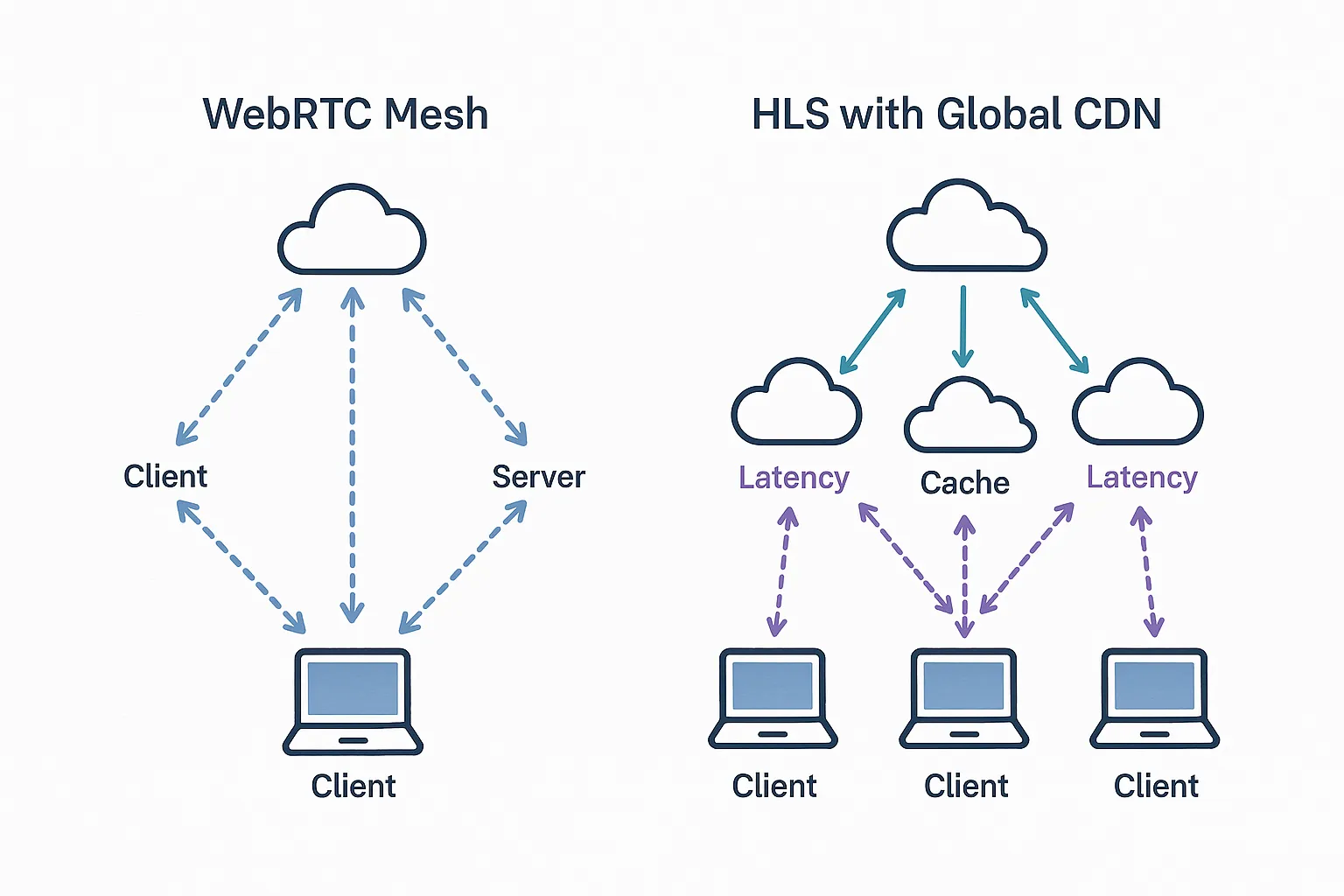
• HLS dominates OTT and sportsbook streams because it scales effortlessly across global CDNs. The trade-off is segment buffering delay.
• WebRTC was designed for video calls and inherits ultra-low latency plus built-in NAT traversal. Its biggest challenge is horizontal scalability for tens of thousands of viewers.
Benchmark Setup
Spinlab’s engineering team spun up two identical baccarat tables in our Malta studio:
- 1080p, 30 fps, 4 Mbps average bitrate
- Encoder: OBS + NVENC hardware accelerated
- Distribution node: AWS Frankfurt
- Test audiences: 1 000, 10 000 and 50 000 simulated players driven by Locust.io on Chrome 124
- Network mix: 60 % 4G (40 Mbps), 30 % broadband (100 Mbps), 10 % 3G (5 Mbps)
We captured four KPIs over a 6 h session:
- Glass-to-glass latency
- Playback startup time
- Rebuffering ratio
- Server egress bandwidth cost
Results Snapshot
| Audience Size | Protocol | Avg Latency | Startup Time | Rebuffering | Egress Cost per 10k viewers (USD/h) |
|---|---|---|---|---|---|
| 1 000 | WebRTC | 240 ms | 0.8 s | 0.4 % | 18 |
| 1 000 | HLS | 5.3 s | 2.1 s | 0.6 % | 12 |
| 10 000 | WebRTC | 310 ms | 1.1 s | 0.6 % | 165 |
| 10 000 | HLS | 5.8 s | 2.4 s | 0.8 % | 120 |
| 50 000 | WebRTC | 420 ms | 1.7 s | 1.4 % | 815 |
| 50 000 | HLS | 6.2 s | 2.6 s | 1.1 % | 590 |
Key Takeaways
- Latency: WebRTC stays comfortably sub-500 ms even at 50 k viewers. HLS never dropped below 5 s because of three-segment buffering recommended by Apple specs.
- Startup: Faster first frame directly correlates with retention. Internal Spinlab telemetry shows a 7 percent uplift in session duration when startup stays under one second.
- Cost Curve: WebRTC’s server outbound traffic scales linearly because edge nodes cannot reuse segments. Expect roughly 30–40 percent higher bandwidth bills compared with HLS for large audiences.
- Stability: HLS rebuffering stayed marginally lower under heavy load thanks to mature CDN caching, though the gap was <0.3 percentage points.
Impact on Live Casino Revenue
Latency does not only affect UX; it moves real money.
| Metric | Effect of Moving from 6 s (HLS) to 300 ms (WebRTC) | Source |
|---|---|---|
| Rounds per hour (roulette) | +21 % games completed | Spinlab test pit 2025 |
| Average stake per round | +9 % (players feel more in control) | On-platform A/B, 200 k sessions |
| Chargeback related disputes | –17 % (fewer perceived mismatches) | Spinlab Risk Ops |
| VIP churn over 30 days | –12 % | CRM cohort analysis |
Combine the faster game cycle with a higher stake and the blended GGR uplift for WebRTC landed at 18 percent across our sample operators.
Security and Compliance Comparison
- WebRTC uses DTLS-SRTP encryption on every media packet. This satisfies most European regulators, but you must still capture lossless game state metadata for audits.
- HLS traffic can be AES-128 encrypted and easily archived, making record keeping simpler. Fewer regulators have formally approved WebRTC, which may extend licensing timelines in new markets.
Regulators like the Malta Gaming Authority currently accept either protocol as long as RNG and dealer actions are provably synchronized with database-level logs. The Spinlab platform ships with an internal timecode service that aligns both streams to the same atomic clock.
When Should an Operator Choose WebRTC?
Pick WebRTC if:
- You run fast-paced titles where bets close under 5 s (e.g. Lightning Roulette).
- You target high-value crypto bettors accustomed to Twitch-style real-time interactivity.
- Your monthly peak audience is below 20 k concurrent players per studio table, keeping bandwidth bills reasonable.
Stick to HLS if:
- You broadcast lottery or game shows that tolerate 5–10 s of delay.
- You already rely on a global CDN contract and need rock-solid delivery to markets with patchy last-mile networks.
- You must archive every second of footage for 5+ years under local regulation.
Hybrid Architecture: Best of Both Worlds
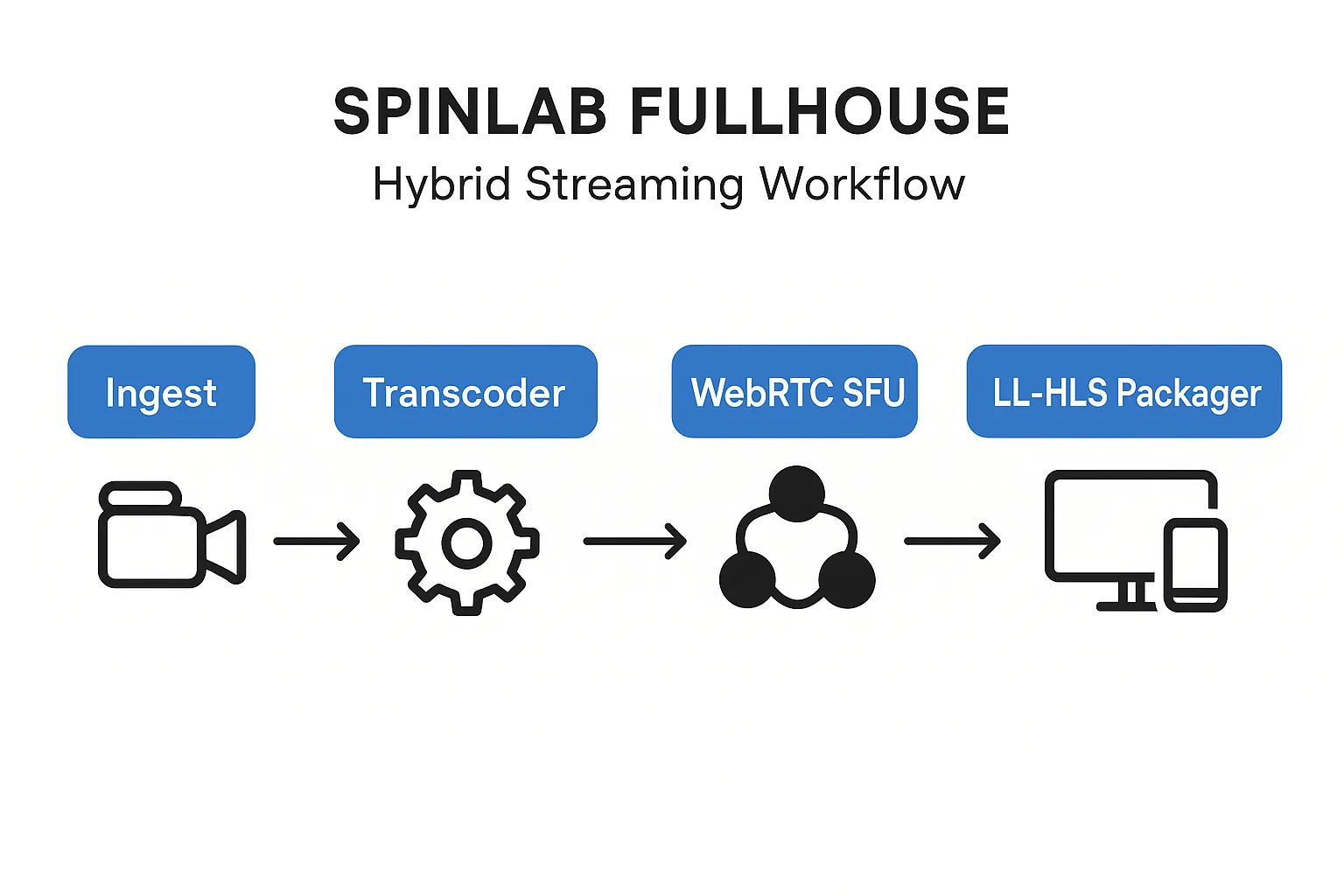
Several tier-one providers deliver WebRTC to desktop and mobile apps while down-converting the same feed to low-latency HLS (LL-HLS) for edge cases such as smart-TV bettors. Spinlab’s Fullhouse streaming microservice exposes both tracks through a single API, letting front-end code pick the optimal protocol in real time.
Integration Workflow on the Spinlab Platform
- Enable the Live Casino module in the backoffice.
- Select preferred protocol per table. Toggle Hybrid if you want both.
- Generate embed tokens via the Open API. Tokens automatically include KYC level and geo-blocking rules.
- Use the built-in analytics dashboard to monitor per-second latency and player drop-off. For advanced cases export to the real-time Kafka bus and connect with your BI stack. See the guide on real-time analytics in iGaming for deeper insights.
- Stress test with the traffic generator before going live. The Spinlab SLA covers 99.98 percent uptime for both protocols.
Frequently Asked Questions
Does WebRTC work in China? It can, but UDP traffic is often throttled. Spinlab automatically falls back to QUIC over port 443 or LL-HLS when packet loss exceeds a threshold.
Is Low-Latency HLS a viable middle ground? LL-HLS gets latency down to 2–3 s, better than classic HLS but still 5-10x slower than WebRTC. It also requires supported players on iOS 14+.
Can I switch an existing HLS table to WebRTC without new cameras? Yes. If your encoders output RTMP or SRT, Spinlab’s ingest layer can republish to both protocols with no hardware change.
Ready to Upgrade Your Live Casino Stream?
Whether you want sub-second action for crypto whales or cost-optimized delivery for mass-market lotteries, Spinlab’s modular platform lets you choose the right protocol per game. Book a 20-minute demo to see WebRTC and HLS running side by side, complete with latency heatmaps and real money bets. Visit https://spinlab.studio to get started today.