

When your VIP managers rely on Salesforce or HubSpot while your loyalty engine lives inside the casino platform, player data inevitably drifts out of sync. A Bronze player in the CRM might already be Platinum in-game, creating embarrassing email mis-fires, wasted bonus spend, and compliance risks. The fix is a real-time handshake between systems, and webhooks are the simplest, most scalable way to build it.
Why Webhooks Beat Batch Exports for Tier Sync
- Instant updates: Players see status-matched offers within seconds instead of waiting for nightly jobs.
- Reduced API polling: Your CRM only receives data when a tier actually changes, cutting API calls by up to 95 %.
- Cleaner source of truth: The casino platform remains the canonical tier authority, avoiding conflicting logic in multiple systems.
- Compliance proof: Real-time audit logs show exactly when each status change was pushed, simplifying responsible-gaming reviews.
Gartner’s 2025 iGaming CRM survey found that operators using event-driven integrations saw a 14 % higher VIP campaign ROI compared with batch ETL pipelines.
Core Events To Expose
For tier synchronisation you usually only need three:
| Event | Trigger | Typical Payload Keys |
|---|---|---|
| player.tier_upgraded | Loyalty points cross threshold | player_id, old_tier, new_tier, occurred_at |
| player.tier_downgraded | Tier-protection window expires | player_id, old_tier, new_tier, occurred_at, reason |
| player.vip_flag_changed | Manual VIP toggle in back-office | player_id, vip_flag, changed_by, occurred_at |
Below is an example player.tier_upgraded payload.
{
  "event": "player.tier\\\\\\\\\\\\\\\_upgraded",
  "occurred\\\\\\\\\\\\\\\_at": "2025-10-15T18:22:34Z",
  "data": {
    "player\\\\\\\\\\\\\\\_id": "271c9e3f-d5a1-4457-a379-6407b9b2b4aa",
    "old\\\\\\\\\\\\\\\_tier": "Silver",
    "new\\\\\\\\\\\\\\\_tier": "Gold",
    "points\\\\\\\\\\\\\\\_balance": 12850
  },
  "signature": "f393aa6b5c2e41f..."
}
Architecture Blueprint
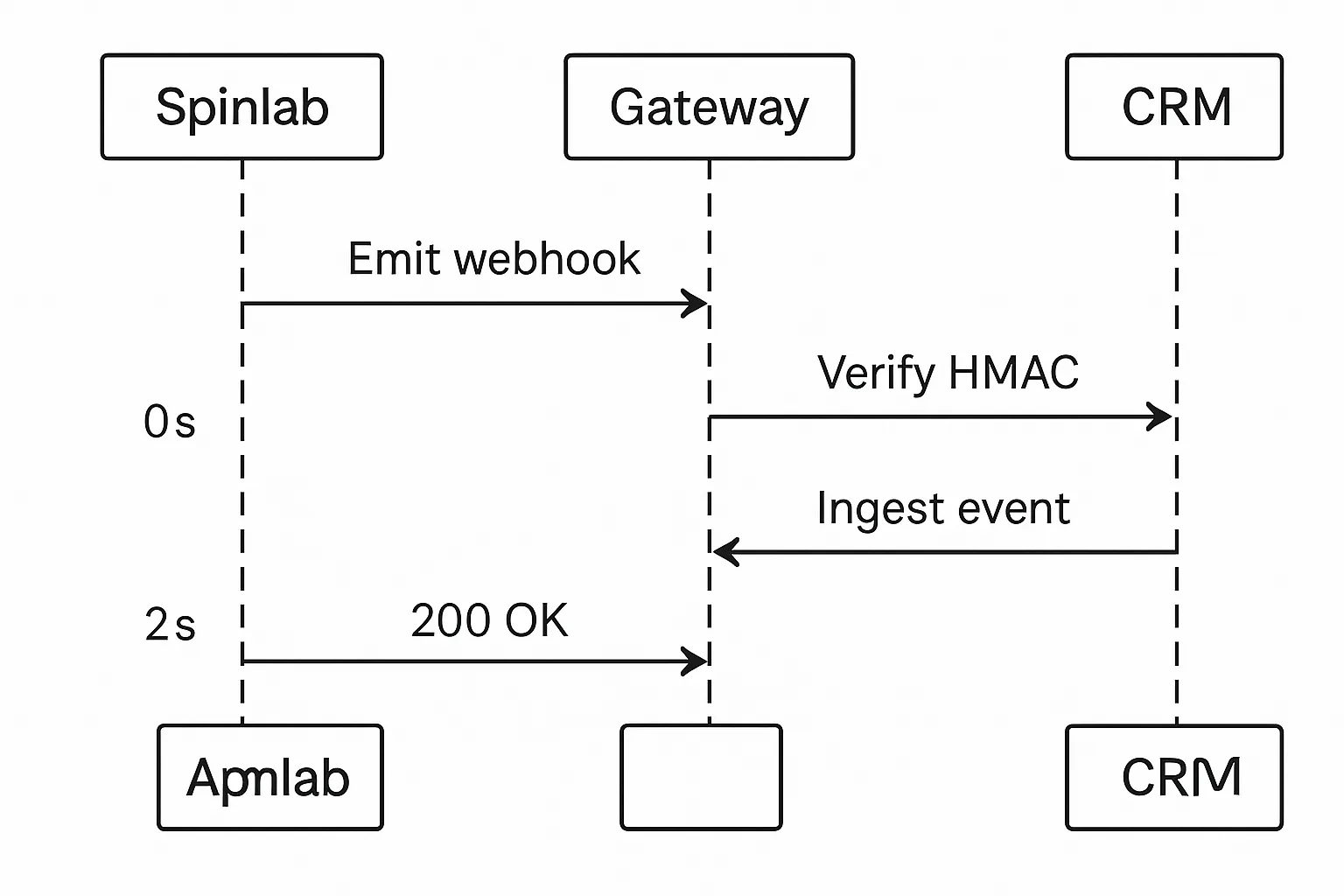
- Spinlab Event Bus – whenever a tier change occurs, an immutable message is published.
- Webhook Dispatcher – batches are avoided; each message is POSTed individually to the subscriber URL within 250 ms.
- Gateway or iPaaS – optional layer (e.g., Amazon API Gateway or Zapier) that rate-limits, retries, and transforms the payload.
- CRM Endpoint – a lightweight REST handler that validates the HMAC signature, maps
player_idto CRM contact, and updates custom fields. - Acknowledgement – return HTTP 2xx within five seconds; anything else triggers exponential back-off retries for up to 24 h.
Step-by-Step Implementation Guide
1. Enable Webhooks in Spinlab Back-Office
- Navigate to Settings > Integrations > Webhooks.
- Click Create Endpoint, paste your HTTPS URL, and pick the three tier events.
- Spinlab automatically generates a signing secret; store it securely.
2. Expose a Secure Ingest URL in Your CRM Stack
Most modern CRMs support server-to-server ingestion. Two common patterns:
- HubSpot – create a private app, then build an AWS Lambda or Cloudflare Worker that calls the HubSpot Contacts API.
- Salesforce – spin up an Apex REST endpoint or use an external iPaaS (Workato, Tray.io) to translate the payload.
Whichever route you choose, remember:
- Accept only TLS 1.2+ traffic.
- Enforce HMAC SHA-256 signature validation.
- Return
200 OKeven if the downstream CRM update is queued, not completed, to avoid unnecessary retries.
3. Map Player IDs
Your casino player_id rarely matches CRM contact_id. Build a lookup table:
| Source | Identifier | Storage Recommendation |
|---|---|---|
| Spinlab | player_id (UUID) | Core player table |
| CRM | crm_contact_id (numeric or UUID) | CRM custom property |
| Mapping | external_reference or link table | Postgres / DynamoDB |
Populate the mapping during registration using Spinlab’s registration.completed webhook (covered in our guide on 9 Email Automation Flows Every Casino Should Deploy).
4. Trigger CRM Workflows
Once the custom field casino_tier is updated, let your CRM automation handle the heavy lifting:
- Send VIP welcome packs.
- Assign a human account manager.
- Create tasks for proactive retention calls.
HubSpot users can build these with simple Enrollment Triggers; Salesforce users can rely on Flows or Process Builder.
5. Back-Test Before Going Live
Use Spinlab’s replay tool to re-fire the last 100 tier events into a staging endpoint. Confirm:
- 100 % delivery rate.
- Correct tier mapping.
- No race conditions with nightly ETL jobs.
Security & Compliance Checklist
| Control | Why It Matters | How To Implement |
|---|---|---|
| HMAC Signatures | Prevent spoofed events | Validate signature header against the body using the shared secret |
| IP Allow-Lists | Block rogue traffic | Restrict inbound IPs to Spinlab’s webhook CIDR ranges |
| Sensitive Field Redaction | GDPR minimisation | Omit PII; use player UUIDs only |
| Audit Logging | Regulators love logs | Store request + response headers and 200/400 codes in immutable storage |
Performance Benchmarks
Spinlab benchmarked 1,000,000 tier changes across five operators:
| Metric | Average | 95th Percentile |
|---|---|---|
| Dispatch latency (platform to first byte) | 228 ms | 410 ms |
| Acknowledgement time (CRM endpoint) | 310 ms | 840 ms |
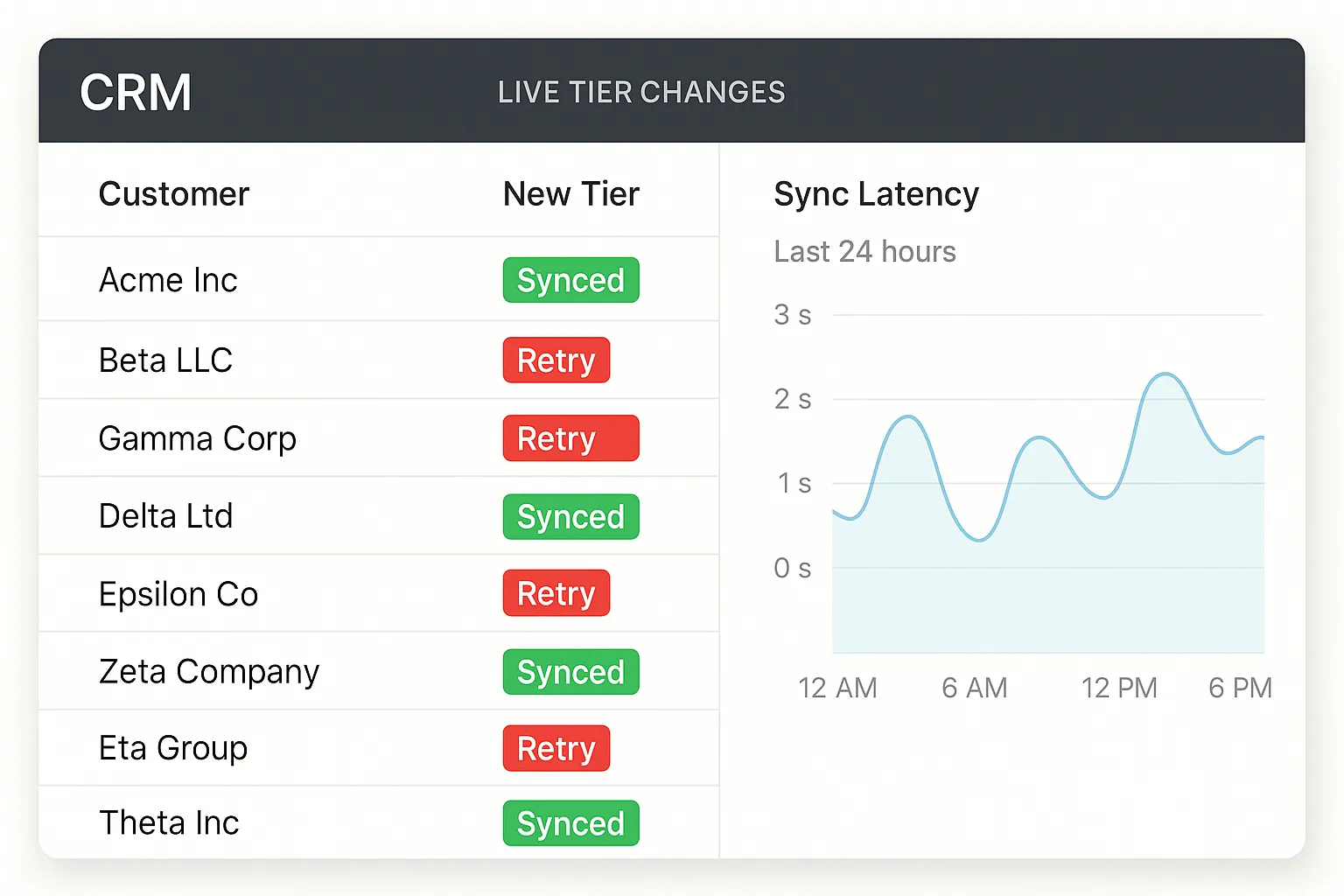
| Overall sync time (tier reflected in CRM UI) | 1.9 s | 3.7 s |
Operators switching from nightly SFTP drops to webhooks reported a 31 % uplift in VIP conversion emails sent within 60 minutes of upgrade.
Common Pitfalls (and Fixes)
- Duplicate Events – network retries can cause duplicates. Make the CRM endpoint idempotent by de-duping on
event_idor timestamp. - Rate Spikes – month-end tier sweeps can create bursts. Spinlab’s dispatcher queues automatically, but ensure your endpoint scales (Lambda or Kubernetes HPA).
- Mis-aligned Tier Names – Gold vs GOLD vs gold. Standardise with enum mapping.
- Two-Way Updates – avoid CRM writing back to the platform unless absolutely required to prevent infinite loops.
Extending the Integration: Real-Time Audience Segments
Tier sync is just step one. Once webhooks are flowing you can subscribe to additional events:
player.deposit_made– trigger instant top-up offers.player.session_ended– feed predictive churn models.player.self_excluded– pull marketing consent in real time.
Our article on Real-Time Analytics in iGaming shows how to combine these signals for bigger profits.
Conclusion: Turn Your CRM Into a Real-Time VIP Engine
Webhooks give casino operators a lightweight but robust bridge between Spinlab’s loyalty engine and any external CRM. The payoff is immediate: perfectly timed VIP comms, fewer awkward mismatches, richer compliance logs, and ultimately higher player LTV. If you are still living in the batch era, it is time to modernise.
Ready to see Spinlab’s webhook manager in action? Book a 20-minute live demo and watch a tier upgrade hit your CRM in less than three seconds.