

Game providers can make or break your casino’s unit economics, not just through game performance, but through the contract you sign. A “standard” agreement can quietly introduce margin leakage (extra fees, territory uplifts, reporting charges), operational risk (weak uptime and support obligations), and long-term lock-in (no export rights to gameplay data, painful termination terms).
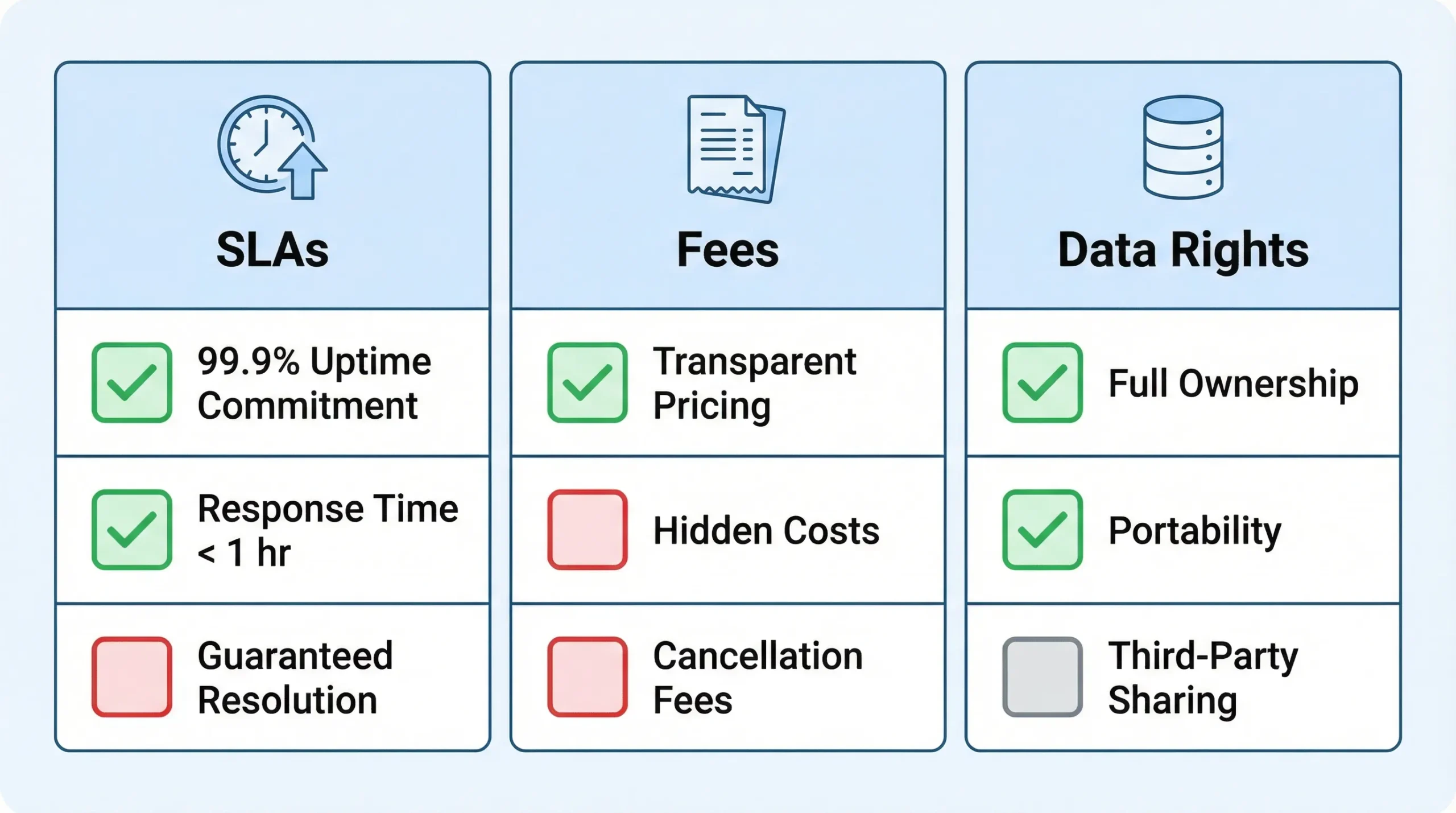
This checklist is built for operators, product leads, and procurement teams negotiating game provider contracts (direct studio deals or via an intermediary). It focuses on three areas that most often drive surprises after launch: SLAs, fees, and data rights.
This article is informational and not legal advice.
Start with the hard part: define scope so nothing leaks later
Most contract disputes are not about “bad faith,” they’re about missing definitions. Before you negotiate numbers, lock the scope.
Scope items to define in the contract (or an attached Order Form):
- Brands/skins included, and whether future brands are automatically covered.
- Channels covered (web, native app, PWA, embedded webview).
- Jurisdictions and traffic sources allowed, including how geo-blocking is enforced.
- Game list, including what counts as “new releases” and whether you get them automatically.
- Currencies supported (fiat, crypto, stablecoins) and how rounding is handled.
- Jackpot types (local, network) and who owns jackpot rules, contributions, and reporting.
A simple rule helps: if it can change your cost, risk, or compliance posture, it needs a definition.
SLA checklist: uptime is not enough, you need measurable player-impact targets
Many providers offer an uptime percentage that sounds great, but is measured in a way that doesn’t protect your players. A game can be “up” while still failing real money bets, timing out, or lagging on mobile.
SLA metrics that matter in iGaming
Ask for SLAs that reflect player experience and revenue protection.
| SLA area | What to specify | Why it matters |
|---|---|---|
| Availability | Uptime target, and what counts as downtime (timeouts, error rate, failed rounds) | Prevents “up but unusable” scenarios |
| Latency | P95 or P99 response time by region | Lag lowers conversion and increases bet drop-offs |
| Incident response | Time to acknowledge, time to mitigate, escalation path | Reduces time-to-recovery during peak hours |
| Maintenance | Allowed windows, notice period, hard caps, emergency rules | Stops surprise outages during campaigns |
| Release governance | Change notice, versioning policy, rollback plan | Avoids breakages after “minor updates” |
| Reporting availability | Status page, incident report timeline, RCA content requirements | You need evidence for regulators and partners |
Service credits: insist on credits that match revenue reality
If the SLA has no real remedy, it’s a marketing paragraph.
- Define the credit trigger (for example, availability below X%, or P95 latency above Y ms for Z minutes).
- Define measurement source (provider status page alone is not enough). Ideally, measurement includes your monitoring, or an agreed third-party probe.
- Define the credit calculation (percentage of monthly fees, rev-share reduction, or both).
- Define exclusions narrowly (for example, force majeure should not cover predictable capacity failures).
If a provider will not offer meaningful credits, your alternative is governance: stronger termination rights tied to repeated incidents.

Operational add-ons that should be contractual, not “best effort”
In iGaming, ops details become compliance details.
- 24/7 support coverage for real-money incidents, with named escalation roles.
- Incident communications standards (what you receive, when, and through which channel).
- Defined responsibilities for player disputes caused by provider faults (for example, stuck rounds).
- Obligations to support regulator or auditor questions, including evidence delivery timelines.
Fees checklist: model total cost of ownership, not the headline rate
A provider deal can look cheaper than it is because costs are spread across setup, hosting, territory uplifts, certification, jackpot contributions, and “optional” reporting.
If you want a framework for spotting hidden costs before signing, align this contract review with your procurement process, for example using a structured RFP. Spinlab’s related resource, Game Provider RFP Template: Questions That Save Money, is useful for standardizing answers.
Commercial model: define the base (GGR vs NGR) in painful detail
If the agreement uses revenue share, you need a strict definition of the base.
Key questions to resolve in writing:
- Is the split based on GGR or NGR?
- If NGR, which deductions are allowed (bonuses, payment fees, chargebacks, affiliate costs, taxes)?
- Are deductions capped?
- Are deductions consistent across jurisdictions and currencies?
- How are progressive jackpots treated (contributions and wins)?
If you run fixed-fee comparisons, you may also want to sanity-check break-even points. See: How to Calculate Break-Even on Fixed-Fee Game Provider Deals.
Fee line items that commonly show up later
Put every potential cost into a single schedule, even if it is “currently waived.” Waivers expire.
| Fee category | Typical gotcha | Contract protection to ask for |
|---|---|---|
| Setup / onboarding | “One-time” becomes per brand or per region | Define what setup includes and what triggers a new setup fee |
| Certification | Pass-through invoices appear after launch | Require pre-approval, cap pass-throughs, list which jurisdictions are in scope |
| Hosting / delivery | Extra fees for high traffic, certain countries, or peak events | Cap hosting uplifts, define included traffic, define burst rules |
| Territory uplifts | Higher rev-share in “restricted” regions | Predefine territory list, require notice and opt-out rights |
| New releases | “Premium studios” or “hot games” cost more | Fix pricing rules for new titles for at least 12 to 24 months |
| Reporting / data access | Player-level exports treated as add-ons | Make required reports part of core service |
| Currency / FX | FX markups or settlement currency constraints | Define FX source, conversion timing, and settlement currency options |
| API overages | Aggregators sometimes charge per call | Require clear thresholds and hard caps |
For a deeper look at how cost stacks accumulate, compare with The True Cost of a Game Aggregator: License Fees, Rev-Share, and Hidden Extras.
Settlement and invoicing: prevent reconciliation chaos
Game providers often invoice on their own timeline, with limited transparency.
Contract items to lock:
- Settlement cadence (weekly, monthly) and invoice delivery deadline.
- A strict definition of the reporting system of record (whose numbers “win” if there’s a mismatch).
- Dispute window (for example, you can challenge within X days) and what evidence must be provided.
- Currency of settlement and who bears bank fees.
- Audit rights for financial reconciliation.
Data rights checklist: if you cannot export event data, you cannot scale intelligently
The most expensive contract mistake in 2026 is not overpaying a rev-share point, it is losing control of your data. Without strong rights, you cannot reliably:
- optimize lobby ranking and personalization,
- run responsible gambling analytics,
- investigate fraud and disputes,
- measure provider performance across cohorts,
- migrate cleanly to another supplier.
Data categories to negotiate explicitly
Do not accept vague language like “provider owns its data.” Split data into categories and assign rights.
| Data type | Examples | Minimum rights operators should seek |
|---|---|---|
| Gameplay events | bet, win, round_id, game_id, timestamps, device, session context | Right to receive raw or near-raw events, in a defined schema, via API or export |
| Game configuration metadata | RTP variants, volatility labels, jurisdiction configs | Right to receive versioned metadata, and change logs |
| Performance telemetry | error rates, timeouts, latency by region | Right to access operational metrics needed for SLA enforcement |
| Player-facing history | round replay references, dispute evidence | Right to obtain evidence packs for disputes and regulator queries |
| Provider reporting | daily GGR by game, jackpot stats | Right to use for internal analytics and financial reconciliation |
Ownership and permitted use: protect your competitive advantage
Negotiate these clauses carefully:
- Ownership of operator data (player and gameplay data generated through your operations).
- Permitted provider use (for example, can they use your data to benchmark, train models, or market “top games” using your brand performance?).
- Sharing restrictions (no sharing with affiliates, studios, or other operators without consent).
- Retention and deletion (how long they keep data, what happens after termination).
- Portability (export format, delivery timelines, costs).
If your operation touches multiple privacy regimes, your contract should be compatible with them. A practical reference point is ensuring your vendor terms support obligations similar to those in GDPR processor agreements (see GDPR Article 28 overview). For broader cross-border context in iGaming data, see Spinlab’s guide: GDPR vs LGPD: Data Rules Every Transatlantic Casino Must Know.
Data processing agreement (DPA): don’t leave it to procurement theater
If the provider processes personal data on your behalf, you typically need a DPA with:
- documented processing instructions,
- sub-processor disclosure and approval mechanics,
- security measures,
- breach notification timelines,
- support for data subject requests,
- audit cooperation.
Even if your legal team handles the DPA, product and engineering should validate one practical thing: can you actually fulfill deletion and export requests with the provider in the loop?
Compliance and audit evidence: require artifacts, not promises
Regulators and banking partners increasingly expect evidence-grade operations. Your provider contract should obligate the provider to supply artifacts on demand.
Ask for:
- Current game certificates and approval coverage by jurisdiction (and a commitment to maintain them).
- Change logs for game versions that affect RTP, rules, or payout behavior.
- Incident RCAs within a fixed timeline.
- Audit log availability for critical events (round lifecycle, jackpot contributions, configuration changes).
If you operate crypto rails or hybrid cashiers, your downstream compliance requirements often require more structured logging. FATF’s guidance is a common reference point for AML expectations in virtual asset contexts (start here: FATF publications).
Integration and change management: avoid “silent breaking changes”
Even when you buy a turnkey or whitelabel casino, game provider integrations introduce operational coupling.
Contract items that prevent expensive surprises:
- Versioned APIs and a deprecation policy (for example, X days notice before breaking changes).
- Sandbox access and test credentials, including load testing permission.
- A documented incident test plan (how to simulate provider downtime and confirm failovers).
- Clear responsibility boundaries for wallet consistency, idempotency, and stuck rounds.
If your stack uses a modular platform approach with open APIs, you can reduce custom glue code and simplify change management across providers. Spinlab, for example, positions its platform as an all-in-one modular iGaming platform with game aggregation, integrated payments (crypto and fiat), compliance tooling, fraud prevention, and real-time analytics, which can reduce the number of separate vendor contracts you need to operationalize.
Termination and exit rights: negotiate the breakup while everyone is friendly
A contract that is hard to exit is a risk multiplier. Termination clauses should cover both “for cause” and “for convenience,” with realistic operational wind-down.
Checklist items:
- Termination for repeated SLA breaches (define breach count and measurement).
- Termination if certifications lapse or jurisdictions become unsupported.
- Wind-down obligations (continue service for X days while you migrate).
- Data export obligations (what you receive, format, cost, and timeline).
- Assistance expectations for transition (reasonable engineering support hours).
If you cannot export the data you need to run your BI, fraud investigations, and dispute evidence packs, termination becomes a business outage.
Quick red flags that should slow down signing
These are not always deal-breakers, but they warrant escalation and revisions:
- SLA measured only by provider self-reporting, with broad exclusions.
- “Best effort support” language for real-money incidents.
- Rev-share base defined loosely, or NGR deductions uncapped.
- Territory uplifts allowed unilaterally with short notice.
- Reporting and player-level data access treated as optional add-ons.
- Provider rights to use your data for “analytics” without clear limits.
- No clear termination assistance, or expensive data export fees.
Putting it into practice: a lightweight contract review workflow
To keep this actionable, run a two-pass review:
Pass 1 (commercial and risk screen): ensure the contract has measurable SLAs, complete fee schedules, and data export rights.
Pass 2 (operational readiness): validate the integration, change management, incident, and audit evidence obligations with engineering, compliance, and payments.
If you’re trying to reduce vendor sprawl, simplify integrations, and get predictable commercials, an all-in-one modular platform can remove entire categories of provider negotiation from your critical path. If you want to see how Spinlab approaches aggregation, payments, compliance, and analytics in one platform, explore spinlab.studio and request a walkthrough that maps your current provider contracts to a consolidated architecture.