

Free spins are one of the fastest levers for activation, but they are also the fastest way to invite multi-accounting if your controls are soft. The pattern is predictable: a promo goes live, registrations spike, conversion looks great for 24 hours, and then withdrawals, payment declines, and manual review queues explode.
This guide is written for operators and product, risk, and CRM teams who need to stop free spins abuse quickly without breaking legitimate onboarding. You will get 8 rules you can implement as eligibility logic, backoffice SOPs, and bonus-engine guardrails.
What “free spins abuse” usually looks like in 2026
Multi-accounting around free spins is rarely just “one person creating two accounts.” Most profitable abuse rings combine:
- Identity recycling (similar PII with slight variations, or fully synthetic identities)
- Device and network reuse (same handset, emulator farms, proxy/VPN patterns)
- Payment reuse (same card, same bank account, same crypto wallet cluster)
- Bonus laundering (spins converted into withdrawable balance through low-variance games, collusion patterns, or promo stacking)
The operational pain is not only promo cost. Abuse drives chargeback pressure, KYC/AML workload, affiliate disputes, and brand risk when legitimate players get caught in blunt blocks.
The goal is a system that is hard to game, easy to explain, and consistent in enforcement.
Rule 1: Make “one player” a first-class object (not just an account)
If your bonus eligibility is keyed only to account_id, you have already lost. Your rules need an operator-defined concept of a “player entity” that can unify multiple identifiers and still remain auditable.
At minimum, define a player-entity key that can link:
- Government identity (once verified)
- Email and phone
- Device fingerprint (probabilistic is fine as a risk signal)
- IP and network ASN
- Payment instruments (card token, bank account reference, crypto wallet address)
Actionable control: evaluate free spins eligibility against this player entity, not the raw account.
Why this stops abuse fast: multi-accounting becomes expensive when creating “a new account” is not enough to become “a new player.”
Rule 2: Gate free spins behind “proof of intent” (without forcing full KYC upfront)
The highest-abuse configuration is “instant free spins at registration” with no friction and no money movement.
Instead, gate free spins behind a lightweight proof that correlates with genuine intent. Depending on your market and risk appetite, that proof can be:
- A verified email plus verified phone (with velocity limits)
- A minimum deposit (even a small one)
- A first successful payment method bind (token created, not necessarily charged)
- A progressive verification step (for example, basic KYC tier before bonus conversion)
Important: do not hide the gate. If players feel tricked, you will increase support tickets and disputes.
Operator tip: if you run aggressive acquisition, consider offering a “demo spins” mode (no bonus value) for new users, then converting to real free spins after proof of intent.
Rule 3: Enforce promo eligibility at multiple points (not only at award time)
A common failure mode is checking eligibility only when the bonus is granted. Abuse then happens later, when value is converted or withdrawn.
Implement checks at three points:
- Award time: should this player entity receive free spins at all?
- Conversion time: should winnings be converted to cash balance or locked bonus balance?
- Withdrawal time: is the player eligible to cash out, or should funds be held pending review?
This is where strong bonus terms and enforceable product logic meet. If you want a deeper template for wording and enforcement, Spinlab has a practical companion piece on casino bonus terms that prevent abuse and chargebacks.
Rule 4: Kill “stacking” by design (one active acquisition promo per player entity)
Promo stacking is the abuse accelerant. Even if each bonus is small, stacking makes multi-accounting profitable.
Rule to implement: one active acquisition promo per player entity within a defined lookback window.
Make the rule explicit in both systems and terms:
- Block claiming multiple welcome offers across brands (if you operate multi-brand)
- Block using affiliate promo codes plus onsite welcome offer simultaneously
- Block re-triggering welcome journeys after account closure or self-exclusion end, unless compliance explicitly allows it
This requires a bonus engine that can evaluate eligibility with cross-account context. If you are designing your stack, the biggest architectural point is making promo decisions from the same unified event and identity layer you use for fraud and payments.
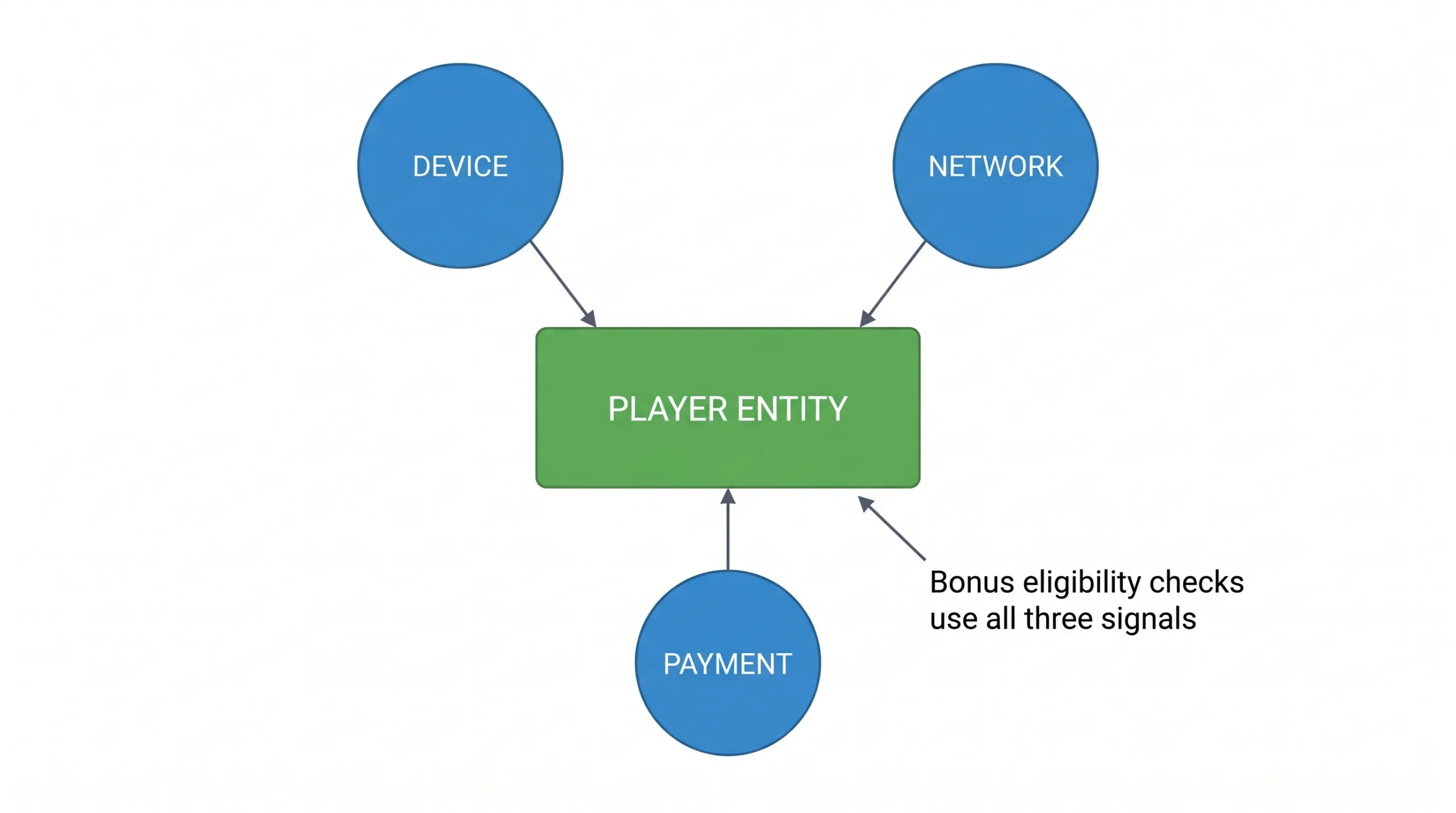
Rule 5: Put hard limits on the “abuse triangle” (device, network, and payments)
Multi-accounting almost always reuses at least one of these three: device, network, payment method.
You do not need perfect fingerprinting to make meaningful progress quickly. You need clear thresholds and graduated responses.
Here is a practical baseline policy that many operators start with and then tune:
| Signal | Example detection | Recommended response for free spins |
|---|---|---|
| Device reuse | Same device fingerprint across multiple new accounts in 24 to 72 hours | Block bonus award, allow browsing, require step-up verification to play |
| Network anomaly | High-risk ASN, proxy patterns, repeated signups from the same IP range | Allow registration, deny bonus until proof of intent, route to risk scoring |
| Payment reuse | Same card token, bank account, or crypto address used across accounts | Deny bonus and flag for investigation, consider linking entities |
| Identity similarity | Same address with variations, name permutations, disposable emails | Limit to one bonus per entity, trigger additional verification |
The key is consistency: do not let players discover that one surface is strict but another is lenient.
Rule 6: Restrict free spins to low-abuse game configurations
Not all free spins are equal. Abuse profitability depends on how easily free spins value can be converted into withdrawable funds.
Controls that reduce abuse without killing legitimate fun:
- Limit free spins to a curated set of slots with predictable mechanics and appropriate volatility for promotions
- Exclude known “conversion-friendly” configurations (for example, edge cases where bonus value can be optimized through specific bet sizing)
- Enforce maximum bet rules during bonus play, and enforce them at the wallet and game-callback layer (not only in UI copy)
- Disable contribution loopholes (game contribution tables are a common exploit vector)
If you rely on a game aggregator, ensure your platform can enforce promo constraints consistently across studios and jurisdictions. This is one reason operators prefer a consolidated iGaming platform where game aggregation and bonus enforcement share the same rules layer.
Rule 7: Detect multi-accounting with velocity and graph rules, then respond in tiers
Teams often over-focus on “finding the perfect signal.” In practice, fast containment comes from combining:
- Velocity rules (how fast something is happening)
- Graph links (how many accounts share a node such as a device or payment method)
- Outcome confirmation (did the pattern lead to bonus conversion or withdrawal attempts?)
A tiered response prevents you from punishing legitimate edge cases (families, shared Wi‑Fi, internet cafes) while still stopping rings.
A simple tier model:
- Tier A (low confidence): increased friction only (delay bonus, require phone verification)
- Tier B (medium confidence): deny bonus award, freeze promo winnings until checks pass
- Tier C (high confidence): lock withdrawals, suspend accounts, preserve audit logs, escalate to compliance if AML triggers exist
Operationally, this works best when your backoffice has a clear case timeline and reason codes, so analysts can explain decisions and tune thresholds weekly.
For a fuller framework of rules, signals, and playbooks, see Spinlab’s dedicated guide on bonus abuse detection.
Rule 8: Make marketing accountable with “promo profitability after fraud” reporting
Free spins abuse persists when teams optimize the wrong success metric. If CRM is celebrating registrations and spin engagement while risk is measuring chargebacks and manual review hours, you will ship incentives that look good but lose money.
Define a shared promo scorecard that includes:
- Cost per qualified player (after fraud removal)
- Bonus-to-net revenue ratio (using your own NGR definition)
- Manual review minutes per 1,000 bonus claims
- Withdrawal hold rate and time-to-paid for the cohort
This is where real-time analytics matters. If you can see in-session promo performance and risk signals while the campaign is live, you can pause or reconfigure fast, instead of doing a post-mortem after budget is gone.
If you also need to improve the top of funnel so you can reduce reliance on aggressive freebies, investing in better landing pages and acquisition SEO can help. A specialist agency like Sleek Web Designs internet marketing services can be useful when you want more qualified traffic, not just more traffic.
A fast containment checklist (what to do in the next 24 hours)
If you are actively being hit, prioritize actions that stop the bleeding without requiring major engineering:
- Reduce promo surface area (pause the highest-abuse free spins campaign first)
- Add proof-of-intent gating (deposit, phone verification, or payment bind)
- Deny bonus to repeated device or payment nodes immediately
- Lock withdrawal of promo-derived funds for flagged entities pending review
- Create a single “abuse war room” dashboard that both CRM and Risk agree to use
After containment, you can tune thresholds and rebuild toward a smoother UX.
How Spinlab Studio supports safer free spins campaigns (without duct tape)
Stopping multi-accounting sustainably is easier when promo logic, identity checks, and payments share the same platform primitives.
Spinlab Studio is a modular iGaming platform designed for building and scaling online casinos with:
- Advanced fraud prevention to help identify suspicious patterns
- KYC and AML compliance workflows for step-up verification and audit readiness
- Real-time analytics dashboards to measure promo impact and risk outcomes quickly
- Affiliate and bonus engine to enforce eligibility, limits, and stacking controls
- Crypto and fiat payment support (including crypto onramp solutions and multi-currency) so you can apply consistent risk rules across rails
If you want to pressure-test your current free spins setup, focus the conversation on implementation details: where eligibility is enforced, what identifiers are linked, what gets logged, and what happens at conversion and withdrawal.
Frequently Asked Questions
What is multi-accounting in online casinos? Multi-accounting is when one person (or a coordinated group) creates multiple accounts to claim bonuses like free spins more than once, often using reused devices, payments, or synthetic identities.
Should free spins require KYC? Not always full KYC upfront, but free spins should be gated behind a proof of intent and you should enforce step-up verification before conversion or withdrawal. The right design depends on jurisdiction and risk.
How do you detect free spins abuse quickly? Combine velocity rules (signup spikes, repeated claims), identity and device links (shared fingerprints), and payment reuse (same card or wallet). Then apply tiered responses to avoid false positives.
What is the biggest mistake operators make with free spins promos? Measuring success on registrations and short-term engagement only. You need promo profitability after fraud removal, plus operational costs like manual review and withdrawal holds.
Can you stop free spins abuse without killing conversion? Yes, if you use graduated friction (delay or gate bonuses for suspicious patterns) and keep clean cohorts fast. Blunt blocks everywhere tend to hurt legitimate users and increase support load.
Want a promo setup that scales without multi-accounting blowups?
If you are launching or scaling a casino and need free spins campaigns that remain profitable, the fastest win is aligning bonus rules, fraud signals, KYC/AML steps, and withdrawal controls in one consistent system.
Explore Spinlab Studio at spinlab.studio to see how a modular, crypto-ready iGaming platform can help you launch, run, and optimize promotions with real-time analytics and built-in compliance and fraud controls.