

Bonuses are supposed to accelerate first deposits and retention. In practice, poorly written bonus terms often do the opposite: they attract high-intent abusers, trigger withdrawals you cannot safely approve, and create “services not as described” narratives that fuel chargebacks.
This guide breaks down casino bonus terms that prevent abuse and chargebacks, with concrete clauses, why they work, and how to implement them without killing conversion.
Why bonus terms are a chargeback and abuse control surface
Most operators treat bonus terms as a legal appendix. Risk teams see them differently: bonus terms are part of your payments risk controls, because they shape player expectations and determine whether you can confidently approve or deny a withdrawal.
When a dispute happens, schemes and PSPs look for two things:
- Was the player clearly told what would happen? (eligibility, wagering, withdrawal limits, verification)
- Can you prove the player accepted and then used the product under those rules? (logs, timestamps, device, wallet events)
Ambiguous terms create room for “I didn’t know” disputes, and they also create operational inconsistency, which is exactly what abusers exploit.
If you want the downstream playbook for disputes, Spinlab has a dedicated guide on building evidence packs: Chargeback representment for casinos.
The design principle: prevent ambiguity, then prevent exploitation
Effective terms do two jobs at once:
- Expectation setting (reduces chargebacks tied to misunderstanding)
- Exploit closure (reduces bonus abuse and withdrawal pressure)
The best-performing operators also align terms with product UX. If the cashier says “Instant payout,” but the bonus terms say “KYC required before withdrawal,” players feel misled unless you disclose that at the right time.
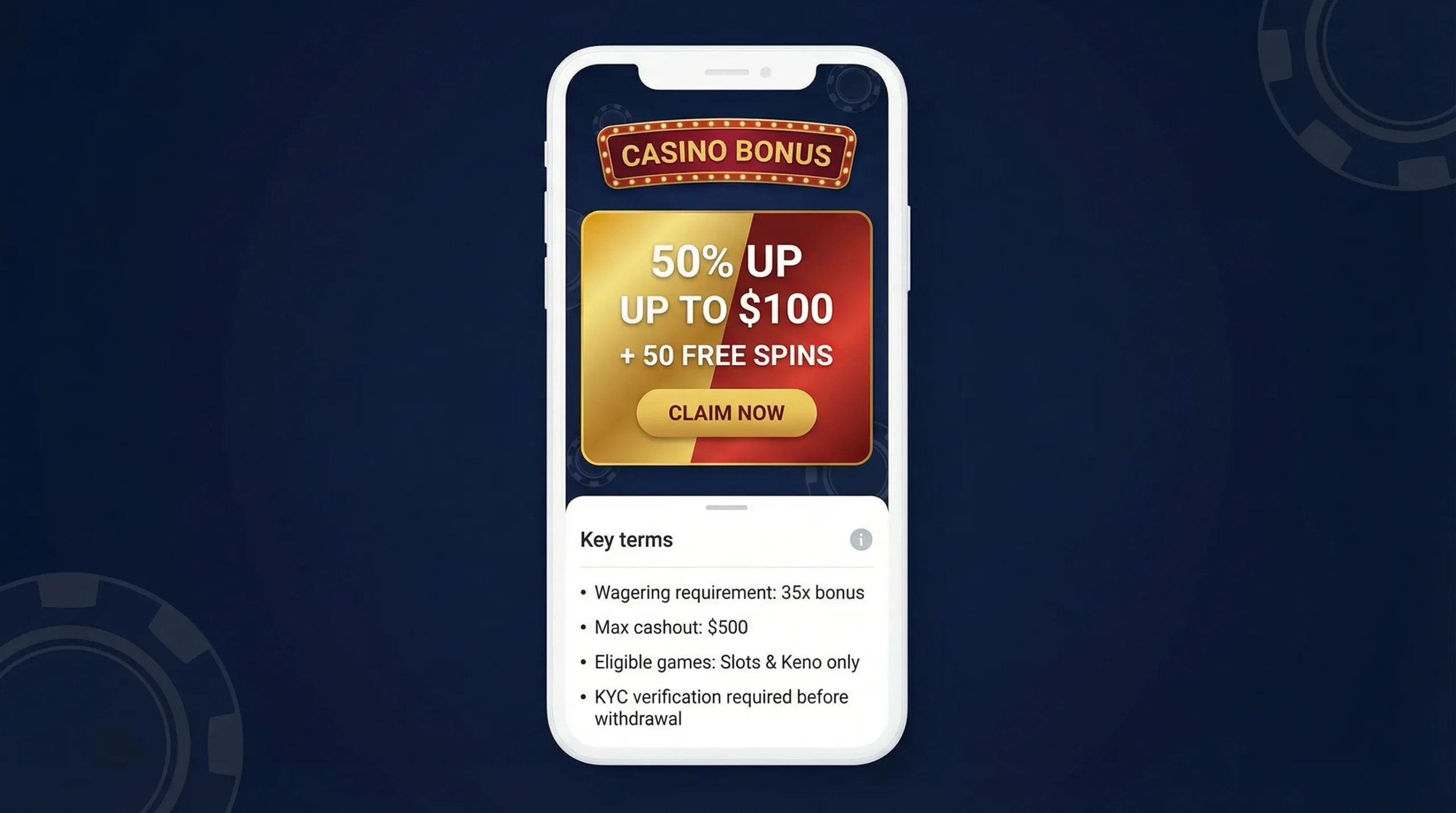
Core bonus terms that reduce bonus abuse and chargebacks
Below are the terms that most consistently reduce abuse while improving dispute defensibility. These examples are operational patterns, not legal advice.
1) Eligibility rules that stop multi-accounting at the source
Problem: Abusers create multiple accounts to repeatedly claim a welcome offer (often using the same device, payment instrument, or IP range).
Terms to include:
- “One bonus per person, household, device, and payment method.”
- “We may withhold bonus eligibility where we reasonably suspect duplicate accounts or coordinated play.”
- “If duplicate accounts are detected, bonus funds and bonus-derived winnings may be voided.”
Why it helps chargebacks: If you later void winnings and the player disputes deposits claiming unfair treatment, your defense is stronger when eligibility is explicit and consistently enforced.
Implementation note: Terms alone are not enough. You need detection. If you want the signals and response ladder, see Bonus abuse detection: rules, signals, playbooks.
2) Clear wagering requirements with a single source of truth
Problem: Players dispute when wagering is unclear (what counts, what doesn’t, when it expires).
Terms to include:
- Wagering multiple (example: “x35”) and what it applies to (“bonus amount,” “deposit + bonus,” or “bonus winnings”).
- A time window (“must be completed within 7 days of bonus activation”).
- A precise completion definition (“wagering is satisfied when the wagering meter reaches 100%”).
Why it helps chargebacks: Ambiguity fuels “not as described.” Clarity lowers disputes and gives you a clean narrative during representment.
Best practice: Mirror the same definitions in the UI (bonus wallet, wagering meter, and cashier withdrawal screen).
3) Game contribution rules (and disclose them where it matters)
Problem: Abusers hunt low-variance paths or excluded content to clear wagering cheaply. Legit players get angry if they learn late that their favorite games contribute less.
Terms to include:
- “Slots contribute 100% toward wagering unless stated otherwise.”
- “Live casino and table games contribute 0% to 20% (as specified per game).”
- “Progressive jackpot games may be excluded.”
Chargeback impact: This is one of the most common “I was misled” triggers, especially if players only discover it at cashout.
Implementation tip: Expose contribution at the game tile level or inside the bonus details drawer. If you already structure game metadata for SEO and UX, a typed CMS approach helps keep this accurate at scale (see Metafields for casino CMS).
4) Max bet / max stake rules (with a fair enforcement model)
Problem: Bonus hunters use high bets to spike variance or to intentionally violate rules, then argue the operator acted unfairly.
Terms to include:
- “Maximum stake while an active bonus is present: $X per spin/hand (or local currency equivalent).”
- “If maximum stake is exceeded, the bonus and bonus-derived winnings may be forfeited.”
How to prevent chargeback narratives:
- Warn in-product (toast/modal) when a player tries to exceed the limit.
- Log the warning event.
- Enforce consistently.
This reduces “gotcha” enforcement, which is what escalates into disputes.
5) Withdrawal conditions that stop “bonus to cash” laundering
Problem: A common abuse pattern is to deposit, claim bonus, cycle minimal wagering, and withdraw quickly, sometimes using stolen cards or mule accounts.
Terms to include (typical controls):
- “We may require successful identity verification (KYC) before any withdrawal.”
- “We may request proof of payment method ownership for card and certain APM deposits.”
- “Withdrawals may only be processed back to the original funding method where supported.”
Chargeback impact: Strong KYC and payment method matching reduce stolen-card monetization, which reduces disputes in the first place.
If you want UX patterns that reduce KYC drop-off while keeping verification effective, see 11 UX tweaks that cut KYC drop-off.
6) Max cashout caps that are explicit and promotion-specific
Problem: Abusers target promos with unlimited upside. Operators then retroactively cap or delay withdrawals, which triggers disputes.
Terms to include:
- “Maximum cashout from this promotion: $X.”
- “Any winnings above the maximum cashout may be forfeited.”
Key detail: Make the cap promo-specific, not hidden in a general bonus policy page. Put it next to the CTA that activates the promo.
7) Bonus expiration and dormancy rules
Problem: Long expiration windows increase abuse surface and accounting complexity.
Terms to include:
- “Bonus must be activated within X days of issuance.”
- “Bonus expires after X days if wagering is not completed.”
Why it helps: Shorter windows reduce edge cases that generate support tickets, and support tickets often become dispute “evidence” used against you.
8) The “voiding” clause, written narrowly enough to be defensible
Problem: Overly broad terms like “we can void anything at any time” read unfair, and can backfire in disputes and regulator conversations.
A stronger pattern:
- Define prohibited behavior categories (multi-accounting, chargeback abuse, payment fraud, collusion, automated play where prohibited, exploiting software bugs).
- State outcomes tied to those behaviors (void bonus, freeze withdrawals pending investigation, close account).
- State process expectations (request documentation, timeline, appeal path if applicable).
This keeps the clause enforceable while still providing coverage.
9) Chargeback and payment dispute consequences (yes, include it)
Problem: Some abusers treat chargebacks as a withdrawal method.
Terms to include:
- “If a payment is reversed or disputed, we may suspend withdrawals and void bonuses until the dispute is resolved.”
- “Accounts with unresolved chargebacks may be restricted.”
Why it works: It blocks the incentive loop. It also sets expectations before the player attempts the tactic.
10) Promo stacking rules (and how to prevent arbitrage)
Problem: Players combine multiple offers (welcome + reload + cashback + VIP) in ways your budget model never intended.
Terms to include:
- “This promotion cannot be combined with other promotions unless explicitly stated.”
- “Only one active bonus can be wagered at a time.”
Operational tip: Enforce through a single bonus engine state machine (not ad hoc scripts), otherwise you create inconsistent enforcement that abusers will find.
A practical mapping: terms, abuse prevented, and chargeback angle
| Bonus term / control | Abuse it prevents | Chargeback risk it reduces | Implementation note |
|---|---|---|---|
| One per person/household/device/payment method | Multi-accounting, referral loops | “Unfair voiding” disputes | Needs device + payment + identity graphing |
| Clear wagering definition + deadline | “I didn’t know” claims, stalling | “Not as described” | Mirror in UI wagering meter |
| Game contribution table | Low-risk clearing, excluded-game arguments | “Misleading promo” | Surface at game and promo level |
| Max bet with in-product warning | High-variance abuse and intentional rule breaks | “Gotcha” enforcement narratives | Log warnings and violations |
| KYC before withdrawal + proof of ownership | Stolen card monetization, mule withdrawals | Fraud chargebacks | Don’t surprise at cashout, disclose early |
| Promo-specific max cashout | Unlimited upside hunting | Disputes after partial payouts | Put cap next to activation CTA |
| Dispute/chargeback consequences | “Chargeback as a cashout” | Repeat disputes | Tie to withdrawal suspension policy |
Make terms measurable: what you should log for dispute defense
Even perfect terms fail if you cannot prove acceptance and enforcement. At minimum, log:
- Terms acceptance event (timestamp, IP, device, terms version hash)
- Bonus activation event and promo ID
- Wagering meter progression snapshots (or replayable ledger of qualifying bets)
- Max bet warnings shown and acknowledged
- KYC status transitions and requested documents
- Withdrawal attempts, payment method matching decisions, and reason codes
This is the backbone of fast, consistent representment.
Common mistakes that create abuse and chargebacks
Hiding key conditions behind a separate page
If the player must click three layers deep to find max cashout or game contribution rules, disputes become much harder to win.
Using vague language like “at our discretion” everywhere
You need some discretion for fraud operations, but if every outcome is discretionary, you look arbitrary.
Writing terms that your product cannot enforce
If you state “one per household” but you do not detect households, you will enforce inconsistently, and inconsistency is what abusers monetize.
Waiting until cashout to introduce KYC
KYC-at-cashout may be necessary, but it should not be a surprise. Surprise is what converts normal friction into a dispute.
How Spinlab fits (without locking you into a rigid bonus system)
If you are building or migrating an online casino stack, the simplest way to operationalize abuse-resistant terms is to ensure your platform can enforce them across payments, bonuses, identity, and fraud.
Spinlab Studio positions its platform as a modular iGaming foundation for launching and scaling online casinos, with components that matter directly for bonus abuse and chargebacks:
- Bonus and affiliate tooling to define offer rules consistently
- Integrated payments (crypto and fiat) to reduce fragmentation across deposit and withdrawal policies
- KYC and AML workflows that can be aligned with withdrawal conditions
- Fraud prevention and real-time analytics to detect patterns like multi-accounting and promo arbitrage
Learn more at spinlab.studio.
Frequently Asked Questions
What bonus terms reduce chargebacks the most? Clear wagering rules, game contribution disclosure, promo-specific max cashout, and transparent KYC-before-withdrawal conditions reduce “not as described” disputes.
Should casinos allow bonus withdrawals before KYC? Most operators require KYC before withdrawals to reduce payment fraud and chargeback exposure. The key is disclosing this early, not surprising players at cashout.
Do max bet rules actually prevent abuse? Yes, but only if they are enforced consistently and ideally warned in-product. Silent retroactive forfeitures tend to trigger complaints and disputes.
How do you stop multi-accounting for welcome bonuses? Combine explicit eligibility terms (one per person/household/device/payment method) with device, payment, and identity signals, plus a graduated enforcement playbook.
Are crypto deposits enough to eliminate chargebacks? Crypto rails do not have card-style chargebacks, but you still face fraud and disputes. Many operators run a hybrid cashier, using crypto and fiat with strong KYC, AML, and fraud controls.
Build bonus terms you can actually enforce
If your current promotions generate support load, suspicious withdrawals, or recurring disputes, you usually do not need “harsher” terms, you need clearer, enforceable terms backed by platform controls.
Spinlab helps operators launch and scale casinos with an integrated platform that connects payments, KYC/AML, fraud prevention, analytics, and bonus operations in one stack. Explore the platform at Spinlab Studio or review their operational thinking on disputes in Chargeback representment for casinos.