

Adding a new payment method looks like a growth win on paper: higher deposit conversion, better approval rates, and more local coverage. In practice, it is one of the fastest ways for an online casino to end up with broken balances, “missing” deposits, messy reconciliation, and an audit headache.
The root cause is usually not the payment provider. It is the way the casino’s ledger of record is designed and how payment events get translated into ledger postings.
This guide explains a practical, engineering-friendly approach to add new payment methods (cards, APMs, pay-by-bank, crypto onramps, stablecoins) without breaking your ledger, your reconciliation, or your ability to prove what happened.
What “breaking your ledger” actually means
In iGaming, “the ledger” is not just a balance table. It is the system that proves, at any time:
- Which player owns which funds
- Which funds are playable vs pending vs locked
- Which movements were fees, FX, chargebacks, reversals, bonuses, or corrections
- Which events map to external reality (PSP reports, bank statements, on-chain transfers)
A ledger is “broken” when at least one of these becomes unreliable:
- Incorrect balances (players see money they do not have, or do not see money they do)
- Non-reproducible history (you cannot replay events and reach the same balances)
- Unreconcilable settlements (ledger totals cannot be matched to PSP or bank totals)
- Ambiguous states (“deposit completed” in UI but funds never became playable)
- Audit gaps (no defensible chain from intent to settlement)
The hard part about adding payment methods is that every new rail introduces new versions of “truth.” Your job is to force those truths through one consistent contract.
Why new payment methods stress a ledger
Most payment issues show up because payment rails are asynchronous, stateful, and inconsistent.
1) New rails introduce new state machines
A card payment might feel “instant,” but can still settle later. A pay-by-bank transfer can be authorized instantly but confirmed later. Crypto deposits can be seen immediately but only become final after confirmations.
If your ledger model assumes “authorized = credited,” adding a rail with longer pending periods will create balance and support problems.
2) Webhooks are not a reliable delivery mechanism
PSPs retry. Networks duplicate messages. Some rails deliver callbacks out of order. Some do not deliver them at all.
If your posting logic is not idempotent and order-tolerant, you will post twice or miss posts.
3) Fees, FX, and partials multiply fast
New payment methods often add:
- Player-paid fees vs operator-paid fees
- Gross vs net settlement differences
- FX conversions, spreads, and rounding behavior
- Partial captures, partial refunds, partial chargebacks
If you do not represent these explicitly as ledger lines, reconciliation becomes guesswork.
4) Crypto adds probabilistic finality and address hygiene
Crypto rails add confirmations, chain reorg risk (rare but real), memo/tag requirements on some networks, and address format rules. The right response is not “special-case crypto,” it is “make the ledger posting contract strong enough to handle probabilistic settlement.”
The core principle: payment providers do not credit wallets, your ledger does
A clean mental model is:
- The PSP (or chain) tells you what it believes happened.
- Your platform decides whether that event is valid, complete, and compliant.
- Only then do you post an immutable entry to the ledger.
That means every new payment method must be integrated through a normalization layer that converts provider-specific events into a platform-wide set of intents, states, and postings.
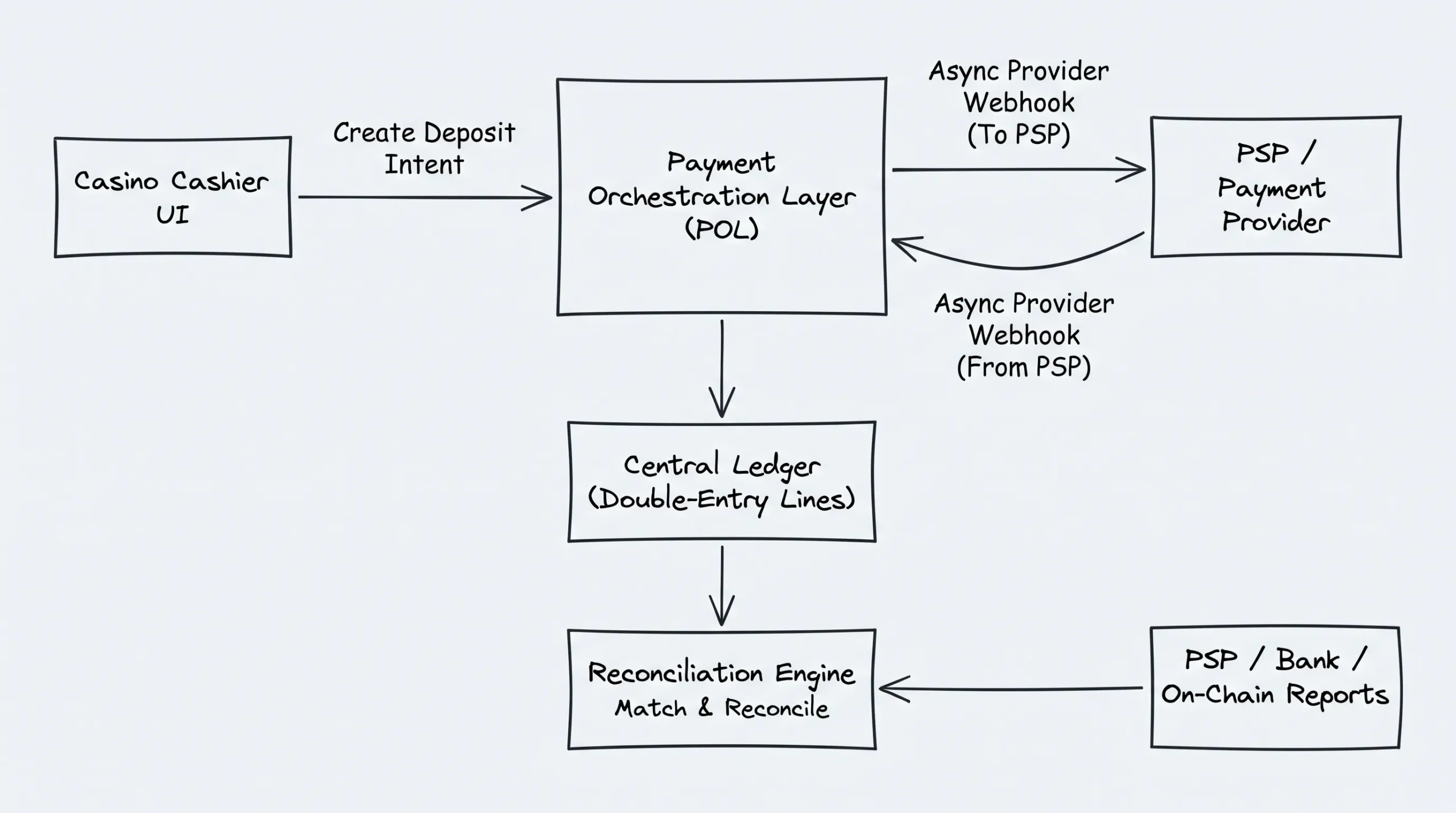
A practical integration blueprint (that survives audits)
Below is a step-by-step approach you can apply whether you are adding Apple Pay, a local APM, pay-by-bank, or a crypto onramp.
Step 1: Define an “intent” object that is rail-agnostic
Before you touch any provider API, define a single internal object for money movement:
deposit_intentwithdrawal_intent
Each intent should have:
- A globally unique ID (your ID, not the PSP’s)
- Player ID
- Currency (and asset for crypto)
- Amount
- Expected fee model (who pays fees)
- A canonical state machine
A typical deposit intent state model looks like:
CREATED(player initiated)ACTION_REQUIRED(redirect, SCA, wallet signature)PENDING(awaiting settlement or confirmations)SUCCEEDED(funds are playable)FAILED(terminal)CANCELED(player aborted)
The key is that every rail maps into this state model, even if the rail’s terms are different.
Step 2: Make ledger posting a pure function of (intent, event)
Ledger correctness improves dramatically when posting is deterministic.
Instead of “the webhook handler updates balances,” implement posting as:
- Input: intent + normalized event
- Output: a set of immutable ledger lines
This makes it possible to replay events, prove history, and run a ledger diff in staging.
Step 3: Use double-entry (even if you do not run a full accounting system)
You do not need to implement your full general ledger to benefit from double-entry discipline.
At minimum, treat every movement as:
- A debit from one account
- A credit to another
Example: when you credit a player deposit, the counterparty should be a clearing account (not “magic”). When settlement completes, move from clearing to your settlement account. When a fee is charged, post it explicitly.
Here is a simplified way to think about it:
| Event type (normalized) | Player wallet impact | Counterparty account | Why it matters |
|---|---|---|---|
| Deposit succeeded | Credit playable balance | Deposit clearing | Prevents crediting funds before you can prove settlement |
| Settlement confirmed | No player change (optional) | Move clearing to settlement | Makes reconciliation explainable |
| Refund / chargeback | Debit playable or lock funds | Chargeback clearing | Enables correct negative-balance handling and evidence packs |
| Fee charged | Debit fee bucket (player or operator) | Fee expense / fee payable | Prevents “mystery net differences” in PSP reports |
If you cannot explain a PSP statement line as a ledger line (or combination), your ledger model is incomplete.
Step 4: Treat idempotency as a first-class requirement
For each provider callback, define:
- The provider event ID (if available)
- Your internal idempotency key (often a hash of stable fields)
- A unique constraint in storage so a callback cannot be applied twice
Also plan for out-of-order delivery:
- A “settled” event may arrive before an “authorized” event.
- A “failed” event might arrive after a UI says “pending.”
Your state machine should be monotonic, and your posting engine should ignore invalid regressions.
Step 5: Separate “funds seen” from “funds playable”
This is the most common ledger break when adding crypto or bank rails.
Adopt a strict rule:
- Seen funds can be shown as pending.
- Playable funds require your policy to mark them as final enough.
For crypto this might include confirmations and compliance screening. For pay-by-bank it might include provider confirmation and bank acceptance logic.
Step 6: Build reconciliation requirements into the integration contract
Reconciliation is not a back-office afterthought. It is part of the payment method definition.
For every new rail, decide upfront:
- What you will match against (PSP report, bank statement, on-chain tx hash)
- What your stable reference is (intent ID should appear in metadata where possible)
- What your daily close looks like
- What the exception queue categories are
If you want a deeper reconciliation framework, Spinlab’s guide on a three-way match is a good companion: Casino Payments Reconciliation: Ledger, PSP, and Bank Match.
Step 7: Roll out in shadow mode before you let it move real balances
A safe pattern is:
- Run the new payment method in shadow posting (compute ledger lines, do not apply them)
- Compare expected balances and settlement totals against your production ledger
- Promote to a small canary cohort
If you want a structured rollout method for wallet code, the canary strategy described here translates well to new payment connectors: Canary Releases in iGaming: Rolling Out New Wallet Code Safely.
What to test before you launch a new payment method
Most teams test “happy path deposit.” Ledger safety depends on testing the ugly paths.
Cover at least these scenarios:
- Duplicate webhook delivery (exact duplicates)
- Retries with modified timestamps (semantically same event)
- Out-of-order events
- Pending that never resolves (timeout and cancellation behavior)
- Partial refunds
- Chargebacks after gameplay
- Currency edge cases (rounding, minor units, precision)
- Provider downtime during redirect or auth
A high-leverage tactic is to standardize your PSP and crypto simulations in a dedicated environment, rather than testing ad hoc in production-like staging. This pairs well with building reusable mocks and faucets, as described in: Creating a Sandbox Environment for PSP Test Cards and Crypto Faucets.
The “ledger-safe” checklist for adding any payment method
Use this as a sign-off checklist across product, engineering, compliance, and finance.
| Area | Sign-off question | Evidence to collect |
|---|---|---|
| Ledger model | Can every provider event be represented as explicit ledger lines? | Posting specs, sample journals |
| State machine | Are intent states monotonic and rail-agnostic? | State transition table |
| Idempotency | Can any callback be received twice without double-crediting? | DB constraints, replay tests |
| Playability policy | Do you separate pending from playable funds? | Policy docs, UI states |
| Reconciliation | Can finance run a daily match without manual spreadsheets? | Matching rules, exception categories |
| Support readiness | Do agents have clear reason codes and timelines? | Runbooks, macros |
| Risk and compliance | Are KYC/AML checks correctly applied per rail? | Decision logs, audit exports |
Where platforms typically go wrong
These are patterns that cause “it worked in staging” but fail at scale.
Posting money directly inside webhook handlers
Webhook handlers should validate, normalize, and enqueue. Posting should happen in a controlled ledger service that guarantees idempotency and ordering rules.
Letting providers define your internal IDs
Provider transaction IDs are not consistent across retries, refunds, or routed payments. Your intent ID must be the anchor, and you should attach it to provider metadata whenever possible.
Mixing product balances with accounting balances
If your “wallet balance” tries to be both a player UX value and an accounting value, you will compromise both. Model playable, pending, locked, and adjustment buckets clearly.
How Spinlab helps you add payment methods safely
If you are operating or launching an online casino and want to add new payment methods without taking ledger risk, the platform architecture matters as much as the payment provider.
Spinlab Studio is built as a modular iGaming platform with payments, wallets, compliance, and analytics designed to work together:
- Support for crypto and fiat payment rails, including crypto onramp flows
- Multi-currency wallet and cashier foundations
- KYC and AML compliance workflows integrated into payment and withdrawal decisions
- Fraud prevention controls that can be applied at cashier and wallet layers
- An operator-friendly, customizable backoffice (positioned as a Shopify-like admin experience)
In other words, you can treat a new payment method as a connector to a stable internal contract, rather than a bespoke feature that touches balances everywhere.
If you are actively improving approvals and routing across multiple providers, this primer can help frame the orchestration layer: Casino Payment Orchestration 101: Routing for Higher Approval.
A useful team exercise: physically model your funds flow
One surprisingly effective way to align product, engineering, and finance is to build a tangible “funds flow model” for a new payment rail. Teams use simple blocks to represent intents, clearing accounts, settlement accounts, and fee lines, then walk through edge cases like refunds and chargebacks.
If you want durable props for workshops (for example, custom tokens representing wallet states or settlement legs), a small 3D printing service can produce reusable pieces quickly.
Frequently Asked Questions
Do I need a full accounting general ledger to add new payment methods safely? No. You do need ledger discipline: immutable entries, clear counterparties (like clearing accounts), explicit fee and FX handling, and replayable postings.
What is the biggest cause of “missing deposits” after adding a new rail? Non-idempotent webhook handling and unclear pending vs playable rules. Both lead to double credits, missed credits, or credits that never become playable.
How should we represent payment fees in the ledger? As explicit lines, not implicit netting. Whether the fee is paid by the player or operator, record it separately so PSP net settlements can be reconciled.
How do we avoid breaking balances during rollout? Use shadow posting and canary cohorts. Compute expected ledger lines without applying them, compare totals, then gradually enable real postings for a controlled segment.
Can we add crypto deposits without redesigning the whole wallet? Often yes, if your wallet already supports pending states and your ledger posting engine can handle asynchronous finality, confirmations, and compliance gates.
Want to add payment methods faster (with less ledger risk)?
If you are planning to expand your cashier with local APMs, pay-by-bank, or crypto rails, Spinlab Studio can help you do it on a unified ledger and wallet foundation.
Explore the platform at spinlab.studio and request a demo to review your current payments flow, ledger model, and rollout plan before you ship the next integration.
Such a fun community and an amazing selection of online games. It is the perfect place to hang out and try your luck. mmdbygonlinegame
Impressive variety and the promotions are actually worth it. I am really happy with the service and the overall gameplay. vnswin88
I’ve tried a few different sites for sports betting, but this one really hits the spot. The interface is smooth and the odds are actually competitive. Definitely my go-to now. Check out bwinapuestas for a great experience.