

Payments are one of the few casino subsystems where a small operational gap can quietly turn into a big financial and compliance problem. When your ledger, PSP reports, and bank statement do not agree, you get a predictable chain reaction: withdrawals pause, VIP support escalations spike, finance cannot close the day, and auditors start asking for evidence you cannot produce quickly.
This guide breaks down a practical, operator-ready way to run casino payments reconciliation as a three-way match (ledger vs PSP vs bank), including the data you need, the match rules that work in iGaming, and the exception workflows that keep you audit-ready while protecting player trust.
What “casino payments reconciliation” really is (the three-way match)
In iGaming, reconciliation is not just “does the bank balance look right?”. It is a three-way match across systems that each tell a slightly different truth:
- Ledger (your source of truth): what your platform believes happened to player and house balances (deposits credited, withdrawals debited, fees accrued, reversals posted). In a robust setup, this is an immutable, append-only accounting record.
- PSP / payment gateway: what the payment provider authorized, captured, settled, reversed, refunded, or flagged (often with its own lifecycle states and batching behavior).
- Bank statement (or bank settlement account): what actually moved in and out of your bank account (often net of fees, rolling reserves, chargeback debits, and settlement delays).
A healthy reconciliation process answers three questions, every day:
- Completeness: did every external payment event that should hit our ledger actually hit it?
- Accuracy: are amounts, currencies, and fees posted correctly?
- Timing: are differences simply timing (pending settlement), or true breaks (missing money, duplicated credits, wrong FX)?
Why reconciliation is harder in casinos than in most ecommerce
Casinos sit at the intersection of high-frequency transactions, multiple rails, and strict compliance. The most common reconciliation breaks happen because iGaming flows are asynchronous and stateful.
The mismatch patterns you will see weekly
- Authorization vs capture gaps (cards): PSP shows auth approved, capture failed (or delayed), but the ledger credited on auth.
- Pending bank rails (A2A, local methods): the PSP marks a payment “initiated” while funds arrive later, sometimes with returns.
- Net settlements: bank receives one lump sum for hundreds or thousands of player deposits, net of fees.
- Chargebacks and reversals: the bank debits you days or weeks later, often with additional fees.
- FX drift and multi-currency rounding: the ledger used one rate, PSP settled at another, bank posts yet another net result.
- Duplicate webhook delivery: PSP retries events, your integration is not idempotent, the ledger posts twice.
- Manual review holds: withdrawals held for KYC/AML, but the PSP/bank event sequence continues.
Crypto adds its own reconciliation edge cases
Crypto is fast, but it is not “simple” from a finance perspective:
- On-chain vs off-chain truth: a custodial wallet system may credit instantly (off-chain), while the blockchain confirmation finality comes later.
- Network fees: gas is a real cost that must be attributed consistently (player-paid vs house-paid).
- Asset and chain mapping: USDT on Ethereum vs USDT on Tron are not the same rail.
- Reorgs and replaced transactions: rare on major chains, but operationally important to model.
If you offer both fiat and crypto, your reconciliation process should treat each rail as a “sub-ledger” with shared governance.
Start with the ledger: the only place reconciliation should “anchor”
The fastest way to make reconciliation impossible is to let your PSP dashboard become the primary record. PSP views are optimized for their operations, not for your accounting.
A reconciliation-friendly casino ledger usually has these properties:
- Double-entry structure: every player credit has a corresponding house debit (or vice versa), plus explicit fee accounts.
- Append-only postings: corrections are posted as adjustments, not overwritten history.
- Idempotent posting keys: each external event maps to exactly one ledger posting, even if the PSP sends the same webhook 10 times.
- Stable identifiers: a single internal identifier (often called
payment_intent_id) that links the full lifecycle (initiation, success, fail, reversal, refund, chargeback).
If you are designing or reworking wallets, it helps to align ledger semantics with your wallet architecture decisions. Spinlab has a related deep-dive on this topic: Casino Wallet Architecture: Single Wallet vs Multi-Wallet.
The minimum data model to reconcile ledger, PSP, and bank
You cannot match what you cannot identify. Before you write match logic, define the fields you must collect and retain.
Here is a practical minimum set.
| System | Record type | Required identifiers | Required amounts | Required timestamps | Notes |
|---|---|---|---|---|---|
| Ledger | Posting / journal entry | payment_intent_id, player id, internal transaction id |
gross amount, fee amount, net effect, currency | created_at, posted_at | Store original event payload hash for auditability when possible. |
| PSP | Transaction + settlement report | PSP transaction id, merchant reference (your payment_intent_id) |
authorized, captured, refunded, fee, settled amounts, currency | event time, settlement date | Pull both event-level data and settlement/batch reports. |
| Bank | Statement line / settlement credit | bank reference, settlement batch id (if provided), counterparty, narrative | credited/debited amount, currency | value date, posting date | Many banks do not expose granular mapping, plan for batch matching. |
| Crypto (if applicable) | On-chain transfer | tx hash, chain id, to/from address, token contract | amount, asset, network fee | block time, confirmation time | Decide your finality threshold per chain and enforce it consistently. |
For regulated operations, retention and access control matter as much as the match itself. If you handle card data, ensure your stack aligns with PCI requirements. A good plain-English reference is the PCI Security Standards Council overview: PCI DSS Resources.
Match strategy: deterministic first, then controlled “fuzzy” logic
A robust reconciliation engine is basically a pipeline:
- Normalize incoming data into a common schema (ledger, PSP, bank, chain).
- Deterministic match using stable keys.
- Secondary match using constrained heuristics.
- Exception queue with reason codes and owners.
Deterministic match rules (what you want to be true)
Your primary rule should be:
ledger.payment_intent_idequalspsp.merchant_referenceequals the identifier you used at initiation time.
If you do not have that mapping today, start by enforcing it for all new flows. You can still reconcile legacy transactions via settlement-based matching, but it will cost you time forever.
Secondary match rules (what you need when reality is messy)
Bank lines and PSP settlements often require batch logic. Common secondary rules:
- Settlement batch match: PSP settlement report batch id to bank narrative reference.
- Net-to-gross decomposition: bank line equals sum(gross) minus sum(fees) minus reserves, within a tolerance.
- Windowed time match: allow matching within a value-date window (for example T+0 to T+3) depending on rail.
- Currency-aware tolerance: tolerate rounding only where expected (for example FX conversions or minor fee rounding).
A simple way to keep this safe is to require that secondary matches are:
- explainable (you can describe why the system matched), and
- reviewable (a human can confirm in an exception UI), and
- reversible (you can unmatch and reprocess without corrupting the ledger).
Practical match rules by rail
| Rail | Primary key | Expected timing | Bank match method | Common exceptions |
|---|---|---|---|---|
| Cards | PSP tx id + your payment_intent_id |
auth instantly, settlement delayed | batch net settlement | chargebacks, partial refunds, fee differences |
| Open banking / pay-by-bank | provider reference + your intent id | can be near-instant or delayed | often per-transaction or small batches | returns, name/IBAN checks, pending states |
| Local APMs | provider reference | variable | batch settlements common | status mapping mismatches, off-hours settlement |
| Crypto deposits | tx hash (plus intent if you pre-generate addresses) | depends on chain finality | on-chain is the bank | address reuse, fee attribution, wrong chain |
If you are implementing pay-by-bank, you will want to design reconciliation into the flow from day one. (Spinlab’s own roadmap on Canada is a useful pattern reference: Integrating Pay-by-Bank Instant Payments in Canada: A Roadmap.)
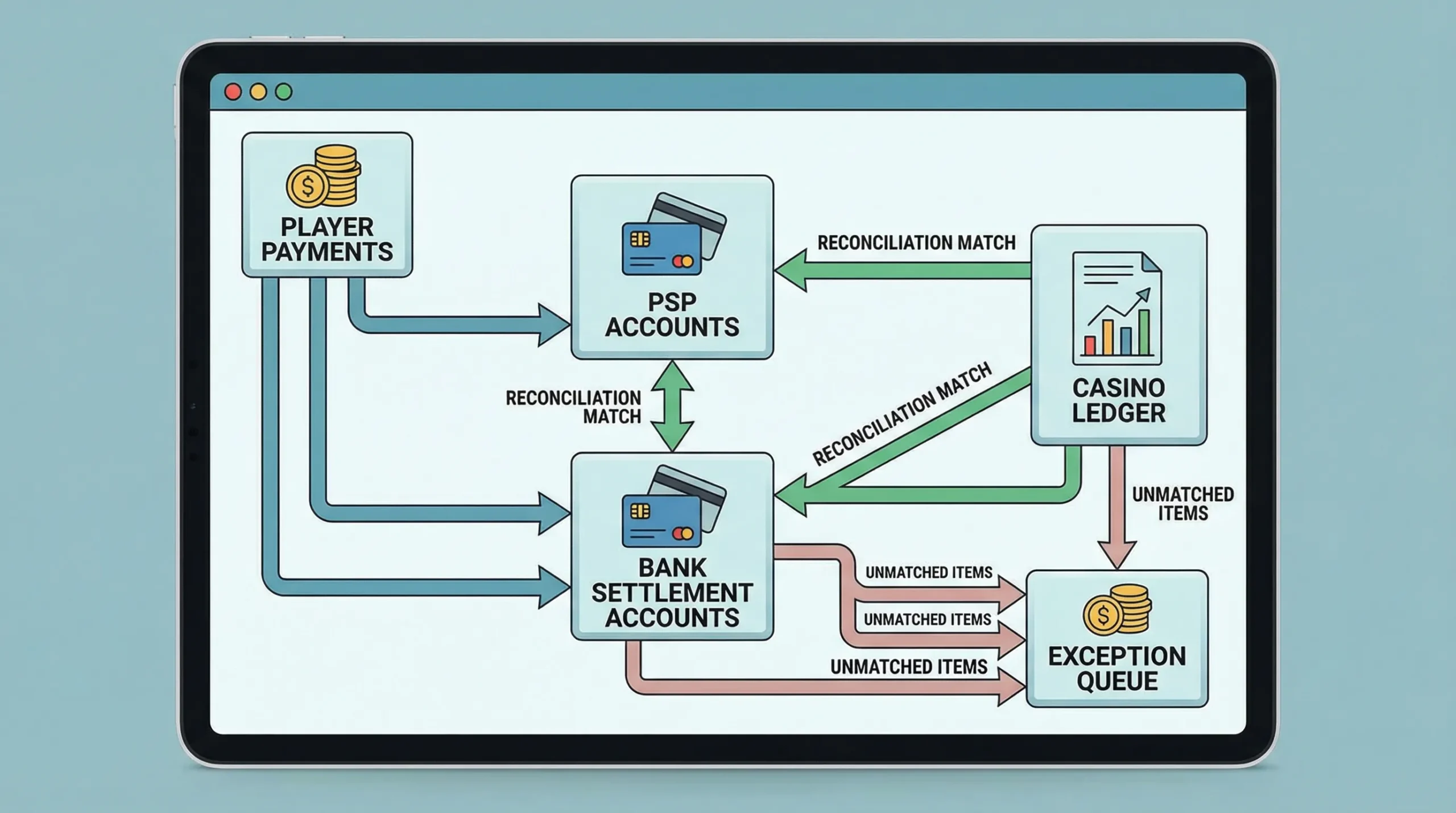
The exception queue: where reconciliation becomes operational excellence
Every operator ends up with an exception queue. The difference between “healthy” and “chaos” is whether exceptions are categorized, owned, and time-boxed.
Use reason codes that map to actions (not vague labels)
Instead of generic statuses like “unmatched”, use reason codes like:
- LEDGER_CREDIT_MISSING_PSP_SUCCESS (PSP shows success, ledger did not credit)
- PSP_SUCCESS_MISSING_BANK_SETTLEMENT (timing vs real settlement failure)
- BANK_SETTLEMENT_AMOUNT_DIFFERS (fee, reserve, FX, or true error)
- DUPLICATE_LEDGER_POSTING (idempotency failure)
- WITHDRAWAL_SENT_PSP_NOT_PAID (provider issue or compliance hold)
Each code should point to an owner (payments ops, finance, risk, engineering) and a default playbook.
Define SLAs by exception type
Not all exceptions are equal. A missing player credit is a player-trust emergency. A settlement timing difference is usually routine.
| Exception type | Player impact | Recommended SLA | Typical owner |
|---|---|---|---|
| Deposit credited incorrectly | High | Same day | Payments ops + engineering |
| Deposit not credited (PSP success) | High | Under 2 hours | Payments ops |
| Bank settlement missing (PSP says settled) | Medium | 1 to 3 business days | Finance |
| Fee mismatch | Low | Weekly close | Finance |
| Chargeback debit posted | Medium | Daily monitoring | Risk + finance |
Chargebacks also require tight evidence workflows. If disputes are a material part of your operation, build a link between reconciliation breaks and dispute packs (Spinlab has a dedicated guide: Chargeback Representment for Casinos).
Daily close: a simple, repeatable reconciliation rhythm
A high-performing casino finance and payments team typically runs two loops:
- Intraday monitoring (operational): catch player-impacting breaks quickly.
- Daily close (accounting): produce an audit-grade snapshot of what happened.
Intraday monitoring (what to watch in real time)
You do not need full accounting intraday, you need alarms:
- spike in “PSP success, ledger missing”
- spike in duplicate webhooks or retries
- drop in approval rates on a major rail (often correlates with reconciliation noise)
- abnormal pending duration by rail
This is where a real-time analytics view helps, but only if it ties back to identifiers used by reconciliation.
Daily close checklist (what to run every day)
- Export ledger totals by rail, currency, and status (success, failed, reversed, refunded).
- Pull PSP event exports plus settlement reports for the same window.
- Pull bank statement lines for the settlement accounts (and reserve accounts if applicable).
- Run match jobs in this order: ledger vs PSP events, PSP settlements vs bank, then net reconciliation by currency.
- Review exceptions above your thresholds, sign off the close, and snapshot outputs for audit.
A key tip: define your “day” consistently (UTC vs local time) and document it. Most recurring discrepancies are just misaligned cutoffs.
Audit-readiness: controls regulators expect to see
Regulators and auditors usually care less about your matching algorithm and more about whether your process is controlled and provable.
Focus on:
- Segregation of duties: the person who can change ledger postings should not be the only person who approves reconciliation adjustments.
- Immutable logs: store who changed what, when, and why (especially for manual adjustments).
- Evidence retention: keep PSP reports, bank statements, and ledger exports for the required period.
- KYC/AML traceability: ensure each payment can be tied to a verified player identity and risk decisions.
If you operate under tightening regimes (for example Curaçao’s reform direction), “audit-grade payments and reconciliation” becomes a core capability, not a back-office detail. See: Curacao Reform 2025: What Operators Need to Change.
What to demand from your iGaming platform, PSP, and banking partners
When reconciliation is painful, operators often blame the bank or PSP. In practice, most pain comes from missing primitives in the platform integration.
Ask vendors these questions:
- Can we enforce a single merchant reference (payment intent id) across all payment rails?
- Do you provide both webhooks (event stream) and settlement exports?
- Are events idempotent by design, and do you support replay?
- How are fees represented (per transaction vs settlement-level), and can they be broken out by type?
- How do you handle multi-currency settlement and FX (rate source, rounding rules, timestamps)?
- Can we export an exception queue and its resolution history for audit?
- For crypto, can we map tx hash, chain, asset, and fee consistently, and support custody controls?
If you have recurring wallet deficits because of reconciliation lag or FX, address that directly. A good operational deep-dive is: How to Handle Negative Balances in Multi-Currency Wallets.
Where Spinlab fits (if you want reconciliation to be simpler)
Spinlab Studio positions itself as an all-in-one, modular iGaming platform for launching and scaling online casinos, with integrated payments (fiat and crypto), multi-currency support, compliance (KYC/AML), fraud prevention, game aggregation, and a customizable backoffice.
From a reconciliation perspective, the practical advantage of an integrated platform is not magic automation, it is fewer disconnected sources of truth:
- One platform layer connecting cashier activity, wallet/ledger movements, compliance decisions, and operations tooling.
- Unified identifiers and APIs across payment rails.
- Backoffice workflows that can support finance and ops teams without custom internal tooling for every vendor export.
If you are evaluating a platform or rebuilding your payments stack, you can explore Spinlab here: spinlab.studio.
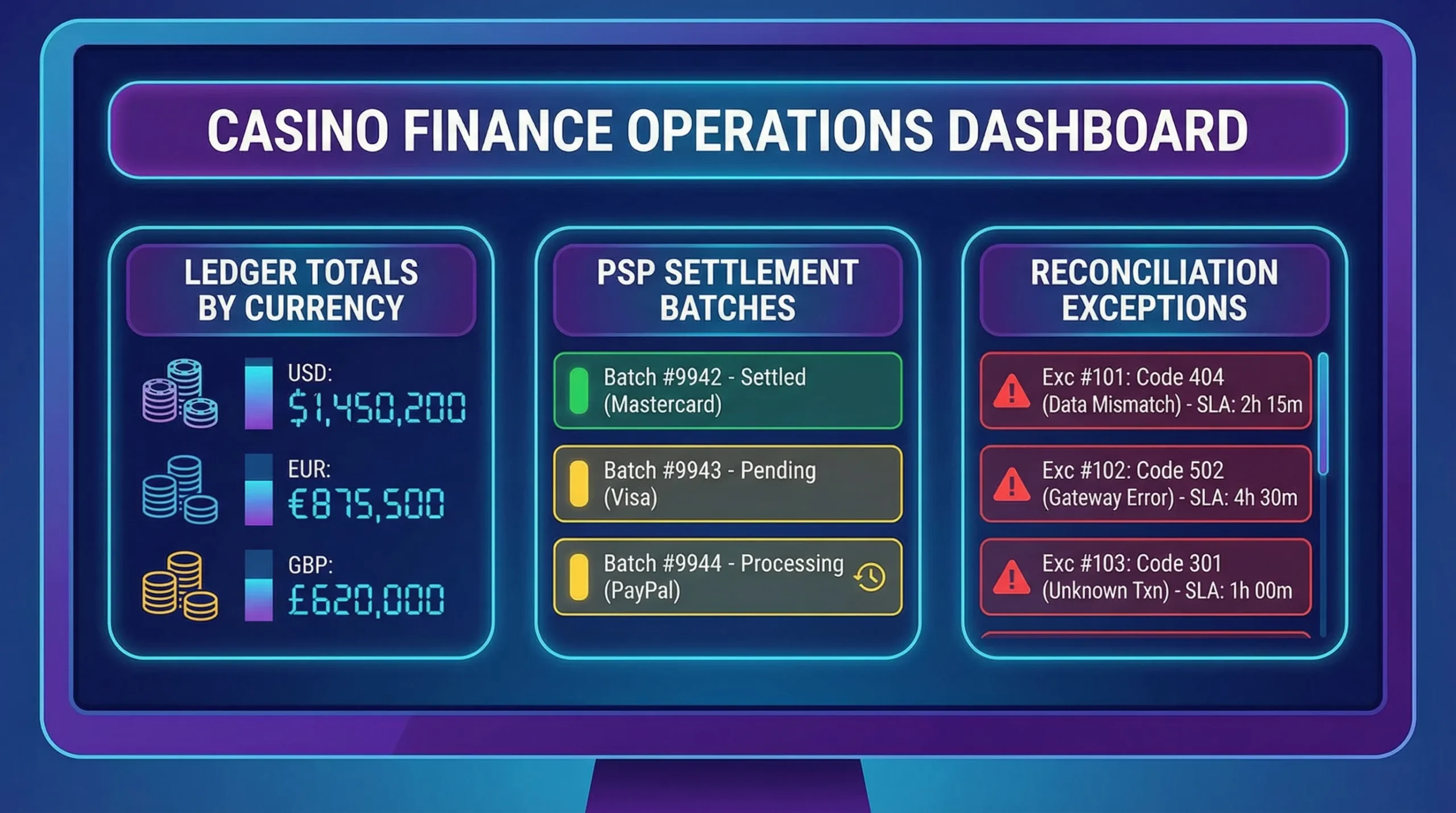
Frequently Asked Questions
What is the difference between ledger reconciliation and bank reconciliation in an online casino? Ledger reconciliation checks whether your platform’s wallet/accounting postings match external payment events (PSP, crypto, bank). Bank reconciliation is narrower, it checks statement lines and balances. Casinos need both, and the ledger should anchor the process.
Why do PSP totals not match bank deposits even when everything “looks successful”? Banks often receive net settlements (gross deposits minus fees, reserves, refunds, or chargeback adjustments) and timing can differ by rail. The fix is to reconcile using PSP settlement reports, not just transaction lists.
How often should a casino run payments reconciliation? Run intraday monitoring for player-impacting breaks (missing credits, duplicate posts), and run a formal daily close for accounting and audit. High-volume brands often add a mid-day mini-close during peak hours.
How do you reconcile crypto deposits and withdrawals? Use tx hash, chain id, asset contract, and confirmation policy as the reconciliation keys. Decide how you treat network fees and whether you credit before finality. Keep an explicit mapping between on-chain transfers and internal payment intents.
What is the biggest technical cause of reconciliation errors? Non-idempotent integrations and weak identifiers. If your PSP webhooks can be processed twice, you will eventually double-credit or double-debit, and reconciliation becomes permanent firefighting.
Want a reconciliation-ready payments stack?
If you are launching a new casino or replacing a fragmented payments setup, the goal is simple: make ledger, PSP, and bank matching a built-in workflow, not a weekly spreadsheet exercise.
Spinlab Studio offers a modular iGaming platform with integrated payments (crypto and fiat), multi-currency support, compliance (KYC/AML), fraud prevention, and a customizable backoffice designed to reduce operational overhead.
Explore the platform and request a walkthrough at spinlab.studio.